Bitcoin holders ‘will regret not selling above $60K,’ Peter Schiff warns

ambcryptoPublished on 2026-07-16Last updated on 2026-07-16

Abstract

Peter Schiff, a well-known Bitcoin critic, warns that Bitcoin holders will regret not selling above $60,000, predicting potential heavy losses. He states he would not buy BTC even at a 3x price drop to $20K, calling it "way too much to pay for nothing." The article notes Bitcoin's recent 11% bounce in July to near $65K, driven by softer CPI data, but analysts express caution. They point to fragile macro conditions, including U.S.-Iran tensions, a lack of Bitcoin-specific demand (with ETF outflows and negative Coinbase premium), and stalled regulatory progress like the CLARITY Act. Analysts from Bitfinex and QCP Capital describe the rally as "borrowed strength" without solid institutional support. QCP's base case projects a range-bound BTC between $60K and $75K, with key resistance at $65K-$67K and the 200-day MA ($73.4K). A break below support could see a dip to $55K-$58K. The overall view is cautious, citing misalignment of macro, regulatory, and ETF demand factors for sustained bullish momentum.

Peter Schiff, a staunch Bitcoin critic, warned investors against holding the crypto asset at current levels.

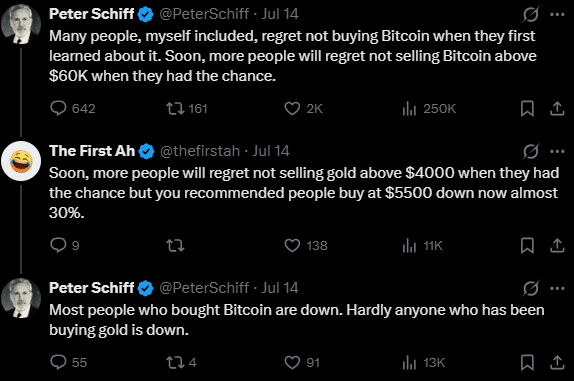
According to him, those who fail to offload their BTC stash at the current value above $60K could incur heavy losses.

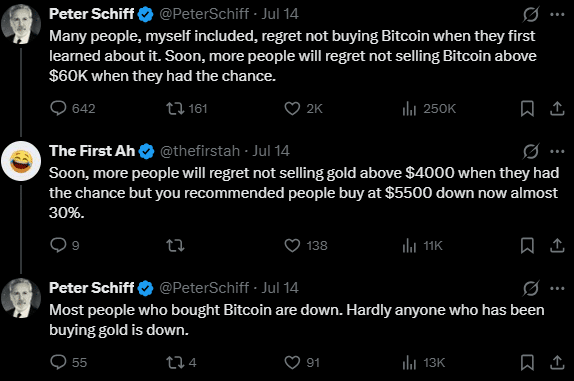
Many people, myself included, regret not buying Bitcoin when they first learned about it. Soon, more people will regret not selling Bitcoin above $60K when they had the chance.
AD
Source: X

Despite his regret, Schiff claimed that he won’t buy BTC even if its price drops 3x, noting that “$20K is way too much to pay for nothing.”

Although Schiff didn’t share the bearish catalysts that could drag BTC lower, other analysts expressed similar caution.

Why fragile macro could stall Bitcoin’s rebound

Bitcoin’s price has been up about 11% in July. It has bounced from a low of $57.8K to nearly $65K, unfazed by Strategy’s BTC sale thanks to improved macro conditions after softer CPI data this week.

However, analysts are cautious that the macro relief could be temporary, as renewed U.S-Iran escalations could dent energy markets and risk appetite again. Additionally, there has been a crypto-specific catalyst to fuel further rally, noted Bitfinex analysts.

We had not seen any Bitcoin-specific demand before the inflation print: the ETF complex sold $424.7 million on 13 July, Strategy bought nothing, and the Coinbase premium is still negative.

This meant that, on average, there was no marginal institutional demand for BTC despite the macro relief. The analysts cautioned that BTC’s relief bounce was a ‘borrowed strength.’

A rally built on a macro catalyst, with limited spot absorption and no price-agnostic bid, that had been a constant in previous uptrends for BTC, is ‘borrowed strength’ that the lender can call back.

A potential capital rotation from AI to crypto was previously viewed as a potential positive catalyst alongside the passage of the CLARITY Act. But the crypto bill has stalled, and the AI sell-off could affect crypto, per QCP Capital.

The bullish setup is not an AI unwind; it is AI stabilisation followed by a crypto-specific catalyst.

Where could Bitcoin trade next?

QCP projected Bitcoin [BTC] could remain range-bound within $60K-$75K, adding that there was a notable hedging against a potential dip to $55K-$58K.

Our base case for BTC is range-bound; the bull case needs lower real yields, stronger ETF inflows and regulatory progress; the bear case is a decisive break below support on continued outflows.
Source: BTC/USDT, TradingView

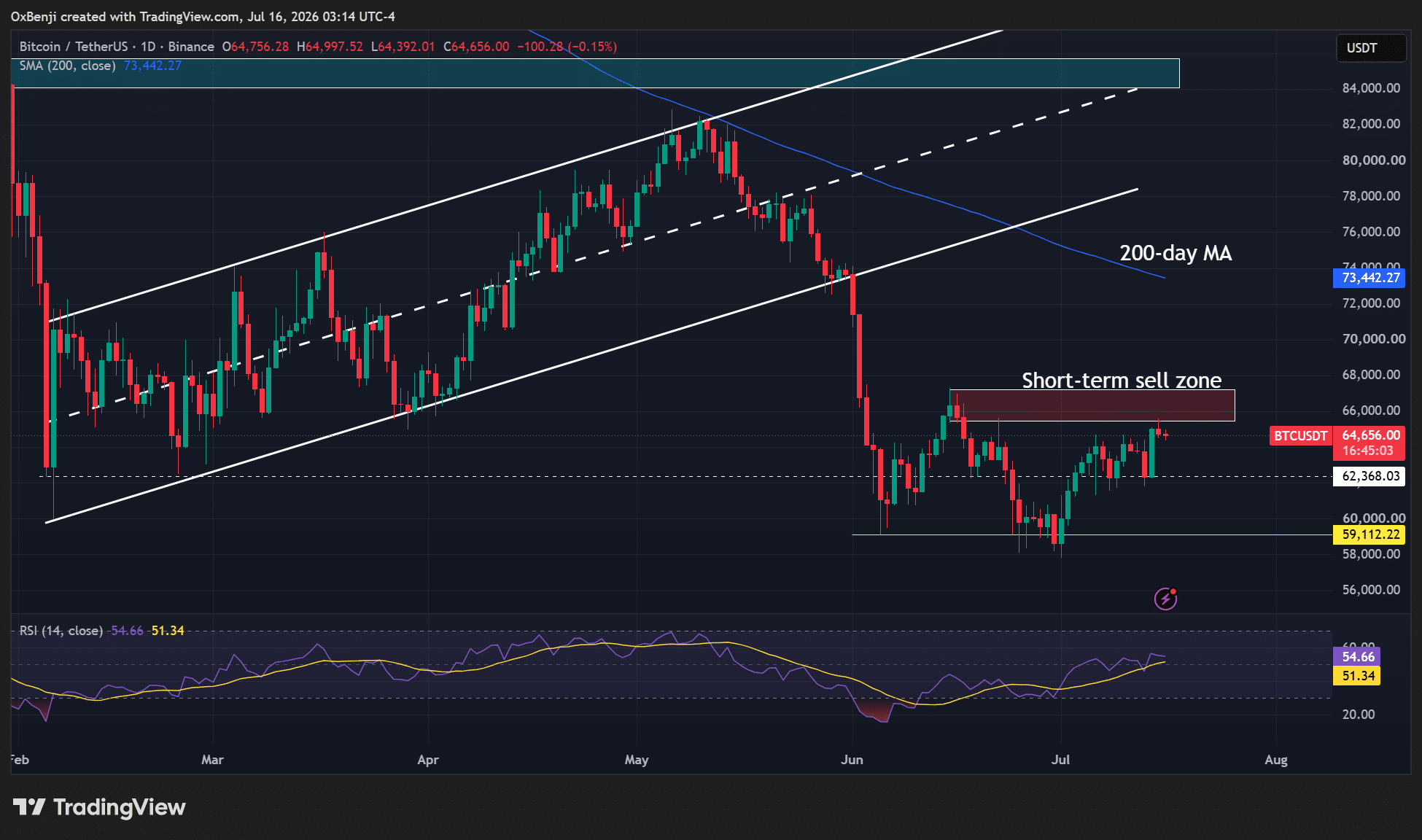
The price chart also painted a similar projection. The $65K-$67K was a short-term sell zone, and another overhead hurdle was at the 200-day Moving Average (MA, blue line, $73.4K). Failure to clear these obstacles could increase the chance of dipping to $60K or below.


Final Summary

  • Peter Schiff urged investors to sell their BTC holdings, warning that the price will drop below $60K.
  • His caution was warranted, as macro, regulatory, and spot BTC ETF demand were not aligned to support a sustainable risk appetite.


Trending Cryptos

Related Questions

QWhat is Peter Schiff's warning to Bitcoin investors in the article?

APeter Schiff warns Bitcoin investors that they 'will regret not selling above $60K' and could incur heavy losses if they fail to offload their BTC at current levels.

QWhat reasons does the article give for caution about Bitcoin's recent price rebound?

AThe article cites several reasons for caution: temporary macro relief, no significant Bitcoin-specific demand or catalyst, negative Coinbase premium, institutional ETF outflows, and the rally being built on 'borrowed strength' from macro conditions.

QAccording to Bitfinex and QCP Capital analysts, what is lacking for a sustainable Bitcoin bull run?

AAccording to the analysts, there is a lack of Bitcoin-specific demand catalysts, strong spot ETF inflows, and regulatory progress. The recent bounce is based on macro factors, not sustained institutional or price-agnostic buying.

QWhat is QCP Capital's base case price projection for Bitcoin?

AQCP Capital projects that Bitcoin could remain range-bound within $60K to $75K.

QWhat key price levels does the technical analysis in the article identify for Bitcoin?

AThe technical analysis identifies $65K-$67K as a short-term sell zone and the 200-day Moving Average near $73.4K as an overhead hurdle. Failure to break these could lead to a dip towards $60K or lower, with some hedging noted against a drop to $55K-$58K.

Related Reads

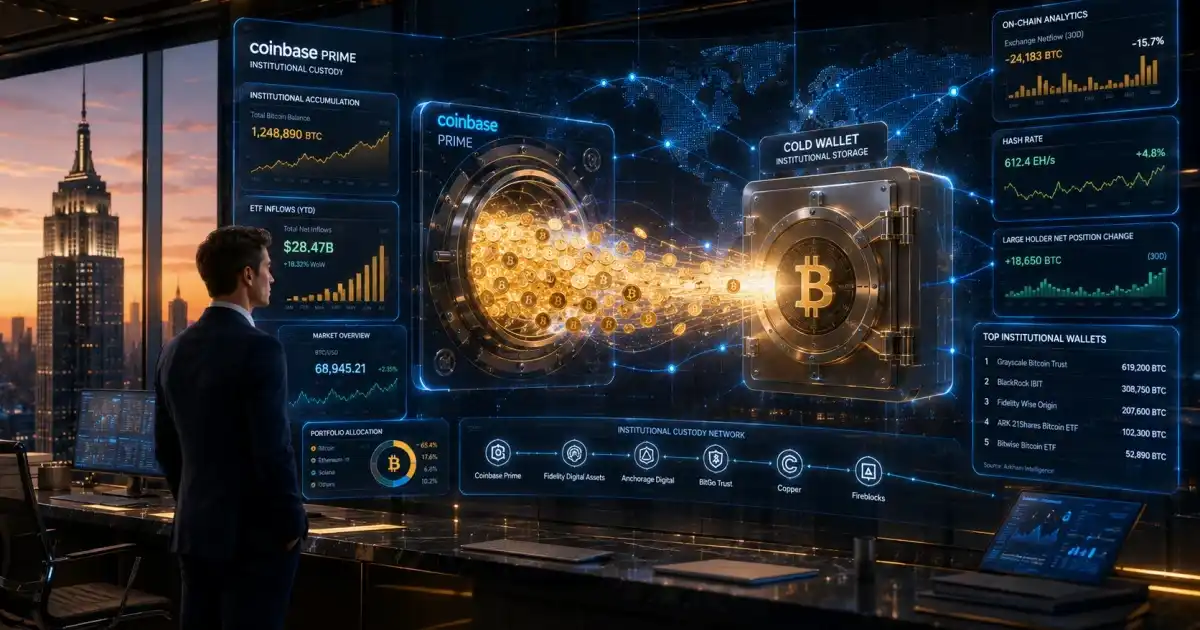
Has BlackRock Again 'Withdrawn' $140 Million Worth of Bitcoin, Signaling the Start of an Era of Institutional Accumulation?

BlackRock is suspected of moving approximately 2,152 BTC (worth ~$140 million) from Coinbase Prime to an unknown cold wallet, a transaction widely interpreted by on-chain analysts as institutional asset allocation. This event highlights a shift in market focus from trading volume to institutional fund flows, particularly withdrawals from exchanges. Such moves typically indicate assets are being moved into long-term custody, reducing immediate market supply—a phenomenon known as supply shock. The context is BlackRock's spot Bitcoin ETF, iShares Bitcoin Trust (IBIT), which continues to see significant net inflows, with assets under management surpassing $20 billion. This reflects a broader trend of institutions treating Bitcoin as a long-term allocation tool rather than merely a speculative asset. The growing use of on-chain analytics platforms allows for increased transparency in tracking these institutional movements. While this single transaction doesn't dictate price, it underscores a structural evolution in the Bitcoin market. The increasing participation of long-term institutional capital, facilitated by ETFs, is gradually changing the market's composition from being trade-driven to being more configuration- or allocation-driven. The key question emerging is whether the market is transitioning into an era defined by long-term institutional holding.

marsbit35m ago

Has BlackRock Again 'Withdrawn' $140 Million Worth of Bitcoin, Signaling the Start of an Era of Institutional Accumulation?

marsbit35m ago

Gold Rush Handbook | Rialto Teams Up with Robinhood Crypto, Targeting Order Routing Rights

**Summary** Rialto is positioning itself as an on-chain spot exchange focused on order routing and execution quality for a range of assets, including cryptocurrencies and tokenized stocks/ETFs. It operates primarily on the Robinhood Chain network. Its core mechanism revolves around **propAMMs** – on-chain market makers that use proprietary inventory and pricing logic, referencing external markets (like underlying stock exchanges for tokenized equities) rather than relying solely on automated market maker (AMM) formulas. For each user order, Rialto's aggregator solicits real-time quotes from multiple liquidity sources, including its own propAMM (Rivo Altus) and traditional DEX pools. It then selects and atomically executes the path offering the best net output after costs, potentially splitting orders across sources. Rialto's key competitive claim is turning **order routing control into a service for better execution**. Instead of users manually finding the best liquidity, the system automatically compares and routes to the optimal source(s) for each trade. It has launched a partner program for integrations and its swap API is already used by several protocols. Challenges ahead include expanding the asset base on Robinhood Chain, ensuring Rivo Altus's price competitiveness, attracting diverse external liquidity, and consistently delivering superior net execution compared to manual routing. Success in these areas would see Rialto competing for the crucial "order routing right" in the emerging on-chain market for tokenized real-world assets.

Foresight News1h ago

Gold Rush Handbook | Rialto Teams Up with Robinhood Crypto, Targeting Order Routing Rights

Foresight News1h ago

Bitwise: RWA and Prediction Markets Continue to Gain Momentum, Crypto is Bottoming Out

Bitwise's Q2 2026 report highlights a challenging crypto market. The Bitwise 10 Crypto Index fell 15.4%, and spot Bitcoin ETFs saw a record $4.9 billion in quarterly outflows as Bitcoin dropped below $60,000. Overall sentiment is described as one of the worst in eight years. Despite the downturn, key sectors show resilience and growth. Real-World Asset (RWA) tokenization reached a record $33 billion, up 45% year-to-date. Prediction markets also hit new highs, with open interest at $1.8 billion and quarterly volume hitting $43 billion, driven partly by political events. Crypto equities outperformed, with the Bitwise Crypto Innovators 30 Index rising 30.6%, largely fueled by AI-related Bitcoin miners. These stocks exhibited low correlation with other major asset classes. Major DeFi protocols like Aave demonstrated strong revenue generation, with the top ten crypto applications collectively earning $5.9 billion over the past year. The report notes that while prices and on-chain activity are down from peaks, fundamental metrics like stablecoin supply (~$300B) and Ethereum transaction activity are significantly higher than at the 2022 bear market bottom. Key Q3 factors include the fate of the CLARITY Act, final rules for the GENIUS stablecoin act, and policy signals from the new Fed Chair. The conclusion is that the industry is building a stronger foundation—with greater adoption, institutional involvement, and real utility—even at depressed prices, setting the stage for the next cycle.

Odaily星球日报1h ago

Bitwise: RWA and Prediction Markets Continue to Gain Momentum, Crypto is Bottoming Out

Odaily星球日报1h ago

Trading

Spot

Hot Articles

What is $BITCOIN

DIGITAL GOLD ($BITCOIN): A Comprehensive Analysis Introduction to DIGITAL GOLD ($BITCOIN) DIGITAL GOLD ($BITCOIN) is a blockchain-based project operating on the Solana network, which aims to combine the characteristics of traditional precious metals with the innovation of decentralized technologies. While it shares a name with Bitcoin, often referred to as “digital gold” due to its perception as a store of value, DIGITAL GOLD is a separate token designed to create a unique ecosystem within the Web3 landscape. Its goal is to position itself as a viable alternative digital asset, although specifics regarding its applications and functionalities are still developing. What is DIGITAL GOLD ($BITCOIN)? DIGITAL GOLD ($BITCOIN) is a cryptocurrency token explicitly designed for use on the Solana blockchain. In contrast to Bitcoin, which provides a widely recognized value storage role, this token appears to focus on broader applications and characteristics. Notable aspects include: Blockchain Infrastructure: The token is built on the Solana blockchain, known for its capacity to handle high-speed and low-cost transactions. Supply Dynamics: DIGITAL GOLD has a maximum supply capped at 100 quadrillion tokens (100P $BITCOIN), although details regarding its circulating supply are currently undisclosed. Utility: While precise functionalities are not explicitly outlined, there are indications that the token could be utilized for various applications, potentially involving decentralized applications (dApps) or asset tokenization strategies. Who is the Creator of DIGITAL GOLD ($BITCOIN)? At present, the identity of the creators and development team behind DIGITAL GOLD ($BITCOIN) remains unknown. This situation is typical among many innovative projects within the blockchain space, particularly those aligning with decentralized finance and meme coin phenomena. While such anonymity may foster a community-driven culture, it intensifies concerns about governance and accountability. Who are the Investors of DIGITAL GOLD ($BITCOIN)? The available information indicates that DIGITAL GOLD ($BITCOIN) does not have any known institutional backers or prominent venture capital investments. The project seems to operate on a peer-to-peer model focused on community support and adoption rather than traditional funding routes. Its activity and liquidity are primarily situated on decentralized exchanges (DEXs), such as PumpSwap, rather than established centralized trading platforms, further highlighting its grassroots approach. How DIGITAL GOLD ($BITCOIN) Works The operational mechanics of DIGITAL GOLD ($BITCOIN) can be elaborated on based on its blockchain design and network attributes: Consensus Mechanism: By leveraging Solana’s unique proof-of-history (PoH) combined with a proof-of-stake (PoS) model, the project ensures efficient transaction validation contributing to the network's high performance. Tokenomics: While specific deflationary mechanisms have not been extensively detailed, the vast maximum token supply implies that it may cater to microtransactions or niche use cases that are still to be defined. Interoperability: There exists the potential for integration with Solana’s broader ecosystem, including various decentralized finance (DeFi) platforms. However, the details regarding specific integrations remain unspecified. Timeline of Key Events Here is a timeline that highlights significant milestones concerning DIGITAL GOLD ($BITCOIN): 2023: The initial deployment of the token occurs on the Solana blockchain, marked by its contract address. 2024: DIGITAL GOLD gains visibility as it becomes available for trading on decentralized exchanges like PumpSwap, allowing users to trade it against SOL. 2025: The project witnesses sporadic trading activity and potential interest in community-led engagements, although no noteworthy partnerships or technical advancements have been documented as of yet. Critical Analysis Strengths Scalability: The underlying Solana infrastructure supports high transaction volumes, which could enhance the utility of $BITCOIN in various transaction scenarios. Accessibility: The potential low trading price per token could attract retail investors, facilitating wider participation due to fractional ownership opportunities. Risks Lack of Transparency: The absence of publicly known backers, developers, or an audit process may yield skepticism regarding the project's sustainability and trustworthiness. Market Volatility: The trading activity is heavily reliant on speculative behavior, which can result in significant price volatility and uncertainty for investors. Conclusion DIGITAL GOLD ($BITCOIN) emerges as an intriguing yet ambiguous project within the rapidly evolving Solana ecosystem. While it attempts to leverage the “digital gold” narrative, its departure from Bitcoin's established role as a store of value underscores the need for a clearer differentiation of its intended utility and governance structure. Future acceptance and adoption will likely depend on addressing the current opacity and defining its operational and economic strategies more explicitly. Note: This report encompasses synthesised information available as of October 2023, and developments may have transpired beyond the research period.

830 Total ViewsPublished 2025.05.13Updated 2025.05.13

What is $BITCOIN

Discussions

Welcome to the HTX Community. Here, you can stay informed about the latest platform developments and gain access to professional market insights. Users' opinions on the price of BTC (BTC) are presented below.

活动图片