Has BlackRock Again 'Withdrawn' $140 Million Worth of Bitcoin, Signaling the Start of an Era of Institutional Accumulation?

marsbitPubblicato 2026-07-16Pubblicato ultima volta 2026-07-16

Introduzione

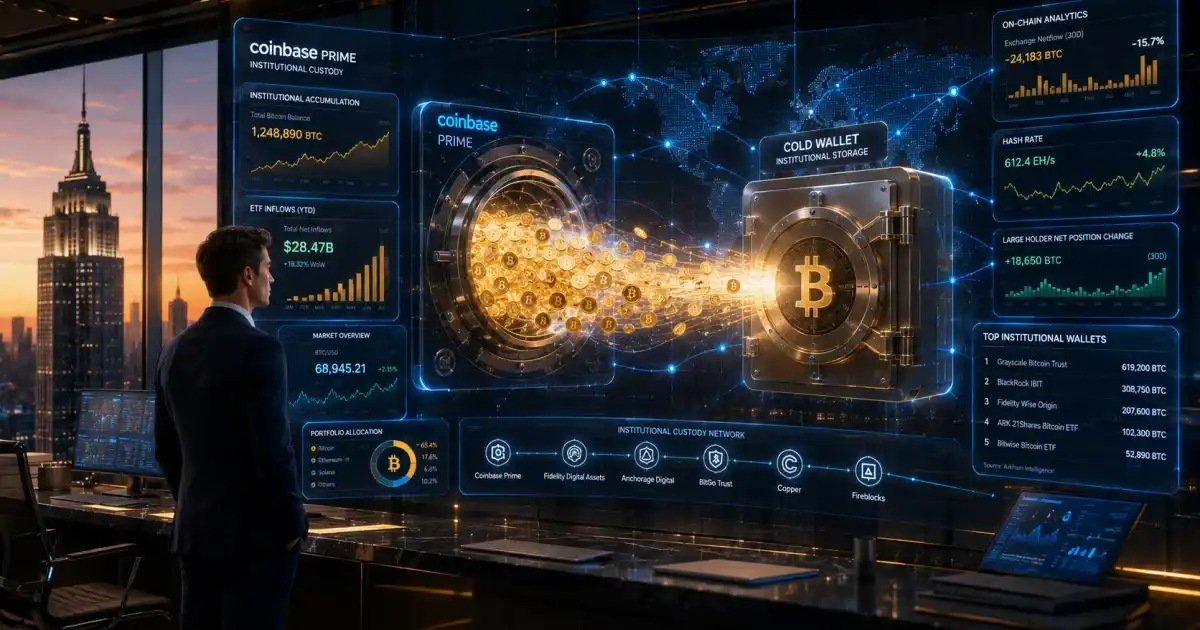
BlackRock is suspected of moving approximately 2,152 BTC (worth ~$140 million) from Coinbase Prime to an unknown cold wallet, a transaction widely interpreted by on-chain analysts as institutional asset allocation. This event highlights a shift in market focus from trading volume to institutional fund flows, particularly withdrawals from exchanges. Such moves typically indicate assets are being moved into long-term custody, reducing immediate market supply—a phenomenon known as supply shock. The context is BlackRock's spot Bitcoin ETF, iShares Bitcoin Trust (IBIT), which continues to see significant net inflows, with assets under management surpassing $20 billion. This reflects a broader trend of institutions treating Bitcoin as a long-term allocation tool rather than merely a speculative asset. The growing use of on-chain analytics platforms allows for increased transparency in tracking these institutional movements. While this single transaction doesn't dictate price, it underscores a structural evolution in the Bitcoin market. The increasing participation of long-term institutional capital, facilitated by ETFs, is gradually changing the market's composition from being trade-driven to being more configuration- or allocation-driven. The key question emerging is whether the market is transitioning into an era defined by long-term institutional holding.

On-chain analytics platform Onchain Lens detected a large transfer of 2152 BTC leaving Coinbase Prime within just one hour, valued at approximately $140 million.

The funds ultimately arrived at an unknown wallet.

Although BlackRock has not publicly confirmed this transaction as its own operation, on-chain analysts point out that factors such as the wallet's historical behavior, the scale of the funds, and the transfer path highly align with the custody patterns of large institutions. Therefore, the market widely interprets this as an asset transfer related to a BlackRock address.

Following the news, industry discussion quickly intensified.

The reason is simple—compared to institutional buying, Bitcoin being withdrawn from an exchange often garners more market attention.

In the on-chain world, the location of a wallet is, in itself, a form of market language.

From "Buying" to "Withdrawing": Institutional Funds Are Changing Market Observation Logic

Over the past few years, the crypto market was accustomed to focusing on two metrics: trading volume and price.

However, with the advent of spot ETFs, institutional capital has begun to emerge as a significant variable influencing the market, gradually shifting the focus of observation.

For large asset management institutions, Bitcoin typically does not remain on trading platforms for extended periods.

After completing purchases, assets are transferred to professional custody wallets for ETF asset management, long-term allocation, or risk isolation. Therefore, BTC outflows from institutional trading platforms like Coinbase Prime often imply a reduced probability of these assets re-entering the circulating market in the short term.

In other words, a withdrawal action does not necessarily represent new buying pressure, but it may signal a reduction in readily tradable market supply.

This is why every significant movement in large institutional wallets becomes a key subject for on-chain analysis.

ETFs Continue Attracting Capital: BlackRock Is Building a Longer-Term Bitcoin Allocation System

This on-chain transfer is not an isolated event.

Recently, BlackRock's spot Bitcoin ETF—iShares Bitcoin Trust (IBIT)—has consistently maintained net capital inflows.

Public data shows that IBIT's assets under management have now surpassed $20 billion, making it one of the world's fastest-growing Bitcoin ETFs.

The operational mechanism of ETFs dictates that when investors continuously subscribe to fund shares, the fund manager needs to acquire a corresponding amount of Bitcoin as the underlying asset.

Therefore, every capital inflow into an ETF may correspond to actual BTC procurement and custody demands.

Notably, institutional logic for holding Bitcoin is also undergoing changes.

In the early days, it leaned more towards trading and tactical allocation, whereas now, Bitcoin is increasingly viewed as a tool for long-term asset allocation.

Whether it's pension funds, family offices, or large asset management institutions, they are beginning to experiment with incorporating digital assets into longer-term investment portfolios.

For them, Bitcoin is no longer just a high-volatility asset but an emerging asset class with long-term allocation value.
Exchange Inventory Declines: The Market Supply-Demand Dynamic Is Quietly Shifting

Why does the market pay such close attention to institutional withdrawals?

The answer is not complex.

Because Bitcoin is an asset with a fixed supply.

When more and more BTC leaves exchanges and enters cold wallets, the liquidity available for immediate market trading decreases.

Analysts commonly refer to this process as a Supply Shock.

Historical data shows that during multiple bull market cycles, a sustained decline in BTC held on exchanges often coincides with an increase in the proportion of long-term holders.

While an absolute causal relationship doesn't exist, the market typically views this as a medium- to long-term positive signal.

Of course, this does not mean the price will necessarily rise.

Short-term movements are still influenced by multiple factors including macroeconomic conditions, US dollar liquidity, Federal Reserve policy, and market sentiment.

However, from a longer time dimension, when new demand persistently increases while the circulating supply gradually diminishes, the supply-demand structure can indeed change.

This is also a crucial reason why, following sustained institutional capital inflows, the market pays extra attention to changes in exchange inventories.

Why Is On-Chain Data Increasingly Becoming a "Microscope" for Institutional Behavior?

In the past, it was difficult for traditional financial markets to observe the position changes of large institutions in real-time.

One of the greatest features of blockchain is the public transparency of fund flows.

Now, on-chain analytics platforms like Arkham, Onchain Lens, and Lookonchain can continuously track large institutional capital through methods such as wallet labeling, transaction paths, fund sources, and historical behavior modeling.

Although it's impossible to confirm the true entity behind every transaction with 100% certainty, on-chain analysis has become a vital reference tool for judging institutional fund flows.

Especially in the ETF era, the market is increasingly accustomed to combining ETF fund flows, exchange balance changes, and on-chain wallet transfers to construct a more complete picture of capital movements.

Compared to simply watching price fluctuations, fund flows are becoming an important dimension for understanding the market.

What's Truly Worth Noting Is Not the $140 Million, but the Changing Logic of Institutional Investment

Ultimately, this transfer of approximately $140 million worth of BTC is not enough to single-handedly determine market direction.

What's truly worth attention is that it once again reflects an increasingly evident trend—institutions are participating in the Bitcoin market in ways different from retail investors.

For institutions, price volatility is important, but asset allocation is more critical.

They focus more on long-term holding, risk management, custody security, and portfolio diversification rather than short-term trading opportunities.

Simultaneously, as ETFs continually attract traditional capital, the participant structure of the crypto market is also changing.

An increasing amount of long-term capital is replacing high-frequency speculative funds, becoming a significant component of the market.

This change will not happen in a single day and does not necessarily imply that prices will continuously rise.

However, what is certain is that the Bitcoin market is undergoing a structural evolution driven by institutional capital.

From One On-Chain Transfer, Seeing a New Phase in the Bitcoin Market

On-chain data shows that 2152 BTC left Coinbase Prime, prompting the market to refocus on BlackRock's Bitcoin strategy.

As of now, the specific purpose of this transfer has not been officially confirmed. Therefore, it cannot be simplistically equated to new buying pressure, nor can it directly imply future price trends.

However, from the continuous capital attraction of ETFs and increasing institutional custody demands to changes in exchange inventories and the strengthening trend of long-term holding, these signals collectively sketch an increasingly clear market portrait.

In the future, Bitcoin prices will still be influenced by multiple factors such as the macroeconomic environment, regulatory policies, and market sentiment.

But for the entire industry, a more significant question worthy of ongoing observation has emerged: As more and more Bitcoin enters long-term custody systems, is the market transitioning from being "trading-driven" to becoming "allocation-driven"?

Perhaps, this is the truly thought-provoking aspect behind this $140 million on-chain transfer that warrants repeated reflection from the market.


Crypto di tendenza

Domande pertinenti

QWhat significant Bitcoin transaction did Onchain Lens detect, and what was its approximate value?

AOnchain Lens detected a large transaction of 2,152 BTC transferred out of Coinbase Prime, valued at approximately $140 million.

QWhy is the movement of Bitcoin from an exchange like Coinbase Prime considered particularly significant for the market?

AWhen Bitcoin is moved out of an exchange and into a custody wallet, it reduces the immediate liquidity and supply available for trading. This is often interpreted by the market as a signal of long-term holding intentions, potentially leading to a supply shock.

QAccording to the article, how is the investment logic of institutional investors towards Bitcoin changing?

AInstitutional investment logic is shifting from being more transaction-oriented to focusing on long-term asset allocation. Institutions are increasingly viewing Bitcoin as a tool for portfolio diversification, long-term holding, and risk management rather than just a high-volatility trading asset.

QWhat role do on-chain analytics platforms play in understanding institutional behavior in the Bitcoin market?

AOn-chain analytics platforms like Arkham and Onchain Lens act as a 'microscope' for institutional behavior. By tracking wallet labels, transaction paths, and historical patterns, they provide crucial insights into the flow of institutional funds, which is a key dimension for understanding market dynamics in the ETF era.

QWhat broader market question does the article suggest is raised by transactions like BlackRock's reported BTC transfer?

AThe article suggests such transactions raise the question of whether the Bitcoin market is transitioning from being 'transaction-driven' to 'allocation-driven,' as more Bitcoin enters long-term custody systems through institutional investment and ETF inflows.

Letture associate

Avalanche Quietly Becomes an RWA Public Chain

Avalanche has strategically shifted its focus towards becoming a leading blockchain for Real-World Asset (RWA) tokenization and payments, moving beyond its initial gaming-centric reputation. Data from RWA.xyz shows Avalanche ranks third among blockchains when considering networks used for settlement, thanks to its unique subnet architecture (now independent Avalanche L1s following the Avalanche9000 and Granite upgrades). These upgrades drastically reduced operational costs and increased autonomy for validators, making it an attractive, cost-effective EVM-compatible Layer 1 for institutional partners. Major institutions like Securitize (which hosts tokenized versions of funds like BlackRock's BUIDL), Galaxy (issuing a $75M CLO), and FinChain have launched significant RWA projects on Avalanche. Its combination of low transaction costs, fast finality, and high customizability through its L1 stack appeals to traditional finance. This is further evidenced by partnerships with entities like NHN KCP, NEC, Progmat, and the formation of the Avalanche Payments Collective with members including Franklin Templeton and VanEck. Recent proofs-of-concept, such as a cross-border settlement for Hyundai, demonstrate practical utility. While Avalanche's ecosystem and institutional adoption are rapidly expanding, its native token (AVAX) price has not reflected this growth, as the protocol prioritizes network flexibility and adoption over immediate tokenomics adjustments like buybacks.

Foresight News8 min fa

Avalanche Quietly Becomes an RWA Public Chain

Foresight News8 min fa

Gold Rush Handbook | Rialto Teams Up with Robinhood Crypto, Targeting Order Routing Rights

**Summary** Rialto is positioning itself as an on-chain spot exchange focused on order routing and execution quality for a range of assets, including cryptocurrencies and tokenized stocks/ETFs. It operates primarily on the Robinhood Chain network. Its core mechanism revolves around **propAMMs** – on-chain market makers that use proprietary inventory and pricing logic, referencing external markets (like underlying stock exchanges for tokenized equities) rather than relying solely on automated market maker (AMM) formulas. For each user order, Rialto's aggregator solicits real-time quotes from multiple liquidity sources, including its own propAMM (Rivo Altus) and traditional DEX pools. It then selects and atomically executes the path offering the best net output after costs, potentially splitting orders across sources. Rialto's key competitive claim is turning **order routing control into a service for better execution**. Instead of users manually finding the best liquidity, the system automatically compares and routes to the optimal source(s) for each trade. It has launched a partner program for integrations and its swap API is already used by several protocols. Challenges ahead include expanding the asset base on Robinhood Chain, ensuring Rivo Altus's price competitiveness, attracting diverse external liquidity, and consistently delivering superior net execution compared to manual routing. Success in these areas would see Rialto competing for the crucial "order routing right" in the emerging on-chain market for tokenized real-world assets.

Foresight News1 h fa

Gold Rush Handbook | Rialto Teams Up with Robinhood Crypto, Targeting Order Routing Rights

Foresight News1 h fa

Trading

Spot

Articoli Popolari

Cosa è BITCOIN

Comprendere HarryPotterObamaSonic10Inu (ERC-20) e la sua posizione nel mondo delle criptovalute Negli ultimi anni, il mercato delle criptovalute ha assistito a un aumento della popolarità delle meme coin, catturando l'interesse non solo dei trader, ma anche di coloro che cercano coinvolgimento comunitario e valore di intrattenimento. Tra questi token unici c'è HarryPotterObamaSonic10Inu (ERC-20), un progetto intrigante che mescola riferimenti culturali nel tessuto delle criptovalute. Questo articolo esplora gli aspetti chiave di HarryPotterObamaSonic10Inu, analizzando i suoi meccanismi, l'etica guidata dalla comunità e il suo coinvolgimento con il panorama crittografico più ampio. Che cos'è HarryPotterObamaSonic10Inu (ERC-20)? Come suggerisce il suo nome, HarryPotterObamaSonic10Inu è una meme coin costruita sulla blockchain di Ethereum, classificata secondo lo standard ERC-20. A differenza delle criptovalute tradizionali che possono enfatizzare l'utilità pratica o il potenziale investimento, questo token prospera grazie al valore di intrattenimento e alla forza della sua comunità. Il progetto mira a creare un ambiente in cui gli utenti coinvolti possono riunirsi, condividere idee e partecipare ad attività ispirate a diversi fenomeni culturali. Una caratteristica notevole di HarryPotterObamaSonic10Inu è la zero tassa sulle transazioni. Questo elemento allettante tende a incoraggiare il trading e il coinvolgimento della comunità, privo di costi aggiuntivi che possono scoraggiare i trader di piccole dimensioni. L'offerta totale della moneta è fissata a un miliardo di token, un numero che segna la sua intenzione di mantenere una circolazione sostanziale all'interno della comunità. Creatore di HarryPotterObamaSonic10Inu (ERC-20) Le origini di HarryPotterObamaSonic10Inu sono avvolte in un certo mistero; i dettagli sul creatore rimangono sconosciuti. Lo sviluppo di questo token non presenta un team identificabile o un piano esplicito, cosa non rara nel settore delle meme coin. Invece, il progetto è emerso organicamente, con il suo progresso fortemente dipendente dall'entusiasmo e dalla partecipazione della sua comunità. Investitori di HarryPotterObamaSonic10Inu (ERC-20) Per quanto riguarda investimenti esterni e finanziamenti, HarryPotterObamaSonic10Inu rimane ambiguo. Il token non elenca alcuna fondazione di investimento conosciuta o un sostegno organizzativo significativo. Invece, la linfa vitale del progetto è la sua comunità di base, che informa la sua crescita e sostenibilità attraverso azioni collettive e coinvolgimento nello spazio crittografico. Come funziona HarryPotterObamaSonic10Inu (ERC-20)? In quanto meme coin, HarryPotterObamaSonic10Inu opera principalmente al di fuori delle strutture tradizionali che governano spesso il valore degli asset. Ci sono diversi aspetti distintivi che definiscono il funzionamento del progetto: Transazioni senza tasse: Senza costi fiscali sulle transazioni, gli utenti possono comprare e vendere liberamente il token senza preoccuparsi di costi nascosti. Coinvolgimento della comunità: Il progetto prospera sull'interazione della comunità, sfruttando le piattaforme social per creare entusiasmo e facilitare il coinvolgimento. Discussioni, condivisione di contenuti e coinvolgimento sono elementi cruciali che aiutano ad espandere la sua portata e a favorire la lealtà tra i sostenitori. Nessuna utilità pratica: Va notato che HarryPotterObamaSonic10Inu non offre un'utilità concreta all'interno dell'ecosistema finanziario. Piuttosto, è classificato come un token principalmente per attività di intrattenimento e comunitarie. Riferimento culturale: Il token incorpora astutamente elementi della cultura pop per attirare interesse, collegandosi a appassionati di meme e seguaci delle criptovalute. HarryPotterObamaSonic10Inu esemplifica come le meme coin operino in modo diverso rispetto ai progetti di criptovalute più tradizionali, entrando nel mercato come costrutti sociali innovativi piuttosto che come asset utilitari. Cronologia di HarryPotterObamaSonic10Inu (ERC-20) La storia di HarryPotterObamaSonic10Inu è segnata da diversi traguardi notevoli: Creazione: Il token è emerso da un meme virale, catturando l'immaginazione di molti appassionati di criptovalute. Le date di creazione specifiche non sono disponibili, sottolineando la sua crescita organica. Inserimento negli scambi: HarryPotterObamaSonic10Inu ha fatto il suo ingresso in vari scambi, consentendo un accesso e un trading più facili da parte della comunità. Iniziative di coinvolgimento della comunità: Attività in corso volte a migliorare l'interazione della comunità, comprese gare, campagne sui social media e generazione di contenuti da parte di fan e sostenitori. Piani di espansione futura: La tabella di marcia del progetto include il lancio di una collezione NFT, merchandising e un sito di eCommerce relativo ai suoi temi culturali, coinvolgendo ulteriormente la comunità e cercando di aggiungere più dimensioni al suo ecosistema. Punti chiave su HarryPotterObamaSonic10Inu (ERC-20) Natura guidata dalla comunità: Il progetto dà priorità al contributo collettivo e alla creatività, garantendo che il coinvolgimento degli utenti sia al centro del suo sviluppo. Classificazione come meme coin: Rappresenta l'epitome delle criptovalute basate sull'intrattenimento, distinguendosi dai veicoli d'investimento tradizionali. Nessuna affiliazione diretta con Bitcoin: Nonostante la somiglianza nel nome del ticker, HarryPotterObamaSonic10Inu è distintivo e non ha alcuna relazione con Bitcoin o altre criptovalute consolidate. Focus sulla collaborazione: HarryPotterObamaSonic10Inu è progettato per creare uno spazio per la collaborazione e la condivisione di storie tra i suoi detentori, fornendo un canale per la creatività e il legame comunitario. Prospettive future: L'ambizione di espandersi oltre il suo presupposto iniziale verso NFT e merchandising delinea un percorso per il progetto per potenzialmente entrare in strade più mainstream all'interno della cultura digitale. Poiché le meme coin continuano a catturare l'immaginazione della comunità crittografica, HarryPotterObamaSonic10Inu (ERC-20) si distingue per i suoi legami culturali e il suo approccio centrato sulla comunità. Anche se potrebbe non adattarsi al modello tipico di un token orientato all'utilità, la sua essenza risiede nella gioia e nella camaraderia coltivate tra i suoi sostenitori, evidenziando la natura in evoluzione delle criptovalute in un'epoca sempre più digitale. Con la continuazione dello sviluppo del progetto, sarà importante osservare come le dinamiche della comunità influenzano la sua traiettoria nel panorama in continuo cambiamento della tecnologia blockchain.

1.8k Totale visualizzazioniPubblicato il 2024.04.01Aggiornato il 2024.12.03

Cosa è BITCOIN

Come comprare BTC

Benvenuto in HTX.com! Abbiamo reso l'acquisto di Bitcoin (BTC) semplice e conveniente. Segui la nostra guida passo passo per intraprendere il tuo viaggio nel mondo delle criptovalute.Step 1: Crea il tuo Account HTXUsa la tua email o numero di telefono per registrarti il tuo account gratuito su HTX. Vivi un'esperienza facile e sblocca tutte le funzionalità,Crea il mio accountStep 2: Vai in Acquista crypto e seleziona il tuo metodo di pagamentoCarta di credito/debito: utilizza la tua Visa o Mastercard per acquistare immediatamente BitcoinBTC.Bilancio: Usa i fondi dal bilancio del tuo account HTX per fare trading senza problemi.Terze parti: abbiamo aggiunto metodi di pagamento molto utilizzati come Google Pay e Apple Pay per maggiore comodità.P2P: Fai trading direttamente con altri utenti HTX.Over-the-Counter (OTC): Offriamo servizi su misura e tassi di cambio competitivi per i trader.Step 3: Conserva Bitcoin (BTC)Dopo aver acquistato Bitcoin (BTC), conserva nel tuo account HTX. In alternativa, puoi inviare tramite trasferimento blockchain o scambiare per altre criptovalute.Step 4: Scambia Bitcoin (BTC)Scambia facilmente Bitcoin (BTC) nel mercato spot di HTX. Accedi al tuo account, seleziona la tua coppia di trading, esegui le tue operazioni e monitora in tempo reale. Offriamo un'esperienza user-friendly sia per chi ha appena iniziato che per i trader più esperti.

4.1k Totale visualizzazioniPubblicato il 2024.12.12Aggiornato il 2026.06.02

Come comprare BTC

Cosa è $BITCOIN

ORO DIGITALE ($BITCOIN): Un'Analisi Completa Introduzione all'ORO DIGITALE ($BITCOIN) L'ORO DIGITALE ($BITCOIN) è un progetto basato su blockchain che opera sulla rete Solana, con l'obiettivo di combinare le caratteristiche dei metalli preziosi tradizionali con l'innovazione delle tecnologie decentralizzate. Sebbene condivida un nome con Bitcoin, spesso definito “oro digitale” a causa della sua percezione come riserva di valore, l'ORO DIGITALE è un token separato progettato per creare un ecosistema unico all'interno del panorama Web3. Il suo obiettivo è posizionarsi come un asset digitale alternativo valido, anche se i dettagli riguardanti le sue applicazioni e funzionalità sono ancora in fase di sviluppo. Cos'è l'ORO DIGITALE ($BITCOIN)? L'ORO DIGITALE ($BITCOIN) è un token di criptovaluta esplicitamente progettato per l'uso sulla blockchain di Solana. A differenza di Bitcoin, che fornisce un ruolo di stoccaggio di valore ampiamente riconosciuto, questo token sembra concentrarsi su applicazioni e caratteristiche più ampie. Aspetti notevoli includono: Infrastruttura Blockchain: Il token è costruito sulla blockchain di Solana, nota per la sua capacità di gestire transazioni ad alta velocità e a basso costo. Dinamiche di Offerta: L'ORO DIGITALE ha un'offerta massima fissata a 100 quadrilioni di token (100P $BITCOIN), sebbene i dettagli riguardanti la sua offerta circolante siano attualmente non divulgati. Utilità: Sebbene le funzionalità precise non siano esplicitamente delineate, ci sono indicazioni che il token potrebbe essere utilizzato per varie applicazioni, potenzialmente coinvolgendo applicazioni decentralizzate (dApp) o strategie di tokenizzazione degli asset. Chi è il Creatore dell'ORO DIGITALE ($BITCOIN)? Attualmente, l'identità dei creatori e del team di sviluppo dietro l'ORO DIGITALE ($BITCOIN) rimane sconosciuta. Questa situazione è tipica tra molti progetti innovativi nel settore blockchain, in particolare quelli allineati con la finanza decentralizzata e i fenomeni delle meme coin. Sebbene tale anonimato possa favorire una cultura guidata dalla comunità, intensifica le preoccupazioni riguardo alla governance e alla responsabilità. Chi sono gli Investitori dell'ORO DIGITALE ($BITCOIN)? Le informazioni disponibili indicano che l'ORO DIGITALE ($BITCOIN) non ha alcun sostenitore istituzionale noto o investimenti di venture capital prominenti. Il progetto sembra operare su un modello peer-to-peer incentrato sul supporto e sull'adozione della comunità piuttosto che su percorsi di finanziamento tradizionali. La sua attività e liquidità si trovano principalmente su exchange decentralizzati (DEX), come PumpSwap, piuttosto che su piattaforme di trading centralizzate consolidate, evidenziando ulteriormente il suo approccio di base. Come Funziona l'ORO DIGITALE ($BITCOIN) Le meccaniche operative dell'ORO DIGITALE ($BITCOIN) possono essere elaborate in base al suo design blockchain e alle caratteristiche della rete: Meccanismo di Consenso: Sfruttando il proof-of-history (PoH) unico di Solana combinato con un modello di proof-of-stake (PoS), il progetto garantisce una validazione efficiente delle transazioni contribuendo all'alta performance della rete. Tokenomics: Sebbene meccanismi deflazionistici specifici non siano stati dettagliati ampiamente, l'ampia offerta massima di token implica che potrebbe soddisfare microtransazioni o casi d'uso di nicchia che devono ancora essere definiti. Interoperabilità: Esiste il potenziale per l'integrazione con l'ecosistema più ampio di Solana, inclusi vari piattaforme di finanza decentralizzata (DeFi). Tuttavia, i dettagli riguardanti integrazioni specifiche rimangono non specificati. Cronologia degli Eventi Chiave Ecco una cronologia che evidenzia traguardi significativi riguardanti l'ORO DIGITALE ($BITCOIN): 2023: Il dispiegamento iniziale del token avviene sulla blockchain di Solana, contrassegnato dal suo indirizzo di contratto. 2024: L'ORO DIGITALE guadagna visibilità poiché diventa disponibile per il trading su exchange decentralizzati come PumpSwap, consentendo agli utenti di scambiarlo contro SOL. 2025: Il progetto assiste a un'attività di trading sporadica e a un potenziale interesse per impegni guidati dalla comunità, sebbene non siano state documentate partnership significative o avanzamenti tecnici fino ad ora. Analisi Critica Punti di Forza Scalabilità: L'infrastruttura sottostante di Solana supporta alti volumi di transazioni, il che potrebbe migliorare l'utilità di $BITCOIN in vari scenari di transazione. Accessibilità: Il potenziale basso prezzo di trading per token potrebbe attrarre investitori al dettaglio, facilitando una partecipazione più ampia grazie a opportunità di proprietà frazionata. Rischi Mancanza di Trasparenza: L'assenza di sostenitori, sviluppatori o di un processo di audit pubblicamente noti potrebbe generare scetticismo riguardo alla sostenibilità e all'affidabilità del progetto. Volatilità del Mercato: L'attività di trading è fortemente dipendente dal comportamento speculativo, il che può comportare una significativa volatilità dei prezzi e incertezze per gli investitori. Conclusione L'ORO DIGITALE ($BITCOIN) emerge come un progetto intrigante ma ambiguo all'interno dell'evolvente ecosistema di Solana. Sebbene tenti di sfruttare la narrativa dell'“oro digitale”, la sua partenza dal ruolo consolidato di Bitcoin come riserva di valore sottolinea la necessità di una chiara differenziazione della sua utilità e struttura di governance. L'accettazione e l'adozione future dipenderanno probabilmente dall'affrontare l'attuale opacità e dalla definizione più esplicita delle sue strategie operative ed economiche. Nota: Questo rapporto comprende informazioni sintetizzate disponibili a ottobre 2023, e potrebbero essersi verificati sviluppi oltre il periodo di ricerca.

142 Totale visualizzazioniPubblicato il 2025.05.13Aggiornato il 2025.05.13

Cosa è $BITCOIN

Discussioni

Benvenuto nella Community HTX. Qui puoi rimanere informato sugli ultimi sviluppi della piattaforma e accedere ad approfondimenti esperti sul mercato. Le opinioni degli utenti sul prezzo di BTC BTC sono presentate come di seguito.

活动图片