Bitcoin Diamond Hands Set New Supply Record Of 14.8 Million BTC

bitcoinistPublished on 2026-05-13Last updated on 2026-05-13

Abstract

The supply of Bitcoin held by long-term holders (those holding for over 155 days) has reached a new all-time high of 14.8 million BTC, signaling strong investor conviction. After a period of profit-taking and selling during price declines through late 2025 and early 2026, this metric has reversed its trend since February. The rising supply indicates a growing tendency to HODL, as coins enter this category only after being held for over five months. Meanwhile, Bitcoin's price has stalled in its recovery, trading sideways around $80,700.

On-chain data shows the Bitcoin long-term holder supply has reached an all-time high (ATH), a sign of rising HODLing conviction among investors.

Bitcoin LTH Supply Has Hit The 14.8 Million BTC Milestone

As pointed out by on-chain and cycle analyst Root in an X post, the Bitcoin long-term holder supply is currently sitting at an ATH. The “long-term holders” (LTHs) refer to the BTC investors who have been holding onto their coins for more than 155 days.

The LTHs make up one of the two main divisions of the Bitcoin network, based on the basis of holding time, with the other side being known as the “short-term holders” (STHs). Statistically, the longer an investor holds onto their coins, the less likely they are to move them at any point. As such, the STHs with their low holding time are considered to represent the weak-minded side of the market, while the LTHs include the resolute diamond hands.

There are a few different ways to track the behavior of these cohorts, with one such method being via the size of their wallet holdings. Below is the chart shared by Root that shows the trend in the supply of the Bitcoin LTHs over the history of the cryptocurrency.
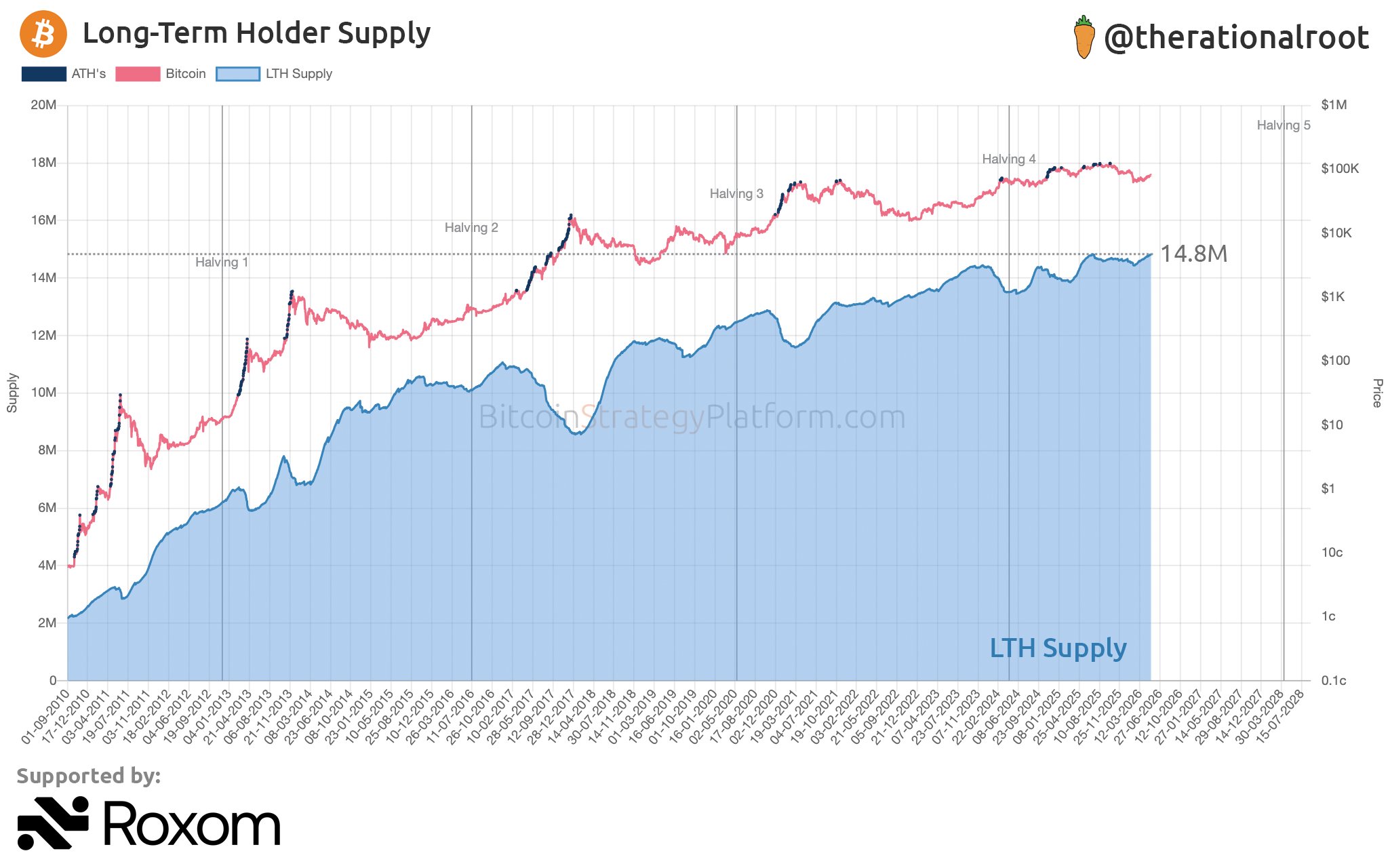
The value of the metric seems to have been rising in recent weeks | Source: @therationalroot on X

As is visible in the graph, the Bitcoin LTH supply declined during the second half of 2025 as the HODLers took their profits of patience. More distribution from the group came alongside BTC’s price drawdown, this time indicating some panic capitulation. Since bottoming alongside the cryptocurrency’s lows in February, however, the trajectory of the metric has reversed. From the chart, it’s apparent that the uptrend in the indicator since then has led it to a value of 14.8 million BTC, which is a record.

Something to note is that while a decline in the LTH supply hints at selling in the present, the same isn’t true when it comes to a surge. By definition, the LTH group only includes tokens that have been held for a period longer than 155 days, so there is always a 155-day delay attached between when coins were bought and when they registered in the metric. In contrast, distribution instantly shows up as tokens see their age reset back to zero as soon as they are transacted.

As such, the recent uptrend in the Bitcoin LTH supply doesn’t reflect any accumulation that’s occurring right now, but rather a growing tendency among investors to HODL their tokens.

BTC Price

Bitcoin has seen its recovery hit the brakes as its price has taken a sideways movement around the $80,700 mark.

The trend in the price of the coin over the last five days | Source: BTCUSDT on TradingView


Trending Cryptos

Related Questions

QWhat is the new all-time high record for Bitcoin Long-Term Holder supply mentioned in the article?

AThe Bitcoin Long-Term Holder supply has reached a new all-time high of 14.8 million BTC.

QAccording to the article, who are considered the 'long-term holders' (LTHs)?

ALong-term holders (LTHs) are Bitcoin investors who have been holding onto their coins for more than 155 days.

QWhat does a recent increase in the LTH supply indicate about current market behavior?

AThe recent increase in the LTH supply indicates a growing tendency among investors to HODL their tokens, reflecting rising conviction, not immediate accumulation. It reflects buying activity from over 155 days ago, as there is a delay before purchased coins are counted in this metric.

QWhat was the primary reason for the decline in LTH supply during the second half of 2025?

AThe decline in LTH supply during the second half of 2025 was because HODLers took profits of patience, and later, some panic capitulation occurred alongside BTC's price drawdown.

QWhat is Bitcoin's price doing at the time of the article's reporting?

AAt the time of reporting, Bitcoin's price recovery has hit the brakes and is moving sideways around the $80,700 mark.

Related Reads

Refunds! Claude 4.8 Sees Overnight Major 'Dumb-Down', GPT-5.6's Computational Power Reportedly 'Halved'

The AI community is currently alarmed by widespread reports of significant performance degradation in two leading models. This article details a "mass self-testing frenzy" triggered by a mysterious prompt designed to detect a hidden "Juice" value, representing a model's reasoning compute budget. On OpenAI's side, users suspect a covert, limited test of a "GPT-5.6-sol" model is underway. When using a specific XML prompt on the Codex platform, a normal "gpt-5.5 xhigh" model reportedly returns a Juice value of 768. However, some users routed to the suspected GPT-5.6 test receive a drastically reduced value of 128—a six-fold decrease. This has sparked debate on whether it signifies a major efficiency leap or a "watered-down, low-cost version" achieved by slashing reasoning depth to save computational expenses. Simultaneously, Anthropic's Claude models, particularly the flagship Opus 4.8 Max, are facing intense user backlash for a perceived "physical brain cut." Users on platforms like Reddit report a dramatic decline in the model's once-impressive reasoning, with complaints of it becoming "absurdly" weakened, performing worse than older, lighter models like Haiku. Specific criticisms include: losing long-context memory, refusing to think deeply even in high-reasoning modes, providing instant incorrect answers, and engaging in unhelpful, argumentative, or "gaslighting" behavior where it contradicts users unnecessarily. The article speculates these "stealth downgrades" might be a calculated corporate strategy. Companies could initially release models with temporarily boosted compute to create an illusion of a major breakthrough, then silently scale back parameters later to manage unsustainable inference costs. A proposed underlying cause is a tightened funding environment, potentially exacerbated by SpaceX's massive IPO soaking up market liquidity, which could delay AI company IPOs and force cost-cutting measures like model "nerfing." The core issue highlighted is the asymmetry of information: subscribers pay for a service that can be silently and fundamentally altered without notification or explanation. The viral "Juice test" resonates because it represents users' desire for transparency about what they are actually paying for.

marsbit38m ago

Refunds! Claude 4.8 Sees Overnight Major 'Dumb-Down', GPT-5.6's Computational Power Reportedly 'Halved'

marsbit38m ago

Earning Six Figures and Still Struggling to Rent in San Francisco

A couple in San Francisco with a combined tech income over $360,000 struggled for months to find a one-bedroom apartment under $5,000 per month. Their story highlights how the AI wealth boom, driven by upcoming IPOs from companies like OpenAI and Anthropic, is dramatically escalating the city's cost of living. Even six-figure salaries are becoming insufficient for a comfortable lifestyle. The article details the financial reality for tech workers earning around $180,000 annually. After taxes, retirement contributions, and healthcare, take-home pay is roughly $7,000 per month. With average rents exceeding $3,800 and one-bedrooms often costing $4,500-$5,200, discretionary income shrinks to $1,500-$2,500. This contrasts sharply with reported median total compensations of $640,000 at OpenAI and $420,000 at Anthropic. The AI gold rush is identified as the primary driver. The scale of potential wealth from these IPOs, far surpassing previous tech booms, is flooding the housing market. Data shows San Francisco's average rent is now the highest in the U.S., with vacancy rates in desirable neighborhoods plummeting to around 3%. The overall cost of living is 65.6% above the national average. The piece features multiple professionals, including a 25-year-old with a $250,000 salary, facing housing instability, fierce competition for rentals, and a persistent, low-grade financial anxiety despite high earnings. It concludes that the rapid concentration of AI wealth is redefining what constitutes a "high salary" in San Francisco, pushing out mid-tier tech talent and creating a stark divide between those in the AI sector and everyone else.

marsbit2h ago

Earning Six Figures and Still Struggling to Rent in San Francisco

marsbit2h ago

Trading

Spot

Hot Articles

What is $BITCOIN

DIGITAL GOLD ($BITCOIN): A Comprehensive Analysis Introduction to DIGITAL GOLD ($BITCOIN) DIGITAL GOLD ($BITCOIN) is a blockchain-based project operating on the Solana network, which aims to combine the characteristics of traditional precious metals with the innovation of decentralized technologies. While it shares a name with Bitcoin, often referred to as “digital gold” due to its perception as a store of value, DIGITAL GOLD is a separate token designed to create a unique ecosystem within the Web3 landscape. Its goal is to position itself as a viable alternative digital asset, although specifics regarding its applications and functionalities are still developing. What is DIGITAL GOLD ($BITCOIN)? DIGITAL GOLD ($BITCOIN) is a cryptocurrency token explicitly designed for use on the Solana blockchain. In contrast to Bitcoin, which provides a widely recognized value storage role, this token appears to focus on broader applications and characteristics. Notable aspects include: Blockchain Infrastructure: The token is built on the Solana blockchain, known for its capacity to handle high-speed and low-cost transactions. Supply Dynamics: DIGITAL GOLD has a maximum supply capped at 100 quadrillion tokens (100P $BITCOIN), although details regarding its circulating supply are currently undisclosed. Utility: While precise functionalities are not explicitly outlined, there are indications that the token could be utilized for various applications, potentially involving decentralized applications (dApps) or asset tokenization strategies. Who is the Creator of DIGITAL GOLD ($BITCOIN)? At present, the identity of the creators and development team behind DIGITAL GOLD ($BITCOIN) remains unknown. This situation is typical among many innovative projects within the blockchain space, particularly those aligning with decentralized finance and meme coin phenomena. While such anonymity may foster a community-driven culture, it intensifies concerns about governance and accountability. Who are the Investors of DIGITAL GOLD ($BITCOIN)? The available information indicates that DIGITAL GOLD ($BITCOIN) does not have any known institutional backers or prominent venture capital investments. The project seems to operate on a peer-to-peer model focused on community support and adoption rather than traditional funding routes. Its activity and liquidity are primarily situated on decentralized exchanges (DEXs), such as PumpSwap, rather than established centralized trading platforms, further highlighting its grassroots approach. How DIGITAL GOLD ($BITCOIN) Works The operational mechanics of DIGITAL GOLD ($BITCOIN) can be elaborated on based on its blockchain design and network attributes: Consensus Mechanism: By leveraging Solana’s unique proof-of-history (PoH) combined with a proof-of-stake (PoS) model, the project ensures efficient transaction validation contributing to the network's high performance. Tokenomics: While specific deflationary mechanisms have not been extensively detailed, the vast maximum token supply implies that it may cater to microtransactions or niche use cases that are still to be defined. Interoperability: There exists the potential for integration with Solana’s broader ecosystem, including various decentralized finance (DeFi) platforms. However, the details regarding specific integrations remain unspecified. Timeline of Key Events Here is a timeline that highlights significant milestones concerning DIGITAL GOLD ($BITCOIN): 2023: The initial deployment of the token occurs on the Solana blockchain, marked by its contract address. 2024: DIGITAL GOLD gains visibility as it becomes available for trading on decentralized exchanges like PumpSwap, allowing users to trade it against SOL. 2025: The project witnesses sporadic trading activity and potential interest in community-led engagements, although no noteworthy partnerships or technical advancements have been documented as of yet. Critical Analysis Strengths Scalability: The underlying Solana infrastructure supports high transaction volumes, which could enhance the utility of $BITCOIN in various transaction scenarios. Accessibility: The potential low trading price per token could attract retail investors, facilitating wider participation due to fractional ownership opportunities. Risks Lack of Transparency: The absence of publicly known backers, developers, or an audit process may yield skepticism regarding the project's sustainability and trustworthiness. Market Volatility: The trading activity is heavily reliant on speculative behavior, which can result in significant price volatility and uncertainty for investors. Conclusion DIGITAL GOLD ($BITCOIN) emerges as an intriguing yet ambiguous project within the rapidly evolving Solana ecosystem. While it attempts to leverage the “digital gold” narrative, its departure from Bitcoin's established role as a store of value underscores the need for a clearer differentiation of its intended utility and governance structure. Future acceptance and adoption will likely depend on addressing the current opacity and defining its operational and economic strategies more explicitly. Note: This report encompasses synthesised information available as of October 2023, and developments may have transpired beyond the research period.

528 Total ViewsPublished 2025.05.13Updated 2025.05.13

What is $BITCOIN

Discussions

Welcome to the HTX Community. Here, you can stay informed about the latest platform developments and gain access to professional market insights. Users' opinions on the price of BTC (BTC) are presented below.

活动图片