Bitcoin Could See a 70% Crash to $38K: Could Be Time for $HYPER

bitcoinistPublished on 2026-02-06Last updated on 2026-02-06

Abstract

Bitcoin is currently trading around $66K after a sharp 24-hour decline, with some analysts predicting a potential 70% crash to $38K from its all-time high near $126K. Such a drop would trigger significant deleveraging and shift ETF buying into panic selling. However, ETF flow data suggests institutional investors are rotating rather than fully exiting, indicating selective interest even during outflows. In this risk-off environment, infrastructure and execution layer projects like Bitcoin Hyper ($HYPER) may gain attention. $HYPER is a Bitcoin Layer-2 solution built with Solana Virtual Machine (SVM) integration, aiming to address Bitcoin's limitations in speed, cost, and programmability. It uses Bitcoin for settlement and a high-throughput SVM L2 for execution, targeting DeFi, payments, and developer tooling. The project has raised over $31.2M in its presale at a token price of $0.0136752 and offers staking with immediate access post-launch. Key risks include execution challenges and reliance on a centralized sequencer before decentralization. The narrative is that during market uncertainty, Bitcoin holders may seek utility within the ecosystem, potentially benefiting scaling solutions like $HYPER.

Trusted Editorial content, reviewed by leading industry experts and seasoned editors. Ad Disclosure

Quick Facts:

  • ➡️ A $38K Bitcoin target implies a severe bear-leg, but the bigger story is positioning: leverage resets, correlations rise, and liquidity concentrates.
  • ➡️ Current pricing puts $BTC near $66K, making mid-$60Ks a critical sentiment zone as traders judge whether this is capitulation or consolidation.
  • ➡️ ETF flows look rotational rather than a full exit, with selective inflows into the most liquid products even during broader net outflow sessions.
  • ➡️ Bitcoin L2 execution narratives can benefit in risk-off tape, and Bitcoin Hyper’s SVM-based design targets Bitcoin’s programmability and throughput gap.

Bitcoin is back in ‘damage control’ mode.

Trading around $66K on CoinMarketCap, $BTC just endured a violent 24-hour swing that’s put the entire market back on edge.

But $66K isn’t the number grabbing headlines. It’s $38,000. That downside target implies a brutal 70% drawdown from the October 2025 all-time high near $126K.
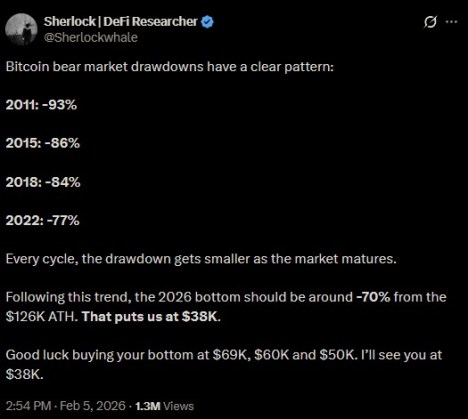
The second-order effects here are brutal. A steep leg lower doesn’t just hurt spot holders; it forces perp deleveraging and turns ‘ETF dip-buying’ into panic selling.

MarketWatch already noted a sharp drawdown featuring massive outflows, including a single $528M exit day, as Bitcoin slid through key support.

When liquidity gets picky, capital rotates toward narratives that work even in sideways tape: infrastructure and execution layers. That’s where Bitcoin Hyper ($HYPER) steps in, a project aiming to fix what Bitcoin still struggles with: speed, cost, and programmability.

Read more about $HYPER here.

The $38K Scenario Isn’t Just Fear, It’s Positioning

A $38K print wouldn’t mean ‘Bitcoin is broken.’ It’s about mechanics. Think risk budgets tightening and flows turning defensive.

ETF data suggests institutions aren’t uniformly out, they’re just rotating.

The data points to a market that still wants Bitcoin beta, just with tighter risk controls and fewer ‘number go up’ buyers.

So, what now? Watch two specific signals:

  1. If $BTC holds the mid-$60Ks or bleeds lower.
  2. If ETF flows stabilize. In crypto, flows often lead price because they reflect real allocation committees, not late-night degens.

That’s the setup where Bitcoin scaling narratives can re-rate, even if the main ticker chops sideways.

Bitcoin Hyper Brings SVM-Speed Execution to Bitcoin

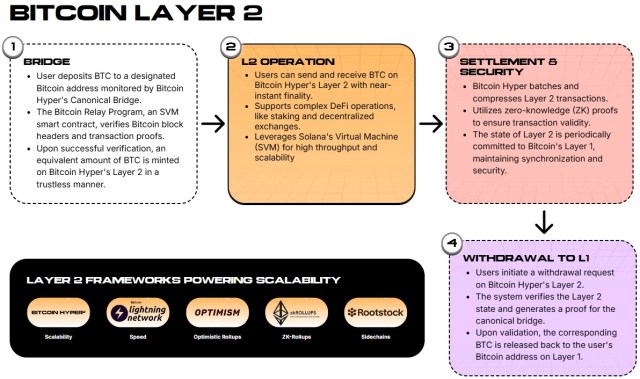
Bitcoin Hyper ($HYPER) markets itself as fastest Bitcoin L2 built with Solana Virtual Machine (SVM) integration. The goal? Low-latency execution positioned as faster than Solana itself (a spicy claim, and one the market will eventually have to benchmark).

The design is modular: Bitcoin L1 for settlement plus a real-time SVM L2 for execution. It relies on a single trusted sequencer and periodic L1 state anchoring. Ideally, this gives Bitcoin something it notoriously lacks: a high-throughput environment where DeFi and gaming dApps can run without turning every interaction into a fee-and-waiting contest.
The real wedge here is the ‘Bitcoin holder’ angle. If the $38K narrative gains traction, investors won’t necessarily abandon Bitcoin—they’ll look for ways to do more with it while waiting.

Bitcoin Hyper’s use cases, high-speed payments, DeFi rails, and Rust developer tooling, target that exact ‘stay in the ecosystem, but make the capital work’ mindset.

Buy your $HYPER today.

$HYPER Presale: $31.26M Raised at $0.0136752

The presale numbers are substantial. According to the official page, Bitcoin Hyper has raised over $31.2M so far, with tokens currently priced at $0.0136752.
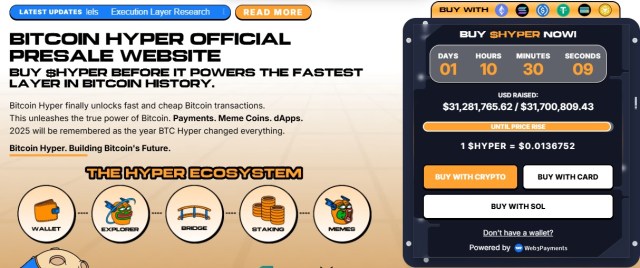
That isn’t institutional adoption, but it is a signal that bigger tickets are probing the trade rather than ignoring it.

Staking plays a major role here. Bitcoin Hyper advertises high APY (rate not disclosed) with immediate staking after TGE. There’s a 7-day vesting period for presale stakers. The lack of a disclosed APY is a caveat, but the structure suggests the team wants tokens engaged (not idle) from day one.

The key risk? Execution. A single trusted sequencer optimizes performance but concentrates operational risk until decentralization milestones arrive. If markets keep sliding, narratives won’t save projects, delivery does.

Buy $HYPER here.

This article is not financial advice; crypto is volatile. Presales carry smart-contract, liquidity, and execution risks, only invest what you can lose.

Editorial Process for bitcoinist is centered on delivering thoroughly researched, accurate, and unbiased content. We uphold strict sourcing standards, and each page undergoes diligent review by our team of top technology experts and seasoned editors. This process ensures the integrity, relevance, and value of our content for our readers.

patrubogdan

Follow

Full Profile

Related Posts

Bithumb Employee’s Mistakenly Sends $233-Worth of $BTC to Users; Could It Fuel $HYPER?

Crypto Firms Propose Key Stablecoin Concessions To Advance CLARITY Act – Report

RWA Perpetuals Record $15B in Volume, Putting LiquidChain’s $LIQUID Presale in Focus

Solana ($SOL) Price Prediction 2026 Turns Bearish: Can It Recover, Or Should We Look at SUBBD Token?

$2.1B in Bitcoin Options Expire Today as Traders Watch Volatility And $BMIC’s Presale Narrative Builds

Metaplanet Will Keep Buying Bitcoin, Says Gerovich, as $HYPER Hits $31M Presale Milestone

Related Questions

QWhat is the potential downside target for Bitcoin mentioned in the article, and what percentage drop does that represent from its all-time high?

AThe potential downside target for Bitcoin mentioned is $38,000, which represents a 70% drop from its October 2025 all-time high near $126,000.

QAccording to the article, what is the primary purpose of the Bitcoin Hyper ($HYPER) project?

AThe primary purpose of Bitcoin Hyper ($HYPER) is to fix Bitcoin's issues with speed, cost, and programmability by being a high-throughput Layer 2 solution that uses the Solana Virtual Machine (SVM) for execution.

QWhat does the article suggest about institutional ETF flows during Bitcoin's price decline?

AThe article suggests that institutional ETF flows are rotational rather than a full exit, with selective inflows into the most liquid products even during broader net outflow sessions, indicating a market that still wants Bitcoin exposure but with tighter risk controls.

QHow much funding has the $HYPER presale raised and at what price per token?

AThe $HYPER presale has raised over $31.2 million with tokens currently priced at $0.0136752.

QWhat is a key operational risk identified for the Bitcoin Hyper project in its current design?

AA key operational risk is its reliance on a single trusted sequencer, which optimizes performance but concentrates operational risk until its planned decentralization milestones are achieved.

Related Reads

Why Do You Always Lose Money on Polymarket? Because You're Betting on News, While the Pros Read the Rules

Why do you always lose money on Polymarket? Because you bet on news, while the pros study the rules. This article explains how top traders ("che tou") profit by meticulously analyzing market rules, not just predicting events. Polymarket, a prediction market platform, often sees disputes over event outcomes due to ambiguous rule wording. For instance, a market asking "Who will be the leader of Venezuela by the end of 2026?" was misinterpreted by many who bet on Delcy Rodríguez, assuming she held power. However, the rules specified "officially holds" as the formally appointed, sworn-in individual. Since Nicolás Maduro was still recognized as president officially, he won the market—even being in prison. To resolve such disputes, Polymarket uses a decentralized arbitration system via UMA protocol. The process involves: 1. Proposal: Anyone can propose a market outcome by staking 750 USDC, earning 5 USDC if unchallenged. 2. Dispute: A 2-hour window allows challenges with a 750 USDC stake; successful challengers earn 250 USDC. 3. Discussion: A 48-hour period on UMA Discord for evidence and debate. 4. Voting: UMA token holders vote in two 24-hour phases (blind then public). Outcomes require >65% consensus and 5M tokens voted; otherwise, four re-votes occur before Polymarket intervention. 5. Settlement: Results are final and automatic. Unlike traditional courts, Polymarket’s system lacks separation between arbitrators and stakeholders—voters often hold market positions, creating conflicts of interest. This leads to herd mentality in discussions and non-transparent outcomes without explanatory rulings, preventing precedent formation. Thus, success on Polymarket hinges on deep rule interpretation, not just event prediction, exploiting gaps between reality and contractual wording.

marsbit29m ago

Why Do You Always Lose Money on Polymarket? Because You're Betting on News, While the Pros Read the Rules

marsbit29m ago

DeepSeek Funding: Liang Wenfeng's 'Realist' Pivot

DeepSeek, a leading Chinese AI company, has initiated its first external funding round, aiming to raise at least $300 million at a valuation of no less than $10 billion. This move marks a significant shift from its founder Liang Wenfeng’s previous idealistic stance of rejecting external capital to maintain independence. Despite strong financial backing from its parent company, quantitative trading firm幻方量化 (Huanfang Quant), which provided an estimated $700 million in revenue in 2025 alone, DeepSeek faces mounting challenges. Key issues include a 15-month gap in major model updates, delays in its flagship V4 release, and the loss of several core researchers to competitors offering significantly higher compensation. The company is also undergoing a strategic pivot by migrating its infrastructure from NVIDIA’s CUDA to Huawei’s Ascend platform, a move aligned with China’s push for technological self-reliance amid U.S. export controls. However, DeepSeek lags behind rivals like智谱AI and MiniMax—both now publicly listed—in areas such as product ecosystem, multimodal capabilities, and commercialization. The funding round, though relatively small in scale, is seen as a way to establish a market-validated valuation anchor, making employee stock options more competitive and facilitating talent retention. It also signals DeepSeek’s transition from a pure research-oriented organization to a commercially-driven player in the global AI ecosystem.

marsbit1h ago

DeepSeek Funding: Liang Wenfeng's 'Realist' Pivot

marsbit1h ago

Trading

Spot
Futures

Hot Articles

What is $BITCOIN

DIGITAL GOLD ($BITCOIN): A Comprehensive Analysis Introduction to DIGITAL GOLD ($BITCOIN) DIGITAL GOLD ($BITCOIN) is a blockchain-based project operating on the Solana network, which aims to combine the characteristics of traditional precious metals with the innovation of decentralized technologies. While it shares a name with Bitcoin, often referred to as “digital gold” due to its perception as a store of value, DIGITAL GOLD is a separate token designed to create a unique ecosystem within the Web3 landscape. Its goal is to position itself as a viable alternative digital asset, although specifics regarding its applications and functionalities are still developing. What is DIGITAL GOLD ($BITCOIN)? DIGITAL GOLD ($BITCOIN) is a cryptocurrency token explicitly designed for use on the Solana blockchain. In contrast to Bitcoin, which provides a widely recognized value storage role, this token appears to focus on broader applications and characteristics. Notable aspects include: Blockchain Infrastructure: The token is built on the Solana blockchain, known for its capacity to handle high-speed and low-cost transactions. Supply Dynamics: DIGITAL GOLD has a maximum supply capped at 100 quadrillion tokens (100P $BITCOIN), although details regarding its circulating supply are currently undisclosed. Utility: While precise functionalities are not explicitly outlined, there are indications that the token could be utilized for various applications, potentially involving decentralized applications (dApps) or asset tokenization strategies. Who is the Creator of DIGITAL GOLD ($BITCOIN)? At present, the identity of the creators and development team behind DIGITAL GOLD ($BITCOIN) remains unknown. This situation is typical among many innovative projects within the blockchain space, particularly those aligning with decentralized finance and meme coin phenomena. While such anonymity may foster a community-driven culture, it intensifies concerns about governance and accountability. Who are the Investors of DIGITAL GOLD ($BITCOIN)? The available information indicates that DIGITAL GOLD ($BITCOIN) does not have any known institutional backers or prominent venture capital investments. The project seems to operate on a peer-to-peer model focused on community support and adoption rather than traditional funding routes. Its activity and liquidity are primarily situated on decentralized exchanges (DEXs), such as PumpSwap, rather than established centralized trading platforms, further highlighting its grassroots approach. How DIGITAL GOLD ($BITCOIN) Works The operational mechanics of DIGITAL GOLD ($BITCOIN) can be elaborated on based on its blockchain design and network attributes: Consensus Mechanism: By leveraging Solana’s unique proof-of-history (PoH) combined with a proof-of-stake (PoS) model, the project ensures efficient transaction validation contributing to the network's high performance. Tokenomics: While specific deflationary mechanisms have not been extensively detailed, the vast maximum token supply implies that it may cater to microtransactions or niche use cases that are still to be defined. Interoperability: There exists the potential for integration with Solana’s broader ecosystem, including various decentralized finance (DeFi) platforms. However, the details regarding specific integrations remain unspecified. Timeline of Key Events Here is a timeline that highlights significant milestones concerning DIGITAL GOLD ($BITCOIN): 2023: The initial deployment of the token occurs on the Solana blockchain, marked by its contract address. 2024: DIGITAL GOLD gains visibility as it becomes available for trading on decentralized exchanges like PumpSwap, allowing users to trade it against SOL. 2025: The project witnesses sporadic trading activity and potential interest in community-led engagements, although no noteworthy partnerships or technical advancements have been documented as of yet. Critical Analysis Strengths Scalability: The underlying Solana infrastructure supports high transaction volumes, which could enhance the utility of $BITCOIN in various transaction scenarios. Accessibility: The potential low trading price per token could attract retail investors, facilitating wider participation due to fractional ownership opportunities. Risks Lack of Transparency: The absence of publicly known backers, developers, or an audit process may yield skepticism regarding the project's sustainability and trustworthiness. Market Volatility: The trading activity is heavily reliant on speculative behavior, which can result in significant price volatility and uncertainty for investors. Conclusion DIGITAL GOLD ($BITCOIN) emerges as an intriguing yet ambiguous project within the rapidly evolving Solana ecosystem. While it attempts to leverage the “digital gold” narrative, its departure from Bitcoin's established role as a store of value underscores the need for a clearer differentiation of its intended utility and governance structure. Future acceptance and adoption will likely depend on addressing the current opacity and defining its operational and economic strategies more explicitly. Note: This report encompasses synthesised information available as of October 2023, and developments may have transpired beyond the research period.

363 Total ViewsPublished 2025.05.13Updated 2025.05.13

What is $BITCOIN

Discussions

Welcome to the HTX Community. Here, you can stay informed about the latest platform developments and gain access to professional market insights. Users' opinions on the price of BTC (BTC) are presented below.

活动图片