Bitcoin Bullish Exhaustion? BTC Whales Close Long Positions After Extreme Upside Bets

BitcoinistPublished on 2025-12-11Last updated on 2026-05-23

Abstract

Bitcoin's price showed strength by approaching $92,000 amid a broader market recovery, but on-chain data reveals a shift in sentiment among large investors. BTC whales have begun closing long positions, suggesting potential profit-taking or anticipation of a price decline. Analysts note this behavior resembles patterns observed in early 2025, often preceding extended sideways movement. Meanwhile, retail traders are exhibiting FOMO, with social media sentiment increasingly bullish. Historically, markets tend to move contrary to retail sentiment, raising concerns about a short-term correction despite recent upward momentum.

Bitcoin’s price is gradually picking up pace following a broader market recovery, allowing the largest cryptocurrency asset to revisit the $92,000 mark on Wednesday. Even though the price is showing strength, key investors are currently moving in the opposite direction of the trend, raising questions about the stability of the recent bounce.

Whales Slams The Brakes On Bullish Bitcoin Bets

Just as the price of Bitcoin staged a slight recovery, the derivatives market has shifted once again as investors make a sudden strategic retreat. On-chain metrics indicate that large BTC holders, also known as whale investors, are stepping back from their bullish positions, a clear sign of growing bearish sentiment.

After navigating the key Bitcoin whale vs. Retail Delta metric, Joao Wedson, an author and founder of the Alphractal analytics platform, disclosed that whales have closed their longs. This strategic pullback or shift in sentiment comes after a heavy positioning to the long side by the cohort.

While the retreat marks a notable change in market sentiment, it also suggests that large investors may be locking in profits or preparing for a potential deeper decline in BTC’s price. Wedson highlighted that while large players are currently starting to take some short positions again, retail investors are moving against them, indicating a clear disparity in sentiment between the two groups.
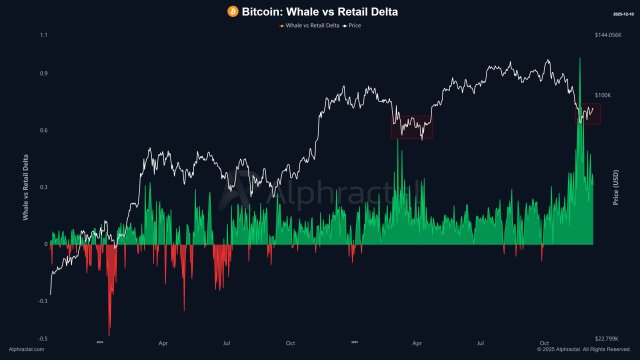
Source: Chart from Joao Wedson on X

Given that whale behavior has historically served as a leading indication for broader price action, this abrupt reversal raises further concerns about Bitcoin’s short-term trajectory. Following an exuberant surge, there are also concerns about whether the market is getting ready for a cooling phase.

The expert stated that the pattern of this metric against price actions looks somewhat similar to what was observed in February and April 2025. In other words, the price of BTC moving sideways longer than what most traders are anticipating is highly likely at this point.

Traders Calling For A BTC Rally

Overall, market sentiment appears to have recovered as Bitcoin traders become greedy, calling for more upward moves. According to a post from Santiment, a leading on-chain data analytics platform, BTC experienced a much-needed rebound back to the $94,600 price mark on Wednesday, which reinvigorated traders.

Interestingly, the brief bounce caused investors to Fear Of Missing Out (FOMO) back in and look forward to the price of BTC going higher. Santiment’s social data, harvesting X, Reddit, Telegram, and other data, shows that calls for higher and above have increased dramatically.

High bars with blue shades indicate calls for lower or below, which is indicative of Fear Uncertainty and Doubt (FUD). It is worth noting that prices often rise as retailers offload their holdings.

Meanwhile, high bars with red shades represent calls for higher or above, signaling FOMO. When calls for higher moves increase, prices usually correct as retailers attempt to acquire more BTC on the way up. During these kinds of occasions, it is crucial to know that markets move in the opposite direction to the behavior of small traders.


Related Reads

IOSG Founder: Web3 Is 'Losing Blood,' How Can Practitioners Survive Better?

IOSG Founder: Web3 Is "Bleeding Out" – How Can Practitioners Survive Better? In a candid reflection, the founder of IOSG Ventures voices deep concerns about the current state of Web3, describing an ecosystem experiencing severe "blood loss." Despite the recent MuShanghai event showcasing a successful pivot towards a more diverse, global community, a somber reality persists: many crypto-native attendees were there exploring exits or new labels in biotech, AI, and robotics. The core issue is identified as a breakdown in the ecosystem's positive feedback loop. Alarmingly, underestimated "low-probability bad events" are occurring simultaneously: a significant brain drain of Chinese developers to AI, a lack of breakout applications despite massive funding, and a widening credibility gap for practitioners globally, often stigmatized as scam artists. This has created a dire接班人 (successor) problem, with the next generation seeing little professional prestige or financial upside in crypto compared to fields like AI. A significant portion of the critique focuses on Ethereum and Vitalik Buterin. While not pessimistic about Ethereum's technology, the founder worries that critical development windows were missed by focusing on niche technical narratives like ZK and L2 instead of mass-market applications. A more urgent concern is that Vitalik may be isolated in an "information bubble," shielded from the grassroots community's hardships by layers of intermediaries, preventing crucial feedback from reaching him. The call is for Vitalik to return to a founder's mindset, re-engage directly with the community, and rally efforts for the next decade. The divergence between U.S. and Chinese OG (Original Gangster) ecosystems is stark. While many U.S. builders reinvest their wealth into the ecosystem, the Chinese scene suffers from a severe lack of "造血能力" (blood-making ability), with most market-driven funds struggling and many early success stories cashing out entirely. This threatens the entire Asian Web3 ecosystem's survival. For individual practitioners, survival advice is pragmatic: find your core "why," maintain life balance beyond token prices, continuously learn new skills (like AI), form small, trusted alliances for mutual support, and practice self-compassion. The industry's greatest need is not money or tech, but lighthouses—individuals at all levels who offer mentorship, grants, referrals, and honest reflection to guide others. The piece concludes with a direct appeal: OGs must pay forward the opportunities the industry gave them; founders must not struggle alone; and builders must continue their work, ensuring it remains a viable profession. The survival of Web3's "cathedral" depends not on any single leader but on the collective responsibility of everyone who remains.

marsbit21m ago

IOSG Founder: Web3 Is 'Losing Blood,' How Can Practitioners Survive Better?

marsbit21m ago

Deficits, Inflation, and the New Fed: The Deep Logic Behind US Bond Yields Breaking 5% and the Market Reset

In the week of May 15-19, 2026, U.S. long-term Treasury yields surged to multi-year highs, with the 30-year yield hitting 5.2%, a level unseen since 2007, and the 10-year yield climbing to 4.687%. Equity markets declined in response. Four primary factors are driving the rise in yields. First, stubborn inflation persists, with April wholesale prices rising 6% year-over-year, fueling expectations of potential future Fed rate hikes instead of cuts. Second, newly confirmed Fed Chair Kevin Warsh inherits a complex inflation battle, with markets closely awaiting his first FOMC meeting. Third, deteriorating U.S. fiscal health, marked by large deficits and rising debt servicing costs, is eroding the traditional "safe-haven" premium for Treasuries. Fourth, the "One Big Beautiful Bill" tax cuts are projected to add trillions to the national debt, contributing to Moody's recent credit rating downgrade. Rising yields pressure stocks through several channels: a higher discount rate reduces the present value of future earnings (especially for growth stocks); rising risk-free rates compress equity risk premiums, making bonds relatively more attractive; higher borrowing costs impact consumers and corporations; and a stronger dollar affects multinational earnings. For investors, the environment favors value and financial stocks over long-duration growth stocks. Bond investors find attractive yields in short to intermediate maturities, while income investors see the best fixed-income opportunities in over a decade. Key developments to watch include Chair Warsh's first FOMC meeting, upcoming inflation data, Treasury auction demand, and whether the 30-year yield approaches 6%, a level that could trigger a more sustained equity valuation reset. The bond market's message is clear: the era of cheap government borrowing is over, posing a central challenge for markets in late 2026.

marsbit22m ago

Deficits, Inflation, and the New Fed: The Deep Logic Behind US Bond Yields Breaking 5% and the Market Reset

marsbit22m ago

Is MicroStrategy Selling Bitcoin Not a Bearish Signal? Deconstructing the 5 Financial Logics Behind Corporate Bitcoin Divestment

The article "Is Strategy Selling Bitcoin Not a Bearish Signal? Decoding 5 Financial Logics Behind Corporate Bitcoin Divestment" analyzes why companies might sell their bitcoin holdings, arguing it's not necessarily negative. It begins by noting the market's surprise at Strategy's potential sale, contrasting its previous "never sell" stance. The core argument is that corporate decisions prioritize shareholder value, and selling bitcoin can be a rational strategic choice. The article outlines five key financial reasons for such sales: 1. **Increase Bitcoin Holdings Per Share:** Companies can use proceeds from bitcoin sales to repurchase shares when the stock price is undervalued relative to its bitcoin assets. This reduces the outstanding share count, potentially increasing the bitcoin amount backing each remaining share. 2. **Optimize Capital Structure & Reduce Financing Costs:** Building cash reserves through bitcoin sales can improve credit ratings (as favored by agencies like S&P), leading to lower future borrowing costs. Repaying debt with sale proceeds also reduces financial leverage. 3. **Legitimate Tax Planning:** In the absence of wash-sale rules for bitcoin in the US, companies can sell to realize capital losses, then repurchase, lowering the tax basis of their holdings and creating tax offsets. 4. **Counter Negative Market Narratives:** A controlled, non-disruptive sale could demonstrate market resilience and disprove fears that corporate selling would crash the market, thereby normalizing bitcoin as a corporate treasury asset. 5. **Repurchase Preferred Stock at a Discount:** If a company's preferred stock trades significantly below its face value, using bitcoin sale proceeds to repurchase it can retire expensive liabilities at a profit, saving on future dividend payments. The conclusion emphasizes that bitcoin's monetary properties offer flexibility. Strategic sales can protect corporate and shareholder interests, making asset utilization more important than rigid "hold" mandates.

marsbit52m ago

Is MicroStrategy Selling Bitcoin Not a Bearish Signal? Deconstructing the 5 Financial Logics Behind Corporate Bitcoin Divestment

marsbit52m ago

Why Did Zhipu Surge Nearly 30% in a Single Day?

"Global AI Model Unicorn" Zhipu's stock surged nearly 30% in a single day, reaching a new market cap high. The catalyst was the launch of its GLM-5.1-highspeed API, boasting a generation speed of **400 tokens per second**, setting a new global benchmark. This speed, roughly 3-5 times faster than industry leaders like OpenAI's GPT-4o and Anthropic's Claude, is achieved **without compromising the full-scale model's capabilities**. In the era of AI Agents requiring dozens of self-calls, such latency reduction is critical, transforming speed from a system metric into a determinant of intelligence limits. The breakthrough stems from a three-layer technical overhaul: 1. **TileRT Inference Engine**: Compiles the entire model into a continuous, always-on computation pipeline using "Warp Specialization," minimizing GPU idle time by having different processor groups handle data loading, computation, and communication in parallel. 2. **Heterogeneous Parallelism for MLA**: To efficiently run the GLM-5.1 model using the MLA attention mechanism, TileRT employs a heterogeneous strategy. One GPU handles sparse indexing/routing, while the others perform dense computation, optimizing for MLA's unique workflow. 3. **ZCube Network Architecture**: Replaces the standard Spine-Leaf (ROFT) network topology with a flat, dual-group interconnect. This design creates a single optimal path between any two GPUs, eliminating network congestion at scale and reducing latency. The business impact is significant: a 15% increase in cluster throughput (free extra capacity), a 40.6% reduction in tail latency (improved stability), and a one-third cut in networking hardware costs. Long-term, this innovation challenges the dominance of NVIDIA's integrated hardware-software stack (GPU+NVLink+InfiniBand), potentially benefiting manufacturers of high-density Leaf switches and optical modules while lowering the software barrier for domestic AI chips like Huawei's Ascend. The innovation proves that more can be achieved with the same compute, reshaping the infrastructure beyond just GPUs.

marsbit2h ago

Why Did Zhipu Surge Nearly 30% in a Single Day?

marsbit2h ago

Trading

Spot
Futures

Hot Articles

What is $BITCOIN

DIGITAL GOLD ($BITCOIN): A Comprehensive Analysis Introduction to DIGITAL GOLD ($BITCOIN) DIGITAL GOLD ($BITCOIN) is a blockchain-based project operating on the Solana network, which aims to combine the characteristics of traditional precious metals with the innovation of decentralized technologies. While it shares a name with Bitcoin, often referred to as “digital gold” due to its perception as a store of value, DIGITAL GOLD is a separate token designed to create a unique ecosystem within the Web3 landscape. Its goal is to position itself as a viable alternative digital asset, although specifics regarding its applications and functionalities are still developing. What is DIGITAL GOLD ($BITCOIN)? DIGITAL GOLD ($BITCOIN) is a cryptocurrency token explicitly designed for use on the Solana blockchain. In contrast to Bitcoin, which provides a widely recognized value storage role, this token appears to focus on broader applications and characteristics. Notable aspects include: Blockchain Infrastructure: The token is built on the Solana blockchain, known for its capacity to handle high-speed and low-cost transactions. Supply Dynamics: DIGITAL GOLD has a maximum supply capped at 100 quadrillion tokens (100P $BITCOIN), although details regarding its circulating supply are currently undisclosed. Utility: While precise functionalities are not explicitly outlined, there are indications that the token could be utilized for various applications, potentially involving decentralized applications (dApps) or asset tokenization strategies. Who is the Creator of DIGITAL GOLD ($BITCOIN)? At present, the identity of the creators and development team behind DIGITAL GOLD ($BITCOIN) remains unknown. This situation is typical among many innovative projects within the blockchain space, particularly those aligning with decentralized finance and meme coin phenomena. While such anonymity may foster a community-driven culture, it intensifies concerns about governance and accountability. Who are the Investors of DIGITAL GOLD ($BITCOIN)? The available information indicates that DIGITAL GOLD ($BITCOIN) does not have any known institutional backers or prominent venture capital investments. The project seems to operate on a peer-to-peer model focused on community support and adoption rather than traditional funding routes. Its activity and liquidity are primarily situated on decentralized exchanges (DEXs), such as PumpSwap, rather than established centralized trading platforms, further highlighting its grassroots approach. How DIGITAL GOLD ($BITCOIN) Works The operational mechanics of DIGITAL GOLD ($BITCOIN) can be elaborated on based on its blockchain design and network attributes: Consensus Mechanism: By leveraging Solana’s unique proof-of-history (PoH) combined with a proof-of-stake (PoS) model, the project ensures efficient transaction validation contributing to the network's high performance. Tokenomics: While specific deflationary mechanisms have not been extensively detailed, the vast maximum token supply implies that it may cater to microtransactions or niche use cases that are still to be defined. Interoperability: There exists the potential for integration with Solana’s broader ecosystem, including various decentralized finance (DeFi) platforms. However, the details regarding specific integrations remain unspecified. Timeline of Key Events Here is a timeline that highlights significant milestones concerning DIGITAL GOLD ($BITCOIN): 2023: The initial deployment of the token occurs on the Solana blockchain, marked by its contract address. 2024: DIGITAL GOLD gains visibility as it becomes available for trading on decentralized exchanges like PumpSwap, allowing users to trade it against SOL. 2025: The project witnesses sporadic trading activity and potential interest in community-led engagements, although no noteworthy partnerships or technical advancements have been documented as of yet. Critical Analysis Strengths Scalability: The underlying Solana infrastructure supports high transaction volumes, which could enhance the utility of $BITCOIN in various transaction scenarios. Accessibility: The potential low trading price per token could attract retail investors, facilitating wider participation due to fractional ownership opportunities. Risks Lack of Transparency: The absence of publicly known backers, developers, or an audit process may yield skepticism regarding the project's sustainability and trustworthiness. Market Volatility: The trading activity is heavily reliant on speculative behavior, which can result in significant price volatility and uncertainty for investors. Conclusion DIGITAL GOLD ($BITCOIN) emerges as an intriguing yet ambiguous project within the rapidly evolving Solana ecosystem. While it attempts to leverage the “digital gold” narrative, its departure from Bitcoin's established role as a store of value underscores the need for a clearer differentiation of its intended utility and governance structure. Future acceptance and adoption will likely depend on addressing the current opacity and defining its operational and economic strategies more explicitly. Note: This report encompasses synthesised information available as of October 2023, and developments may have transpired beyond the research period.

363 Total ViewsPublished 2025.05.13Updated 2025.05.13

What is $BITCOIN

Discussions

Welcome to the HTX Community. Here, you can stay informed about the latest platform developments and gain access to professional market insights. Users' opinions on the price of BTC (BTC) are presented below.

活动图片