Bitcoin fell below the $72,000 mark (Note: Bitcoin has now fallen below $71,000), bringing the issue of 'faith' in the crypto market to the forefront. Against the backdrop of a sharp decline in global risk appetite, investors are reassessing Bitcoin's position during market turbulence, and the safe-haven narrative of crypto assets is being questioned.
According to Bloomberg, Bitcoin fell to $71,739 in late trading in New York on Wednesday, marking the first time it dropped below $72,000 in about 15 months. Compared to its peak in October of last year, Bitcoin has experienced a cumulative pullback of over 42%, with a year-to-date decline of about 17%, sliding to its lowest level since November 6, 2024.
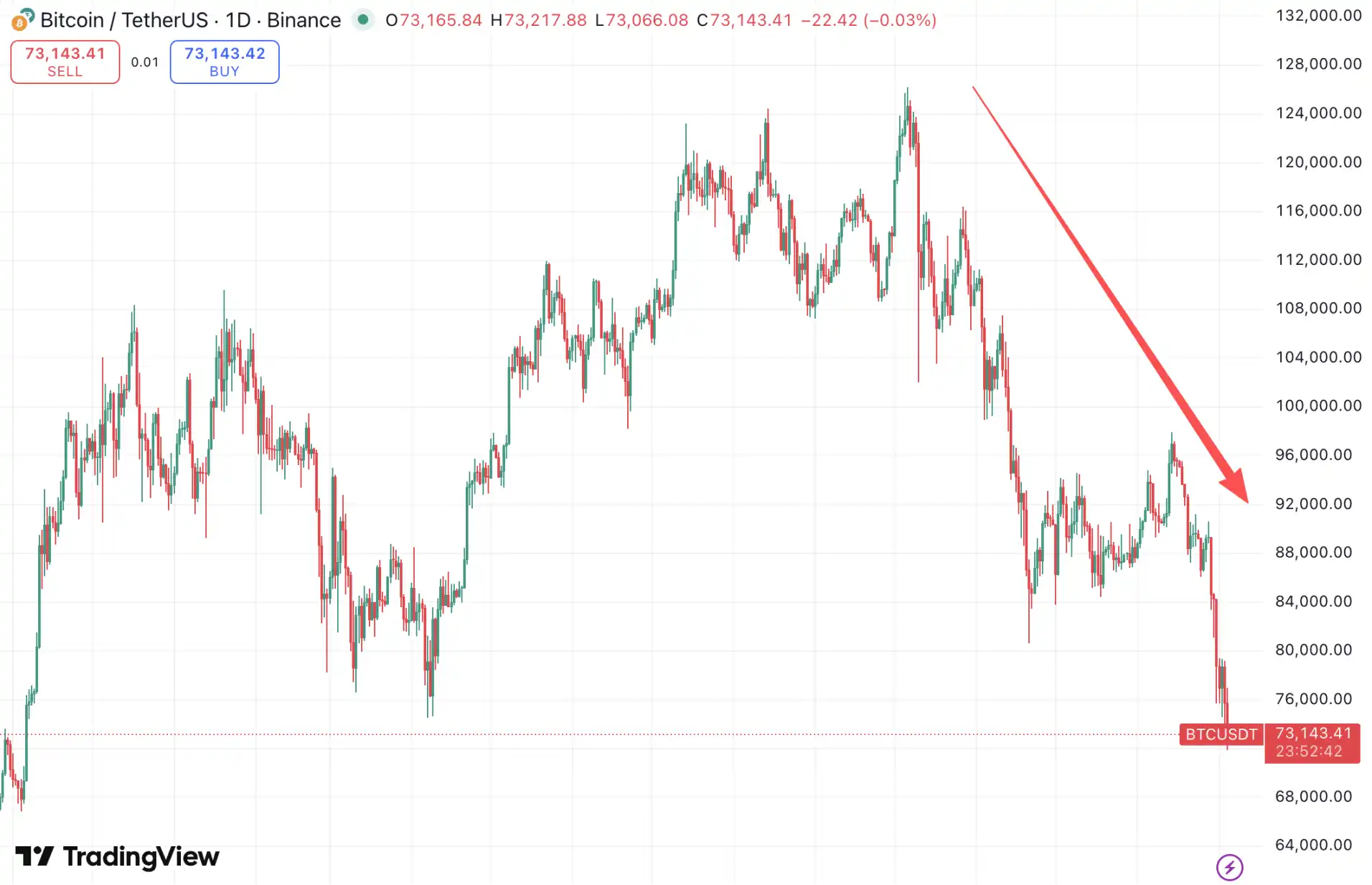
This round of decline is no longer just a continuation of internal deleveraging in the crypto market but is driven by broader cross-asset pressures. Global markets saw synchronized selling on Wednesday, with the Nasdaq 100 index falling over 2%. Sectors more sensitive to interest rates, such as software and chips, were generally under pressure, and Bitcoin weakened accordingly.
On the sentiment front, a 'crisis of faith' is forming. Shiliang Tang, Managing Partner of Monarq Asset Management, stated that the market is experiencing a 'crisis of faith.'
Andrew Tu, Head of Business Development at Efficient Frontier, added that crypto market sentiment is already in 'extreme fear.' If the $72,000 level is lost, Bitcoin could fall to $68,000 or even return to the low range seen before the initial rebound in early 2024.
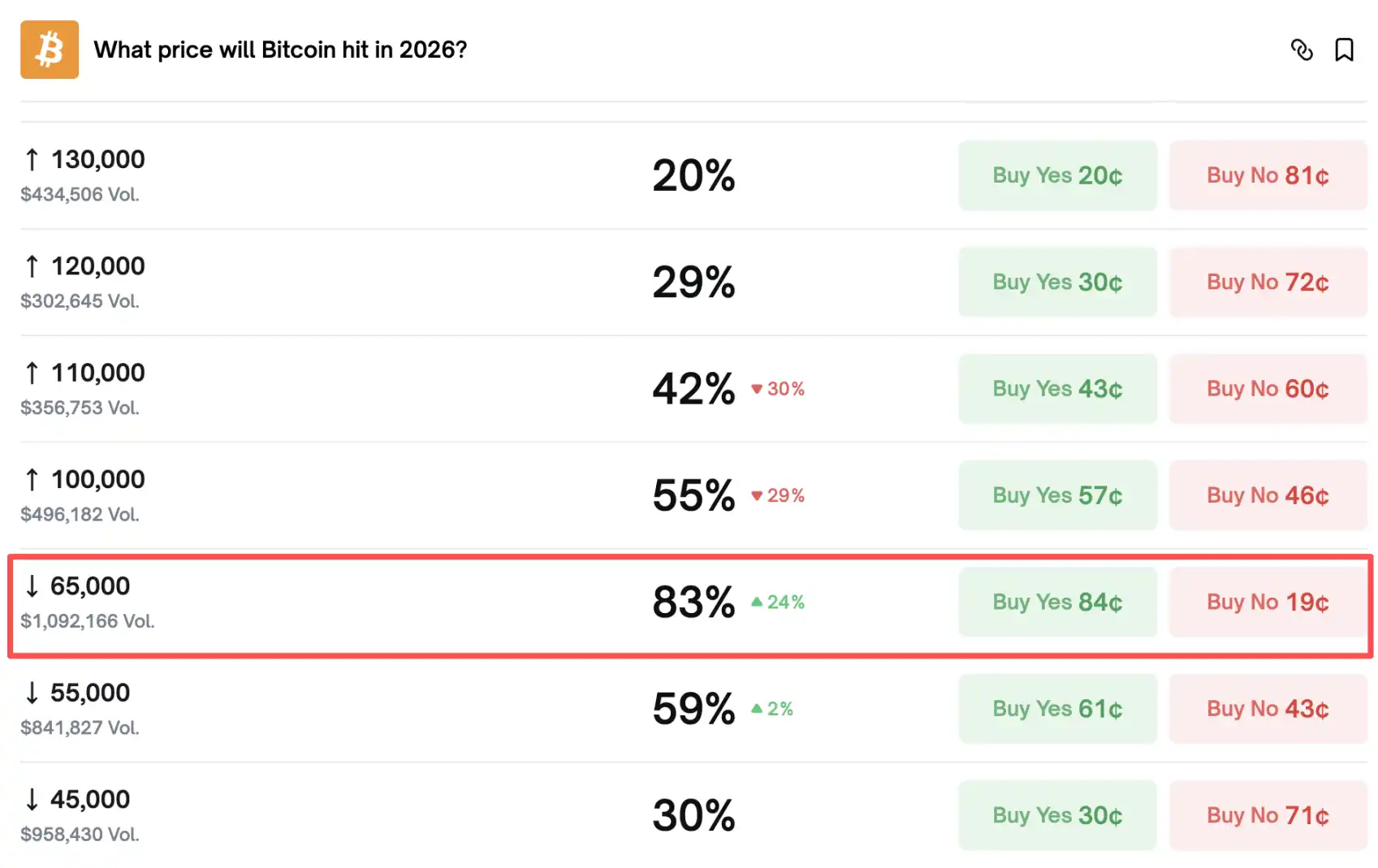
According to Polymarket, there is an 83% probability that Bitcoin will fall to $65,000 this year, while the probability of breaking below $55,000 has climbed to about 59%.
Risk appetite shifts sharply, Bitcoin treated as a 'high-volatility risk asset'
According to Bloomberg, the selling pressure on Bitcoin on Wednesday was related to broader cross-asset tensions rather than being solely driven by internal crypto asset liquidations. This point is clear to investors: during synchronized selling phases, Bitcoin has not demonstrated resilience independent of risk assets but instead behaves more like a high-volatility, long-tail risk asset.
The Nasdaq 100 index fell over 2% on the same day, with losses spreading to sectors such as software and chips. Bitcoin broke below key integer levels during the same trading session, reinforcing the market's perception of its correlation with risk appetite.
42% pullback from peak, crypto market loses over $460 billion in a week
The price pullback is quickly translating into market cap contraction. According to CoinGecko data, the total market capitalization of crypto assets has shrunk by approximately $1.7 trillion since the peak in October last year. In the past week alone, the crypto market cap decreased by over $460 billion.
As the largest cryptocurrency, the extent and speed of Bitcoin's decline have an 'anchoring effect' on market sentiment. When Bitcoin's year-to-date losses expand to about 17%, risk control, margin management, and redemption pressures often rise simultaneously, further exacerbating overall volatility.
How the 'crisis of faith' emerged: From liquidation shocks to emotional collapse
Statements from market participants indicate that sentiment changes are becoming a core variable. The 'crisis of faith' mentioned by Shiliang Tang refers to investors' simultaneous wavering in both the long-term narrative of crypto assets and their short-term pricing mechanisms.
More critically, the driver of the decline has changed. According to Bloomberg, previous decline phases were more driven by crypto-specific liquidations, while Wednesday's pressure came from broader cross-market tensions.
This means that even if internal leverage unwinding in the crypto market concludes, Bitcoin may still lack independent catalysts for a rebound as long as external risk assets remain under pressure.
$72,000 becomes short-term watershed, prediction markets bet on drop to $65,000 within the year
Several traders view the $72,000 level as a key short-term price point. Andrew Tu pointed out that if this level cannot be held, Bitcoin is 'very likely' to test $68,000 and may return to the low range seen before the initial rebound in early 2024.
According to Polymarket, there is an 83% probability that Bitcoin will fall to $65,000 this year, while the probability of breaking below $55,000 has climbed to about 59%.
The funding side is also sending mixed signals. According to data compiled by Bloomberg, U.S.-listed spot Bitcoin ETFs recorded approximately $562 million in net inflows on Monday but turned to net outflows of $272 million on Tuesday, indicating that incremental capital is not stable.
Amid the price decline and反复的资金流 (repeated fund flow fluctuations), market skepticism about Bitcoin's role as a 'safe-haven asset during periods of pressure' is rising.
Twitter:https://twitter.com/BitpushNewsCN
Bitpush TG Discussion Group:https://t.me/BitPushCommunity
Bitpush TG Subscription: https://t.me/bitpush





















