Bank Of England Shares Stablecoin, Tokenization Plan For UK’s Digital Financial Future

bitcoinistPublished on 2026-01-30Last updated on 2026-01-30

Abstract

The Bank of England (BoE) has announced plans to prioritize stablecoins, tokenization, and the Digital Securities Sandbox (DSS) in 2026 to shape the UK’s digital financial future. Executive director Sasha Mills stated that these innovations could modernize payments, improve efficiency, and benefit the real economy. The BoE, alongside the Financial Conduct Authority (FCA), aims to finalize regulations for systemic stablecoins by year-end, ensuring they meet standards equivalent to traditional money. The bank also proposed controversial ownership caps for stablecoins. Additionally, the BoE will provide policy clarity on tokenized collateral under existing regulations and develop a framework for assessing stablecoins within the DSS to support financial stability and international alignment.

The Bank of England (BoE) has outlined its plan to prioritize key innovation areas in 2026, including stablecoins and tokenization, to shape the future of the UK’s digital financial landscape.

BoE To Prioritize Stablecoins In 2026

On Thursday, the Bank of England’s executive director for financial market infrastructure, Sasha Mills, shared the bank’s priorities plan for the year, highlighting the role of regulators in ensuring a safe, responsible, innovative future.

During her speech at the Tokenisation Summit in London, Mills affirmed that financial authorities have “the opportunity to build truly holistic digital financial markets in the UK, bringing real benefits to the real economy.”

To achieve this, the BoE will prioritize systemic stablecoins, tokenized collateral, and the Digital Securities Sandbox (DSS) as three key areas of innovation this year.

The executive director explained that the Bank is focused on advancing its efforts to regulate stablecoins, including its collaboration with the Financial Conduct Authority (FCA) to test the tokens in the DSS, and clarifying policies on the treatment of tokenized collateral under the UK European Market Infrastructure Regulation (EMIR).

Regarding stablecoins, Mills detailed that they “have the potential to modernise retail and wholesale payments, enabling faster, cheaper and more efficient transactions. They could offer a valuable choice for individuals and businesses making payments in the UK and they could offer new functionalities – through programmability – to deliver real benefits for the UK real economy.”

As a result, the Bank is planning to finalize its regime for systemic stablecoins, alongside the FCA, by the end of this year. She noted that these tokens “need to meet the same standards as existing forms of money used in the UK real economy.”

As reported by Bitcoinist, the BoE released a consultation paper on its proposed regulatory framework for sterling-denominated systemic stablecoins, addressing backing rules and holding limits.

Notably, the Bank also moved forward with a controversial proposal to cap stablecoin ownership to £10,000 to £20,000 for individuals and £10 million for businesses, similar to its proposed approach to the digital pound.

UK Seeks Regulatory Clarity For Market Stability

The BoE also seeks to offer clarity for its second priority, tokenization, as the UK is already seeing “practical applications of tokenisation being piloted in collateral markets, offering greater automation and faster settlement, with the potential to lower firm operating costs and increase system-wide liquidity.”

Mills noted that, just like with stablecoins used for payments and traditional collateral, tokenized collateral will be required to meet certain standards to support financial stability.

She asserted that the Bank “aims to avoid mandating or prohibiting specific technologies.” Nonetheless, she also emphasized that clarity on these topics and how they can operate under the UK’s EMIR rules will be crucial to ensure market confidence.

“To provide greater certainty, we will set out further policy later this year on how tokenised collateral can operate under the existing regulatory framework. Ensuring smoother movement of cross-border collateral requires a consistent international approach, so our policy will be shaped by engagement with industry and our international counterparts,” the executive director affirmed.

Regarding the third area of focus, the Digital Securities Sandbox and stablecoins within it, Mills detailed that the BoE is developing an assessment framework to determine a set of regulated stablecoins that meet high enough standards for use in the sandbox.

“As regulatory regimes for stablecoin issuers in the UK and internationally are still being developed, this assessment framework may not map exactly to future standards for what may be permitted in wholesale markets,” she stated. “However, (...) [it] will both ensure some degree of resilience for market participants, and aid transition to a future permanent regime for the use of stablecoins in wholesale markets.”

“The future is ambitious. But making the changes I outlined today (...) will support financial stability domestically and internationally.” Mills concluded.

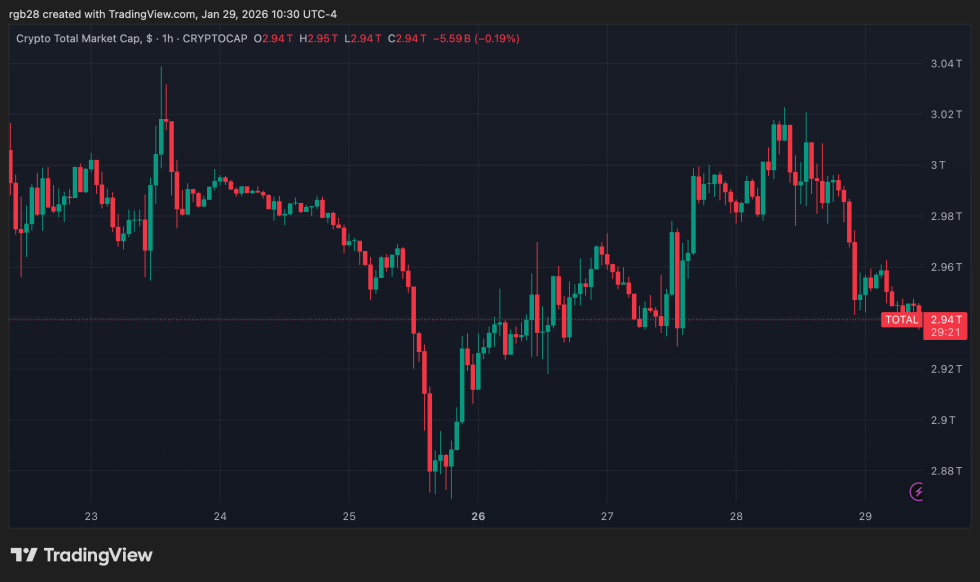
The total crypto market capitalization is at $2.94 trillion in the one-week chart. Source: TOTAL on TradingView

Related Questions

QWhat are the three key areas of innovation that the Bank of England will prioritize in 2026?

AThe Bank of England will prioritize systemic stablecoins, tokenized collateral, and the Digital Securities Sandbox (DSS) as its three key areas of innovation in 2026.

QWhat is the Bank of England's proposed ownership cap for stablecoins for individuals and businesses?

AThe Bank of England has proposed a controversial cap on stablecoin ownership of £10,000 to £20,000 for individuals and £10 million for businesses.

QAccording to Sasha Mills, what potential benefits do stablecoins offer for the UK economy?

ASasha Mills stated that stablecoins have the potential to modernize retail and wholesale payments, enabling faster, cheaper, and more efficient transactions. They could offer a valuable payment choice and new functionalities through programmability to deliver real benefits for the UK real economy.

QWhat is the purpose of the Digital Securities Sandbox (DSS) in relation to stablecoins?

AThe Bank of England is developing an assessment framework within the Digital Securities Sandbox to determine a set of regulated stablecoins that meet high enough standards for use. This framework aims to ensure resilience for market participants and aid the transition to a future permanent regime for using stablecoins in wholesale markets.

QHow does the Bank of England plan to approach the regulation of tokenized collateral?

AThe Bank of England aims to avoid mandating or prohibiting specific technologies but will provide policy clarity on how tokenized collateral can operate under the existing UK European Market Infrastructure Regulation (EMIR). It will set out further policy later this year and shape it through engagement with industry and international counterparts to ensure a consistent international approach.

Related Reads

Michael Saylor's Latest Long Read: Who Defines the Soul of Bitcoin?

Michael Saylor's essay outlines four key ideological factions within the Bitcoin community, each shaping its future. **Bitcoin Maximalists** view Bitcoin as the dominant monetary network—a breakthrough offering superior property rights and sound money. They focus on its moral imperative and resist dilution. **Bitcoin Capitalists** believe Bitcoin's full potential is unlocked through deep integration with the global economy—into capital markets, corporate treasuries, and financial instruments. Their risk is excessive financialization. **Bitcoin Technologists** advocate for ongoing protocol improvements in scalability, privacy, and security to meet evolving demands and threats. Their core risk is destabilizing changes to the foundational layer. **Bitcoin Fundamentalists** prioritize protecting Bitcoin's core principles: self-custody, running nodes, decentralization, and its use as money. They guard against corruption, capture, and compromise. The essay argues that Bitcoin's success requires a balanced synthesis of these perspectives: maintaining its sacred core (Fundamentalists), recognizing its dominance (Maximalists), enabling global integration (Capitalists), and allowing carefully considered innovation (Technologists). The goal is disciplined expansion where most innovation occurs in higher layers, preserving the integrity of the base protocol while making Bitcoin useful for all.

marsbit33m ago

Michael Saylor's Latest Long Read: Who Defines the Soul of Bitcoin?

marsbit33m ago

SpaceX's Blazingly Hot IPO Breaks Records; The Previous Record Holder Was a Chinese Company

SpaceX's upcoming IPO has ignited a feverish market response, poised to break records as the largest in US and global history with a targeted valuation of $1.77 trillion and fundraising of $75 billion. Elon Musk's assertive stance, rewriting IPO rules by allocating 30% of new shares to retail investors—far exceeding the typical 5-10%—and slashing underwriting fees below 0.75%, has fueled the frenzy. This event surpasses the previous US IPO fundraising record set by Chinese e-commerce giant Alibaba in 2014. Alibaba's landmark 2014 NYSE listing raised over $25 billion, crowning it the world's fourth-largest tech company. It symbolized China's rising consumer class and digital economy, ushering in a golden era for US-listed Chinese tech firms and even prompting Hong Kong's exchange to reform its listing rules. However, Alibaba's fortunes shifted post-2020 peak. It faced a record antitrust fine for "choosing one from two" practices, internal cultural crises, and strategic missteps. A focus on premium consumption eroded its core e-commerce market share to around 30%, while costly expansions into new retail and media incurred massive losses. In late 2023, its market value was overtaken by PDD (Pinduoduo). Now, Alibaba is pivoting to AI as a new growth engine. Its Tongyi Qianwen model boasts high user engagement, and Alibaba Cloud remains China's leading public cloud provider, with AI-related revenue growing significantly. The company is integrating AI across its ecosystem. Yet challenges persist, including strong competition from ByteDance's Doubao model, talent retention issues, and an unclear strategic focus between consumer and enterprise AI. Alibaba's journey—from its record-setting IPO peak, through periods of regulatory scrutiny and strategic overreach, to its current AI-driven recalibration—highlights the cyclical fate of tech giants and underscores the critical role of core technological innovation in navigating industry shifts.

marsbit39m ago

SpaceX's Blazingly Hot IPO Breaks Records; The Previous Record Holder Was a Chinese Company

marsbit39m ago

Why Does Ethereum Still Need Kohaku? Privacy Concerns Aren't Just in Transactions

The article "Why Ethereum Still Needs Kohaku: Privacy Issues Extend Beyond Transactions" explains the Kohaku initiative as a suite of privacy-first tools designed to improve user privacy on the Ethereum network. It addresses the problem that while Ethereum's transparency enables innovation, it also exposes users' financial activities, asset holdings, and social connections when they reuse a single address. Kohaku aims to bridge the gap between existing privacy protocols (like Railgun, Privacy Pools) and practical user experience by integrating privacy features into wallets, developer tools, and daily interactions. Key focuses include: enabling wallets to manage multiple accounts for different purposes ("many accounts, many you"), facilitating controlled visibility for transactions instead of full transparency, protecting user data during RPC queries and network activity, and providing developers with easier ways to integrate privacy. The article clarifies that Kohaku is not a single product but an ongoing effort to make privacy a default, usable component of the ecosystem, moving beyond complex protocols to practical application. It counters common misconceptions, arguing that privacy is a fundamental user right for normal activities, not just for anonymity, and that it can coexist with compliance through selective disclosure. Ultimately, Kohaku represents an essential step for Ethereum's maturation, ensuring users can participate in the open network while maintaining control over their personal information boundaries.

marsbit40m ago

Why Does Ethereum Still Need Kohaku? Privacy Concerns Aren't Just in Transactions

marsbit40m ago

AI Kills India's Most Profitable Business: 2 Trillion

The article discusses the significant impact of AI on India's IT outsourcing industry, a sector that has been the backbone of the country's economic growth for three decades. On June 3, India's IT stock index plunged 5.8%, with major firms like TCS, Infosys, and Wipro seeing sharp declines. The panic stems from the realization that AI tools capable of coding, testing, documentation, and customer service directly threaten India's core business model of selling programmer hours. The industry, which generated approximately $282 billion in revenue in the 2025 fiscal year with nearly 80% from exports, faces an existential challenge. The traditional growth logic—more projects requiring more engineers—is being dismantled. Estimates suggest AI could reduce development teams from 100 people to just 2-3 for certain tasks, slashing project costs and company profit margins. Consequently, leading firms have begun reducing headcounts, a reversal of a decades-long trend, and entry-level job openings have plummeted. The risk is profound as IT services account for over 7% of India's GDP and support millions of jobs. With high youth unemployment, the AI-driven reduction in low-to-mid-level engineering roles poses a severe socio-economic threat. However, India also shows potential to adapt and lead in the AI era. Reports indicate it has the world's highest rates of AI tool adoption among employees and managers. Major IT firms are rapidly deploying enterprise AI solutions like Microsoft Copilot. The new opportunity may lie not in competing to build foundational AI models but in becoming the world's premier center for AI implementation, deployment, and productivity enhancement—exporting AI-powered services and expertise instead of just manual coding labor.

marsbit46m ago

AI Kills India's Most Profitable Business: 2 Trillion

marsbit46m ago

Fei-Fei Li's Manifesto for World Models

"Feifei Li's World Model Manifesto" draws a crucial distinction between current AI's linguistic prowess and its lack of understanding of the physical world. Citing Wittgenstein, Li argues that true intelligence requires moving beyond text statistics to comprehend physical laws like optics, inertia, and collision. The article diagnoses the current confusion around "world models" and proposes a clear taxonomy based on the Partially Observable Markov Decision Process (POMDP) framework. Li identifies three core, interdependent pillars for building such models: 1) The **Renderer**, which masters visual plausibility and pixel generation (e.g., Sora, image models) but lacks structural integrity. 2) The **Simulator**, which prioritizes strict adherence to physical laws (mass, friction, collision) and is essential for robotics and real-world application, though it is computationally demanding and data-hungry. 3) The **Planner**, which connects perception to action, enabling decision-making in complex, unstructured environments. Li posits the **Simulator as the critical nexus** linking rendering and planning, highlighting NVIDIA's Omniverse as a leading example. Mastering physical simulation is key to industrial AI applications. Despite challenges like scarce annotated 3D data and "physics-unrealistic" generative outputs, a convergent trend is emerging. The future lies in a **unified foundational model** that seamlessly integrates rendering, simulation, and planning into a dynamic, interactive system. Ultimately, this pursuit of "world models" represents the next evolutionary step for AI: developing **spatial intelligence** to interact with the physical world. It's not merely an algorithmic challenge but a redefinition of digital-physical standards on the path to AGI. However, as noted by Yann LeCun, achieving even rudimentary physical understanding akin to a dog's intelligence may still be years away.

marsbit47m ago

Fei-Fei Li's Manifesto for World Models

marsbit47m ago

Trading

Spot
Futures

Hot Articles

Discussions

Welcome to the HTX Community. Here, you can stay informed about the latest platform developments and gain access to professional market insights. Users' opinions on the price of S (S) are presented below.

活动图片