Author: ChandlerZ, Foresight News
Original Title: What Does the Simultaneous Occurrence of the Yuan Breaking 7 and the Discount on the Dollar Stablecoin Mean?
At the end of 2025, the foreign exchange market is undergoing a quiet but intense asset repricing.
In late December, the offshore yuan (CNH) exchange rate against the US dollar broke through the 7.0 mark during intraday trading, reaching as high as the 6.99 range, hitting a new high since the third quarter of 2024. The onshore yuan against the US dollar also touched 7.0133.
While the official exchange rate was still fluctuating around the 7.0 mark, the OTC price of USDT had already fallen below 6.90 much earlier. As of the time of writing, data from multiple exchanges show that the USDT OTC price (Buy 1) is approximately 6.83 yuan, representing a negative premium rate of 2.48% relative to the current exchange rate of 7.0040.
This inversion was almost unimaginable during the strong dollar cycle of the past three years.
The Collapse of the Dollar 'High Ground'
The decline of the US dollar in 2025 is the most important external backdrop for the yuan's strength.
In 2025, the US dollar index plummeted by 9% for the year, marking its worst performance in eight years, reflecting, to some extent, a global reassessment of "US Exceptionalism".
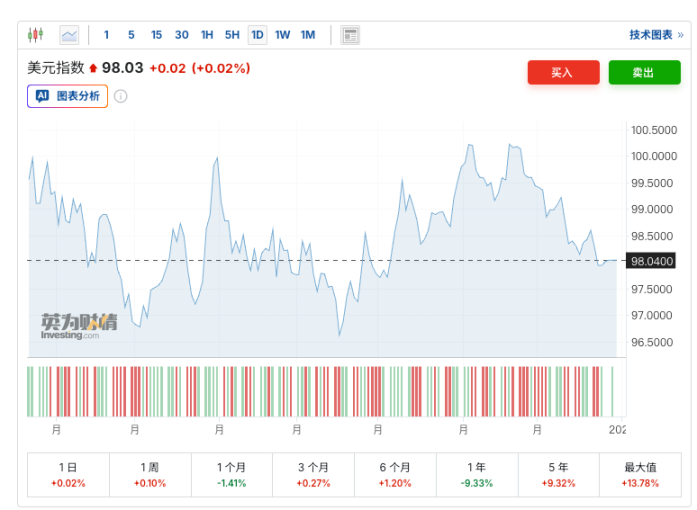
First is the gravitational pull of valuation regression. Although the dollar index has rebounded nearly 2% from its September low, from a fundamental perspective, the dollar is still outrageously "expensive." Data from the Bank for International Settlements (BIS) shows that as of October, the dollar's real broad effective exchange rate (REER), although down from its historical high of 115.1 in January to 108.7, remains at an absolute high. Karl Schamotta, Chief Market Strategist at global corporate payments company Corpay, stated bluntly: "From a fundamental perspective, the dollar is still overvalued."
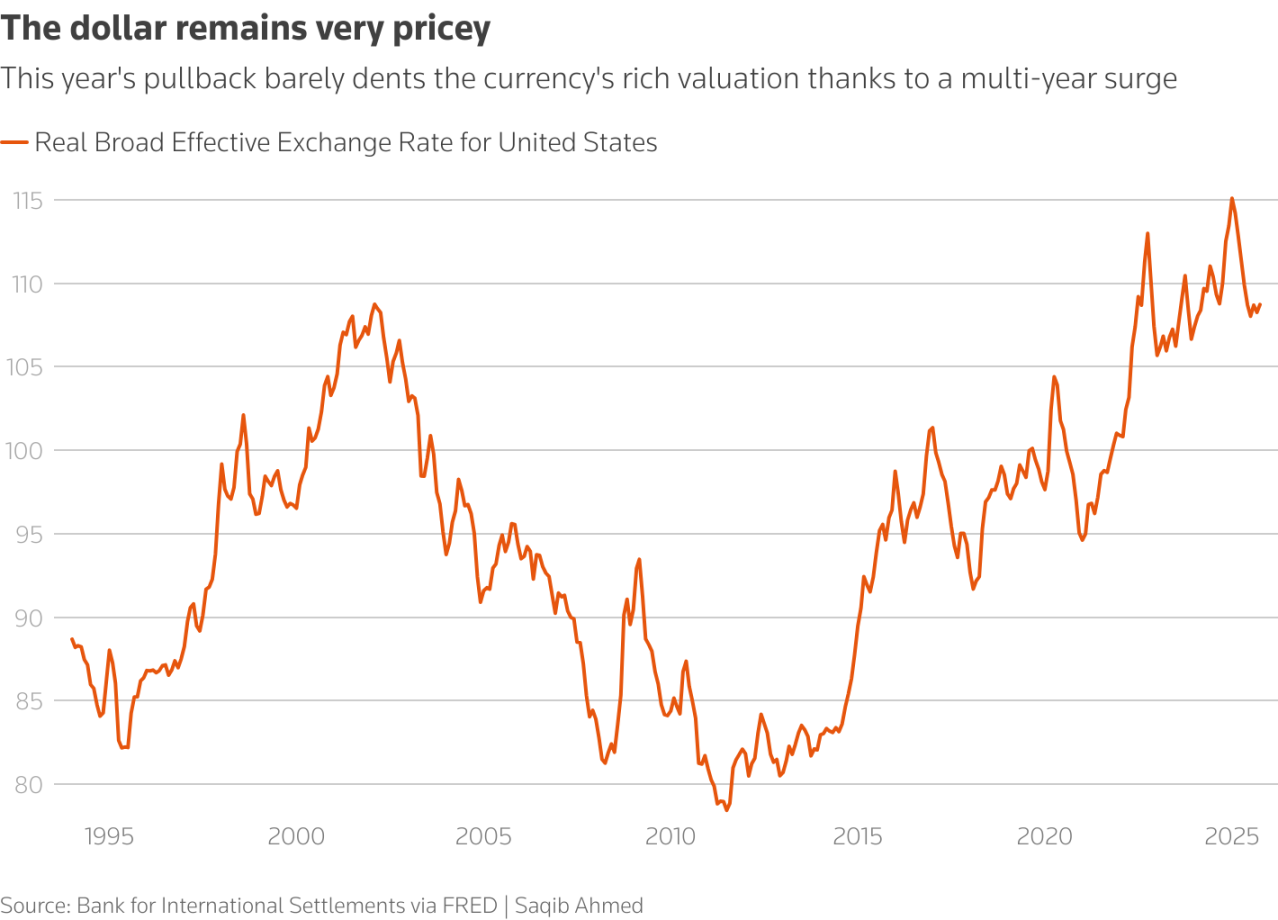
The line chart shows that due to years of sustained gains, this year's correction has barely impacted the dollar's high valuation.
Second is the dovish expectations for the new Fed. The market is pricing in a more accommodative 2025. With Powell set to step down and the Trump administration favoring low-interest-rate policies, leading candidates for his successor, including White House economic adviser Kevin Hassett and former Fed Governor Kevin Warsh, have all shown clear dovish tendencies.
Reuters noted in its year-end market report that the drop in the dollar index is driven more by expectations of Fed rate cuts, narrowing interest rate differentials with other economies, and changes in risk premiums due to the US fiscal deficit and political uncertainty.
And as the relative returns and safety premium of dollar assets are repriced, non-US currencies gain some upward room.
Institutional Consensus: Short-term Upward Momentum, Long-term Intensified Game
With the psychological barrier of 7.0 broken, the biggest question in the current market is whether this marks the start of a new long-term yuan appreciation cycle or is merely a short-term rebound driven by sentiment.
Standing on the threshold of 2026, the consensus among institutions is trending towards冷静 (calmness): short-term惯性向上 (inertia upward), long-term博弈加剧 (game intensifies).
Huachuang Securities believes that in terms of domestic supply and demand, the core factor behind it is foreign exchange settlement and sales. Although December's FX settlement and sales data have not yet been released, logical deduction suggests that the yuan's appreciation itself affects corporate expectations and behavior regarding FX settlement. Coupled with the typically strong seasonal characteristic of higher FX settlement at year-end, these two factors may have jointly driven the stronger performance of domestic supply and demand factors in the second phase of appreciation. On one hand, the continuous appreciation of the yuan exchange rate affects corporate expectations regarding FX settlement decisions; on the other hand, net FX settlement is usually strong at year-end.
However, the macro research team at Guotai Junan Securities also pointed out that the formation of yuan appreciation expectations is not without obstacles. Measuring domestic capital expectations using gold purchasing power parity, the volatility in 2025 was actually not low. Trade frictions in April once pushed domestic capital's depreciation expectations above 7.5, while the start of the Fed's rate cut cycle in September brought domestic capital's appreciation expectations to around 7.0. The reason is essentially that, in an environment where the internal economy has not yet shown significant elasticity, most investors remain somewhat hesitant about trend appreciation.
What Are the Reasons for USDT's Deep Discount?
Crypto market data analyst @Phyrex_Ni analyzed that the deep discount on USDT is mainly due to three reasons:
First: On a macro level, the Chinese yuan is currently strengthening significantly against the US dollar. Since the second half of 2025, the yuan has continued to strengthen. Reasons include the continuation of the Fed's rate-cutting cycle, the weakening US dollar index, and improved Chinese economic data. Holding USDT is equivalent to indirectly holding US dollar assets, which will incur exchange rate losses in the context of yuan appreciation. That is to say, the market itself, anticipating further yuan strength, has already priced in some exchange rate deviation, but this is not the main reason, only a very minor secondary factor.
Second: Chinese regulatory policies have tightened significantly. In early December 2025, the PBOC and twelve other departments jointly issued a document strengthening the crackdown on virtual currency trading speculation, explicitly bringing stablecoins (like USDT) into the regulatory scope, focusing on illegal cross-border capital flows, money laundering, and underground banks using USDT. This has led many OTC merchants and traders to suspend or reduce operations, causing market liquidity to tighten. Some holders, fearing account freezes or regulatory risks, are eager to sell USDT for yuan, increasing supply while demand plummets, directly depressing P2P prices. Historically, every regulatory upgrade in China (e.g., the 2021 ban) has led to negative OTC premiums for USDT. This time the力度 (force) is greater, so the deviation in USDT's exchange rate against the yuan is larger.
Third: The overall crypto market is volatile, and coupled with regulatory negative news, retail and institutional demand for USDT has decreased. Some investors based in mainland China, seeking to avoid risks, hope to offload their USDT as soon as possible, similar to the current negative premium cycle in China's real estate market.
Under the dual pressures of a turning macro cycle and tightening regulatory boundaries, the one-sided safe-haven logic of "holding US dollars means guaranteed gains" that prevailed over the past three years has completely失效 (failed).
For all market participants, the core task now is no longer to bet on whether the next point will be 6.8 or 7.0, but to告别 (bid farewell to) the path dependency on unilateral dollar appreciation. In a future where volatility is significantly elevated, the focus must回归风险中性 (return to risk neutrality).
Twitter:https://twitter.com/BitpushNewsCN
BitPush TG Discussion Group:https://t.me/BitPushCommunity
BitPush TG Subscription: https://t.me/bitpush