An AI Read SpaceX's Prospectus and Wrote This Investment Memo in 12 Minutes

marsbitPublished on 2026-05-25Last updated on 2026-05-25

Abstract

An AI agent autonomously analyzed SpaceX's 226MB S-1 filing, purchased real-time market data on-chain for $1.87, and generated a comprehensive investment memo in 12 minutes. The memo concludes a "Hold" recommendation. Bull Thesis: SpaceX holds a near-monopoly in commercial launch (80% of global orbital mass since 2023), operates the profitable Starlink business (10.3M subscribers, $7.2B adj. EBITDA), and is vertically integrated from rockets to AI via the xAI acquisition. Starlink alone is a standout, high-margin business. Bear Thesis: The AI division is a massive cash burn ($6.4B operating loss on $3.2B revenue in 2025). True debt obligations approach ~$42B, not the headline $29B, due to bridge loans and X-related debt. Significant contingent liabilities exist, including a potential $10B fee from a Cursor option agreement. The company faces concentrated counterparty risk (e.g., a $45B Anthropic contract), slowing revenue growth, and complex governance as a controlled company with four share classes. Valuation anchors Starlink's standalone value at ~$84B (applying Iridium's 7.4x sales multiple), suggesting the current ~$500B+ IPO target prices in immense future execution risk for Starship and AI. Key risks include Starship delays, accelerating AI losses, and underwriter conflicts (the IPO's lead banks are also lenders on the $20B bridge loan it aims to refinance). Investment triggers: upgrade to "Overweight" if priced ≤$350B and Starship meets milestones; downgrade to "Pa...

Author:Nick Prince

Compiled by: Deep Tide TechFlow

Deep Tide Introduction: An AI agent autonomously completed work that would take an investment analyst team days: reading a 226MB SpaceX S-1 filing, purchasing real-time market data using USDC on the Base chain, and generating an investment committee memo with multi-faceted arguments, valuation models, and risk matrices—all for a total cost of just $1.87. This is not a demo, but a record of real, paid API calls. When AI agents can pay for data themselves and decide their own analytical paths, the way Wall Street works is being reshaped.

An AI agent read the 226MB SpaceX S-1 filed on Monday, purchased real-time market data using USDC on the Base chain, and generated this investment committee memo in 12 minutes. Total cost: 6 paid API calls, $1.87 USDC, no API keys required.

Decision Card (Conclusion = Hold/Watch)
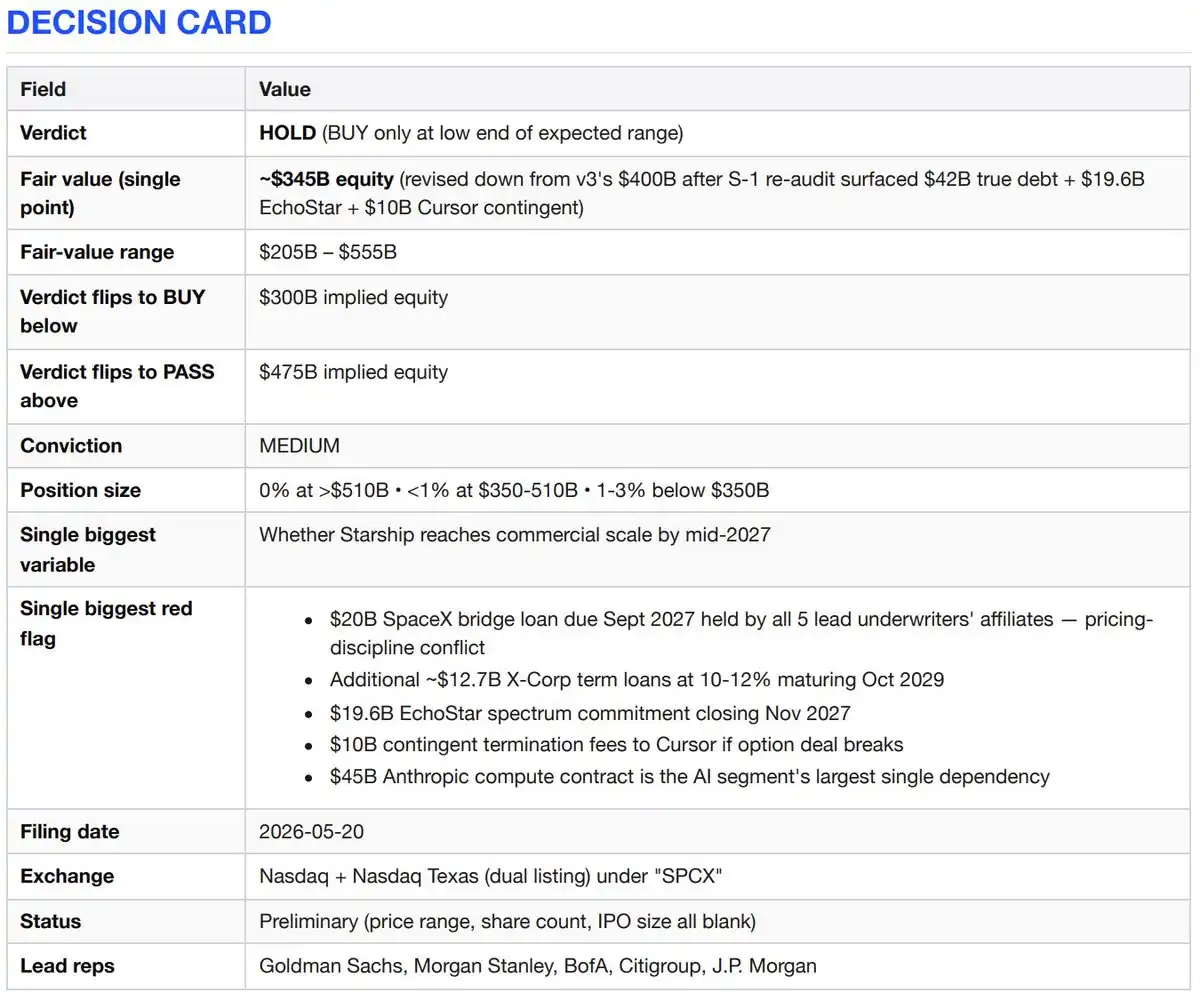
Bull Case

SpaceX has three businesses that competitors cannot replicate. First, a near-monopoly on commercial space access—80% of global orbital mass since 2023, 99% Falcon mission success rate, reusability technology leading by a decade. Second, the world's only deployed low-Earth orbit broadband network—Starlink has 10.3 million subscribers in 164 countries, up 49.8% YoY, with segment adjusted EBITDA of $7.2 billion. Third, since acquiring xAI in February 2026, it's the only AI lab vertically integrated down to the launch rocket level, with orbital compute capability planned for deployment. By any reasonable valuation method, this is a generational asset.

Bear Case

The Connectivity business is real and profitable. But everything else is either burning cash at an astounding rate—the AI segment lost $6.4 billion on $3.2 billion revenue in 2025—or betting on Starship, which has completed 11 flight tests but hasn't delivered payloads to orbit yet. This IPO is partly a refinancing event. SpaceX borrowed a $20 billion bridge loan to acquire xAI, maturing September 2027, and the bridge lenders are the underwriters of this IPO. If the valuation exceeds $500 billion, you're paying for yet-to-be-realized execution capabilities, corporate governance you have no say over, and a refinancing transaction underwriters need to succeed.

Investment Thesis

Starlink is an excellent standalone business. 2025 revenue $11.4B (+49.8%), operating income $4.4B (+120%), segment adjusted EBITDA $7.2B (+86%). High-price subscription services, 10.3 million paid users.

Launch business is unique. Over 80% of global orbital mass since 2023, Falcon success rate over 99%, Falcon 9 first stage flown up to 34 times.

Vertical integration is real and compounding. Rocket → Satellite → Spectrum (EchoStar AWS-4/H-band deal FCC approved) → AI Compute (two COLOSSUS clusters ~1GW).

Government reliance is a moat, not a risk. Primary U.S. national security launch provider: 11 of 12 NSS launches in 2025, all 5 NASA crew and cargo flights.

Option value of orbital AI compute, planned for 2028. If Starship achieves even 50% of targeted economics—99% launch cost reduction—addressable market expands by an order of magnitude.

Counter-Thesis

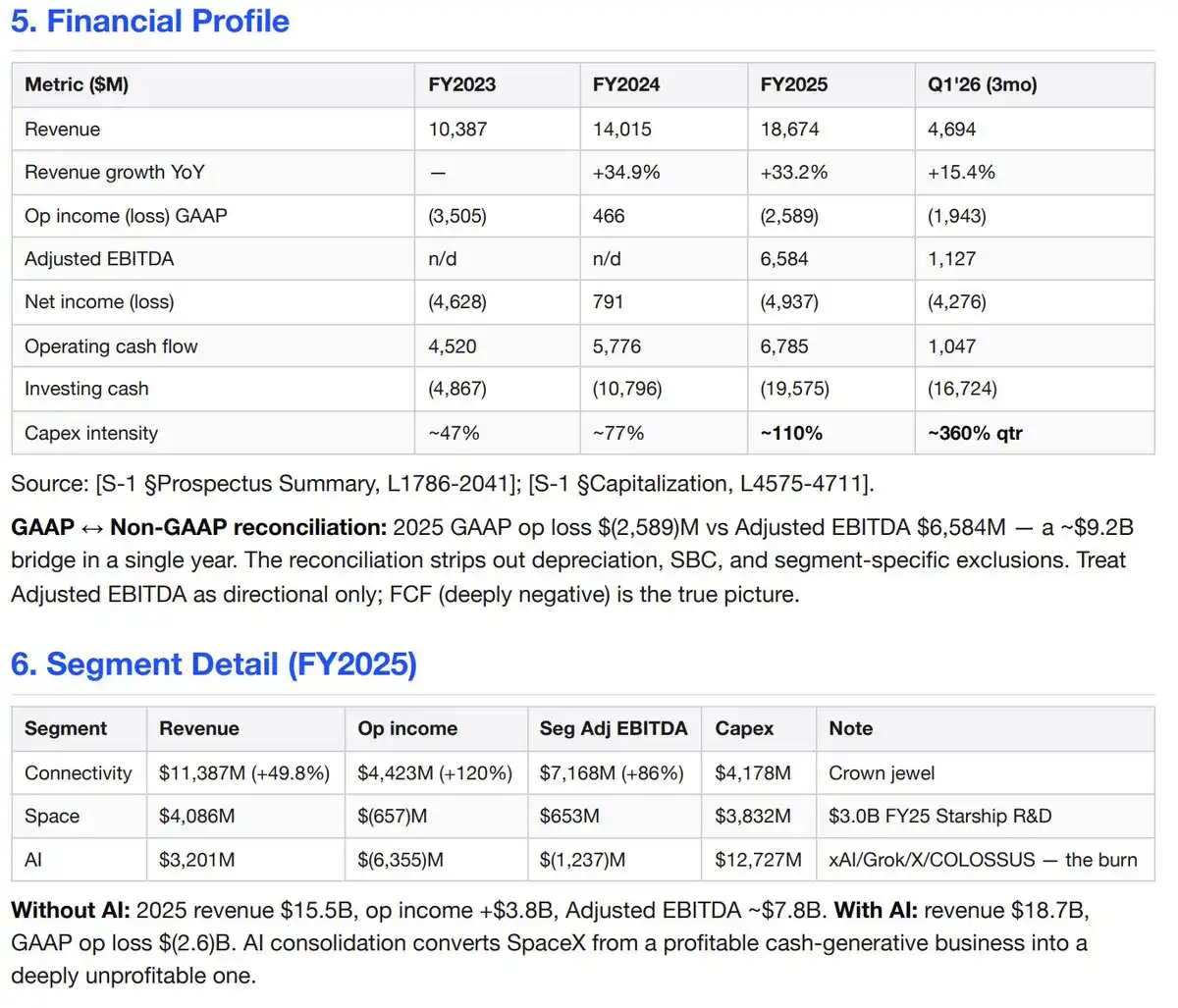
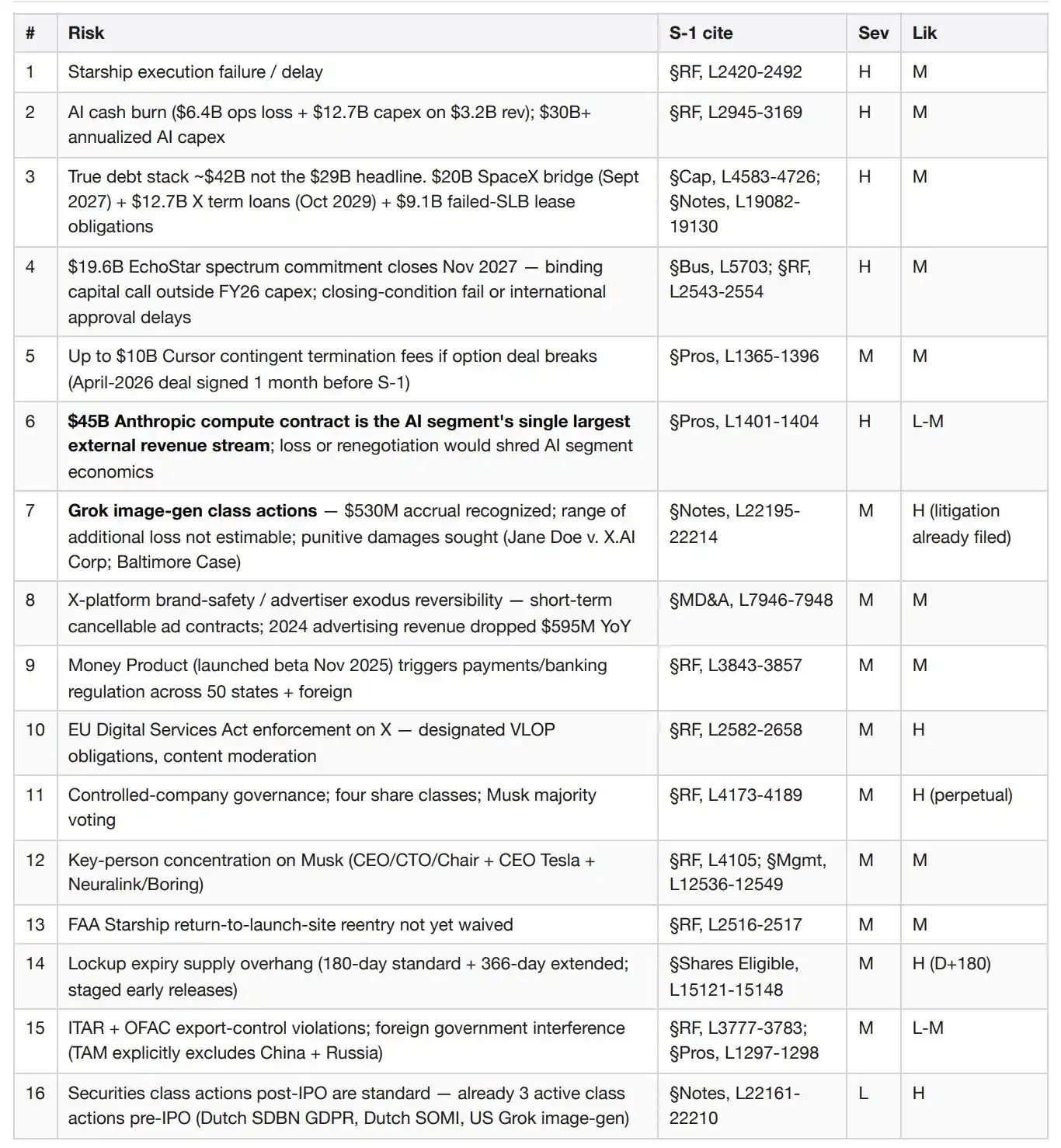
The AI segment is a money pit burning over $6B annually. 2025: $3.2B revenue vs. $6.4B operating loss, segment adjusted EBITDA -$1.2B, CapEx $12.7B. Just Q1 2026: $818M revenue vs. $2.5B operating loss, CapEx $7.7B. Annualized AI CapEx now exceeds $30B, versus AI revenue of $3.2B.

True debt load is ~$42B, not the headline $29B figure. Comprises: ~$20B SpaceX bridge loan (Sept 2027 maturity), ~$6.7B X Corp B-1 Term Loan and ~$6B X Corp B-3 Term Loan (both Oct 2029 maturity, effective rate 10-12%), and ~$9.1B "Other Financing" including obligations from failed AI infrastructure sale-leasebacks. X-related loans alone generate ~$1.2-$1.3B annual interest expense, booked to AI segment.

$19.6B EchoStar spectrum commitment due November 2027. Equity-plus-cash consideration for 65MHz U.S. spectrum and global mobile satellite service licenses. A binding capital commitment on top of bridge loan and FY26 CapEx.

Option agreement with Cursor could trigger up to $10B in termination fees. SpaceX signed a compute-and-option deal with Anysphere (Cursor) in April 2026—one month before this S-1 filing—implying a $60B Cursor valuation. If either party terminates, SpaceX pays Cursor $1.5B termination fee plus $8.5B deferred service fees, payable in cash or Class A stock.

$45B Anthropic contract is AI segment's largest single external revenue source. Cloud services agreement signed May 2026 obligates Anthropic to pay $1.25B monthly until May 2029. SpaceX is selling its COLOSSUS compute to a directly competing frontier model company, creating extreme counterparty concentration risk.

$530M litigation provision recognized on balance sheet for Grok image generation class actions—Jane Doe v. X.AI Corp (Jan 2026), Jane Doe 1 (March), Baltimore (March). Plaintiffs seek compensatory, statutory, and punitive damages. S-1 states additional loss range cannot be estimated.

Q1 2026 revenue growth slowed to 15.4% ($4.69B vs. $4.07B YoY), below 33.2% for full-year 2025.

SpaceX will be a controlled company with four share classes. Musk holds majority voting post-IPO. Company will rely on Nasdaq controlled company exemptions, waiving independent compensation and nominating committees.

Adjusted EBITDA prettifies ~$9B. Management's 2025 headline figure is $6.6B "Adjusted EBITDA" vs. GAAP operating loss of -$2.6B. Adjustments strip depreciation, stock comp, and segment-specific exclusions.

Company Overview

SpaceX (Space Exploration Technologies Corp.; SEC CIK 0001181412) designs and operates reusable rockets, the world's largest LEO satellite constellation (~9,600 broadband sats plus ~650 direct-to-cell sats), and—since acquiring xAI in February 2026—gigawatt-scale AI training infrastructure. Three reportable segments: Space, Connectivity (10.3M Starlink subs), and AI (Grok models, X social platform with 550M MAUs, and COLOSSUS/COLOSSUS II compute clusters). 2025 revenue $18.7B; GAAP operating loss -$2.6B; cash on hand $15.85B versus $29.1B long-term debt per capitalization table cover.
X (Social Platform) Is a Business Unit, Not a Footnote

The corporate chain is worth retracing. SpaceX acquired xAI in Feb 2026. xAI acquired X Holdings in March 2025. X Holdings acquired Twitter in Oct 2022. Result: Twitter/X is now folded into SpaceX's AI segment, with its own balance sheet items, its own litigation, and its own debt structure.

Scale. 1.3B accounts supported over past 12 months, 550M monthly active users (up from 520M in Dec 2025), 350M posts daily. Of those MAUs, 117M use Grok features—X is the primary distribution channel for that model. Money product (payments, banking, financial services) launched beta Nov 2025 and moving toward general availability. X Ads Manager began phased rollout April 2026.

Financial contribution. AI segment revenue 2023-2024 almost entirely from X—advertising, X Premium subscriptions, data licensing. In 2024 alone, ad revenue fell $595M YoY due to "loss of advertising partners at X," partially offset by $157M increase in X Premium subs and $90M increase in data licensing.
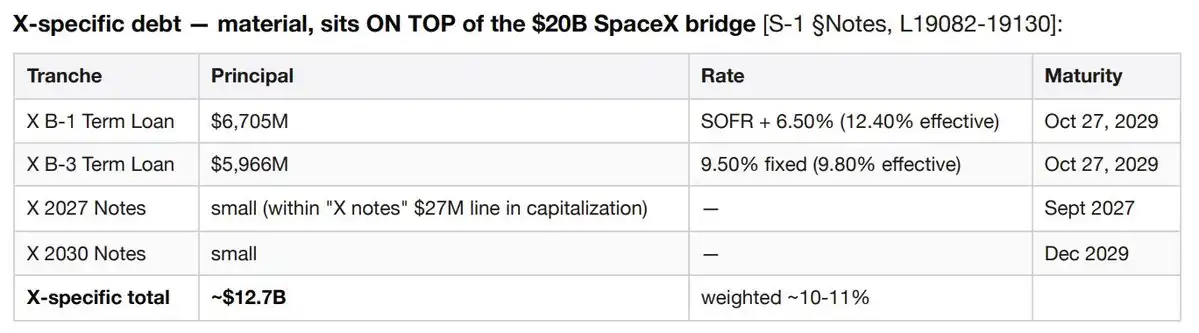
Adding the $20B SpaceX bridge loan (Sept 2027) and $9.1B "Other Financing" line, total long-term debt is ~$42B—not the headline $29B figure on the capitalization cover.

X-specific risks not present in SpaceX's other businesses. EU Digital Services Act enforcement on VLOPs. Advertiser brand safety reversibility on short-term ad contracts cancellable at will—the 2024 exodus could replay in a single news cycle. Money product triggers payments/money transmission/banking regulation in all 50 U.S. states and every foreign jurisdiction. Content moderation policy reversals could trigger simultaneous advertiser pauses and user migration.

Market Position — Live Comparable Data

This comp table was assembled live during analysis by paying $0.10 to Jintel's GraphQL endpoint for bulk fundamental data on all five comps. No Bloomberg terminal, no FactSet contract.
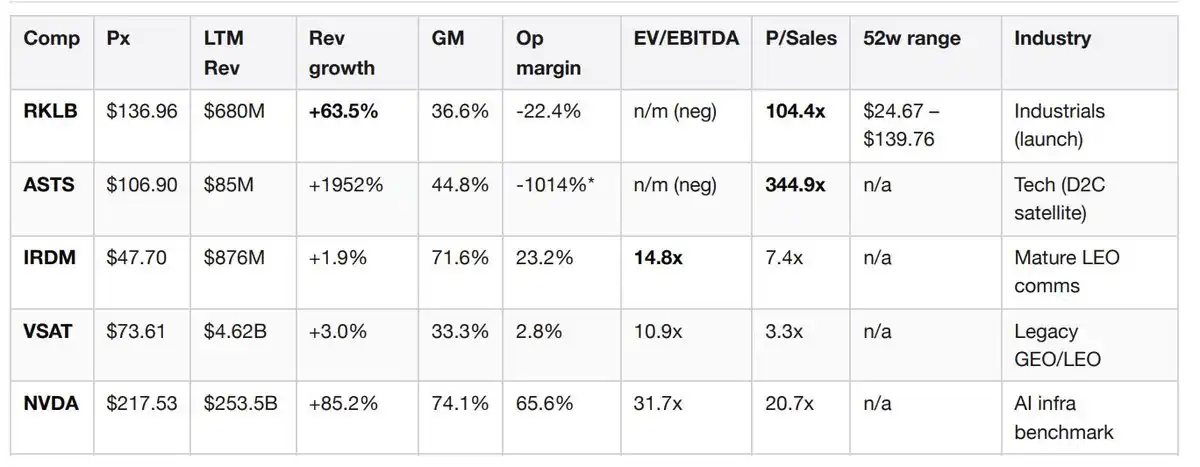
ASTS operating margin reflects pre-revenue massive investment. Source: via x402 on Base chain from Jintel entitiesByTickers, retrieved 2026-05-22.

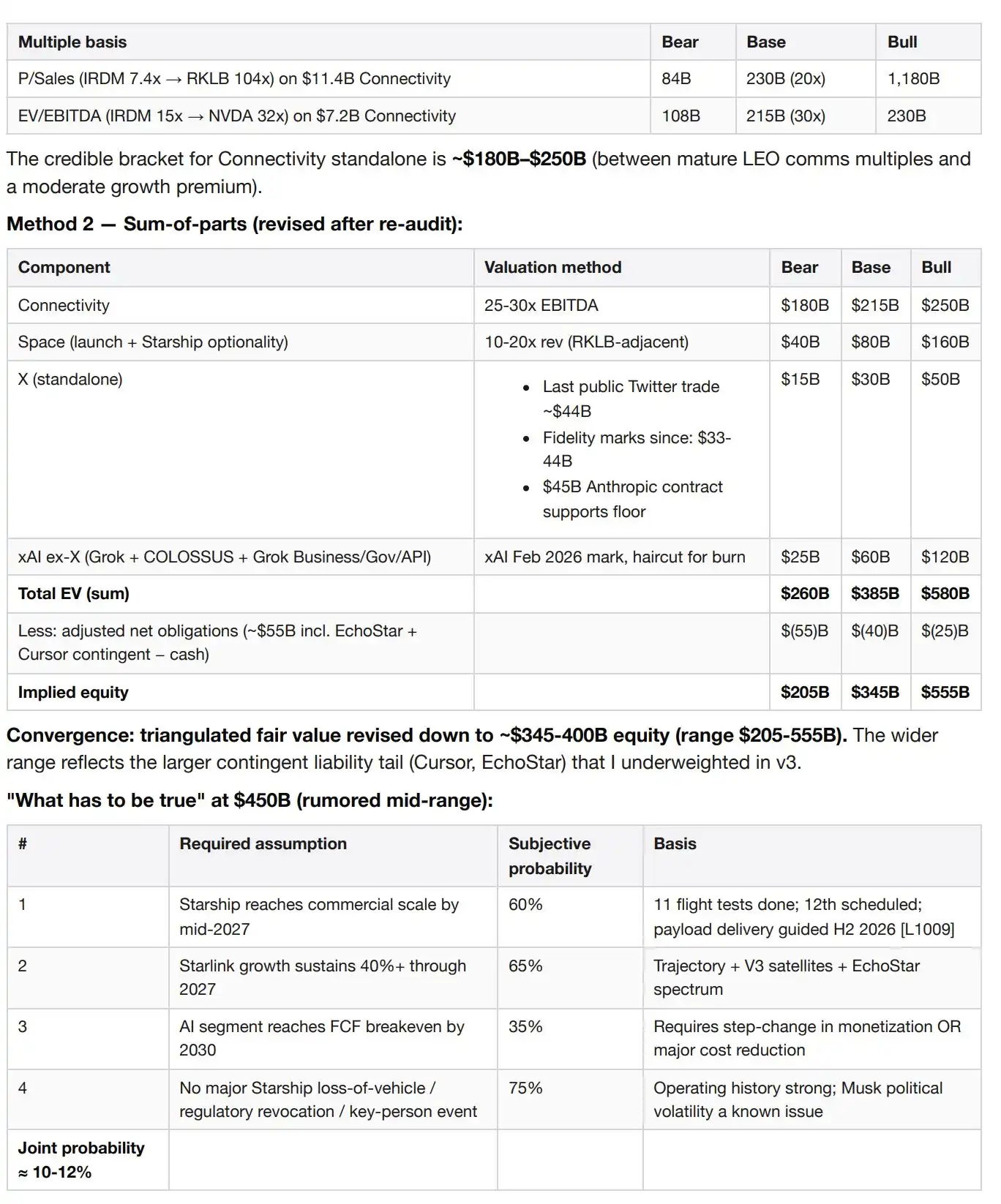
Reading the comp set. Rocket Lab's 104x P/S is the closest narrative comp—investors willing to pay extreme multiples for scaled reusable launch plus LEO option value, even at negative margins. SpaceX deserves higher multiples than RKLB, but blindly applying 104x to SpaceX's Connectivity-only $11.4B revenue implies $1.2T equity value, which can't anchor to anything. AST SpaceMobile's 345x is purely pre-revenue narrative valuation, just an upper bound reference for direct-to-cell option value. Iridium's 7.4x Sales and 14.8x EBITDA represents what mature profitable LEO comms looks like—applying 7.4x to Starlink's $11.4B yields $84B Starlink standalone business value (bear anchor). NVIDIA's 31.7x EV/EBITDA on 85% revenue growth is the level the AI segment needs to grow into to merit a fundamentals-based valuation. Not there yet.

Signal worth noting. Rocket Lab filed a 424B5 prospectus supplement on May 20, 2026—the same day SpaceX dropped the S-1. RKLB doing a secondary equity raise in SpaceX's news cycle suggests management sees the IPO window open and competitive supply pressure imminent.

Pending Major Deals & Contingent Obligations

Each of these four is individually material and they layer on top of each other. Two were signed within 60 days of this S-1 filing.
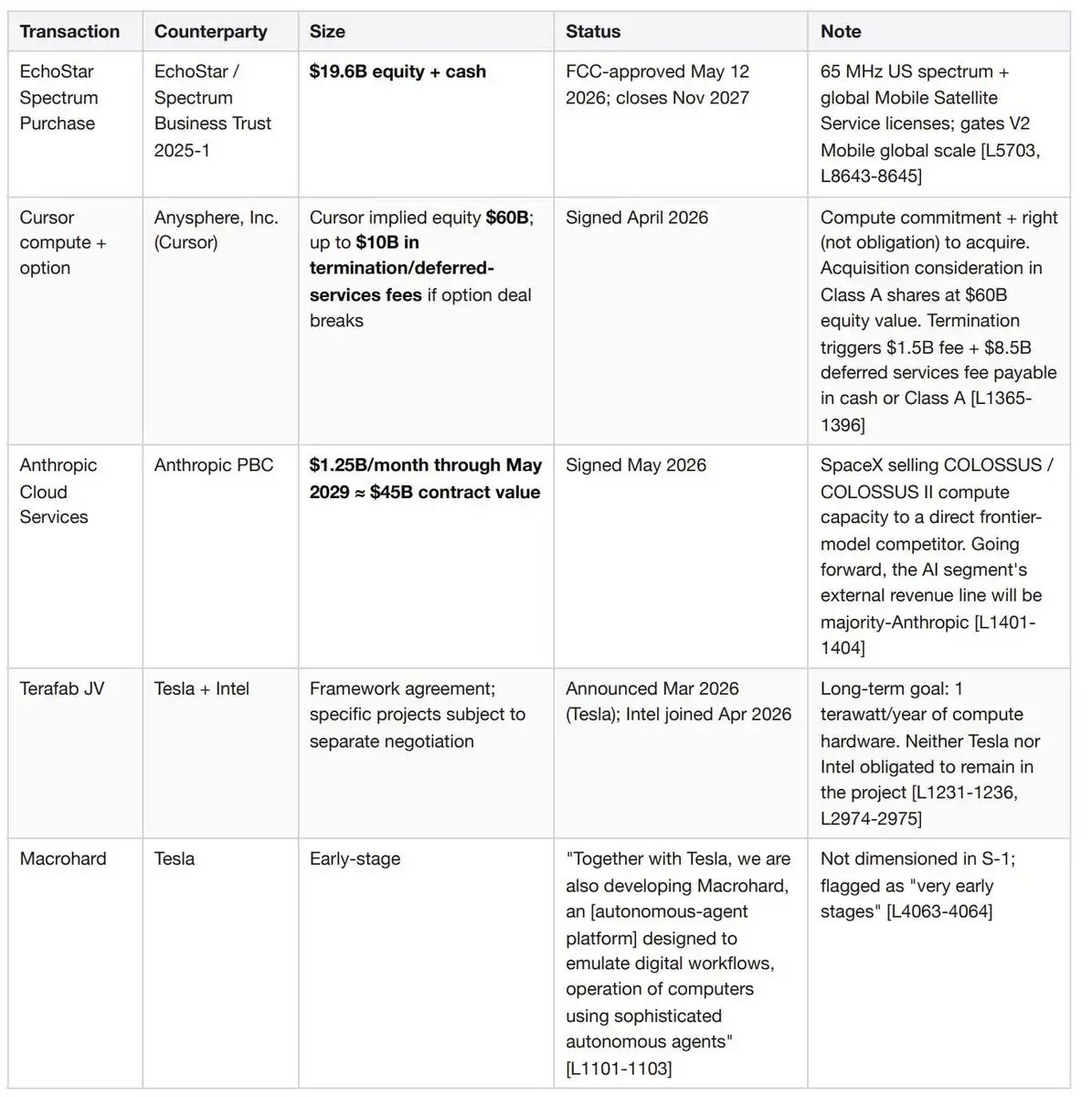
Why this matters for valuation. A clean "adjusted net obligations" view: $42B total debt plus $19.6B EchoStar commitment plus up to $10B Cursor contingent liability, minus $15.85B cash on hand, equals ~$55B net obligations, not counting any IPO proceeds. That's three to four times the number a naive read of the capitalization cover page suggests, materially changing the bear case.

Valuation

Method 1 — Based on Connectivity segment standalone trading multiples, as it's the only segment with positive standalone economics.
Position Sizing Ladder
Key Risks (Severity × Likelihood)
Underwriter Conflicts of Interest

This is buried in the Underwriting section, rarely picked up in news coverage, but material. Affiliates of the five lead underwriters (Goldman Sachs, Morgan Stanley, BofA, Citi, JPMorgan) plus the five additional bookrunners (Barclays, Deutsche Bank, RBC, UBS, Wells Fargo) were lenders on the $20B SpaceX bridge loan they are now pricing the IPO to refinance. Morgan Stanley additionally advised SpaceX on the xAI acquisition (which the bridge loan funded). The underwriting syndicate has a direct financial interest in maximizing IPO proceeds. This should keep the investment committee alert on pricing discipline.

Related-Party Density
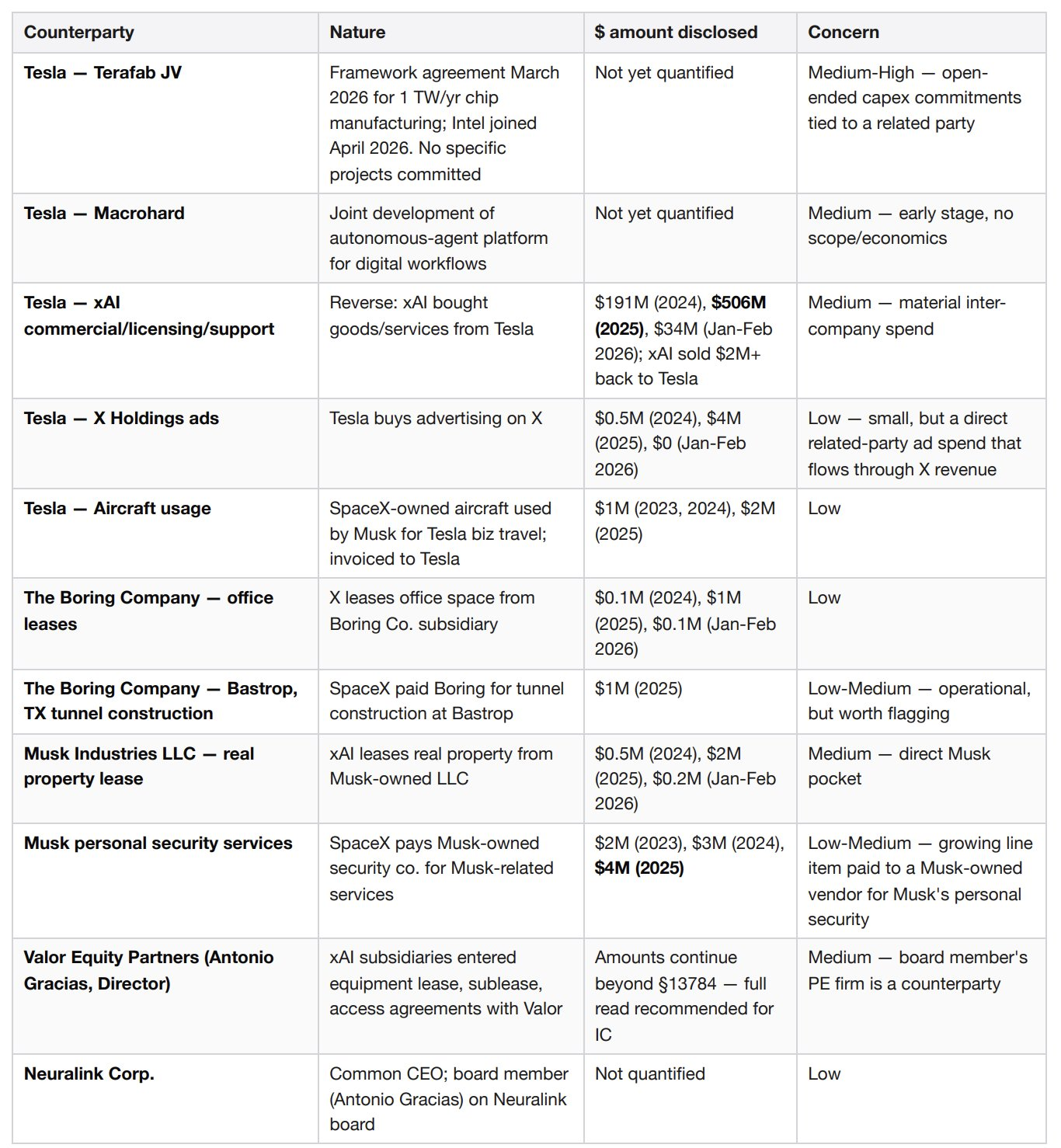
None individually looks concerning. What is concerning is the density—a network of Musk-controlled entities has at least nine distinct financial touchpoints with SpaceX. Public company governance committees typically review one or two such relationships. Here there's an order of magnitude more.

Decision Triggers

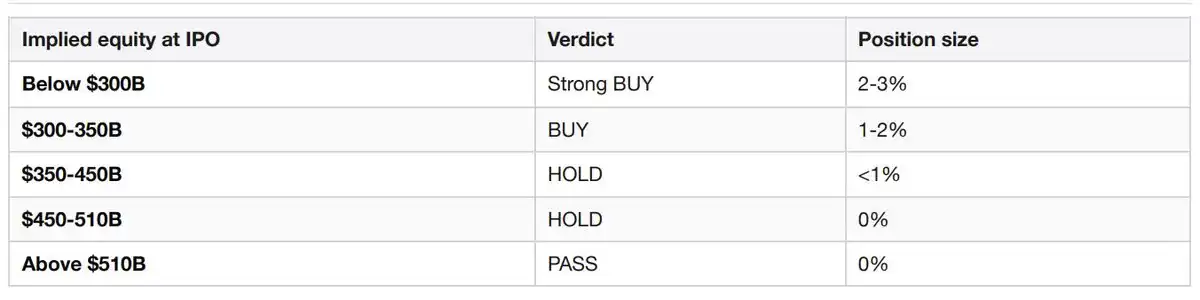
Upgrade to Overweight if deal prices at implied equity $350B or below, AND Starship achieves commercial payload delivery in H2 2026 per guidance, AND Q2 2026 Connectivity revenue growth exceeds 40% YoY.

Downgrade to Pass if deal prices above $510B, OR Starship experiences a vehicle loss event delaying V3 sat deployment post-2027, OR AI segment burn accelerates in Q2-Q3 2026 to >$8B annualized operating loss, OR FAA grounds Starship long-term.

First 180 Days & Multi-Year Watchlist

D+1: First-day pop benchmark vs. comp IPOs

D+30: First quarterly earnings (Q2 2026)—triggers early-release lockup tiers (20% immediate release, +10% if stock +30% vs. offer price)

D+70, +90, +105, +120, +135: Staggered early-release lockup tiers, 7% each

D+90: Quiet period ends, sell-side analyst coverage initiates

D+180: All standard tier lockups expire

H2 2026: Starship guidance hit for commercial payload delivery

Q2-Q3 2026: Grok image generation class action procedural milestones (watch if $530M provision increases)

April 2027: Cursor option agreement one-year mark—watch for exercise or termination signals

September 2027: $20B SpaceX bridge loan maturity (must refinance or repay)

November 2027: $19.6B EchoStar spectrum deal completes—V2 mobile global rollout contingent on this

May 2029: $45B Anthropic compute contract ends; renewal terms will define AI segment economics for years after

October 2029: Combined $12.7B X Corp B-1 & B-3 term loans mature

Sources

SpaceX S-1, SEC Accession No. 0001628280-26-036936, filed 2026-05-20

Live comp fundamentals via Jintel GraphQL entitiesByTickers, x402 on Base, retrieved 2026-05-22

Live SEC EDGAR via x402helper /companies/profile for RKLB, IRDM, VSAT, retrieved 2026-05-22

Industry IPO context via Parallel Search, x402 on Base, retrieved 2026-05-22

Four Scenarios for the SpaceX IPO—Acadian Asset Management

Generated by IPO Analysis pack on agentic.market. 6 paid x402 calls. $1.87 USDC on Base. No API keys. No sign-up. Pay-per-request.

A Bloomberg terminal seat is $24,000 a year. This memo shows what agents can now produce when they can pay for data themselves.


Related Questions

QWhat is the main conclusion and recommendation given by the AI agent's investment memo on SpaceX?

AThe AI agent's conclusion is 'Hold-Wait' (Hold & See). It recommends not buying immediately but waiting for specific triggers. The decision would be upgraded to 'Overweight' if the IPO prices at or below $350B implied equity, Starship achieves commercial payload delivery in H2 2026 as guided, and Starlink revenue growth exceeds 40% YoY in Q2 2026. It would be downgraded to 'Abandon' if pricing exceeds $510B, Starship suffers a vehicle loss delaying V3 satellite deployment beyond 2027, AI segment burn accelerates, or the FAA grounds Starship long-term.

QWhat are the three core businesses of SpaceX as identified in the memo, and which one is currently profitable?

AThe three core businesses are: 1) Space Launch (a near-monopoly with ~80% of global orbital mass since 2023), 2) Connectivity (the Starlink low-Earth orbit broadband network with 10.3M subscribers), and 3) AI (the vertically integrated AI lab from the xAI acquisition, including Grok, X platform, and COLOSSUS compute clusters). Among these, only the Connectivity business (Starlink) is currently profitable, generating $11.4B in revenue and $7.2B in segment-adjusted EBITDA in 2025.

QWhat significant financial risks and obligations does the memo highlight beyond the headline debt figure of $29.1 billion?

AThe memo identifies several major obligations that bring total commitments to approximately $550 billion. Key items include: ~$20B SpaceX bridge loan (due Sep 2027), ~$12.7B in X Holdings term loans, ~$9.1B in 'Other financing' (including failed AI infrastructure sale-leasebacks), a $19.6B binding commitment for the EchoStar spectrum deal (due Nov 2027), and a potential $10B termination fee from the Cursor option agreement. When offset by $15.85B cash on hand, the net obligation is roughly $55B, much higher than the simple headline debt.

QHow does the AI agent characterize the governance and control structure of SpaceX post-IPO?

AThe memo states SpaceX will be a controlled company with four classes of stock. Elon Musk will retain majority voting control after the IPO. The company will rely on Nasdaq's 'controlled company' exemptions, which allow it to forego requirements for an independent compensation committee and an independent nominating committee. This structure, combined with a high density of related-party transactions (at least nine distinct financial touchpoints with Musk-controlled entities), presents significant corporate governance concerns.

QWhat is the estimated cost and time for the AI agent to complete this analysis, and what does this imply for traditional finance roles?

AThe AI agent completed the entire analysis in 12 minutes at a total cost of $1.87. This cost covered 6 paid API calls to process the 226MB SpaceX S-1 filing, purchase real-time comparable company data on-chain, and generate the full investment memo. The article contrasts this with the annual cost of a Bloomberg Terminal seat at $24,000, suggesting that AI agents capable of autonomously paying for and synthesizing data are fundamentally restructuring the workflow and cost basis of traditional financial analysis roles like those on Wall Street.

Related Reads

Female Crypto Mogul Survived Mining Crackdown and Market Plunge, but Paid a $60 Million Tuition to a U.S.-Style 'Pig-Butchering' Scam

An 80s-born Chinese entrepreneur, Fiona Lyu (also known as Lv Yongshuang), CEO of the mining firm Chengdu Valarhash Technology, was defrauded of over $9.4 million (approx. RMB 60 million) in the US, according to a Caixin report. Lyu's company once operated the 1THash and Bytepool mining pools, which collectively controlled about 9% of the global Bitcoin hash rate at their peak in early 2020. The scam began in 2021 after China's crackdown on crypto mining forced Lyu to seek overseas relocation for her operations. She was introduced to Zubair Al Zubair, who posed as an "UAE royal family member" with connections to Middle Eastern capital and US local government resources. He and his brother, who impersonated a hedge fund manager, orchestrated a fake contract signing for a mining facility in Ohio, witnessed by local officials. Lyu transferred millions in contract payments. The brothers, both US citizens with fabricated backgrounds, later fraudulently sold 1,067 of her miners for $6.17 million. The scheme involved bribing a mayor's chief of staff for legitimacy. In May 2026, US courts sentenced Zubair to 24 years in prison, his brother to 23 years, and the official to 8 years. Simultaneously, Lyu faced a separate legal battle in China. A subsidiary of listed company ST Zhongchang sued her firm, seeking refunds for a 2021 contract involving Bitcoin mining equipment. Chinese courts ruled the mining contract invalid and ordered a refund of nearly RMB 19.3 million. This dual blow marked a stark downturn for the once-prominent figure in the crypto mining industry.

Foresight News12m ago

Female Crypto Mogul Survived Mining Crackdown and Market Plunge, but Paid a $60 Million Tuition to a U.S.-Style 'Pig-Butchering' Scam

Foresight News12m ago

Trade.xyz Pricing Controversy Exposes Fatal Weakness of Pre-IPO Perpetual Contracts

The Trade.xyz pricing controversy surrounding its SPCX (SpaceX) pre-IPO perpetual contract on Hyperliquid has exposed a critical vulnerability in decentralized finance (DeFi) platforms offering such instruments. The dispute erupted after SpaceX's updated filing revealed its total shares outstanding were approximately 10% higher than market estimates. While centralized exchanges (CEXs) paused trading and repriced contracts based on the new data, Trade.xyz maintained its position that its "IPOP" contract tracks market expectations for the per-share price, not the company's fundamental valuation or share count. This discrepancy triggered cross-platform arbitrage and led to significant losses for leveraged long positions on Trade.xyz, as the contract price gaped down without a value-neutral adjustment mechanism. The incident highlights the absence of a "Rebase" function—a mechanism that proportionally adjusts contract prices and user positions to reflect corporate actions like share count changes—within many decentralized perpetual exchanges (Perp DEXs). Unlike CEXs, which can centrally execute such adjustments, implementing Rebase on-chain involves significant technical complexity, gas costs, and potential security risks. Trade.xyz's architecture, which allows independent market deployment, further complicates platform-wide Rebase implementation. The controversy underscores broader challenges for Perp DEXs venturing into real-world assets (RWA) like pre-IPO shares. It raises questions about pricing reliability, transparent rule disclosure, and the ability to handle corporate events, testing user trust and the long-term viability of these synthetic markets for price discovery before official listings.

链捕手28m ago

Trade.xyz Pricing Controversy Exposes Fatal Weakness of Pre-IPO Perpetual Contracts

链捕手28m ago

When AI Traffic Surpasses Humans, How Do You Prove You're Human?

As AI-generated web traffic now surpasses human activity, the internet's foundational business models—built on human attention, browsing, and advertising—face severe disruption. AI agents crawl websites at immense scale without generating ad revenue, while AI summaries divert traffic from original content sites. In response, over 2.5 million sites are blocking AI crawlers, and protections like Cloudflare's "honeypot" traps have emerged, though advanced AI can bypass these. The collapse of traditional CAPTCHAs, which assumed machines were weaker than humans, has led to a shift toward behavioral biometrics for human verification. Companies like IBM and BioCatch now analyze unique human patterns—cursor movements, typing rhythms, keystroke dynamics, and even cognitive delays like the Stroop effect—to distinguish real users from bots. These biometric signatures are difficult to fake or alter, offering a new layer of security but raising significant privacy concerns. Two competing visions for a reliable human verification system are emerging. One, exemplified by Sam Altman’s World (formerly Worldcoin), uses centralized iris scanning to generate unique credentials, though it faces bans and criticism over unauthorized data collection. The other employs cryptographic zero-knowledge proofs, allowing users to prove they are human without revealing identity or biometric data, as advocated by Vitalik Buterin. However, decentralized approaches risk exploitation through identity renting in economically unequal regions. The central dilemma is between a scalable but privacy-invasive centralized system that permanently controls users' biometric data, and a privacy-preserving cryptographic system vulnerable to real-world economic manipulation. The author expresses a preference for the cryptographic path, arguing that despite its flaws, it avoids the irreversible biometric surveillance inherent in centralized alternatives.

Foresight News36m ago

When AI Traffic Surpasses Humans, How Do You Prove You're Human?

Foresight News36m ago

Crypto Primary Market Investment and Financing Forward-Looking Weekly Report | Stablecoin Regulation Nears Implementation, ETF Funds Continue to Withdraw, Capital Begins Betting on Payment and Cash Flow

Crypto Market Weekly Report (Jun 1-7, 2026): Capital Shifts Focus to Payments & Cash Flow Market data indicates a significant divergence: while traditional institutional funds continue exiting via BTC and ETH ETFs (recording net outflows of $1.72B and $168M this week, respectively), stablecoin supply continues growing. This suggests capital is shifting from speculative asset allocation toward defensive positioning within on-chain liquidity, awaiting new, concrete opportunities. This trend is reflected in venture capital focus. Weekly fundraising fell 27% to $302M, with investments concentrating on infrastructure with tangible revenue potential: 1. **Stablecoin Infrastructure (28% of funding):** Projects like M0 Protocol ($35M raise) are gaining attention as regulatory clarity (e.g., the GENIUS Act) nears, shifting the focus from legitimacy to building payment and settlement networks. 2. **AI Agent Infrastructure (26%):** Investments are moving from conceptual AI Agents towards the execution and economic layers required for a functional "Agent economy." Key raises include OpenRouter ($40M) and Halliday ($20M). 3. **Real World Assets (RWA) (18%):** The search for on-chain yield and cash flow drives continued interest in RWA platforms like Ondo Finance. Security threats are evolving from smart contract exploits toward key management failures, permission control issues, and regulatory execution risks (e.g., court-ordered asset freezes). **Key Takeaways:** The investment thesis is shifting from narrative-driven bets to revenue and cash-flow-generating protocols. Future attention should be on the progression of stablecoin regulations, the commercial validation of AI Agent economies, and the performance of high-revenue protocols like derivatives platforms.

marsbit43m ago

Crypto Primary Market Investment and Financing Forward-Looking Weekly Report | Stablecoin Regulation Nears Implementation, ETF Funds Continue to Withdraw, Capital Begins Betting on Payment and Cash Flow

marsbit43m ago

Trading

Spot
Futures

Hot Articles

Discussions

Welcome to the HTX Community. Here, you can stay informed about the latest platform developments and gain access to professional market insights. Users' opinions on the price of AI (AI) are presented below.

活动图片