All about Bitcoin’s cheapest ETF day of 2026 and whether a sell-off is coming next

ambcryptoPublished on 2026-03-27Last updated on 2026-03-27

Abstract

Bitcoin's trajectory faces potential bearish pressure as U.S. traditional investors recorded one of the lowest ETF inflows of 2026 at just $7.61 million. This marks the third minimal inflow event this year, with previous instances leading to significant sell-offs. Following similar low inflows in January and February, Bitcoin’s price dropped by billions in value. The negative Coinbase Premium Index of -0.04 further indicates weaker U.S. buying pressure, historically correlating with price declines. While institutional Bitcoin holdings have decreased, the tokenized real-world asset market has grown, suggesting a shift toward de-risking rather than complete market exit. These signals point to a heightened risk of another major sell-off.

Bitcoin’s trajectory over the next couple of weeks could turn bearish, given a new pattern emerging from the activity of traditional investors in the United States.

This, on the back of ongoing geopolitical tensions involving the U.S, Israel, and Iran. Given U.S traditional investors’ deep exposure to Bitcoin [BTC], with a combined net asset value of $95.21 billion, their behavior carries significant weight and warrants close analysis.

A familiar pattern is forming around Bitcoin’s weak ETF inflows

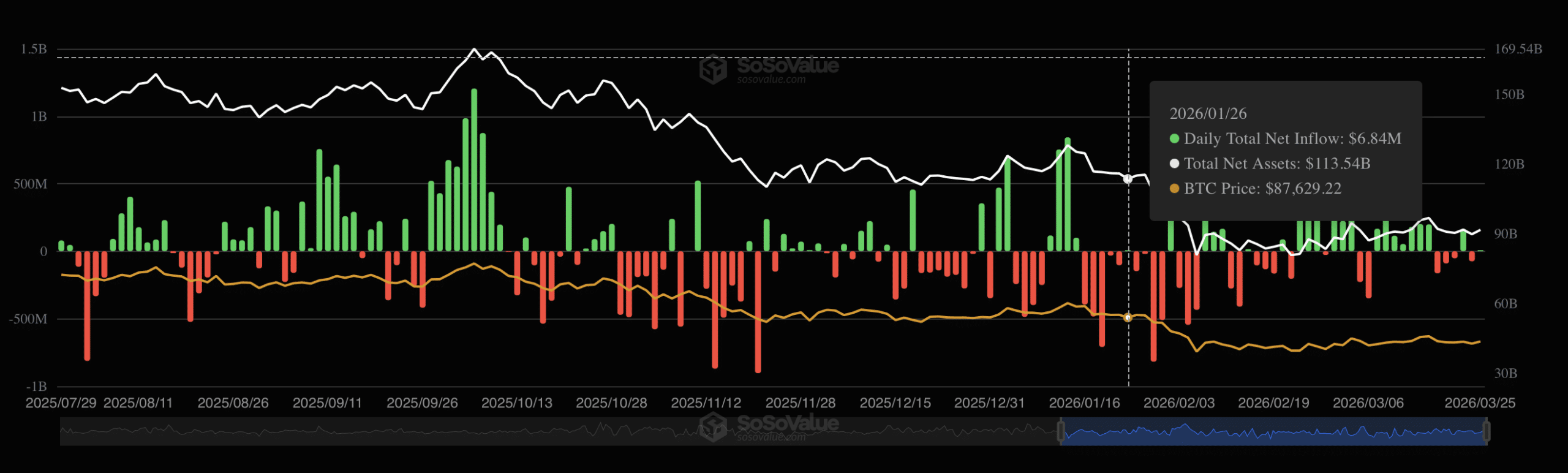
Bitcoin exchange-traded funds (ETFs) recorded one of their lowest daily inflows of 2026, pulling in just $7.61 million on the day.

This marks the third time inflows have reached minimal levels, and the second-lowest reading of the year. It sits between the 26 January inflow of $6.84 million and the 13 February inflow of $15.20 million.

Despite registering positive inflows, both prior occasions signaled early signs of buyer exhaustion. This could make the press time reading another fractal in the making.
Source: CoinGlass

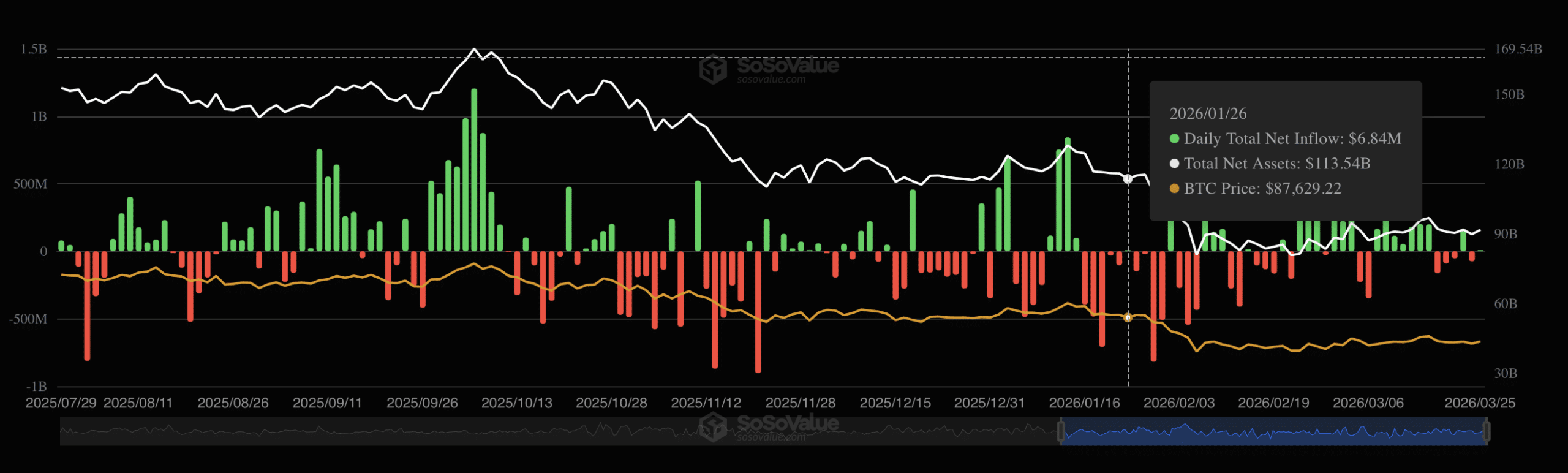
In the first instance, following the $6.84 million inflow on 26 January, Bitcoin’s price dropped from $87,630 to $83,910 within four days, with $1.49 billion worth of the asset sold off. Then, on 13 February, following the $15.20 million inflow, it fell from $68,780 to $64,470, with $403.90 million worth sold.

If this fractal holds, Bitcoin could suffer another major sell-off. The median of the last two occurrences projects approximately $949.24 million in outflows.

Negative premium puts U.S investors in the bearish camp

The bearish case grows stronger when broader U.S. crypto investor sentiment is factored in.

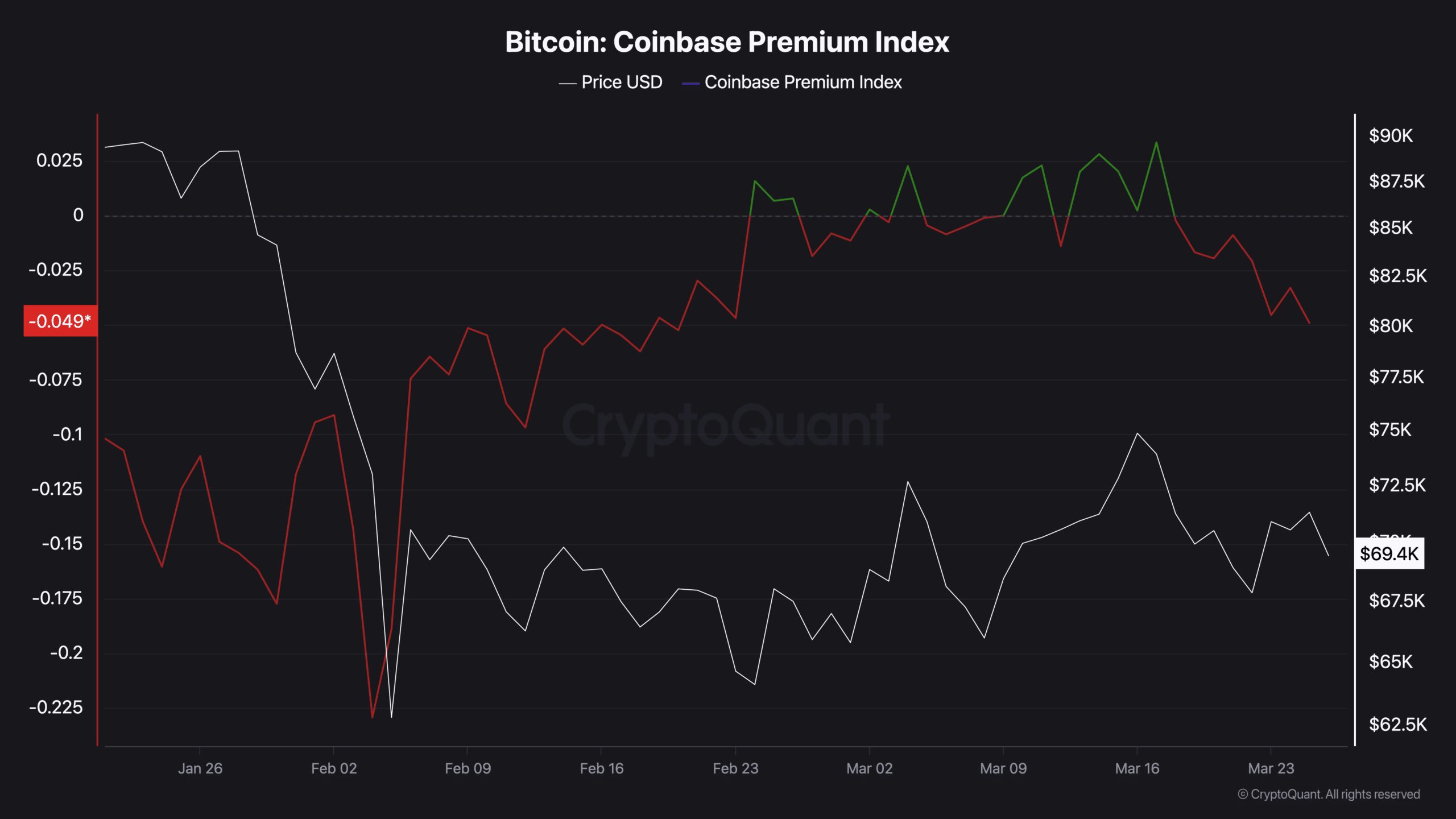
That sentiment can be measured using the Coinbase Premium Index. It is an indicator that compares buying pressure on Coinbase, a predominantly U.S-based exchange, against Binance, a globally dominant platform.

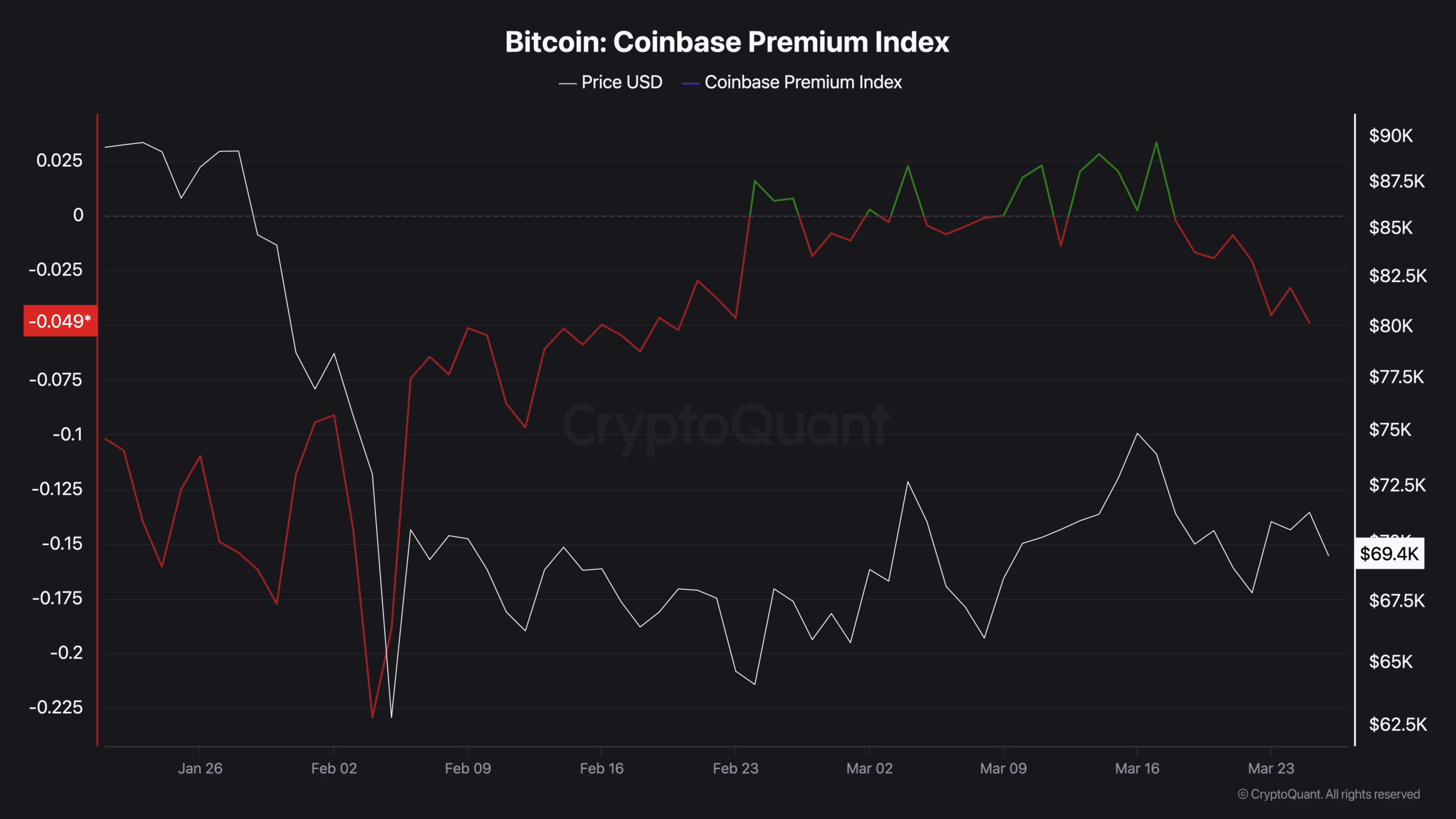
At the time of writing, the premium sat in negative territory at -0.04, indicating weaker buying pressure from U.S investors. Historically, readings in the red zone have correlated with price declines, with this reading no exception.
Source: CryptoQuant

If the premium continues to slide deeper into negative territory, it would mean that the market remains broadly bearish. It would also increase the likelihood that U.S investors pull funds from Coinbase, and by extension, through asset managers.

Institutions are not leaving the market!

While institutional Bitcoin holdings have fallen by $69.94 billion since their 8 October peak, the tokenized asset market has moved in the opposite direction.

For instance – Data from RWA.xyz revealed the real-world asset (RWA) on-chain market has grown by $7.85 billion since the broader crypto market began falling, bringing its total valuation to $26.60 billion. U.S-based assets have so far dominated this segment.

This trend points to a deliberate de-risking move, with some institutional investors remaining active in the market, but rotating into tokenized real-world assets rather than maintaining Bitcoin exposure.


Final Summary

  • Bitcoin’s U.S traditional investors bought $7.61 million in Bitcoin, but left signs of a possible pullback ahead.
  • Bitcoin’s premium on Coinbase turned negative, confirming that selling pressure has been building.


Trending Cryptos

Related Questions

QWhat was the amount of Bitcoin ETF inflows on the day mentioned in the article, and how does it rank for the year 2026?

AThe Bitcoin ETF inflows were $7.61 million, marking the second-lowest reading of the year 2026.

QAccording to the article, what pattern has been observed following previous instances of minimal ETF inflows?

AFollowing previous instances of minimal inflows, Bitcoin's price experienced a significant drop, signaling buyer exhaustion and leading to a major sell-off.

QWhat does a negative Coinbase Premium Index indicate about U.S. investor sentiment?

AA negative Coinbase Premium Index indicates weaker buying pressure from U.S. investors and has historically correlated with price declines, suggesting bearish sentiment.

QHow has the tokenized real-world asset (RWA) market performed compared to the broader crypto market decline?

AThe tokenized real-world asset (RWA) market has grown by $7.85 billion since the broader crypto market began falling, reaching a total valuation of $26.60 billion, indicating a move by institutional investors to de-risk by rotating into these assets.

QWhat is the projected amount of outflows if the current fractal pattern of low ETF inflows holds, based on the median of the last two occurrences?

AIf the fractal pattern holds, the median of the last two occurrences projects approximately $949.24 million in outflows.

Related Reads

Media: Anthropic Aims for Revenue Up to $200 Billion by 2028 Ahead of IPO

Anthropic, the AI company behind Claude, is reportedly projecting its revenue could reach between $190 billion and $200 billion by 2028, according to sources cited by Reuters. This forecast, significantly higher than its reported $47 billion annual run-rate in May 2026, is being used by investors and bankers to value the company ahead of a potential IPO. Anthropic has confidentially filed with the SEC, with listing details dependent on market conditions and regulatory approval. The valuation reportedly applies a revenue multiple (EV/Revenue) to these future 2028 figures, an approach common for high-growth tech firms but unusual for a forecast two years ahead of an IPO. This reflects confidence in Anthropic's rapid scaling; its annual run-rate grew tenfold yearly for three years leading into 2026, jumping from ~$9B in late 2025 to over $47B by May 2026. Investors are betting the company's massive spending on GPUs, model training, and infrastructure will eventually outpace costs, leading to expanding margins. Public companies like Palantir, Cloudflare, and SpaceX, valued at high multiples of their forward revenue, serve as benchmarks. While this forward-looking method has precedents, some analysts question the sustainability of such valuations and the actual productivity gains from AI. Despite these concerns, earlier reports suggested Anthropic could be valued at over $1 trillion for its IPO.

cryptonews.ru21m ago

Media: Anthropic Aims for Revenue Up to $200 Billion by 2028 Ahead of IPO

cryptonews.ru21m ago

Open Blockchain Business: Who Gets the Fees and Why a Foundation is Needed

Business of Open Blockchain: Who Gets the Fees and Why a Foundation is Needed In public blockchains, user transaction fees do not simply become "revenue" for a single entity. The flow of money is complex and protocol-dependent. In Ethereum, fees consist of a base fee (burned, permanently removing ETH from circulation) and a priority tip (paid to the validator). In Solana, half the base fee is burned and half goes to the validator, while priority fees go entirely to validators. Thus, "fees" are not synonymous with "project revenue"; they may go to network operators or be destroyed. Foundations like the Ethereum Foundation do not take a cut of user fees. They are funded by their own treasuries, which can generate income (e.g., from staking rewards) and finance ecosystem development, research, and security. Their role is to fund public goods that are hard to monetize directly. Developers of open-source blockchain code can monetize through services, not the code itself. For example, Optimism provides its technology freely but sells enterprise support and managed services (OP Enterprise). Additionally, networks built on Optimism's tech, like Coinbase's Base, share a portion of their revenue with the Optimism ecosystem via agreements, creating an economic link. Token holders do not automatically receive fees as dividends. In Optimism, a portion of protocol revenue is now used to buy back and treasury-lock OP tokens, creating an indirect link between network usage and token economics. In Ethereum, fee burning reduces ETH supply but doesn't distribute funds to all holders; stakers and validators receive direct rewards. For evaluation, analysts should look beyond total fee figures. Key questions are: Who paid and for what? Where did the money go (to validators, operators, treasury, or burning)? What were the recipient's costs? Is there a mechanism linking this income to the token? The same fee amount impacts different blockchain economies in vastly different ways depending on these factors.

cryptonews.ru23m ago

Open Blockchain Business: Who Gets the Fees and Why a Foundation is Needed

cryptonews.ru23m ago

Trading

Spot

Hot Articles

Discussions

Welcome to the HTX Community. Here, you can stay informed about the latest platform developments and gain access to professional market insights. Users' opinions on the price of S (S) are presented below.

活动图片