AI, Why Does It Also Need to Sleep?

marsbitPublished on 2026-04-07Last updated on 2026-04-07

Abstract

Anthropic's accidental leak of Claude Code's source code in 2026 revealed an experimental feature called "autoDream," part of the KAIROS system, which gives AI a sleep-like cycle. Unlike the prevailing AI agent paradigm of continuous, uninterrupted operation, autoDream operates offline when users are inactive. It processes and consolidates daily logs—resolving contradictions, converting vague observations into facts, and discarding redundant information—while avoiding the accumulation of noise in the limited context window, a phenomenon known as "context corruption." This mirrors human brain function: the hippocampus temporarily stores daily experiences, and during rest, the brain prioritizes and transfers important memories to the neocortex through processes like active systems consolidation. Both systems must go offline to perform memory maintenance, as simultaneous processing and consolidation compete for resources. autoDream differs in one key aspect: it labels its outputs as "hints" rather than definitive truths, requiring verification upon use—a cautious approach unlike human memory, which often constructs narratives with high confidence. The emergence of this sleep-like mechanism suggests that, beyond mere biological imitation, intelligent systems may inherently require periodic rest to maintain coherence and performance. It challenges the assumption that more power and continuous operation always lead to greater intelligence, pointing instead to the necessity of rh...

Written by: Tang Yitao

Edited by: Jing Yu

Source: GeekPark

On March 31, 2026, Anthropic accidentally leaked 510,000 lines of Claude Code's source code to the public npm registry due to a packaging error. The code was mirrored to GitHub within hours and could not be retrieved.

A lot of content was leaked, and security researchers and competitors took what they needed. But among all the unreleased features, one name sparked widespread discussion—autoDream, automatic dreaming.

autoDream is part of a background resident system called KAIROS (Ancient Greek for "the right moment").

KAIROS continuously observes and records while the user is working, maintaining a daily log (somewhat like a lobster). autoDream, on the other hand, only starts after the user turns off the computer, organizing the memories accumulated during the day, resolving contradictions, and converting vague observations into confirmed facts.

The two form a complete cycle: KAIROS is awake, autoDream is asleep—Anthropic's engineers have created a sleep-wake cycle for AI.

Over the past two years, the hottest narrative in the AI industry has been Agent: autonomous operation, never stopping, which is seen as AI's core advantage over humans.

But the company that has pushed Agent capabilities the deepest has precisely set rest times for AI in its own code.

Why?

The Cost of Never Stopping

An AI that never stops will hit a wall.

Every large language model has a "context window," a physical upper bound on the total amount of information it can process at any one moment. As an Agent runs continuously, project history, user preferences, and conversation records keep piling up. After exceeding a critical point, the model begins to forget early instructions, becomes inconsistent, and fabricates facts.

The tech community calls this "context corruption."

Many Agents adopt a crude coping strategy: shove all the history into the context window and hope the model can prioritize on its own. The result is that the more information there is, the worse the performance becomes.

The human brain hits the same wall.

Everything experienced during the day is quickly written into the "hippocampus." This is a temporary storage area with limited capacity, more like a whiteboard. True long-term memories are stored in the "neocortex," which has large capacity but is slow to write to.

A core task of human sleep is to empty this overloaded whiteboard, moving useful information to the hard drive.

The laboratory of Björn Rasch at the Neuroscience Center of the University of Zurich, Switzerland, named this process "active systems consolidation."

Continuous sleep deprivation experiments repeatedly prove: a brain that never shuts down does not become more efficient; memory fails first, followed by attention, and finally even basic judgment collapses.

Natural selection is extremely cruel to inefficient behaviors, but sleep has not been eliminated. From fruit flies to whales, almost all animals with a nervous system sleep. Dolphins evolved "unihemispheric sleep," where the two brain hemispheres rest alternately—it would rather invent a whole new way of sleeping than give up sleep itself.

Killer whales, belugas, and bottlenose dolphins resting at the bottom of a pool | Image source: National Library of Medicine (United States)

The two systems face the same set of constraints: instant processing power is limited, but historical experience expands infinitely.

Two Answers

In biology, there is a concept called convergent evolution: species that are distantly related, because they face similar environmental pressures, independently evolve similar solutions. The classic example is the eye.

Both octopuses and humans have camera-like eyes: a adjustable lens focuses light onto a retina, and an iris controls the amount of light entering. The overall structure is almost identical.
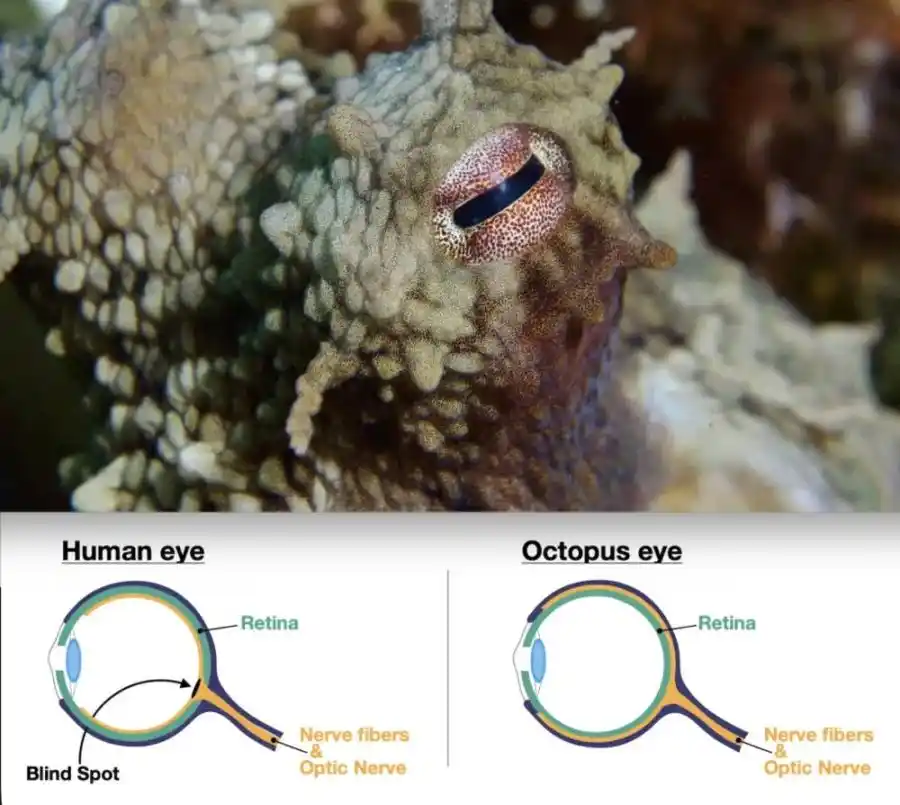
Comparison of octopus and human eye structure | Image source: OctoNation

But octopuses are mollusks, and humans are vertebrates. Their common ancestor lived over 500 million years ago, a time when there were no complex visual organs on Earth. Two completely independent evolutionary paths arrived at almost the same endpoint. Because to efficiently convert light into a clear image, the path allowed by physical laws is almost only the camera type: a lens that can focus, a light-sensitive surface to capture the image, and an aperture to regulate light intake—all indispensable.

The relationship between autoDream and human brain sleep might be of this kind—under similar constraints, the two types of systems may converge to similar structures.

The necessity to go offline is one of their most similar common points.

autoDream cannot run while the user is working. It starts independently as a forked subprocess, completely isolated from the main thread, with strictly limited tool permissions.

The human brain faces the same problem and offers a more radical solution: moving memories from the hippocampus (temporary storage) to the neocortex (long-term storage) requires a set of brainwave rhythms that only appear during sleep.

The most critical among these are the hippocampal sharp-wave ripples, responsible for packaging the day's encoded memory fragments and sending them piece by piece to the cerebral cortex; the slow oscillations of the cortex and the spindle waves from the thalamus provide precise timing coordination for the entire process.

This set of rhythms cannot form in a waking state; external stimuli disrupt it. So you don't sleep because you are tired; rather, the brain must close the front door to open the back door.

Or put another way, within the same time window, information intake and structural organization compete for resources; they are not complementary.
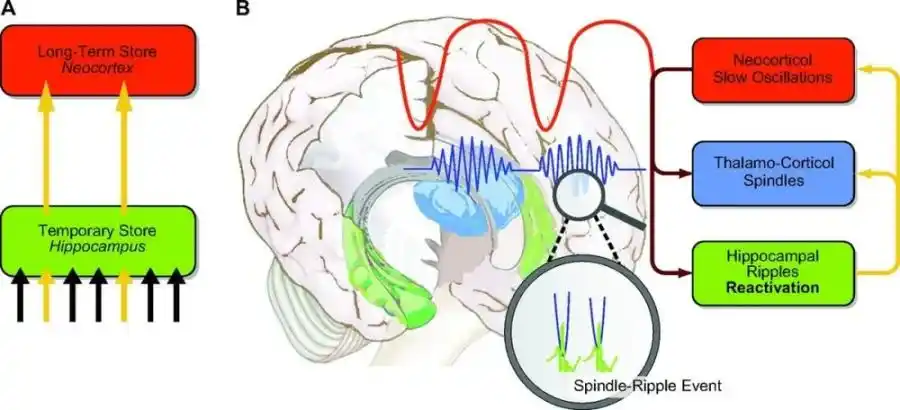
Active systems consolidation model during sleep. A (Data Migration): During deep sleep (slow-wave sleep), memories recently written to the 'hippocampus' (temporary storage) are repeatedly replayed, gradually transferred, and consolidated into the 'neocortex' (long-term storage). B (Transmission Protocol): This data transfer process relies on highly synchronized 'dialogue' between the two regions. The cerebral cortex emits slow brainwaves (red line) as the master rhythm. Driven by the wave peaks, the hippocampus packages memory fragments into high-frequency signals (green line, sharp-wave ripples), perfectly synchronized with the carrier waves (blue line, spindle waves) emitted by the thalamus. This is like embedding high-frequency memory data precisely into the gaps of the transmission channel, ensuring information is synchronously uploaded to the cerebral cortex. | Image source: National Library of Medicine (United States)

Another similarity is not making full memories, but editing them.

After starting, autoDream does not keep all logs. It first reads existing memories to confirm known information, then scans KAIROS's daily log, focusing on processing parts that deviate from previous cognition: memories that contradict what was said yesterday, or are more complex than previously thought, are prioritized for recording.

The organized memories are stored in a three-layer index: a lightweight pointer layer is always loaded, topic files are loaded on demand, and the full history is never loaded directly. Facts that can be directly looked up from the project code (like which file a function is defined in) are not written into memory at all.

The human brain does almost the same thing during sleep.

A study by Harvard Medical School lecturer Erin J. Wamsley showed that sleep preferentially consolidates unusual information, such as things that surprised you, caused emotional波动, or are related to unsolved problems. Large amounts of repetitive, featureless daily details are discarded, leaving only abstract patterns—you might not remember exactly what you saw on your way to work yesterday, but you clearly remember how to get there.

Interestingly, there is one point where the two systems made different choices. The memories produced by autoDream are explicitly labeled as "hint" rather than "truth" in the code. The agent must re-verify their validity before each use because it knows its organized content might be inaccurate.

The human brain lacks this mechanism. This is why eyewitnesses in court often give wrong testimony. They are not intentionally lying; it's because memory is temporarily pieced together from scattered fragments in the brain, and errors are the norm.

Evolution probably found no need to install an uncertainty tag for the human brain. In a primitive environment requiring quick physical reactions, believing memory enables immediate action, while doubting memory leads to hesitation—and hesitation means defeat.

But for an AI that repeatedly makes knowledge-based decisions, the cost of verification is low, while blind confidence is dangerous.

Two different contexts lead to two different answers.

Smarter Laziness

In evolutionary biology, convergent evolution means two independent lineages, without directly exchanging information, arrive at the same endpoint. There is no plagiarism in nature, but engineers can read papers.

When Anthropic designed this sleep mechanism, was it because they hit the same physical wall as the human brain, or did they reference neuroscience from the start?

The leaked code contains no citations of neuroscience literature; the name "autoDream" seems more like a programmer's joke. A stronger driver was likely the engineering constraints themselves: the context has a hard limit, long-term operation leads to noise accumulation, and online organization would pollute the main thread's reasoning. They were solving an engineering problem; biomimicry was never the goal.

What truly determined the shape of the answer was the compressive force of the constraints themselves.

Over the past two years, the AI industry's definition of "stronger intelligence" has almost always pointed in the same direction—larger models, longer context, faster reasoning, 7×24 uninterrupted operation. The direction is always "more."

The existence of autoDream suggests a different proposition: a smarter agent might be a lazier one.

An agent that never stops to organize itself will not become smarter; it will only become more chaotic.

The human brain, through hundreds of millions of years of evolution, arrived at a seemingly clumsy conclusion: intelligence must have rhythm. Wakefulness is for perceiving the world; sleep is for understanding it. When an AI company, in solving an engineering problem, independently arrives at the same conclusion, this perhaps hints at something:

Intelligence has some unavoidable basic overhead.

Perhaps, an AI that never sleeps is not a stronger AI. It is merely an AI that has not yet realized it needs to sleep.


Related Questions

QWhat is the main reason AI systems like Claude Code might need a 'sleep' mechanism similar to humans?

AAI systems need a 'sleep' mechanism to prevent 'context corruption,' where continuous operation leads to information overload, causing the model to forget early instructions, become inconsistent, and generate false information, due to the physical limits of their context window.

QHow does the human brain's memory consolidation during sleep compare to the AI's autoDream system?

ABoth systems offline to transfer information from temporary storage (human hippocampus or AI's daily logs) to long-term storage (human neocortex or AI's indexed memory), prioritizing unusual or conflicting information for consolidation while discarding redundant details.

QWhat is 'convergent evolution' as mentioned in the article, and how does it relate to AI and human sleep patterns?

AConvergent evolution refers to unrelated species developing similar solutions to similar environmental pressures. Similarly, AI (like Anthropic's autoDream) and human brains independently evolved offline 'sleep' mechanisms to manage limited processing capacity and infinite historical data expansion.

QWhy does the AI's autoDream label its consolidated memories as 'hints' rather than 'truth,' and how the human brain handles memories?

AAI labels memories as 'hints' to enforce verification before use, avoiding overconfidence in potentially inaccurate consolidated data. Human brains lack this mechanism, often leading to false memories, as evolution prioritized quick action over accuracy in primitive environments.

QWhat does the existence of autoDream suggest about the future direction of AI intelligence development?

AIt suggests that smarter AI may not be about continuous operation ('more'), but about rhythmic cycles of activity and rest ('laziness'), emphasizing that intelligence has fundamental overheads like periodic consolidation to avoid chaos and improve understanding.

Related Reads

Farewell to Traditional Bulls and Bears: The Market Has Entered an Era of Rotating Bubbles

Farewell to traditional bull and bear markets; we have entered an era of rolling bubbles. This article uses a meteorological analogy to explain the modern market's shift from slow-moving, long-term trends to a chain of rapid, successive speculative frenzies. The old market resembled "stratiform" weather—slow, broad cycles lasting years. Today's market is like a "mesoscale convective system," where isolated storms (bubbles in sectors like AI, GLP-1 drugs, or crypto) form in sequence. Each is triggered by the outflow of capital and sentiment from the previous one, creating a self-perpetuating chain of booms and busts. This structural change is driven by eight permanent shifts: the democratization of speculation (zero-commission trading, retail options activity), perpetual buying from defined-contribution retirement plans, the dominance of passive investing (creating price-insensitive flows), the rise of multi-strategy funds and high-frequency trading (weakening price discovery), suppressed volatility that erupts violently, an index composition now dominated by long-duration, narrative-driven tech stocks, the elimination of information delays, and a permissive fiscal/monetary backdrop. These conditions ensure that rolling bubbles are the new normal. To navigate this environment, investors should either become deep-sector experts who understand the underlying technologies and business models or become adept observers of trends and capital flows. While chaotic from within each "storm," a higher-altitude view reveals a predictable pattern of serial booms. The key is to avoid being emotionally swept up in any single narrative and to recognize the market's new, permanent structure.

marsbit5m ago

Farewell to Traditional Bulls and Bears: The Market Has Entered an Era of Rotating Bubbles

marsbit5m ago

The Right Way to Use Skills: 5 Reflections After Anthropic Publicly Shared Its Internal Methodology

A deep dive into Anthropic's internal methodology for building effective AI "Skills" reveals five key insights for maximizing their value. First, Skills should focus on capturing "Gotchas" and tacit organizational knowledge—like common pitfalls and undocumented rules—rather than restating general information the AI already knows. Second, think of Skills as a form of "Context Engineering"; they are best structured as folders, not monolithic documents. A core `SKILL.md` file should act as a navigational index, progressively pulling in detailed references, examples, and assets only as needed to avoid overwhelming the model's context window. Third, whenever possible, automate repetitive tasks with scripts. This preserves the model's reasoning capacity for judgment and analysis, while scripts reliably handle the execution, saving tokens and improving accuracy. Instructions within a Skill provide the "why" and the expert judgment, while scripts provide the concrete "how." Fourth, a Skill's description is critical and often misunderstood. It should not be a list of features but a routing rule that clearly signals *when* the Skill should be triggered based on user intent and common phrasing. Finally, as Skills scale from personal tools to team-wide assets, management is crucial. Anthropic advocates for a lightweight, organic approach: let new Skills spread organically within small groups first. Those that prove genuinely useful through adoption naturally graduate to a formal marketplace, ensuring the curated library contains only high-value, battle-tested tools.

marsbit22m ago

The Right Way to Use Skills: 5 Reflections After Anthropic Publicly Shared Its Internal Methodology

marsbit22m ago

Vying for the AI Payment Track: Traditional Card Networks Face Off Against Coinbase

As AI agents increasingly conduct commercial transactions, a battle for control over the underlying payment infrastructure is unfolding. The competition centers on two divergent and incompatible technical approaches for autonomous AI payments. One camp, led by traditional card networks Visa and Mastercard, relies on tokenized card credentials within the established banking rails. Visa's "Intelligent Commerce" and Mastercard's "Agent Pay" services extend their existing tokenization technology to authorized AI agents for consumer retail transactions, leveraging decades of fraud protection and dispute resolution systems. Their partners include major AI firms like Anthropic, OpenAI, and Microsoft. The opposing camp, spearheaded by Coinbase, advocates for an open internet protocol using stablecoins. Coinbase's x402 protocol utilizes the HTTP 402 status code to enable direct, machine-to-machine micropayments with USDC on-chain. This model eliminates card fees and is designed for high-frequency, low-value transactions between AI agents, such as paying for API calls or data streams, where traditional card costs are prohibitive. Currently, application scenarios are clearly divided. Mainstream consumer-facing AI shopping services (e.g., ChatGPT's "one-click checkout," Amazon's AI-assisted shopping) predominantly use card channels due to their mature consumer protections and merchant networks. Conversely, the stablecoin channel dominates machine-to-machine payments, as seen in Amazon Bedrock's core payment service using Base blockchain. Significantly, traditional card networks are not solely defending their turf; they are also investing in the stablecoin arena. Visa has rapidly expanded its stablecoin settlement volume and partnered with Coinbase on interoperability, while Mastercard moved to acquire stablecoin platform BVNK. This dual-strategy indicates their intent to become the fee-collecting gateway for all payment flows, regardless of the underlying rail. The short-term outlook is for coexistence: cards for personal retail, stablecoins for machine transactions. The long-term outcome hinges on whether AI-driven commerce will resemble traditional retail or evolve into a vast network of machine micropayments. Visa and Mastercard's hedging strategy suggests they are prepared for either future, while companies betting on a single channel face greater risk.

Foresight News24m ago

Vying for the AI Payment Track: Traditional Card Networks Face Off Against Coinbase

Foresight News24m ago

For the First Time, Pure Human Video Pretrained VLA for Dexterous Manipulation: Deployable with Minimal Fine-Tuning Data

For the first time, a purely human-video-pretrained Vision-Language-Action (VLA) model for dexterous manipulation requires only a small amount of data for fine-tuning to achieve successful real-world deployment. Achieving human-level dexterous manipulation remains a core challenge in robotics. While multi-fingered hands offer hardware potential, Visual-Language-Action (VLA) models lag behind due to the high cost of collecting diverse, high-quality robot data. A novel framework, VITRA, developed by Microsoft Research Asia and Tsinghua University, addresses this by automatically transforming massive, unlabeled real-world human activity videos into a structured V-L-A training dataset. Key innovations include precise 3D hand motion annotation from monocular video, atomic action segmentation based on hand-speed minima, and automated instruction generation using VLMs combined with 3D trajectory visualization. This process created a massive dataset of 1 million clips. Pretrained exclusively on this human video data, the VLA model (combining a VLM backbone with a Diffusion Transformer action expert) demonstrates strong zero-shot hand motion prediction in unseen environments. Crucially, it requires minimal fine-tuning (~1.2k demonstrations) on real robot data to achieve high-success-rate dexterous manipulation tasks like grasping, placing, pouring, and sweeping on hardware like the Realman robot with the XHAND1 dexterous hand. The model shows exceptional generalization to novel objects and environments. The research also observes promising scaling behavior, where performance improves with more pretraining data, paving the way for more generalized embodied intelligence.

marsbit34m ago

For the First Time, Pure Human Video Pretrained VLA for Dexterous Manipulation: Deployable with Minimal Fine-Tuning Data

marsbit34m ago

Trading

Spot
Futures

Hot Articles

Discussions

Welcome to the HTX Community. Here, you can stay informed about the latest platform developments and gain access to professional market insights. Users' opinions on the price of AI (AI) are presented below.

活动图片