AI has solved an 80-year-old mathematical problem: the Erdős plane unit distance conjecture.
One afternoon in May, when Timothy Gowers first heard this news, he thought AI had provided a proof.
If true, "mathematicians might be out of a job soon."
He spent the whole night readjusting his worldview.
The next morning, a clarifying email arrived: AI had not proven the conjecture; it had refuted it.
Gowers actually felt "relieved."
Why did finding a counterexample make Gowers feel more at ease than proving a theorem?
On August 12th, his blog post provided an answer.
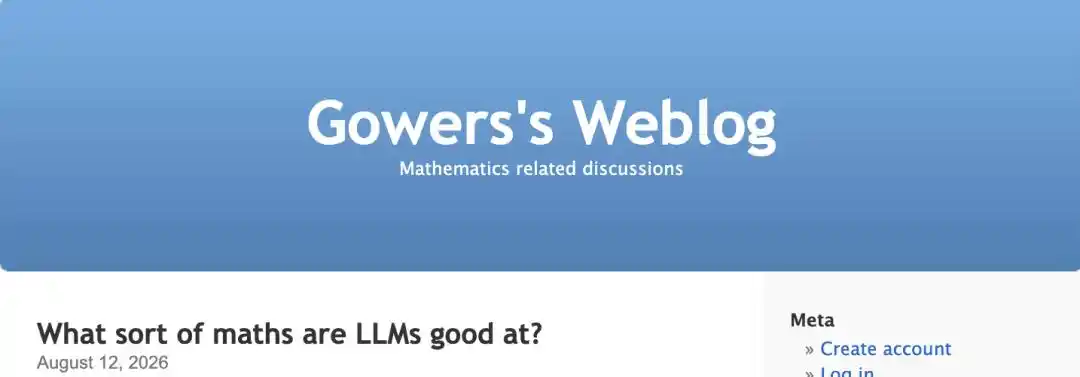
It all started on August 1st.
That day, OpenAI dropped ten research achievements in mathematics and theoretical computer science all at once.
In their own words: each one either solves a long-standing open problem or represents a substantial advance on a related problem.
These results came from an unreleased internal version of a model called Astra.
For those few days, social media had only one reaction: this time, it's really different.
As Simon Willison put it, mathematicians online were collectively experiencing a "Deep Blue moment."
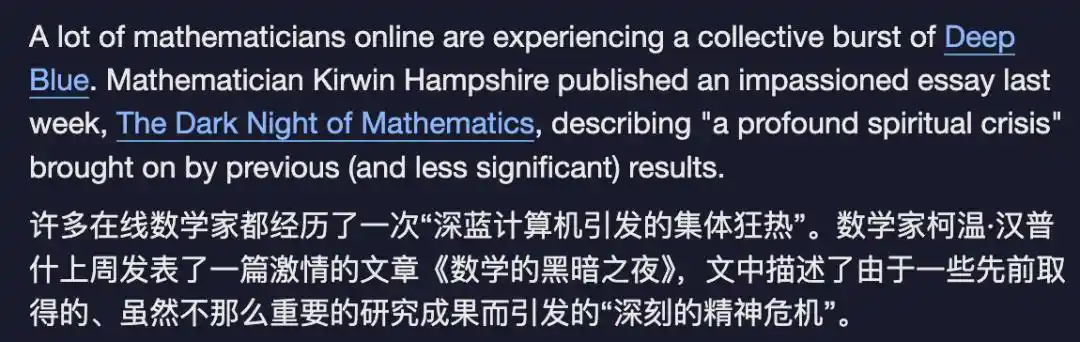
A few days earlier, mathematician Kirwin Hampshire had already written "The Dark Night of Mathematics." What triggered him then were previous, less significant results; he described falling into a profound spiritual crisis.
Gowers first acknowledged that these ten results were extremely impressive, then posed a question:
If large models were already stronger than all humans in all aspects of mathematics, given their speed advantage, results should have flooded out like a deluge.
Why hasn't the deluge arrived?
Two mathematicians immediately wrote papers based on these results
In the 11 days following OpenAI's ten results, two papers appeared on arXiv.
On August 3rd, Cambridge group theorist Francesco Fournier-Facio posted one first.
He took the crucial criterion from OpenAI's proof, bypassed the Leavitt algebra used in the original method, and created from scratch a version that the original method couldn't produce: a torsion-free non-sofic group.
On August 11th, Raphael Steiner modified OpenAI's recursive construction for multicolor Ramsey numbers, generalizing it to all fixed odd cycles.
The fact that people could write follow-up papers based on Astra's research results shows that it provided a method capable of generating new things.
Fournier-Facio also said that from the Kun–Thom result, there are countless possible directions to push forward, many of which simply aren't valid, and many others, even if valid, would be useless.
The specific direction OpenAI chose, most experts familiar with this area could probably prove. The difficulty was thinking, among countless possibilities, to try this particular one.
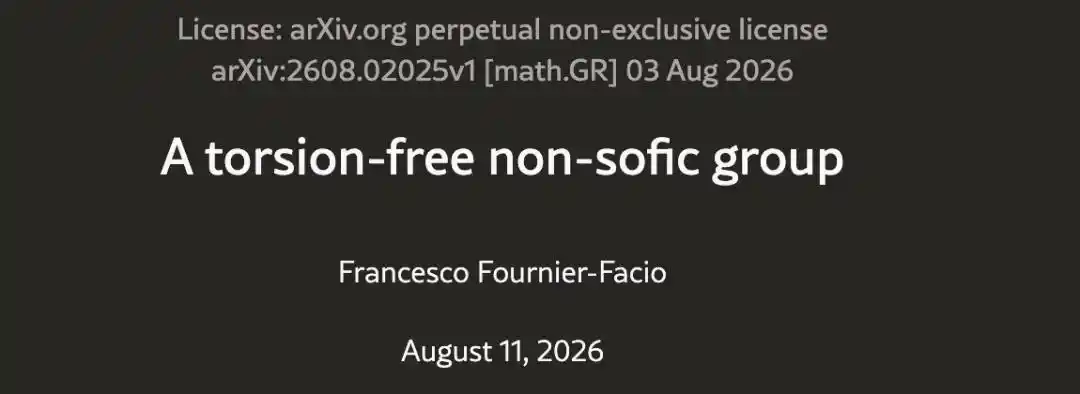
In his paper, Fournier-Facio judged that OpenAI's novelty lay in stating that proposition, not in the proof technique.
He gave a vivid metaphor:
AI is unrestricted by time and resources, so it can keep throwing things at the wall to see what sticks.
Counterexamples and theorems are not two different abilities at all
In a mathematician's intuition, finding a counterexample is a matter of luck.
You just need to cobble together a special case, punch a hole in the conjecture, and the proposition falls. Proving a theorem is hard work; you must guarantee there are no exceptions, and you need those insights that only dawn after much thought.
So it's acceptable if AI is good at finding counterexamples. If AI were good at proving theorems, that would truly signal a changing of the guard.
But what Gowers wants to say is that this line simply doesn't hold. Finding counterexamples and proving theorems are not two different abilities at all.
He first acknowledges that AI's most significant results to date are indeed concentrated on counterexamples.
The unit distance conjecture, the Jacobian conjecture, non-sofic groups, multicolor Ramsey numbers—they all seem to be.
But large models can also prove difficult universal propositions; it's just that those theorems haven't reached the significance of these counterexamples yet.
Then, he presents two results.
Vinogradov proved in 1937: Any sufficiently large integer can be written as the sum of three primes.
Gluskin proved in 1981: In any dimension, there exist two "shapes" of spaces that are extremely far apart.
Translating these two statements into the format mathematicians use for papers, their skeletons are almost identical. Yet no one would say Vinogradov found a counterexample, nor would they say Gluskin proved a theorem.
The difference lies in where the difficult step lands.
Vinogradov's entire effort lies in making three primes add up to exactly the specified number. For Gluskin, constructing two spaces of a specified dimension isn't difficult at all; the difficulty is making them sufficiently far apart.
The same skeleton, different points of difficulty—one becomes a theorem, the other becomes an example.
There's an even subtler layer. The word "counterexample" carries a psychological component. Only when it overturns a proposition that people originally had good reason to believe does it deserve to be called a counterexample.
Non-sofic groups don't count. According to Gowers and Fournier-Facio, the literature already had several construction ideas; few experts really believed all groups were sofic. Therefore, more accurately, OpenAI provided the first explicit instance of a non-sofic group.
Regarding the multicolor Ramsey result, Gowers has more authority. He studied an equivalent form in his youth, and the direction he worked on back then turned out to be the correct one later proven. For him personally, that was an expected example, not a counterexample.
The same result is a counterexample for those who originally believed the conjecture, but just an example for him.
This shows the line follows the person, not the mathematics.
Since counterexamples and theorems are inseparable, AI's strengths and weaknesses in mathematics cannot be drawn along proposition types.
Then, how should they be divided?
Eight methods for finding examples, AI is only good at four
The division is not in proposition type, but in how to search.
Gowers lists eight conventional tactics mathematicians use to find examples:
Go through standard examples on hand and try them one by one.
Assemble from basic examples.
Leave blanks first, then fill in conditions later.
Prove by contradiction that it cannot exist.
Repeatedly revise guesses from the previous version.
Construct step by step according to conditions.
Randomly pick one.
Take a sufficiently generic example.
He judges that large models will be very strong at four of these: trying existing examples, building step by step, random picking, and taking generic examples.
These four share common traits: mature patterns, dense instances in training data, and low cost of failure. As long as the model keeps trying one by one, it will eventually hit upon one.
The other three are different. Leaving blanks and filling later, proving impossibility by contradiction, and repeatedly revising guesses—all three require you to repeatedly judge the same thing mid-process: is the path I'm on now still worth pursuing?
Gowers's explanation is easy to understand.
Large models have two undeniable advantages: First, their knowledge is so broad it almost covers all standard arguments. Second, they are fast, capable of failing countless times before finding a solution.
Together, these create a style completely different from humans: the heavier the luck component of a problem, the more superior it is.
The territory humans can still hold onto is problems with particularly many and deep branches.
Mathematicians call this a search tree.
With each step down, a dozen more branches fork out beneath your feet, widening as you go deeper. You can't travel them all; you must judge midway which ones are根本 worth going down at all and prune them directly.
This action is called pruning. Without pruning, relying on computational power alone, you wouldn't reach the bottom by dawn.
One piece of evidence comes from the collective reaction of experts.
Gowers noticed that everyone's说法 was highly consistent: initially shocked that this problem was solved, but upon closer look, the method wasn't actually that novel; a suitable expert, given a hint, could have found it too.
This isn't belittling AI's discovery; it's giving it a more accurate portrait:
Its advantage lies not in being smarter than humans, but in its ability to "afford to fail."
For the same problem, humans can only try a few paths; it can try hundreds.
Why can't large models develop this sense of smell?
The first reason: the training data simply doesn't include this lesson.
Published proofs are all "clean finished products": which directions the discoverer tried, at which step they thought something was wrong, why they turned back—all erased.
The model sees conclusions, not the process.
Actually, humans aren't formally taught this either. The difference is that mathematicians develop this skill through their own process of getting stuck, going wrong, and turning back. Models can only learn from the curated finished products of others.
The second reason is more counterintuitive: Speed itself is a hindrance.
Humans must prune aggressively because a lifetime is only enough for a few paths.
Large models have speed and breadth of knowledge, able to withstand inefficient searches that humans completely cannot afford. Since they aren't lacking, there's no compelling pressure to prune.
Gowers states plainly: Large models' success today might be using methods humans consider extremely inefficient, but the branches just haven't multiplied enough to overwhelm them yet.
Third, this is hard to experiment on. An idea that seems to come only from deep thought could also just be recalling the deep thought of some human mathematician from the literature.
Gowers's own user experience is also written into the long piece.
Discussing open problems with 5.6 Pro often yields promising-sounding solutions that, upon细想, don't quite work. It also often ends with this line: I couldn't answer your question, but I've reduced it to a narrower, more precise problem.
After five times in a row, no progress is discernible.
Interestingly, another Fields Medalist is saying the same thing.
On July 24th, Terence Tao gave a public lecture at the International Congress of Mathematicians titled "Mathematics in the Age of AI."
He吐槽 that AI-generated mathematics is torturous to read: the emphasis is completely misplaced, capable of spending three pages proving an obvious lemma, then glossing over the truly interesting step in three lines.
Humans don't write proofs like that. Simple parts are passed over briefly; difficult parts pause, carefully organized, minimizing wasted effort. Readers rely on this rhythm to infer where the difficulty lies.
Tao gave it a name: natural friction.
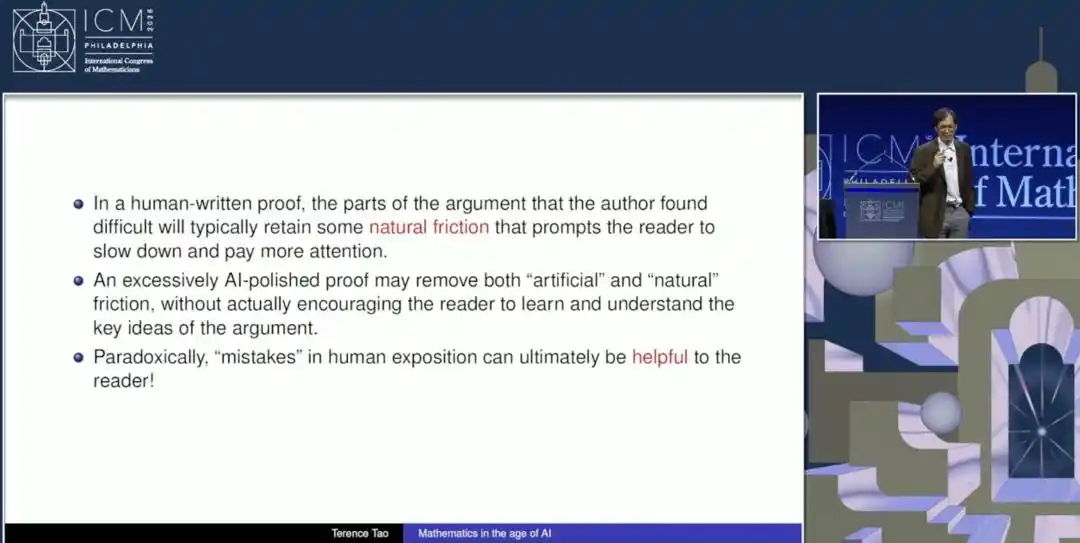
Screenshot from Terence Tao's ICM 2026 lecture: Human-written proofs leave "natural friction" at difficult points, reminding readers to slow down; AI-polished proofs grind it away along with the rest.
AI speeds over both easy and difficult parts uniformly, making everything look the same.
He shared his own example.
As a graduate student grappling with Bourgain's 1991 paper, the margins still bear his annotation from back then: I hate Jean Bourgain.
After struggling through it, he反而 understood the other's way of thinking and later preferred reading his papers.
He said if that proof had been polished by multiple layers of AI, he might not have gotten that training.
The information of "which step is difficult" has never been formally recorded in the tradition of human mathematical writing, so models cannot learn it.
And what AI writes out further grinds away even these remaining traces.
This becomes a vicious cycle: models can't learn judgment, and what they write makes it even harder for the next generation of models to learn it.
Gowers's prescription lands on the model's reward function.
During training, you can't just reward it when it gets the solution; you must also penalize it for two things: exploring too many dead ends, and directly翻ing for ready-made answers in the literature.
Rewarding only results yields only results without process.
This holds true for training, and also for the mathematical community.
What counts as crossing the threshold?
Gowers offers a yardstick that's hardest to fudge.
He cites the cap-set problem from 2016.
This problem asks: In a high-dimensional grid over three elements (ternary), what is the maximum number of points you can select such that no three form an arithmetic progression? For decades, the bounds were only nudged down bit by bit.
That year, a new solution emerged,甩开 the previous best bound by a wide margin, using an approach unlike any he had imagined.
Yet in hindsight, the method clearly should have been done that way; no one had thought of it before.
Immediately, a large group of people rushed in, wanting to understand what else this new technique could do.
A truly good method doesn't just solve the immediate problem; it makes a whole group of people immediately change their current work.
The day a model produces something of equivalent weight on its own, that's when he'll consider the threshold crossed.
This article is from the WeChat public account "新智元" (New Zhiyuan), author: ASI启示录