Published every Monday to Friday morning, focusing on macroeconomics, U.S. stocks, AI, precious metals, crude oil, and other directions. We review the market with data and seize opportunities with trends, produced by PANews.
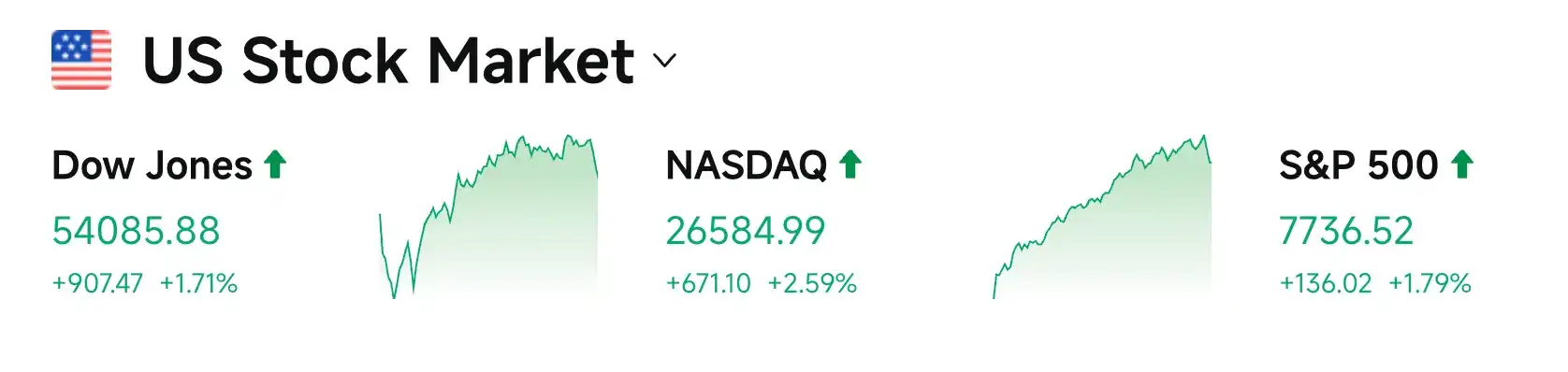
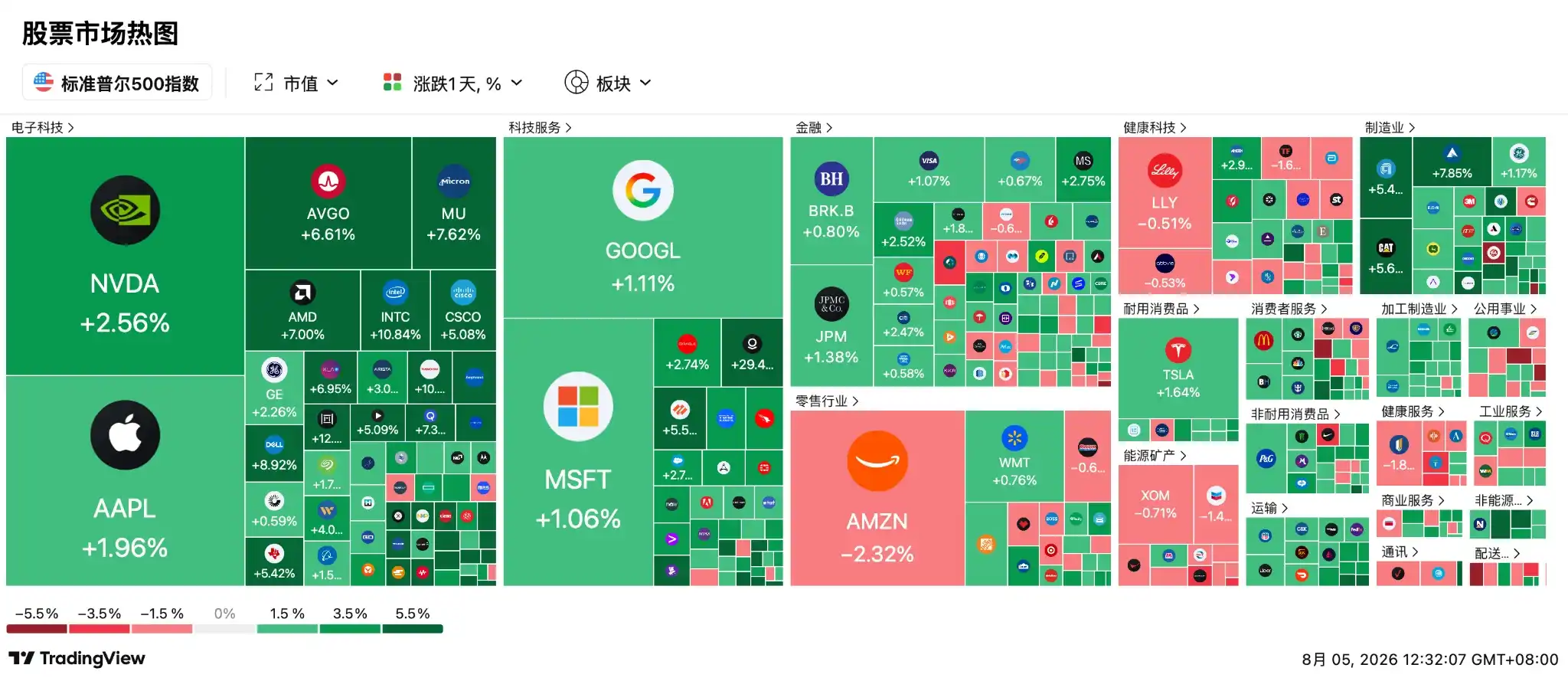
U.S. stocks soared across the board last night, driven by robust corporate earnings and geopolitical optimism. The Dow Jones Industrial Average surged 1.71%, breaking above 54,000 points for the first time and hitting a record closing high. The S&P 500 index rose 1.79%, also setting a new record. The Nasdaq Composite jumped 2.59%, led by the tech sector. Market sentiment swiftly shifted from recent volatility to a chase for gains, rallying from a near one-month low to new highs in just a few trading sessions.
Strait of Hormuz Agreement Nears Finalization, Oil Prices Fall for 3rd Straight Day
The most watched macroeconomic event is signs of easing tensions in the Strait of Hormuz. According to Axios, the U.S., Iran, and Oman are close to reaching an interim agreement, aiming for a formal announcement on Wednesday local time. The agreement aims to reopen the Strait of Hormuz, restore the U.S.-Iran ceasefire, and create conditions for subsequent nuclear talks. Influenced by this geopolitical positive development, concerns about energy supply disruptions eased, and international oil prices plunged sharply. WTI crude fell 5.58% yesterday, down 13.27% in August, currently fluctuating around $73.5; Brent crude broke below $80, hitting a low of $77.7, down about 12% this month.
The arrangement is tentatively set for 60 days and may be extended in the future. According to the currently discussed plan, all inbound vessels will use the northern shipping lane near the Iranian coast, and outbound vessels will use the southern lane near the Omani coast, coordinated jointly by Oman and Iran.
The agreement also includes a crucial component: parties plan to complete mine-clearing operations in the central channel of the Strait of Hormuz within 30 days. According to Bloomberg, Iran's stance has softened, now for the first time considering allowing European countries to participate in mine-clearing, in exchange for trust from shipping companies and insurers. No passage fees or related charges will be levied during the 60-day interim arrangement. In the long term, Oman proposes referencing the Strait of Malacca model, establishing a "voluntary fund" jointly financed by Gulf states and European member states of the International Maritime Organization (IMO) for channel maintenance, search and rescue, and security. Besides Oman, Qatar, Pakistan, and Saudi Arabia have also participated in mediation.
Despite rapid progress, the agreement still faces multiple uncertainties. Hardliners within Iran's Revolutionary Guards still have disagreements over foreign participation in mine-clearing and channel control rights, and there are precedents of agreements collapsing leading to escalated military conflict.
Falling Oil Prices Ease Inflation Concerns, September Rate Hike Probability Declines
The sharp drop in oil prices significantly eased inflation concerns. The 10-year U.S. Treasury yield fell about 6 basis points to near 4.6%, providing additional support for risk assets. Institutions like Wells Fargo noted that lower oil prices help moderate energy price pressures, but overall price stickiness persists, and inflation is unlikely to normalize overnight.
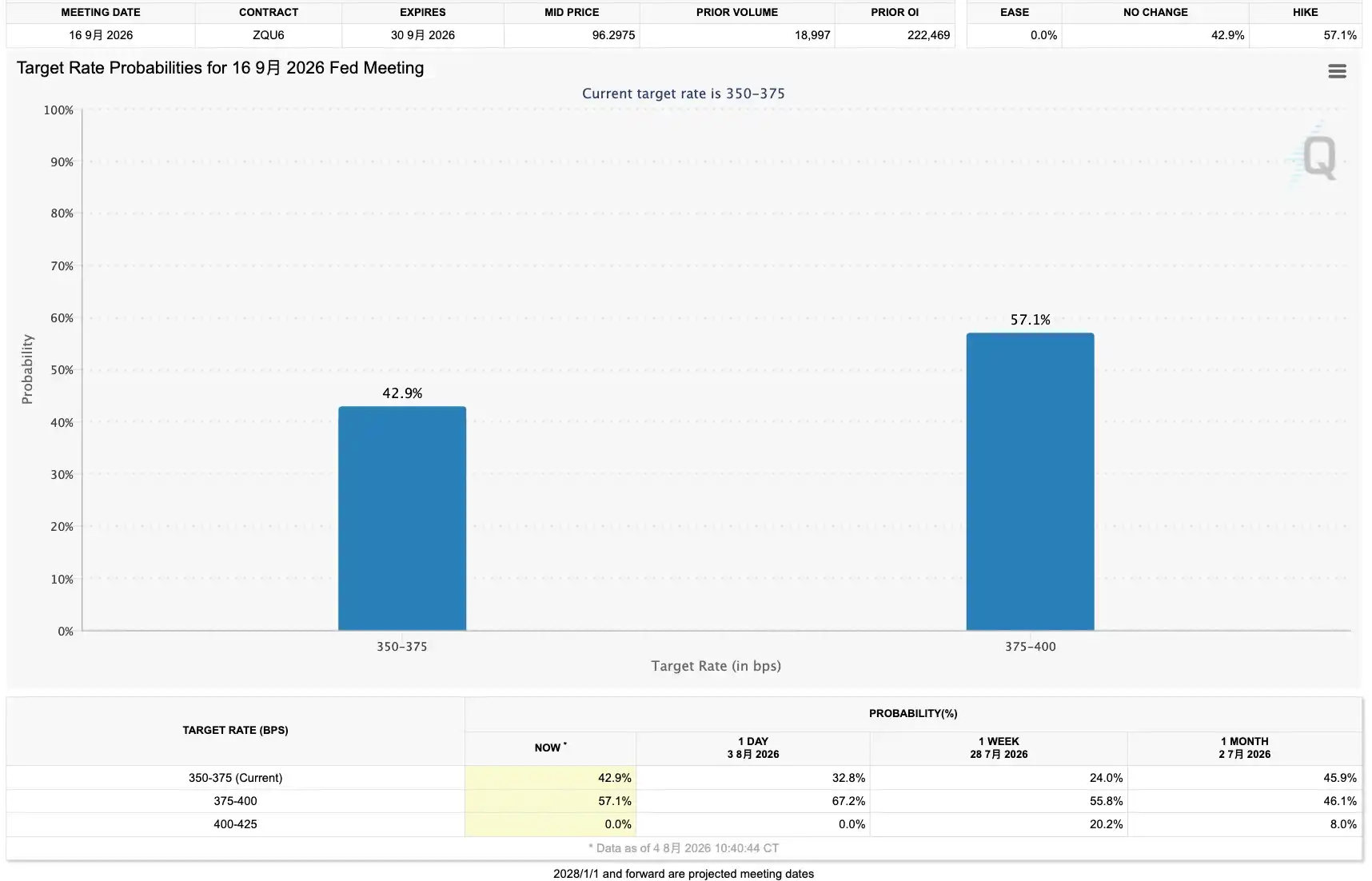
The U.S. dollar weakened slightly, and the yen's rally stalled. Regarding interest rates and institutional views, the CME FedWatch Tool shows that the probability of a 25 basis point rate hike in September is about 57.1%, down sharply from 67.2% the previous day, while the probability of holding steady is 42.9%. The market is closely watching this Friday's non-farm payrolls report. Strong data could reinforce rate hike expectations, while weak data could increase room for inaction. Institutions like JPMorgan believe that in a context where oil prices dominate Treasury movements, employment data will become a key short-term pricing node.
AI Trading Makes a Comeback, Funds Believe in the 'Computing Power-Application-Infrastructure' Loop Again
The strongest sector in U.S. stocks last night was still AI. Unlike previous rallies solely reliant on chip stocks, this AI market move is more comprehensive: Palantir used strong earnings to prove AI applications can drive revenue growth; semiconductor, memory, and optical communication sectors reflect rising computing power demand; Caterpillar shows data center construction demand is trickling down to traditional industrial equipment.
The Philadelphia Semiconductor Index surged 6.55%, rising for the fourth consecutive day, with 30 component stocks broadly higher. Memory chips, optical communication, AI software, data center infrastructure, and industrial equipment sectors performed notably well. The Nasdaq 100 index rose about 3.3% in a single day, its largest single-day gain since May 2025.
Major tech stocks were also generally stronger. Nvidia rose over 2%, Apple, Microsoft, and Tesla rose over 1%, Google rose 1.11%, but Amazon fell over 2%. Over the past four trading days, the "Magnificent Seven" tech giants have collectively risen nearly 10%, indicating funds are flowing back into large-cap growth stocks.
Peter Callahan, Goldman Sachs' chief tech trader, believes this rally stems from four factors: the market has already undergone a round of de-risking earlier, leaving cleaner positioning; technicals have improved; the Nasdaq 100 valuation is still at about a 10% discount to its five-year average; the earnings season has improved investor confidence in profits.
However, Goldman's trading desk also cautioned that market trading volume is about 7% below the 5-day average, indicating not exceptionally high activity. This means that while the index rally is strong, not all funds have fully returned yet. Future moves still depend on whether earnings and macro data can continue to support the uptrend.
Specific Company Actions and Stock Price Movements:
-
Palantir closed up 29.45%, strongly breaking above its 200-day moving average: The company's Q2 revenue soared 93% year-over-year to $1.935 billion, with U.S. commercial revenue surging 149%. CEO Alex Karp called this a "supernatural" quarter and stated that demand for AI sovereignty is being unleashed. Related AI software stocks also rose, Datadog and Shopify rose over 5%, ServiceNow and Applovin rose over 3%, Adobe and Salesforce rose over 2%.
-
Caterpillar surged over 5%, hitting a record high: This heavy equipment giant's Q2 sales broke the $20 billion mark for the first time (up 24% year-over-year) and it comprehensively raised its full-year guidance. Wells Fargo strategist Ohsung Kwon pointed out that Caterpillar is "the most traditional stock close to the AI concept," and the spillover benefits from data center construction have just begun. The industrial sector has performed strongly this year, rising about 20%.
-
SpaceX closed up 9.43%, after-hours fell nearly 9% due to high capex concerns: Yesterday, Musk confirmed AI services will exclusively adopt Nvidia architecture and set sights on the U.S. telecom market. Space-related stocks rose broadly, Rocket Lab rose nearly 6% (won a $397 million contract from the U.S. Space Force), AST SpaceMobile rose nearly 11%. The after-hours Q2 earnings report showed revenue of $7.8 billion, up 92% year-over-year, EBITDA surged, but AI-related capital expenditures reached $15.8 billion, expected to remain high in subsequent quarters.
-
AMD closed up 7%, after-hours fell nearly 8%: CEO Lisa Su expects data center sales to double by 2027 and announced collaborations with Anthropic and others. Semiconductor sector surged, ARM surged 17.36%, Marvell Technology rose nearly 13%, Intel rose nearly 11%, Qualcomm rose 7.23%, Broadcom rose nearly 7%, TSMC rose over 2%. After-hours Q2 earnings showed revenue of $11.54 billion, up 50% year-over-year, beating expectations, but Q3 revenue guidance didn't completely "wow" the market.
-
Nvidia closed up 2.56%: Nvidia CEO Jensen Huang announced the official open-source commercial release of Alpamayo 2 Super, Nvidia's open-source inference model for autonomous driving, aiming to advance applications like robotaxis, robots, and logistics vehicles. Concurrently, SpaceX stated future AI services will be "exclusively" based on Nvidia systems and plans to deploy Nvidia Vera Rubin NVL72 rack-scale systems on the ground and in space.
-
Micron Technology closed up 7.62%, market cap returned to the $1 trillion club: Bank of America reiterated a Buy rating and a $1,550 target price, viewing the recent pullback as an "excellent buying opportunity," and expects memory chip prices to normalize in 2027-2028. Memory sector rose across the board, SanDisk rose 10.84% (jointly released the first standard specification for High Bandwidth Flash HBF with SK Hynix), Rambus rose over 9%, SK Hynix rose over 8%, Western Digital rose over 4%.
-
Intel closed up 10.84%: Media reports indicated Intel's EMIB-T advanced packaging technology has made progress, with packaging yields nearing 90% and costs about 50% lower than TSMC's CoWoS solution. Intel expects to offer this packaging service at scale by 2027, while continuing to advance construction of its large Ohio wafer fab campus, targeting full operation by 2031.
-
Oracle closed up 2.74%: However, its stock price has been halved since June, its five-year credit default swap spread has surged to a historical high exceeding the peak of the 2008 financial crisis. Due to aggressive borrowing to fund AI data center construction, its current debt stands at $129.5 billion. S&P Global has downgraded its credit rating to BBB-, just one notch above "junk" grade. Moody's warned its leverage ratio may approach 5x, and the market is deeply concerned about the mismatch risk between its 15-year long-term leases and short-term AI contracts.
-
Bitdeer surged 23% intraday before closing up 0.09%: Bitdeer signed a 16-year data center hosting and services agreement with Norwegian cloud startup Volta Infra for deploying Nvidia GPUs and serving leading AI labs. Concurrently, Anthropic was reported to have reached a $100 billion, six-year computing power agreement with Volta.
-
Arista Networks (ANET) closed up 3.04%, after-hours surged 12.5%: Supported by AI networking demand, Q2 revenue slightly exceeded $3 billion, up 37.7% year-over-year, and the company raised its 2026 guidance for the third time, expecting full-year revenue of $12.6 billion, an annual growth rate of about 40%.
-
Apple rose nearly 2%: Apple has begun preparations for its September launch event, with U.S. retail employees able to apply for on-site work. The event is expected in the first half of September. Separately, Apple reportedly requested a judge to immediately ban OpenAI from using its trade secrets and demanded OpenAI return all confidential information.
Upcoming Focus:
August 5th Major Earnings: Circle, Uber, Eli Lilly, BeiGene, etc.
August 6th (Thursday)
-
SpaceX Lock-up Expiration: Up to 911.5 million restricted shares of SpaceX will be unlocked, with a potential value nearing $100 billion based on the latest stock price, representing the week's biggest liquidity pressure test. If selling pressure is limited post-expiration, it will boost market confidence in the capacity to absorb high-valuation tech assets; if concentrated selling emerges, it could dampen sentiment for the Nasdaq and Musk-related assets.
-
05:00 SanDisk, Western Digital After-Hours Earnings: Will directly influence sentiment in the memory sector. Following recent consecutive pullbacks in Micron, SanDisk, and SK Hynix, the market will closely focus on enterprise SSD, NAND prices, AI data center storage demand, inventory cycles, and H2 guidance.