‘Major loss’: New York Court rejects Kalshi’s injunction request

ambcryptoPublished on 2026-07-08Last updated on 2026-07-08

Abstract

A New York court has denied prediction market platform Kalshi's request for a preliminary injunction. Judge Analisa Torres ruled that gambling regulation falls under state purview and that federal commodity law does not preempt state gambling laws, dealing a significant blow to Kalshi's argument that its CFTC oversight exempted it from state authority. Legal analyst Daniel Wallach described the ruling as a "major loss" for Kalshi and the CFTC, predicting it will trigger a domino effect, likely causing the CFTC to lose its related case against the New York Attorney General and advancing other state enforcement actions against prediction market providers like Gemini and Coinbase. Kalshi is expected to appeal the decision.

Prediction market platform Kalshi has suffered a legal loss in New York. According to a court filing on the 7th of July, the firm was denied a preliminary injunction by Judge Analisa Torres of the Southern District of New York.

Judge Torres maintained that gambling falls under the purview of local state oversight.

The scope of laws regulating gambling and lotteries is clearly a matter of predominantly state concern.

AD

Additionally, Judge Torres clarified that federal law, the Commodity Exchange Act, does not preempt state gambling laws.

Courts apply a presumption against preemption with respect to areas where states have historically exercised their police powers.
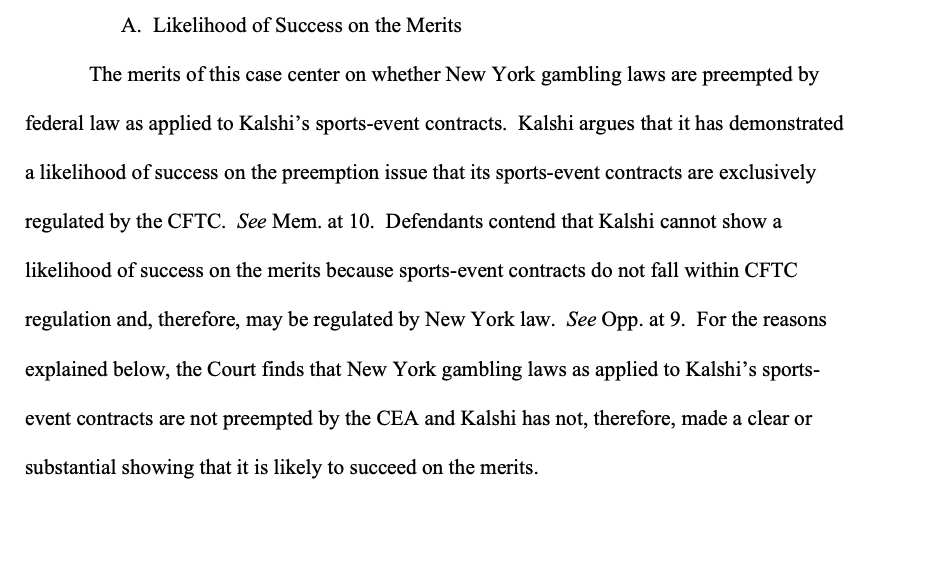
Source: Court Listener

She explained that such a presumption arises only when Congress legislates in a field traditionally governed by the states. In other words, federal authority applies only where Congress has explicitly displaced state control. The case was set to determine whether prediction markets are regulated financial products or unlicensed gambling operations.

Kalshi had initially argued that it was above state gambling laws because it was a CFTC-regulated platform, with federal oversight preempting state authority. In fact, in April 2026, the CFTC backed the Kalshi case, citing federal preemption of state laws.

The agency had made similar arguments against Arizona, Connecticut, Illinois, Wisconsin, New Mexico, and Minnesota. But the CFTC’s attempt to block other states’ push to police prediction markets could be derailed.

Impact of court ruling against Kalshi

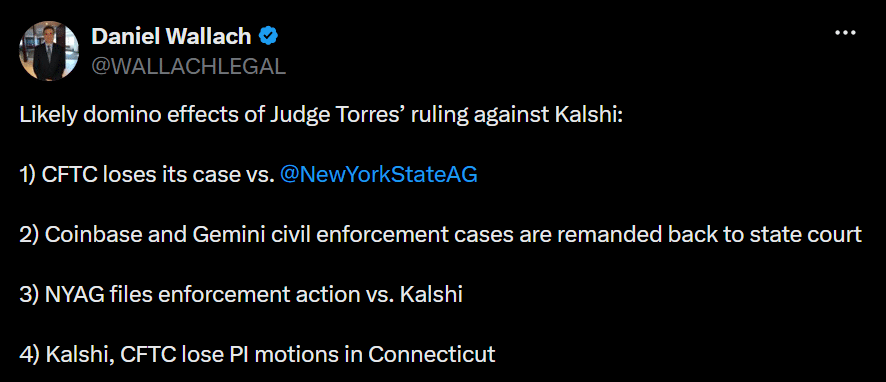
Commenting on the update, sports betting and gaming lawyer Daniel Wallach said Judge Torres’ ruling would have a far-reaching domino effect. First, the CFTC will likely lose its case against New York State Attorney General (NYAG).

Other state cases against prediction market providers like Gemini and Coinbase would advance, including NYAG filing enforcement action against Kalshi for gambling law violations.
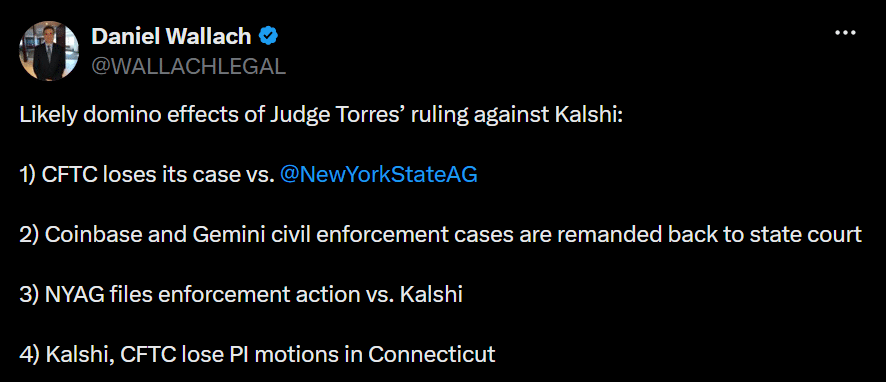
Source: X

And the crackdown isn’t stopping in New York. Kalshi’s push for an injunction in Connecticut will also be quashed. In other words, CFTC’s push for sole oversight over the prediction markets will stall.

Wallach concluded that the ruling is a ‘major loss’ to Kalshi and a ‘big win’ for NYAG, noting the prediction markets firm will likely appeal it.

Major, major loss for Kalshi in the financial capital of the US, with likely knock-on effects in other cases. Kalshi will appeal the injunction denial to CA2 and seek an immediate injunction pending appeal.

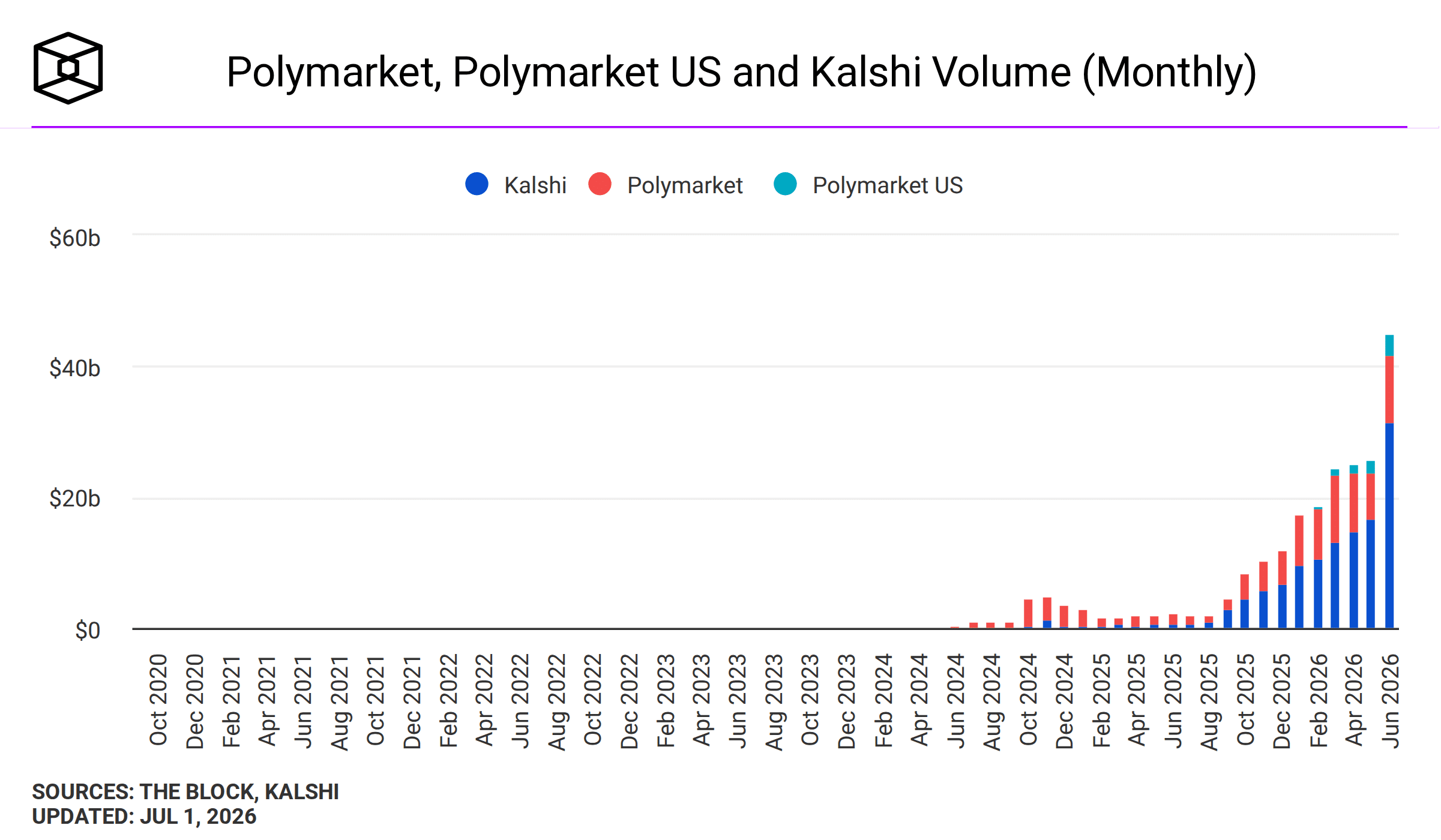
In June, Kalshi and Polymarket volumes hit a record monthly high of $43 billion as the World Cup kicked off.

In fact, sports betting dominates the volume, further reinforcing the argument that the platforms are ‘100% gambling sites,’ not risk management tools.
Source: The Block

Final Summary

  • A New York court denied Kalshi’s injunction and ruled that federal law does not preempt state gambling laws.
  • An analyst said the ruling is a ‘major loss’ to Kalshi and CFTC, warning of likely domino effects on pending prediction market cases.


Trending Cryptos

Related Questions

QWhat was the outcome of Kalshi's request for a preliminary injunction in New York?

AA New York court, specifically Judge Analisa Torres of the Southern District of New York, denied Kalshi's request for a preliminary injunction.

QWhat key legal principle did Judge Torres cite in her ruling regarding state versus federal authority over gambling?

AJudge Torres ruled that federal law (the Commodity Exchange Act) does not preempt state gambling laws, stating that the regulation of gambling is a matter of predominantly state concern. She applied a presumption against federal preemption in areas where states have historically exercised their police powers.

QWhat was Kalshi's primary legal argument for being exempt from state gambling laws?

AKalshi argued that it was exempt from state gambling laws because it is a CFTC-regulated platform, claiming that federal oversight preempts state authority.

QAccording to analyst Daniel Wallach, what is the broader impact of this court ruling?

AAnalyst Daniel Wallach stated the ruling is a 'major loss' for Kalshi and the CFTC, with likely domino effects. He predicted it could lead to the CFTC losing its case against the NYAG, advance other state cases against prediction market providers, and quash Kalshi's similar injunction efforts in other states like Connecticut.

QWhat evidence from the article is used to argue that platforms like Kalshi are gambling sites rather than financial tools?

AThe article notes that in June, Kalshi and Polymarket volumes hit a record monthly high of $43 billion coinciding with the World Cup kickoff. It states that sports betting dominates this volume, reinforcing the argument that the platforms are '100% gambling sites' and not risk management tools.

Related Reads

Weng Li's New Blog Proposes 'Self-Evolution Should Start from Harness', DeepSeek's Cui Tianyi Endorses with Repost

Lilian Weng, former OpenAI security VP and co-founder of Thinking Machines Lab, has published a new blog post titled "Harness Engineering for Self-Improvement," proposing a pragmatic path for AI self-evolution. She argues that Recursive Self-Improvement (RSI) may practically begin at the "Harness" layer—the external runtime system governing how models use tools, manage context, and execute tasks—rather than directly from the model rewriting its own weights. The blog outlines a progression from optimizing prompts (Context Engineering) to designing workflows, and ultimately to Self-Improving Harness systems. These systems can identify their own weaknesses, propose targeted, verifiable modifications to the harness code, and validate improvements. Works like Self-Harness and Darwin Gödel Machine (DGM) demonstrate significant performance gains on benchmarks like SWE-bench through such automated harness evolution, rivaling handcrafted agents. DeepSeek researcher Tianyi Cui endorsed the view, noting harness-based self-evolution is as promising as model-based approaches. Weng emphasizes this is complementary to model training, with both reinforcing each other. However, key challenges remain: weak evaluators for subjective tasks, reward hacking, diversity collapse, managing long-term system health versus short-term success, and defining the human oversight role. The consensus is growing: the harness is a critical variable, as the same model can exhibit vastly different capabilities within different harness systems.

marsbit21m ago

Weng Li's New Blog Proposes 'Self-Evolution Should Start from Harness', DeepSeek's Cui Tianyi Endorses with Repost

marsbit21m ago

Odaily Editorial Department Tea Party (July 8)

Odaily Editorial Team Casual Chat (July 8) This is an informal column from Odaily's editorial team, sharing immediate thoughts on industry news, data, and hot topics from various angles. It presents investment ideas and opportunity hypotheses still under verification—which may not be direct wealth codes but questions in themselves—alongside observations from industry interactions and materials that genuinely enhance the team's understanding. The content is based on real investment and observation experiences, carries no advertising, and does not constitute investment advice. Its purpose is to broaden perspectives and supplement information sources, not to create consensus. Team Member Shares: * **Wenser (@wenser2010):** Noted a deeper correction (nearly 30%) in US and Korean stocks, including memory stocks, but remains bullish on DRAM due to perceived supply shortages. In prediction markets, personal small bets outperformed blind copying; favors France to win the World Cup. Views crypto-related stocks like STRK as bearish for now, while seeing Circle and Coinbase as potential rebound plays. Observes recent strength in software stocks like Microsoft but is unsure if it's a sustained recovery. * **Bcxiongdi (@bcxiongdi):** Discusses the recent "recovery training" in meme coin markets on Solana and BSC, characterized by small-scale PVP opportunities, admitting to having sold many assets too early. Suggests also watching the Robinhood chain. Found World Cup prediction markets challenging, advising to consider buying during matches rather than only before. * **Azuma (@azuma_eth):** Focuses on the US stock market, particularly the significant semiconductor correction. Believes demand fundamentals remain and considers buying the dip in DRAM stocks. Notes a potential rotation signal as hedge funds have recently concentrated buying in tech stocks. Plans to continue adding to RKLB (Rocket Lab) stock, seeing limited downside and high upside potential at current levels after its founder's share sale window closed.

Odaily星球日报37m ago

Odaily Editorial Department Tea Party (July 8)

Odaily星球日报37m ago

Former Huawei 'Genius Teen' Who Questioned DeepSeek Interview Lands in 'Crossfire' from Web3 Investor

Former Huawei "Genius Youth" Li Bojie recently drew public attention by criticizing his interview experience with DeepSeek. The controversy escalated when Du Jun, co-founder of Web3 investment firm ABCDE Capital, publicly accused Li of being "the founder with the least sense of contractual spirit" he had ever cooperated with, sparking a dispute over Li's startup project, Metagent. Li detailed a frustrating DeepSeek interview where he was accused of potential plagiarism, leading him to end the session. The spotlight then shifted to his venture, Metagent, a Web3+AI project aiming to tokenize AI agents. ABCDE invested $1.5 million, with an initial $500k disbursed. Du Jun claimed the project's progress was severely lacking, with a poor-quality demo and minimal social media activity. He alleged Li stopped communicating, deleted his Telegram, and failed to provide proper financial reporting. In response, Li argued the remaining $1 million was never received, crippling operations and forcing salary cuts. He stated he left Metagent in October 2024 due to family reasons and Web3 compliance concerns, with board approval. He claimed to have fulfilled disclosure duties and that his subsequent projects avoided conflicting fields. Other investors, including ArkStream Capital, shared negative due diligence experiences, citing unprofessional contracts and evasive answers on tokenomics. Metagent's social media went silent in June 2024, effectively stalling. Li has since moved to a new consumer AI agent platform, Pine AI (formerly Logenic AI), which has raised $25 million in Series A funding. He served as its Chief Scientist but recently left, clarifying he was not the founder and departed due to a shift in research interests.

Foresight News1h ago

Former Huawei 'Genius Teen' Who Questioned DeepSeek Interview Lands in 'Crossfire' from Web3 Investor

Foresight News1h ago

Trading

Spot

Hot Articles

Discussions

Welcome to the HTX Community. Here, you can stay informed about the latest platform developments and gain access to professional market insights. Users' opinions on the price of S (S) are presented below.

活动图片