【Introduction】 First Avocado, now Mango. Zuckerberg's AI counterattack has begun.
Just now, Zuckerberg made his move.
Meta's Superintelligence Lab (MSL) has dropped its first image generation model, Muse Image, codenamed 'Mango'.
This is our most advanced image generation model to date.
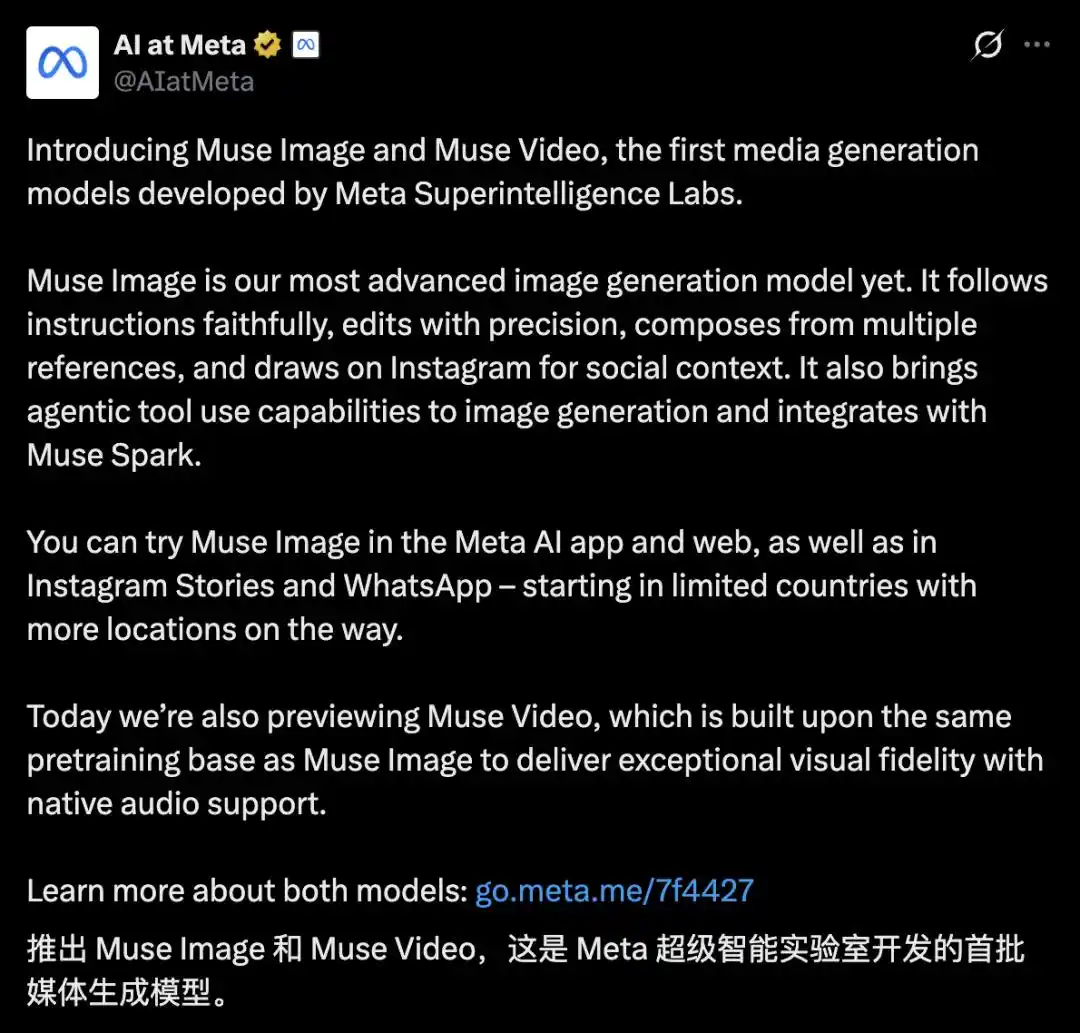
Appearing alongside Muse Image is the video model Muse Video, currently in preview.
On the third-party Arena leaderboard for text-to-image, Muse Image has climbed to second place, closely following OpenAI's GPT Image 2.
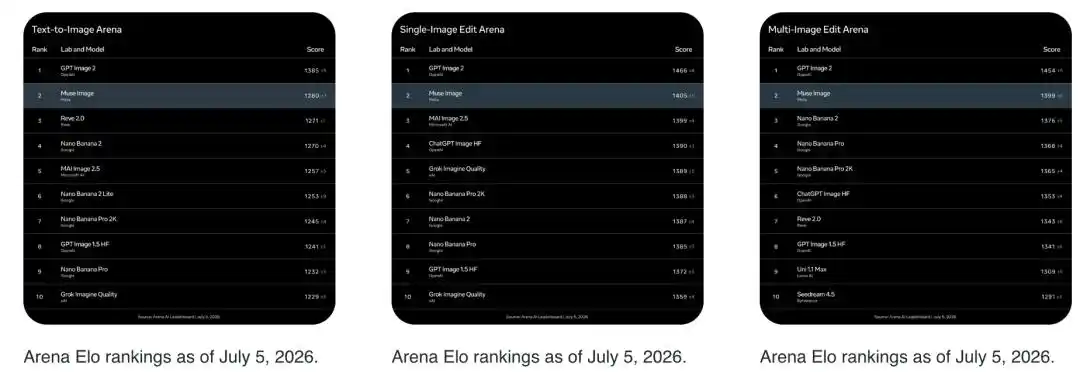
Arena Image Triple Chart Elo rankings, as of July 5, 2026. Muse Image ranks #2 across all three charts, trailing only GPT Image 2. For text-to-image, the score is 1280 vs. 1385, a difference of 105 points. (Source: Arena AI Leaderboard)
While it didn't top the chart in pure image quality this time, Mango did something even more formidable: it changed the way images are created.
And there's one skill that sends a chill down the spine: as long as your Instagram account is public, anyone can @ your username to use your public photos for image generation.
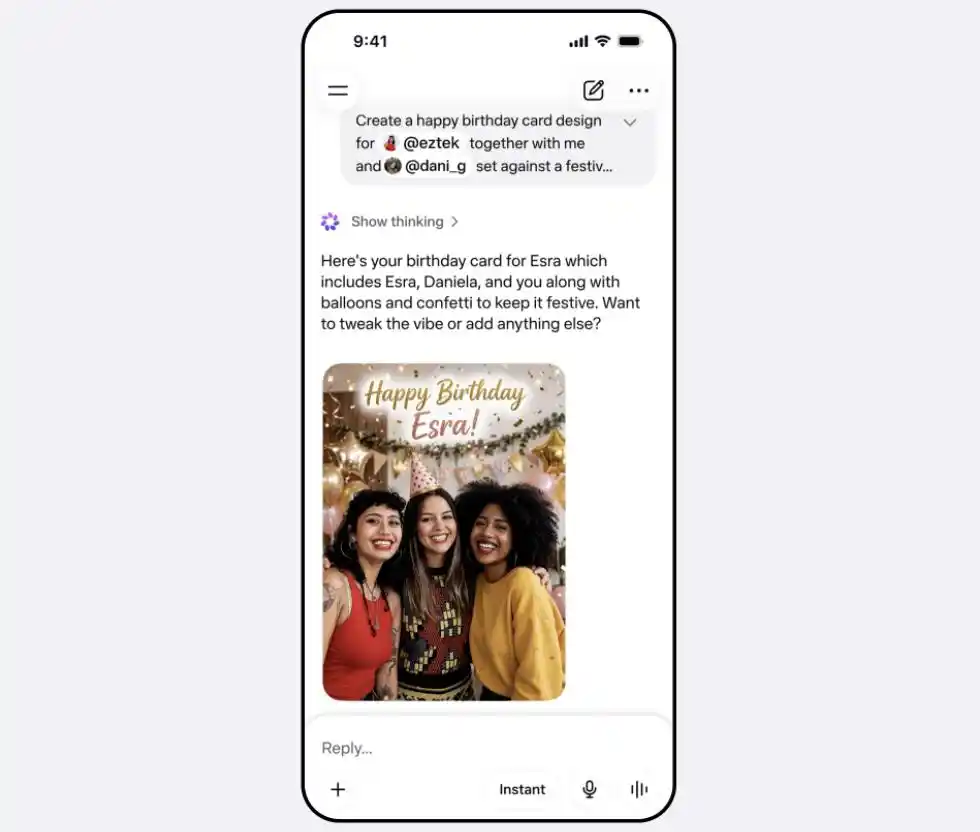
Inside Meta AI, when you @ a public Instagram username, Mango can directly pull that person's appearance from their public photos into the image you want to generate.
Creating an event invitation flyer or a creative concept collage? Just @ the username.
Although it didn't achieve top image quality, Meta holds the trump card: a social network with billions of users. This is its ace in the hole.
No More Instant Output, It Thinks Before It Draws
Muse Image operates as an agent.
It does things traditional image generation models don't.
For instance, when faced with knowledge-dense prompts involving real-world facts, it first searches the web for factual information, anchoring the image in reality.
To generate QR codes or charts, it writes and runs code on the spot, calculating accurately before 'drawing,' and can even use the rendered results to calibrate the image.
The most counterintuitive feature is self-correction: after generating an image, if it detects an issue, it can reflect, make minor edits, or completely redraw if the direction is wrong. If unsure, it can even turn to research.
Meta states this behavior wasn't explicitly designed; it emerged on its own during reinforcement learning.
Because revising prompts earned higher rewards, the model learned to revise. An action not explicitly taught emerged during training.
This kind of 'emergence' suggests that image models are beginning to develop a foundational ability similar to language models: 'the more they practice, the more they learn to figure things out on their own.'
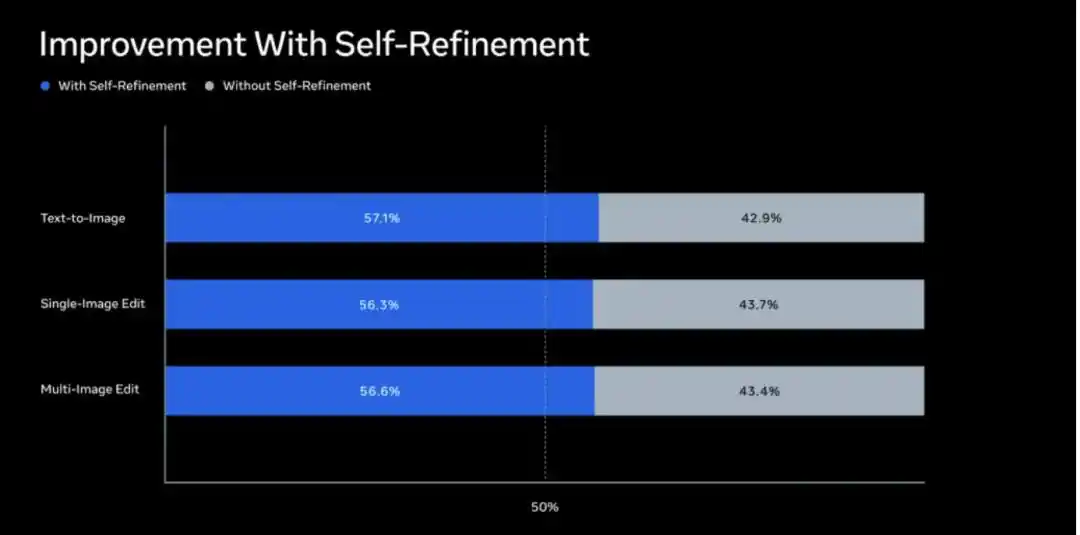
Win rate comparison before and after enabling self-correction (internal ablation tests). 57.1% for text-to-image, 56.3% for single-image editing, 56.6% for multi-image editing—all three metrics exceed 50%, indicating self-correction makes Mango consistently produce better images. (Source: Meta AI official blog)
Simultaneously, Muse Image is following a path parallel to language models: the more it thinks, the better it draws.
During testing, with more computational power allocated, it searches more times, revises more rounds, and the Elo score based on human preference rises accordingly, approximating a log-linear curve.
Meta also found that instead of generating several images at once and picking the best one, it's better to invest the same compute power in careful reasoning: the former plateaus quickly, while the latter can keep improving.
A developer on X pinpointed it in one sentence: 'Image models are starting to think clearly before they finish drawing.'
This is certainly not Meta's direction alone.
OpenAI's GPT Image 2 launched its 'Thinking' mode as early as April this year: reasoning to plan composition, searching the web for references, generating candidates, and then self-checking, beating Mango by two and a half months.
Looking further back, the academic world proposed the 'think before generating' paradigm as early as 2025.
The image generation track is shifting from 'competing on quality' to 'competing on whether it can think.'
Mango Served with Avocado, Two Fruits on One Plate
Mango isn't fighting alone—it's integrated with Avocado (Muse Spark): the two models share tools and plan together.
The language model thinks, the image model draws, and together they can do more than just 'output an image.'
In an official demo, Mango created a 'growth' asset pack for a cream-colored Persian cat: generating images from kitten, to young adult cat, to senior cat, then packaging them into a playable 2048-style web game.
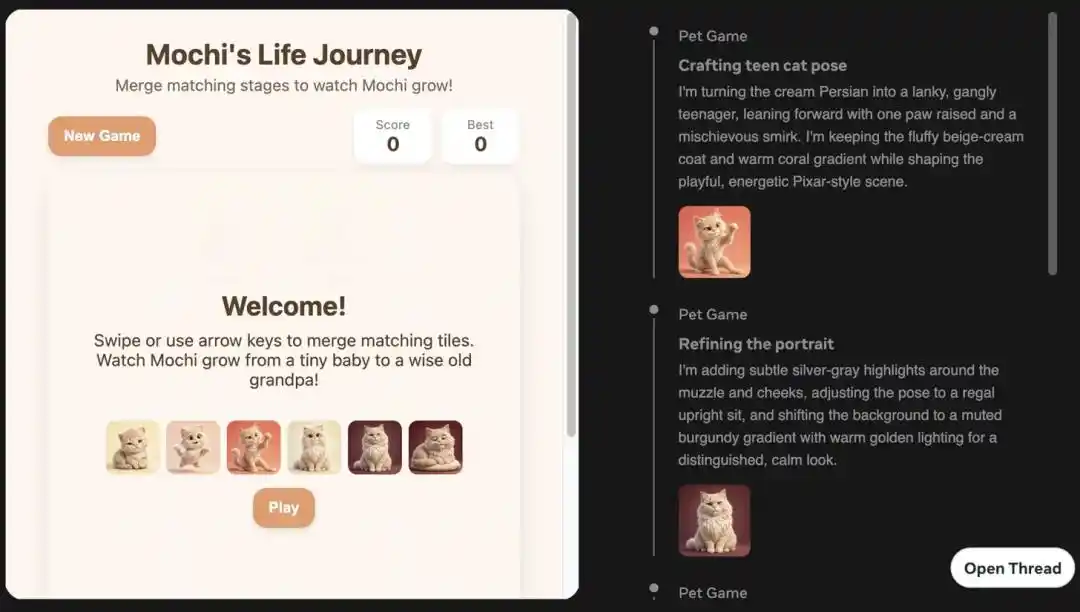
Mango, in collaboration with Muse Spark, generated images of Persian cat Mochi across six life stages (from kitten to senior) and packaged them into a playable 2048-style fusion web game. (Source: Meta AI official blog)
For Meta, building its own image generation model is significant in itself.
Previously, its image and video features were powered by third-party models like Midjourney and Black Forest Labs.
Now, with Mango's launch, a capability called billions of times daily becomes 'self-made.'
For video, Muse Video shares the same pre-trained base model as Mango, focusing on native audio: generating picture and sound together.
Muse Video is currently in 'preview,' not yet officially open, but it's already on Arena for blind testing, ranking #3 for text-to-video.
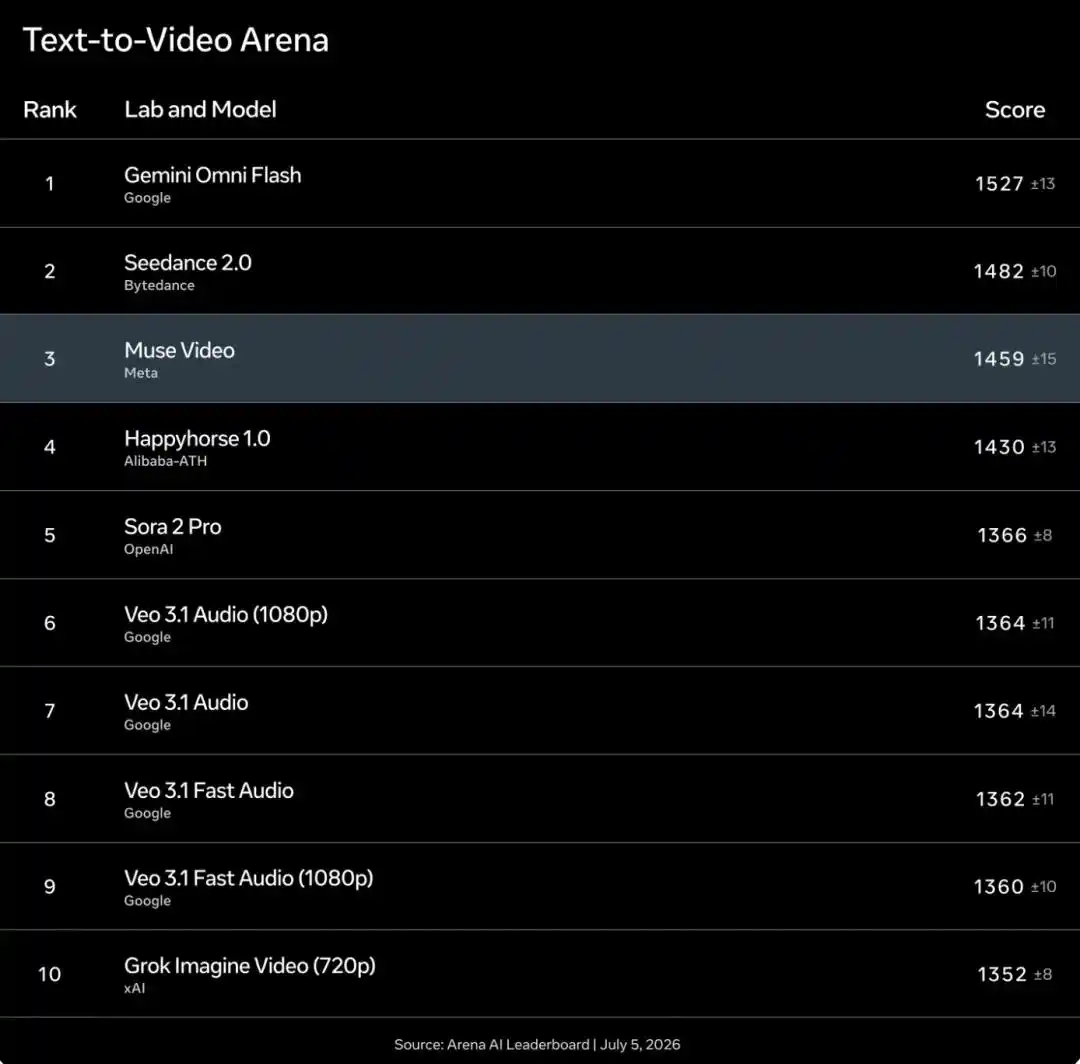
Arena Text-to-Video chart Elo ranking, as of July 5, 2026. Muse Video in preview ranks 3rd (1459), behind Google's Gemini Omni Flash (1527) and ByteDance's Seedance 2.0 (1482). (Source: Arena AI Leaderboard)
Meta also openly acknowledges shortcomings, noting gaps in audio-visual synchronization and the physical accuracy of fast motion.
@ing Can Draw Your Social Network into the Image
Mango's regular features include:
Fusing multiple reference images into one, drawing/annotating directly on an image for it to edit, clearly rendering Chinese characters in images without blur, taking a photo of a room and having it redesign it using real products from Facebook Marketplace...

Take a photo of a room, Mango searches Facebook Marketplace for real second-hand furniture for sale, and generates a whole-room renovation concept image. (Source: Meta AI official blog)
On Instagram Stories, it brings over 30 new AI effects at once: one-click to transform photos into disposable camera aesthetics, add night flash, or even input a prompt to create a custom effect, launching first in the US.
The truly unique feature is the @ function, a capability neither OpenAI nor Google can offer. But the problem lies here: this feature is enabled by default.
As long as your Instagram is a public account, others can @ you to use your photos for image generation, and you won't receive any notification.
To disable it, you must manually dig into settings, find the 'Sharing and Reuse' section, and turn it off. Images already generated won't be deleted even after disabling.
Wired directly calls this default-on setting a privacy concern.
Such worries are not unfounded.
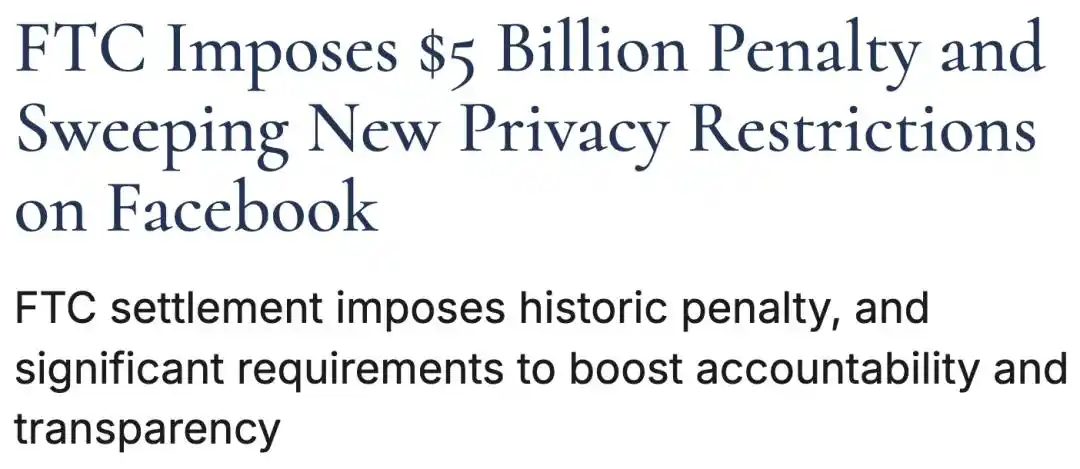
During the 'Cambridge Analytica' incident, data from 87 million users was used without consent by a political consulting firm.
For this, Meta received a $5 billion fine from the FTC in 2019, the largest US government privacy violation penalty at the time.
In 2021, it proactively shut down its entire facial recognition system, deleting facial recognition templates for over 1 billion people.
This time, Mango offers a feature no one else can provide, but it also introduces a problem no one else has touched.
Meta's Killer Move Isn't the Model
Although Mango didn't top the charts in image quality, its real killer move is distribution.
Mango is directly integrated into Meta AI, Instagram, and WhatsApp now, with Facebook and Messenger following next. Advertisers can also call it via Advantage+.
Combined, these apps have nearly 4 billion monthly active users, the world's largest social network.
While Midjourney and ChatGPT bet on 'who draws best,' Meta is betting on something else: when AI image generation becomes as effortless as posting on social media, whoever is closest to the user wins.
Of course, the wider images are distributed, the clearer their origin must be labeled.
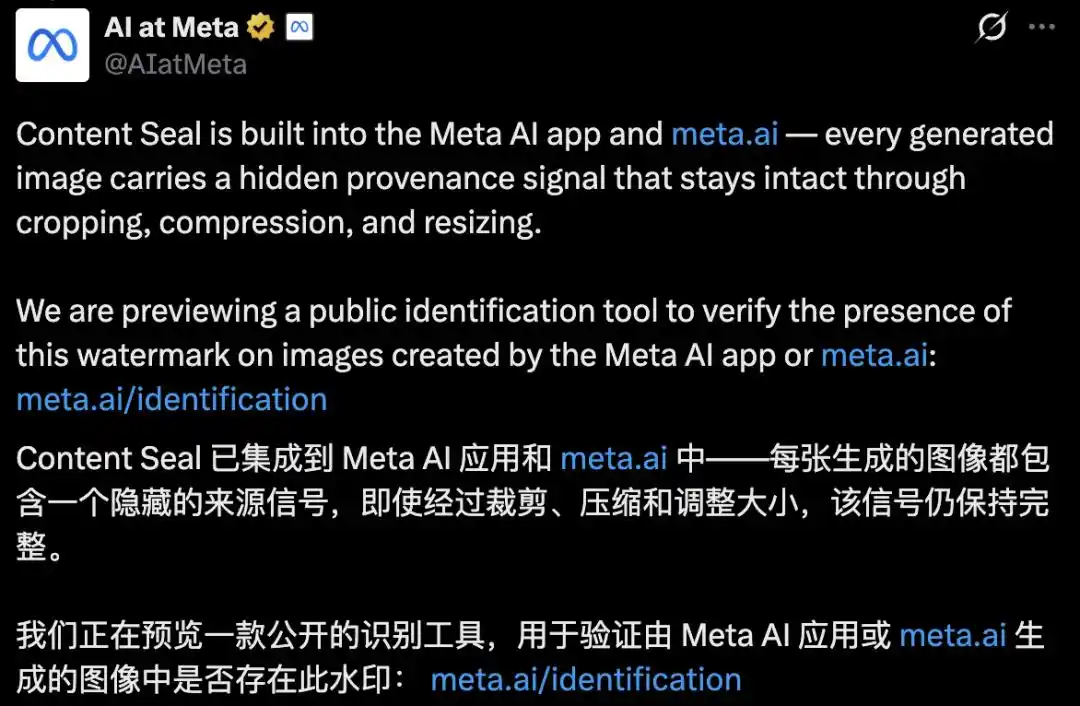
Every image generated by Mango carries an invisible watermark called Content Seal, resistant to cropping, compression, and scaling, specifically marking it as 'AI-generated.'
Meta has also released a public detection tool (meta.ai/identification). Anyone can upload an image to check if it was generated by Meta AI.
This time, Meta is not only keeping pace with 'thinking image generation models' but also holds the world's largest social network.
However, when @ing a stranger allows using their photos for image generation, where exactly the boundaries lie, Mango hasn't provided an answer.
References:
https://ai.meta.com/blog/introducing-muse-image-muse-video-msl/
https://about.fb.com/news/2026/07/introducing-muse-image-meta-ai/
https://x.com/AIatMeta/status/2074587884665901143
This article comes from the WeChat public account 'AI New Frontier' (新智元), author: ASI启示录; editor: 元宇