Why Bitcoin Ignores Bad News from the US? The Answer is in the QCP Report

cryptonews.ruPublished on 2026-08-18Last updated on 2026-08-18

Abstract

The Bitcoin market is showing resilience despite weak US economic data and high oil prices, according to a QCP Capital report. While poor retail sales and consumer sentiment figures lowered expectations for an immediate Fed rate hike, persistently high oil prices complicate the inflation outlook. Bitcoin itself is trading in a narrow range just above $63,000, absorbing negative news without a significant breakdown. Similarly, Ethereum remains around $1,900. Market volatility is compressing, with implied volatility exceeding realized volatility, creating conditions for short volatility strategies, though QCP warns of significant risks if volatility spikes unexpectedly. Trader focus is now shifting to key upcoming events: the FOMC meeting minutes, July's PCE inflation data, and the Jackson Hole Economic Symposium, which could provide a new directional catalyst for the market currently stuck in a wait-and-see pattern.

A report from trading firm QCP Capital has noted that the Bitcoin market remains in a stable range despite weak macroeconomic data from the US and rising oil prices. Analysts at the company point out that the asset's quotes are holding near the lower boundary of its recent trading channel, while volatility continues to decline.
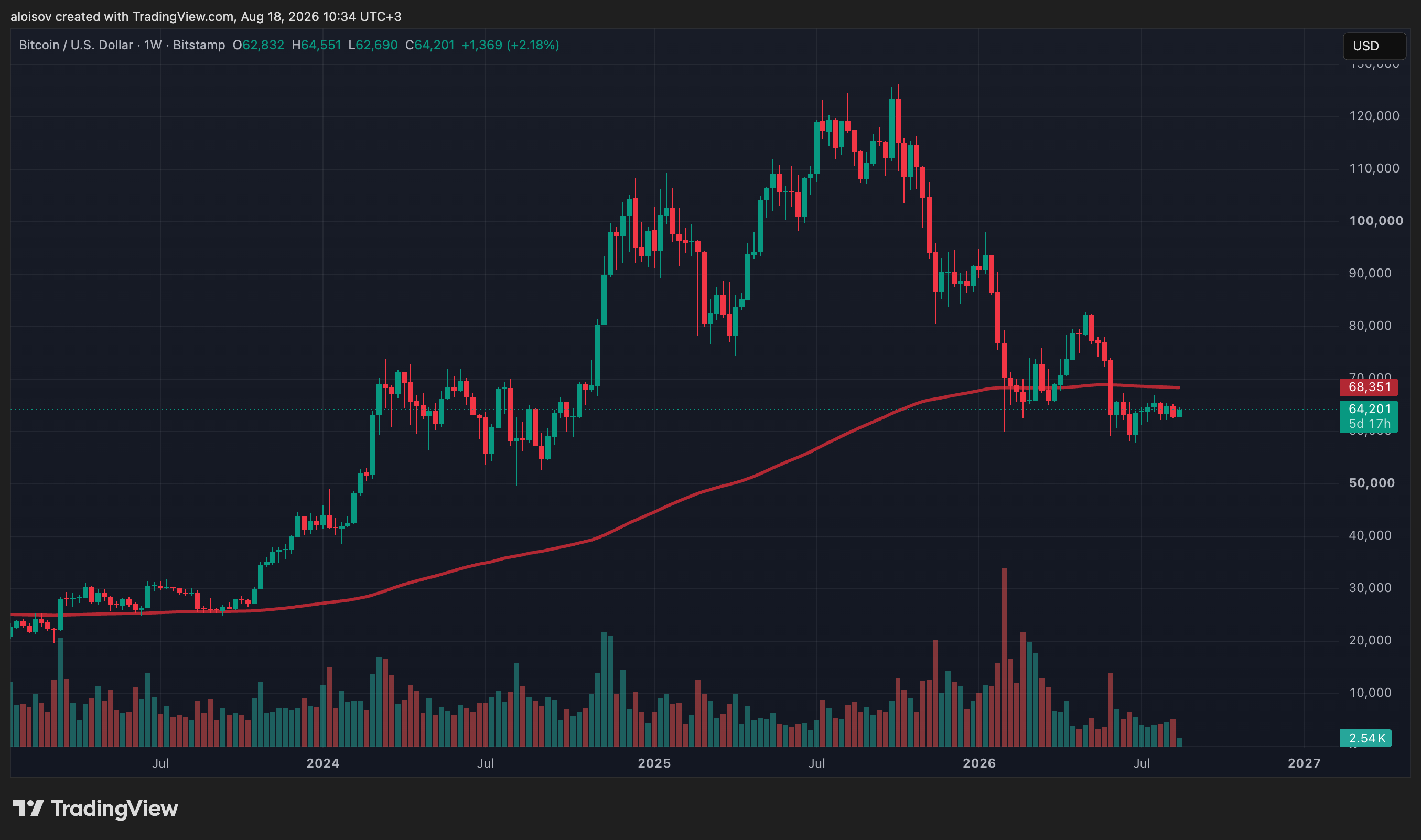
1-week BTC/USD chart and 200EMA. Source: Bitstamp

Weak Data, Strong Oil

U.S. stock indexes closed Friday, August 14th, slightly in the red: the S&P 500 lost 0.17%, the Nasdaq Composite fell 0.28%, and the Dow Jones dropped by approximately 108 points. According to QCP, economic statistics provided a more significant signal. The University of Michigan's preliminary Consumer Sentiment Index fell to 51.0 in August from 55.2 in July, and retail sales in July declined by 0.6%—the strongest monthly drop since May 2025.

Coupled with weaker labor market data released earlier this month, this statistics have reduced expectations for an immediate tightening of monetary policy. Federal funds rate futures now price in roughly a 30% probability of a 25 basis point rate hike at the September meeting. However, inflation remains above the target level, so the future policy trajectory will still depend on incoming data.

Oil remains the main counterweight to weakening business activity. WTI traded around $82.40, and Brent around $88.70 early Monday amid unresolved negotiations concerning the Strait of Hormuz. High energy prices can translate into general inflation and inflation expectations, complicating the interpretation of weak activity data for regulators.

The Range Holds, No Momentum

Against this backdrop, Bitcoin continues, as QCP notes, to "stagnate" rather than sharply decline. The spot price is holding just above $63,000 after a drop of about 3% over the week, continuing to fluctuate within the range that has defined its dynamics in recent weeks.

Analysts emphasize an important difference from the previous review: Bitcoin continues to absorb negative macroeconomic and geopolitical news without a sustained breakdown to the downside.

Instead of looking for directional signals at specific price levels, QCP suggests focusing on the fact that Bitcoin remains near the lower boundary of its recent range. A sustained exit beyond this channel would provide more information about market participants' positioning than the relatively restrained fluctuations within it.

Ethereum shows a similar lack of momentum, trading around $1,900 in recent sessions. Thus, the entire crypto market is currently characterized more by restrained conviction among participants than by acute stress.

Volatility is Compressing

The options market reflects the same calm. Bitcoin's one-week implied volatility is around 26%, while the seven-day realized volatility is closer to 20%. This gap means that options are still pricing in more movement than Bitcoin has actually demonstrated recently.

This is where the essence of the strategy analyzed by QCP in its report comes into play—so-called short volatility. The concept is simple: when implied volatility is higher than realized volatility, a trader can sell options, hoping to profit from the difference between how much movement is "priced in" and how much movement actually occurs.

  • The trader sells options (calls, puts, or their combinations) on Bitcoin or Ethereum

  • The option buyer pays a premium for the right, but not the obligation, to buy or sell the asset at a fixed price

  • If realized volatility turns out to be lower than what was priced into the option, the seller can potentially profit from the decay of the option's time value

  • However, if the market moves sharply and unexpectedly, the option seller incurs a loss, which is theoretically unlimited for naked positions

QCP explicitly warns: such a gap between implied and realized volatility is often called a positive volatility risk premium, but it does not mean that short volatility strategies are automatically profitable. Realized volatility can spike sharply, especially in the face of unexpected macroeconomic, geopolitical, or crypto-specific events—and then losses on sold options can exceed the premium received.

Overall, volatility has decreased over the past week as several scheduled catalyst events have passed. The U.S. Congress is on recess, so risks from the legislative agenda are also reduced for the near term, although the macroeconomic calendar remains busy.

Focus on the Jackson Hole Symposium

Market attention is shifting back to monetary policy. On Wednesday, the minutes of the July FOMC (Federal Open Market Committee—the body of the U.S. Federal Reserve responsible for the interest rate) meeting will be released—the document may provide more details on the 9-to-3 vote to keep the rate unchanged, including the arguments of the three committee members who voted for an increase.

Next, on August 26th, the July PCE index (Personal Consumption Expenditures index—a key inflation indicator monitored by the Fed) and the second estimate of Q2 GDP will be released, and from August 27th to 29th, the Economic Policy Symposium in Jackson Hole will take place. This year's theme is "Financial Innovations: Implications for Payments and Policy," making the event particularly significant for both monetary policy participants and digital asset market players.

For the crypto market, the backdrop remains more balanced than directional. Weak consumption and sentiment data have reduced some pressure in favor of further policy tightening, while high oil prices continue to complicate the inflation picture. Meanwhile, restrained realized volatility and sideways range movement indicate that neither side has yet gained sustained momentum.

Key Events

  • August 19 — FOMC meeting minutes

  • August 26 — U.S. July PCE index, second estimate of Q2 GDP

  • August 27–29 — Economic Policy Symposium in Jackson Hole

  • September 15–16 — FOMC meeting

The Bitcoin range resembles a taut but unbroken string—the market tests its boundaries again and again, yet a breakout has not occurred so far.

Currently, price and volatility are moving in sync, as if frozen in anticipation of a new external impulse—be it inflation data or signals from the Fed at the Jackson Hole symposium.

AI Opinion

From the perspective of machine data analysis, Bitcoin's range-bound phase finds a parallel in the asset's history after reaching peaks. As Hash Telegraph noted, after peaking at $73,679 in March 2024, Bitcoin traded for almost eight months within a $20,000 wide channel before breaking out on the backdrop of Trump's election victory. Similar mechanics—a prolonged hang-up in a wide channel after a local high followed by a sharp exit on an external trigger—recur in the asset's history more often than is commonly assumed when assessing the current pause.

The macroeconomic calendar rarely creates such a density of catalysts in a row—the FOMC minutes, PCE index, and Jackson Hole symposium form a kind of decision-making funnel, where the market postpones positioning until the last event. The risk of such a waiting strategy is that participants may react simultaneously to several signals, rather than sequentially, which can abruptly widen the range instead of a smooth breakout. Will the current channel remain relevant after the symposium, or will a new narrative on digital payments set a different trajectory for the crypto market?


Trending Cryptos

Related Questions

QAccording to the QCP Capital report, how does the bitcoin market react to negative US macro news?

AThe bitcoin market is absorbing the negative macroeconomic and geopolitical news without a sustained breakdown to the downside. It remains within a stable range, showing resilience and a lack of clear directional momentum.

QWhat key US economic data points mentioned in the article are currently weakening market expectations for an immediate policy tightening?

AThe weakening data points include the University of Michigan's preliminary consumer sentiment index dropping to 51.0 in August, July retail sales falling by 0.6%, and earlier weaker-than-expected labor market data. These have reduced expectations for an immediate monetary tightening by the Fed.

QWhat trading strategy related to volatility does QCP discuss, and what are its risks?

AQCP discusses the 'short volatility' strategy. This involves selling options when implied volatility is higher than realized volatility, aiming to profit from the decay of time value. The key risk is that realized volatility can spike unexpectedly due to macro, geopolitical, or crypto-specific events, potentially causing losses that exceed the premium received.

QWhat upcoming economic events are highlighted as key catalysts for the market's focus?

AThe key upcoming events are: the FOMC meeting minutes on August 19, the July PCE index and the second estimate of Q2 GDP on August 26, and the Jackson Hole Economic Symposium from August 27 to 29.

QWhat historical pattern regarding bitcoin's price action after a peak is mentioned in the article's 'AI Opinion' section?

AThe 'AI Opinion' section notes a historical pattern where after reaching a peak (like the $73,679 high in March 2024), bitcoin often trades within a wide range for an extended period before breaking out sharply due to an external trigger, such as a major political event.

Related Reads

Century-Old Chain Director Regulations Revived, a16z Faces Antitrust Investigation

The US Department of Justice has launched an antitrust investigation into venture capital firm Andreessen Horowitz (a16z), according to people familiar with the matter. The probe centers on whether a16z partners improperly hold board seats at competing artificial intelligence companies, specifically Databricks Inc. and Fivetran Inc., which both provide data collection and analytics services. a16z co-founder Ben Horowitz sits on Databricks' board, while partner Martin Casado is on Fivetran's board. The previously unreported investigation, ongoing for nearly a year, began around the time regulators reviewed and ultimately approved Fivetran's acquisition of a rival, dbt labs, last October. The inquiry revives a Biden-era enforcement focus on "interlocking directorates" under a 1914 law, where individuals or entities serve on the boards of direct competitors. While typical resolutions involve directors resigning from one board, this case is notable because the concern involves multiple partners from the same firm serving on competing boards. The scrutiny is heightened by a16z's significant political connections and influence, including donations to groups supporting both Trump and Harris, and its advocacy for relaxed AI regulations. A16z, managing $90 billion in assets, is a major investor in AI startups. The DOJ has not decided on any action, and the investigation may conclude without charges.

marsbit2m ago

Century-Old Chain Director Regulations Revived, a16z Faces Antitrust Investigation

marsbit2m ago

What Is the Cost of Bitcoin Mining Companies Going All-In on AI?

Bitcoin mining companies are undergoing a massive transformation, pivoting from cryptocurrency mining to AI infrastructure and high-performance computing (HPC) services. This shift is driven by the severe profitability crisis in Bitcoin mining following the 2024 halving and the October 2025 market crash, which pushed mining costs as high as $140,000 while Bitcoin's price fell to around $63,000. In response, major public miners like Core Scientific and TeraWulf are rebranding as "energy infrastructure platforms" or "AI cloud service providers." Their revenue structures have flipped, with AI/HPC hosting now constituting over 70-80% of quarterly revenue, dramatically surpassing declining Bitcoin mining income. They are securing massive, long-term contracts worth tens of billions of dollars with tech giants like AMD, CoreWeave, and Anthropic, locking in future cash flow. However, this all-in bet on AI carries significant risks. The AI compute market lacks Bitcoin's self-correcting mechanism, where unprofitable miners exit, reducing network difficulty and boosting profitability for those who remain. An AI compute supply glut could rapidly drive prices down, making today's lucrative long-term contracts burdensome. Furthermore, the transition is largely one-way; retrofitting facilities for AI and signing decade-plus contracts makes it nearly impossible to return to mining when its profitability eventually rebounds. Some companies, like Marathon Digital and Hut 8, are taking a more hedged approach. They are funding AI expansion through debt secured by Bitcoin holdings or by spinning off mining into separate subsidiaries, rather than completely divesting. This strategy maintains the optionality to shift power load back to Bitcoin mining if it becomes profitable again, positioning them as flexible power operators rather than being captive to a single, unproven market cycle. The article concludes that while the pivot to AI is a necessary survival move for many, abandoning Bitcoin mining entirely for long-term AI contracts is a risky gamble that could backfire.

marsbit6m ago

What Is the Cost of Bitcoin Mining Companies Going All-In on AI?

marsbit6m ago

Walsh May "Beat Around the Bush" at Global Central Bankers' Conference, but Internal Fed Division Is the Real Focus?

With the annual Jackson Hole symposium approaching, market expectations are rising for clues from Federal Reserve Chair Kevin Wash's upcoming speech on September monetary policy. However, analysts caution that expectations for clear guidance may be overstated, while underestimating the Fed's growing internal divisions. Since taking office in May, Wash has adopted a notably less communicative style than his predecessor, downplaying forward guidance and emphasizing policy independence from market pricing. His scheduled speech on "Financial Innovation in Payments" is thus more likely to focus on broad narratives than near-term policy signals. The more significant focus lies within the Fed itself. At Wash's first meeting in June, nearly half the committee's dot plot projections hinted at a 2026 rate hike need. The July meeting saw three regional Fed presidents dissent in favor of an immediate rate increase—an unusually high level of early-term dissent. This internal rift presents a clearer signal of policy uncertainty than any public speech. Market pricing currently shows high conviction for a September pause, with prediction markets assigning roughly a 74% probability to unchanged rates. Despite this consensus, traders remain wary of potential hawkish surprises amid mixed economic data. Analysts suggest that for investors, tracking the evolving voting patterns within the FOMC may offer more insight into future rate direction than parsing Wash's likely guarded Jackson Hole remarks.

marsbit7m ago

Walsh May "Beat Around the Bush" at Global Central Bankers' Conference, but Internal Fed Division Is the Real Focus?

marsbit7m ago

Automotive Chips Initiate a New Round of Game

After two years of deep inventory correction, the global automotive semiconductor industry is signaling a turning point in the second half of 2026, entering a structural upcycle. Unlike the broad-based shortages of 2022, this recovery is characterized by significant divergence across different chip segments, driven by 800V high-voltage platforms, high-level autonomous driving, and ongoing localization of supply chains in China. The industry-wide destocking cycle has concluded, with inventory levels at automakers and Tier 1 suppliers returning to healthy ranges. Key indicators, including rising OEM orders, lengthening component lead times, improving vendor revenues, and the initiation of price hikes by major suppliers like Infineon and Texas Instruments, confirm the start of a replenishment cycle. Segments are diverging into three tiers based on demand and supply dynamics. The first and strongest tier includes Silicon Carbide (SiC), high-voltage IGBTs, and automotive power management chips, fueled by the rapid adoption of 800V platforms. The second tier, experiencing a moderate recovery, comprises high-end 32-bit MCUs and automotive NOR Flash/DRAM, benefiting from advanced compute domains and AI-driven capacity constraints on mature nodes. The third tier, consisting of low-voltage MOSFETs and basic body electronics, remains stable with ample supply. The core growth logic has shifted from pure vehicle sales volume to increasing semiconductor content per vehicle. This is propelled by the transition to domain/centralized E/E architectures, software-defined vehicles, and new applications like commercial vehicle electrification and V2X communications. While the domestic Chinese supply chain is seizing this window for localization, risks remain, including potential softness in end-demand, future SiC oversupply, and possible easing of 8-inch wafer capacity constraints. In the near term, key segments are expected to see simultaneous volume and price increases, with the industry's cyclicality gradually giving way to more prominent long-term growth characteristics.

marsbit27m ago

Automotive Chips Initiate a New Round of Game

marsbit27m ago

Trading

Spot

Hot Articles

What is $BITCOIN

DIGITAL GOLD ($BITCOIN): A Comprehensive Analysis Introduction to DIGITAL GOLD ($BITCOIN) DIGITAL GOLD ($BITCOIN) is a blockchain-based project operating on the Solana network, which aims to combine the characteristics of traditional precious metals with the innovation of decentralized technologies. While it shares a name with Bitcoin, often referred to as “digital gold” due to its perception as a store of value, DIGITAL GOLD is a separate token designed to create a unique ecosystem within the Web3 landscape. Its goal is to position itself as a viable alternative digital asset, although specifics regarding its applications and functionalities are still developing. What is DIGITAL GOLD ($BITCOIN)? DIGITAL GOLD ($BITCOIN) is a cryptocurrency token explicitly designed for use on the Solana blockchain. In contrast to Bitcoin, which provides a widely recognized value storage role, this token appears to focus on broader applications and characteristics. Notable aspects include: Blockchain Infrastructure: The token is built on the Solana blockchain, known for its capacity to handle high-speed and low-cost transactions. Supply Dynamics: DIGITAL GOLD has a maximum supply capped at 100 quadrillion tokens (100P $BITCOIN), although details regarding its circulating supply are currently undisclosed. Utility: While precise functionalities are not explicitly outlined, there are indications that the token could be utilized for various applications, potentially involving decentralized applications (dApps) or asset tokenization strategies. Who is the Creator of DIGITAL GOLD ($BITCOIN)? At present, the identity of the creators and development team behind DIGITAL GOLD ($BITCOIN) remains unknown. This situation is typical among many innovative projects within the blockchain space, particularly those aligning with decentralized finance and meme coin phenomena. While such anonymity may foster a community-driven culture, it intensifies concerns about governance and accountability. Who are the Investors of DIGITAL GOLD ($BITCOIN)? The available information indicates that DIGITAL GOLD ($BITCOIN) does not have any known institutional backers or prominent venture capital investments. The project seems to operate on a peer-to-peer model focused on community support and adoption rather than traditional funding routes. Its activity and liquidity are primarily situated on decentralized exchanges (DEXs), such as PumpSwap, rather than established centralized trading platforms, further highlighting its grassroots approach. How DIGITAL GOLD ($BITCOIN) Works The operational mechanics of DIGITAL GOLD ($BITCOIN) can be elaborated on based on its blockchain design and network attributes: Consensus Mechanism: By leveraging Solana’s unique proof-of-history (PoH) combined with a proof-of-stake (PoS) model, the project ensures efficient transaction validation contributing to the network's high performance. Tokenomics: While specific deflationary mechanisms have not been extensively detailed, the vast maximum token supply implies that it may cater to microtransactions or niche use cases that are still to be defined. Interoperability: There exists the potential for integration with Solana’s broader ecosystem, including various decentralized finance (DeFi) platforms. However, the details regarding specific integrations remain unspecified. Timeline of Key Events Here is a timeline that highlights significant milestones concerning DIGITAL GOLD ($BITCOIN): 2023: The initial deployment of the token occurs on the Solana blockchain, marked by its contract address. 2024: DIGITAL GOLD gains visibility as it becomes available for trading on decentralized exchanges like PumpSwap, allowing users to trade it against SOL. 2025: The project witnesses sporadic trading activity and potential interest in community-led engagements, although no noteworthy partnerships or technical advancements have been documented as of yet. Critical Analysis Strengths Scalability: The underlying Solana infrastructure supports high transaction volumes, which could enhance the utility of $BITCOIN in various transaction scenarios. Accessibility: The potential low trading price per token could attract retail investors, facilitating wider participation due to fractional ownership opportunities. Risks Lack of Transparency: The absence of publicly known backers, developers, or an audit process may yield skepticism regarding the project's sustainability and trustworthiness. Market Volatility: The trading activity is heavily reliant on speculative behavior, which can result in significant price volatility and uncertainty for investors. Conclusion DIGITAL GOLD ($BITCOIN) emerges as an intriguing yet ambiguous project within the rapidly evolving Solana ecosystem. While it attempts to leverage the “digital gold” narrative, its departure from Bitcoin's established role as a store of value underscores the need for a clearer differentiation of its intended utility and governance structure. Future acceptance and adoption will likely depend on addressing the current opacity and defining its operational and economic strategies more explicitly. Note: This report encompasses synthesised information available as of October 2023, and developments may have transpired beyond the research period.

1.9k Total ViewsPublished 2025.05.13Updated 2025.05.13

What is $BITCOIN

Discussions

Welcome to the HTX Community. Here, you can stay informed about the latest platform developments and gain access to professional market insights. Users' opinions on the price of BTC (BTC) are presented below.

活动图片