Author: Dave
Have you ever experienced a situation where, after buying some altcoins, the price keeps moving in the opposite direction in a short time, as if the "market manipulators" are targeting you? Why does this happen? Is it really a conspiracy by the manipulators?
This post will introduce the market maker's quoting system and unveil the mystery behind the "manipulator" conspiracy. The conclusion is: prices often move against us not due to subjective manipulation, but rather due to Inventory-based pricing quote skew under the Avellaneda–Stoikov model and the protective mechanism for handling toxic flow. How exactly? Once upon a time...
First, let's understand the concept of inventory. As we all know, market makers are not directional investors. Under strict hedging, spot price changes should not affect the total P&L. At this point, holding inventory is a "passive" behavior. Changes in inventory lead to an expansion of positions, and the more positions you hold, the greater your risk exposure to adverse price movements. At this time, retail traders' buy and sell orders cause changes, and market makers react to the risks brought by these inventory changes.
In a nutshell, you break their balance, and the MM has to protect themselves and try to return to balance. The means of protection is the quoting system.
1. Quote Skew
When the MM is heavily bought by you, it is equivalent to: the MM has sold heavily, and the inventory becomes a short exposure. What does the MM hope to do at this time: (1) Replenish the inventory as soon as possible. (2) Protect the exposed short position.
So the MM's reaction is: lower the price to attract selling, prevent further buying, and ensure that their net short position remains temporarily non-loss-making, giving time to hedge.
2. Spread Widening
When the inventory continues to deteriorate, the MM not only skews the price but also widens the spread to reduce the probability of execution.
Their goal is to reduce the execution risk per unit time and, through spread profits, earn more to protect against price losses.
While writing this article, each additional mathematical formula reduces the number of readers by 10%, but in case some小伙伴们 want to see something substantial, I will briefly introduce the formation of quotes (which is also the mathematical mechanism behind the above quote changes).
The price at which we trade with the market maker is called the Reservation Price, which comes from the Inventory-based pricing model:
Reservation Price = Mid price − γ⋅q
q: current inventory
gamma γ: risk aversion coefficient
Actually, the Reservation Price looks like the following, but I don't want to disgust everyone, so just take a glance:

When retail traders buy or sell heavily, q changes significantly, causing the quoted Reservation Price to change significantly. The specific amount of change comes from the Avellaneda–Stoikov model. As you might guess, since buying and selling cause small changes in inventory, this model is a partial differential equation. Guess what? I'm not interested in deriving this equation either, so we only need to know the core conclusion:
The optimal quote is symmetrically spread around the Reservation Price. Inventory must mean-revert to 0. The optimal spread widens with risk.
If you don't understand the above, it's okay. Just roughly understand that after retail buying, prices often move against the bullish direction, essentially because our flow changes the market's risk pricing. The reasons why retail traders often encounter this situation are:
• Retail traders almost always use aggressive orders
• Concentrated size, non-stealthy timing
• No hedging
• Not timing the market, not splitting orders
In small altcoins, this situation is even more severe because altcoin liquidity is poor. Often, your order is one of the few aggressive orders within 5 minutes. In large品种, natural hedging might occur, but in small coins, you are the counterparty to the manipulator.
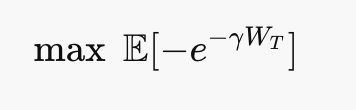
So professional MMs are not trying to crush you; their objective is maxE[Spread Capture]−Inventory Risk−Adverse Selection. Actually, their objective function looks like this, with inventory risk being exponentially penalized.
Readers who have made it this far must be韭菜 with dreams of becoming market manipulators. So to激励 the brave, I'll share a small trick to utilize the quoting mechanism. We said retail traders often have concentrated size and non-stealthy timing, so just do the opposite. Suppose Dave wants to go long 1000U. Instead of going all in at once, using the manipulator's method, first buy 100U. The quoting system will lower the price, allowing me to build a position at a cheaper level. Then I buy another 100U, and the price will continue to fall. Thus, my average entry cost will be much cheaper than going all in at once.
The story of retail's bad luck is only half told here. Besides inventory management quoting factors, the MM's handling of order flow is another element causing price divergence, namely the toxic order flow mentioned at the beginning. In the next part, I will introduce the market maker's order book and order flow, and I will also speculate on the micro-market reasons behind the 1011惨案.
To know what happens next, stay tuned for the next episode.