Original|Odaily Planet Daily (@OdailyChina)
Author|CryptoLeo (@LeoAndCrypto)
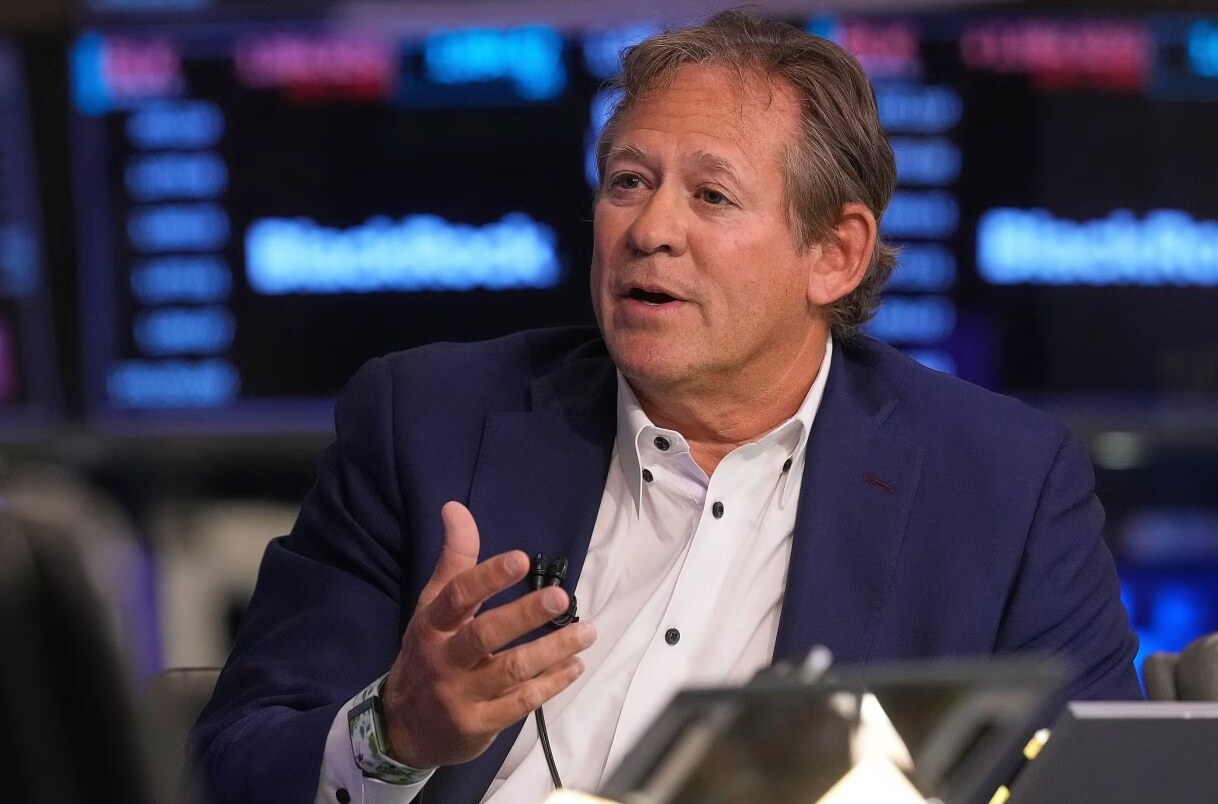
The full list of candidates for Federal Reserve Chair was finalized yesterday. Yesterday, Trump announced that he will interview Rick Rieder, BlackRock's Global Chief Investment Officer of Fixed Income, on Thursday to assess his potential as the next Federal Reserve Chair, marking the fourth and final interview for candidates to succeed Chair Powell. Besides Rieder, the final shortlist includes former Federal Reserve Governor Kevin Warsh, National Economic Council Director Kevin Hassett, and Federal Reserve Governor Christopher Waller. Trump stated that he will make the final decision in January.
Among the four candidates, Rieder is likely the least familiar to everyone, while Odaily has previously covered the other candidates. Today, we will introduce this potential Federal Reserve Chair candidate.
Related references:
"Academic Underdog, Small-Town Professor Waller Becomes Top Contender for Fed Chair"
"Is BTC's Strict Principal Coming? If He Leads the Fed, the Crypto Party Might End Abruptly"
A Veteran "BlackRocker" Deeply Rooted in Fixed Income
Rieder was born in October 1961. LinkedIn data shows that Rieder studied at Emory University and the Wharton School of the University of Pennsylvania. He earned a Bachelor of Business Administration (BBA) in Finance from Emory University in 1983 and an MBA from Wharton in 1987.
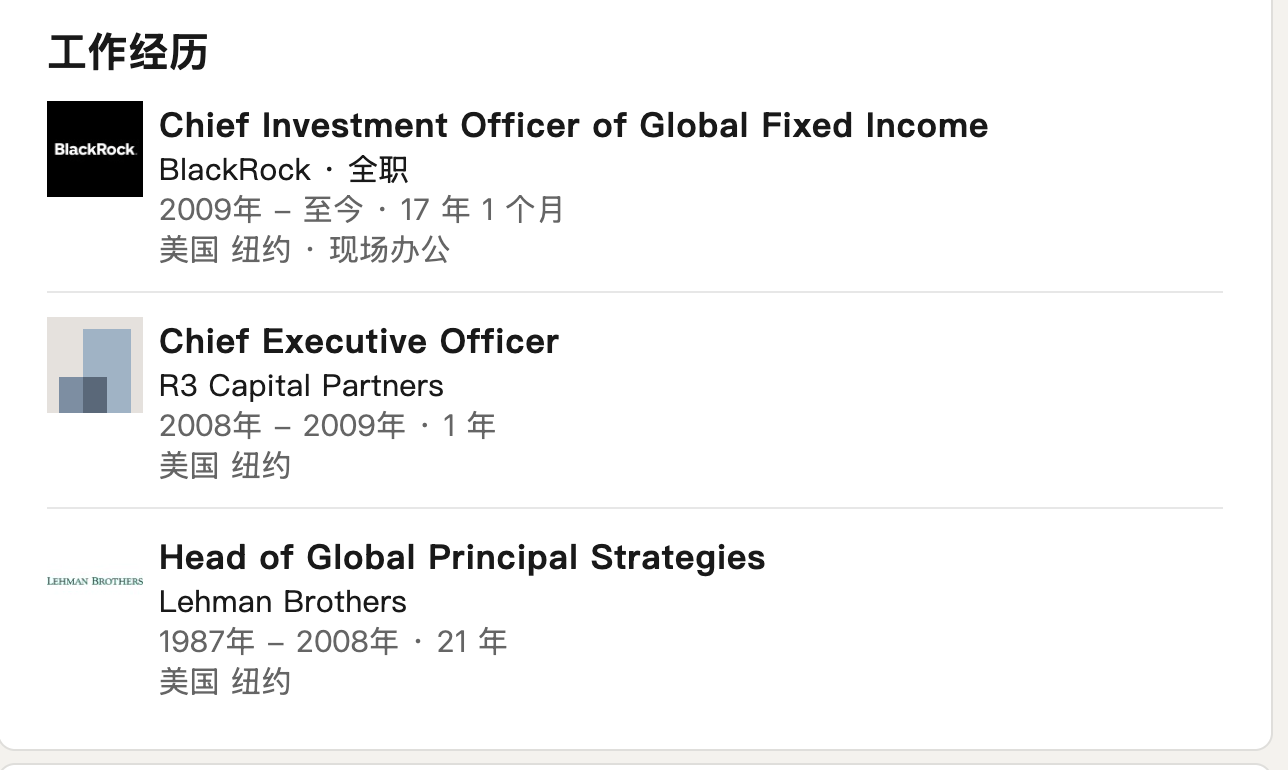
After graduation, Rieder worked at Lehman Brothers for 20 years from 1987 to 2008, holding senior positions such as Global Head of Credit Business and Global Head of Principal Strategies Team.
After Lehman Brothers collapsed in 2008, Rieder started his own business, founding R3 Capital (primarily focused on multi-strategy credit investments) and serving as its CEO. The firm was acquired by BlackRock in 2009. This means Rick Rieder joined BlackRock along with his startup, becoming a Managing Director and leading the Fixed Income Alternatives Portfolio Team.
To this day, Rieder has been with BlackRock for 17 years. His current positions include BlackRock's Global Chief Investment Officer of Fixed Income, Head of Fundamental Fixed Income, and Head of the Global Allocation Investment Team. Rieder manages trillions of dollars in assets, is a member of BlackRock's Global Executive Committee (GEC) and its GEC Investment Subcommittee, and chairs the firm-wide BlackRock Investment Committee. He is also currently a member of the Alphabet/Google Investment Advisory Committee and the UBS Research Advisory Committee.
Notably, Rieder has also served as Vice Chairman of the Treasury Borrowing Advisory Committee and as a member of the Federal Reserve's Investment Advisory Committee on Financial Markets.
How Rieder Differs from the Other Candidates
Compared to the other three candidates, Rieder has less experience working for the U.S. government. However, from the perspective of the crypto industry, the key point worth noting is: Rieder is decidedly pro-crypto. Over the past few years, Rieder has repeatedly expressed positive views on cryptocurrencies (especially Bitcoin) in public, evolving from an initially cautious stance to recognizing Bitcoin's investment value as a durable asset, a hard asset. Below are his public statements related to crypto:
November 2020: Rieder commented on CNBC, stating that digital payment systems are real, and cryptocurrencies will also exist long-term. Bitcoin's mechanism is more durable, functional, and easier to track; it can largely replace gold, especially given the high acceptance of digital payments among millennials.
2021: In an interview with CNBC, Rieder stated that Bitcoin is a durable asset and will be part of the investment landscape long-term. BlackRock has begun "dipping its toes in a small way." Although Bitcoin faces challenges like high volatility and regulation, these will be overcome over time.
Additionally, Rieder mentioned that he personally holds Bitcoin but did not disclose the amount. He believes Bitcoin's price will rise significantly in the future, and holding Bitcoin as a speculative tool offers high value.
2022: In an interview with Yahoo Finance, Rieder stated that the crypto market crash is similar to the early internet era. Rieder still maintains that Bitcoin and cryptocurrencies are durable assets, but there was simply too much excessive investment built around them. The crash is just a recalibration for the industry, eliminating some excess leverage. Once the market is healthy, he remains bullish long-term, "It will only take 2 or 3 years for the crypto market to be higher than it is today."
September 2025: In a CNBC interview, Rieder stated that an ideal investment portfolio should hold "hard assets" like gold and Bitcoin to hedge against fiat currency devaluation. Rieder mentioned that BlackRock invests 3–5% in gold, but investment in cryptocurrencies is "far below that." He believes Bitcoin will rise, but a 5% allocation seems too high.
From the evolution of his public statements, from Rieder's professional investment perspective, he is personally bullish on Bitcoin, affirming its long-term value, and considers holding Bitcoin as an institution a good investment approach.
Potential Impact on Crypto if Rieder is Elected
Between 2020 and 2025, Rieder repeatedly evaluated Bitcoin from the perspectives of institutional investment portfolios, macro hedging (e.g., against inflation, fiat devaluation), and liquidity. Recently, after being listed as a candidate for Federal Reserve Chair, these comments of his are worth revisiting. Compared to the other candidates, Rieder is decidedly the pro-crypto figure among them. If elected Fed Chair, it would indirectly bring several benefits to the crypto industry:
1. Macro Policy: Advocating for Significant Interest Rate Cuts
Rieder has maintained a consistent desire for rates to fall to 3% over the past few months, meaning at least a 50 basis point cut from current levels. Rieder stated: "For so many months now, my stance has been very clear. The Fed must cut rates, and I don't think it needs to cut by much, ultimately landing at 3%—a level closer to the neutral rate."
Furthermore, Rieder mentioned that whoever assumes the position of Fed Chair, the entire Federal Open Market Committee (FOMC) will make appropriate decisions based on economic data analysis and assessment.
2. Professional Perspective: More Institutional Entry
As BlackRock's Global CIO of Fixed Income, Rieder began leading and promoting BlackRock's allocation to Bitcoin futures as early as 2021. The subsequent launch of IBIT was also very successful. Rieder's investment track record is verifiable. If elected Fed Chair, his pro-crypto stance would attract more institutional investors into the market.
3. Personal Perspective: Bullish on Crypto and Promoting Development
Although Rieder has not publicly disclosed his Bitcoin holdings, the development from BlackRock's early Bitcoin futures to crypto ETFs shows that Rieder doesn't just talk the talk. He is very bullish on Bitcoin's long-term value, emphasizing Bitcoin's "upside convexity," which can amplify crypto returns in a loose environment.
Additionally, as a professional fixed-income analyst, Rieder pursues yield in high-interest/volatility environments, areas where the crypto market can perform well. He would likely promote the development of asset tokenization, stablecoins, and the DeFi sector within the crypto industry.
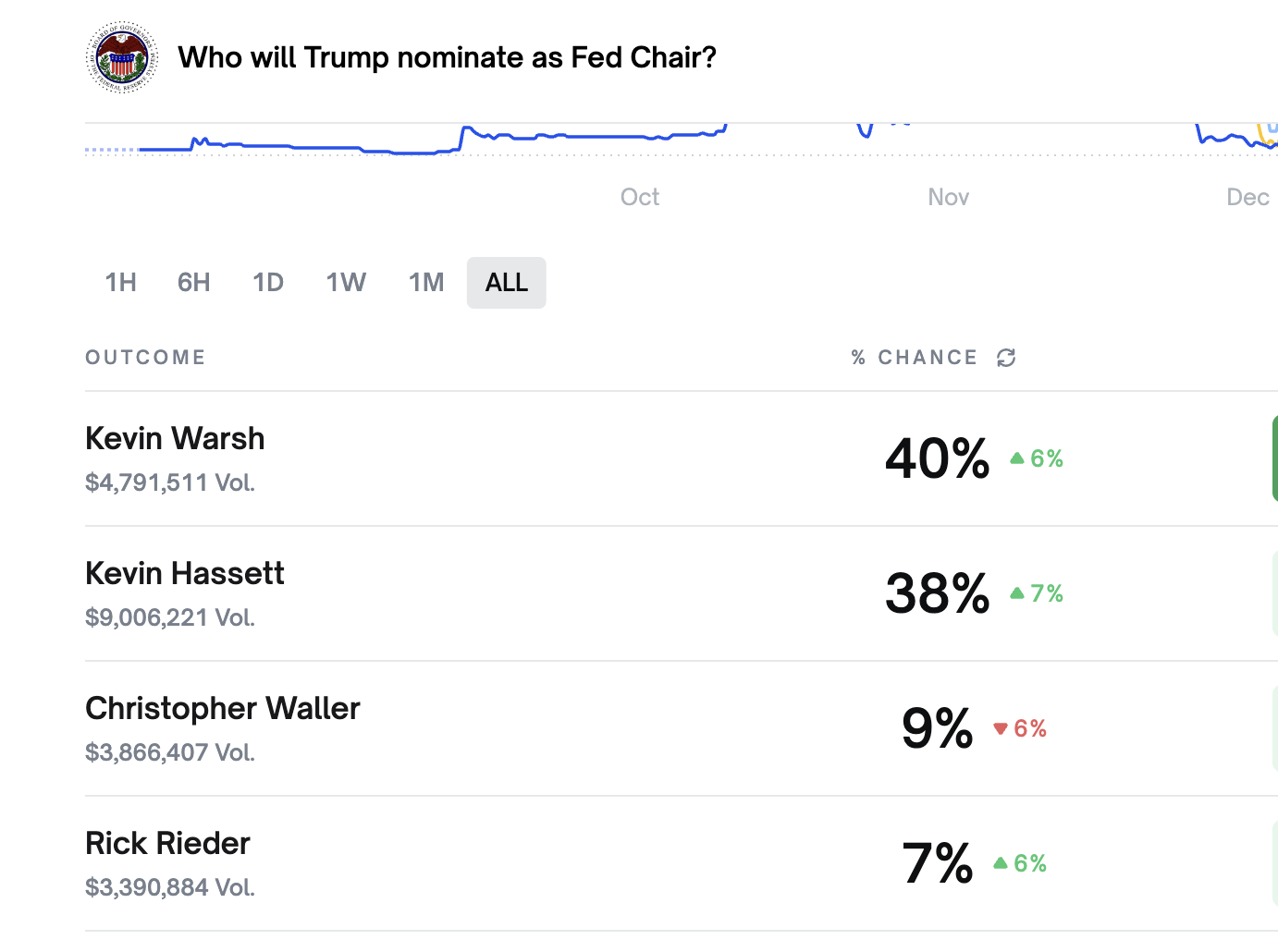
As of writing, Polymarket data shows the probability of Kevin Warsh being elected Fed Chair is temporarily at 40% (up 6%), Kevin Hassett at 38% (up 7%), Christopher Waller at 9% (down 9%), and Rick Rieder has the lowest probability, temporarily at 7% (up 6%). Although his chances are lower compared to Warsh and Hassett, at least it increased by 6 points, soon surpassing Waller.
Furthermore, if Trump's chosen candidate is not currently a member of the Federal Reserve Board, that person must first join the Board. For Rieder, to become Chair, he would need to be nominated by Trump and confirmed by the Senate to become a member of the Federal Reserve Board—a process that could take months before becoming Fed Chair.
The specifics depend on the outcome of his meeting with Trump and [presumably a typo, likely meant his team] on Thursday. Odaily will follow up on related developments promptly. Everyone can also closely monitor the data changes of the corresponding contracts on Polymarket.