Claude to Mandate "Face-Scan ID Verification", No ID No Service Starting July?

链捕手Published on 2026-06-15Last updated on 2026-06-15

Abstract

Anthropic, the creator of Claude AI, has sent privacy policy update emails to users, signaling a significant shift. The key change, effective July 8, is the potential requirement for consumer-level users (Free, Pro, Max plans) to verify their age or identity. This verification would be conducted through the third-party service Persona, involving uploading a government-issued photo ID and taking a live selfie for comparison. Anthropic states this data is for security purposes only, will not be used for model training, and is processed by Persona, not stored on its own servers. The update also clarifies data handling for Claude's new capabilities: when performing multi-step tasks or connecting to third-party apps, user data may flow between Anthropic and those external services. Additionally, more information may be collected from users who participate in Anthropic research. This move is seen as a major step towards establishing accountability as AI agents become more powerful and autonomous, capable of executing complex, real-world tasks. It follows previous enforcement actions, like the banning of the "Fable 5" account, and indicates a broader industry trend toward stricter user identification and safety measures. The verification is expected to apply in specific scenarios, particularly as users engage Claude in more complex agentic workflows.

Author: New Zhiyuan

Anthropic is in the headlines again!

In recent days, many Claude users opened their email to find a message from Anthropic. The title seemed innocuous - "Privacy Policy Update Notification". But the content left them stunned:

"We may ask you to verify your age or identity."
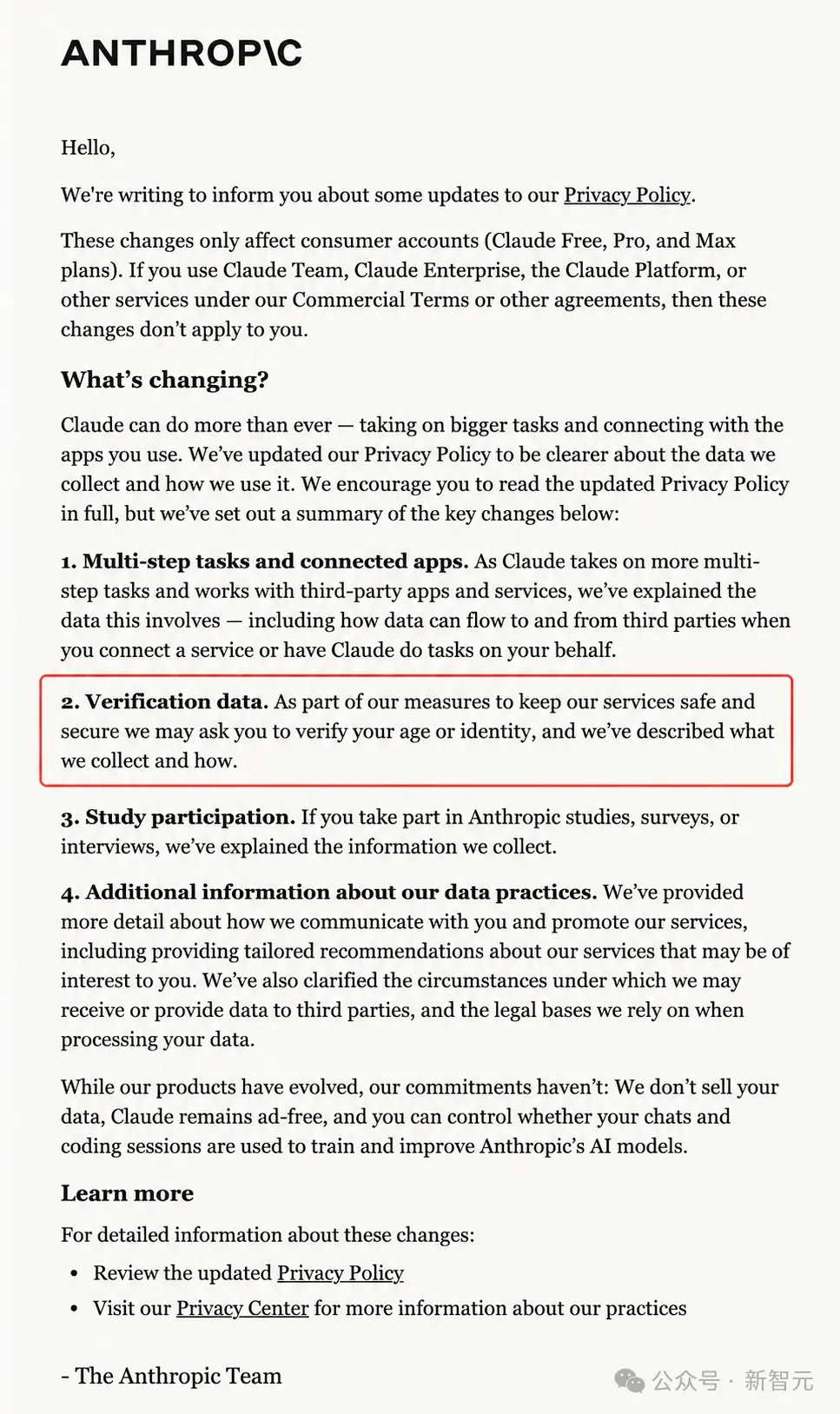
Someone shared a screenshot of the email on X, and the comments exploded. According to the email content, starting July 8th, Claude will likely start asking for your ID. Has Anthropic's real-name verification finally arrived?
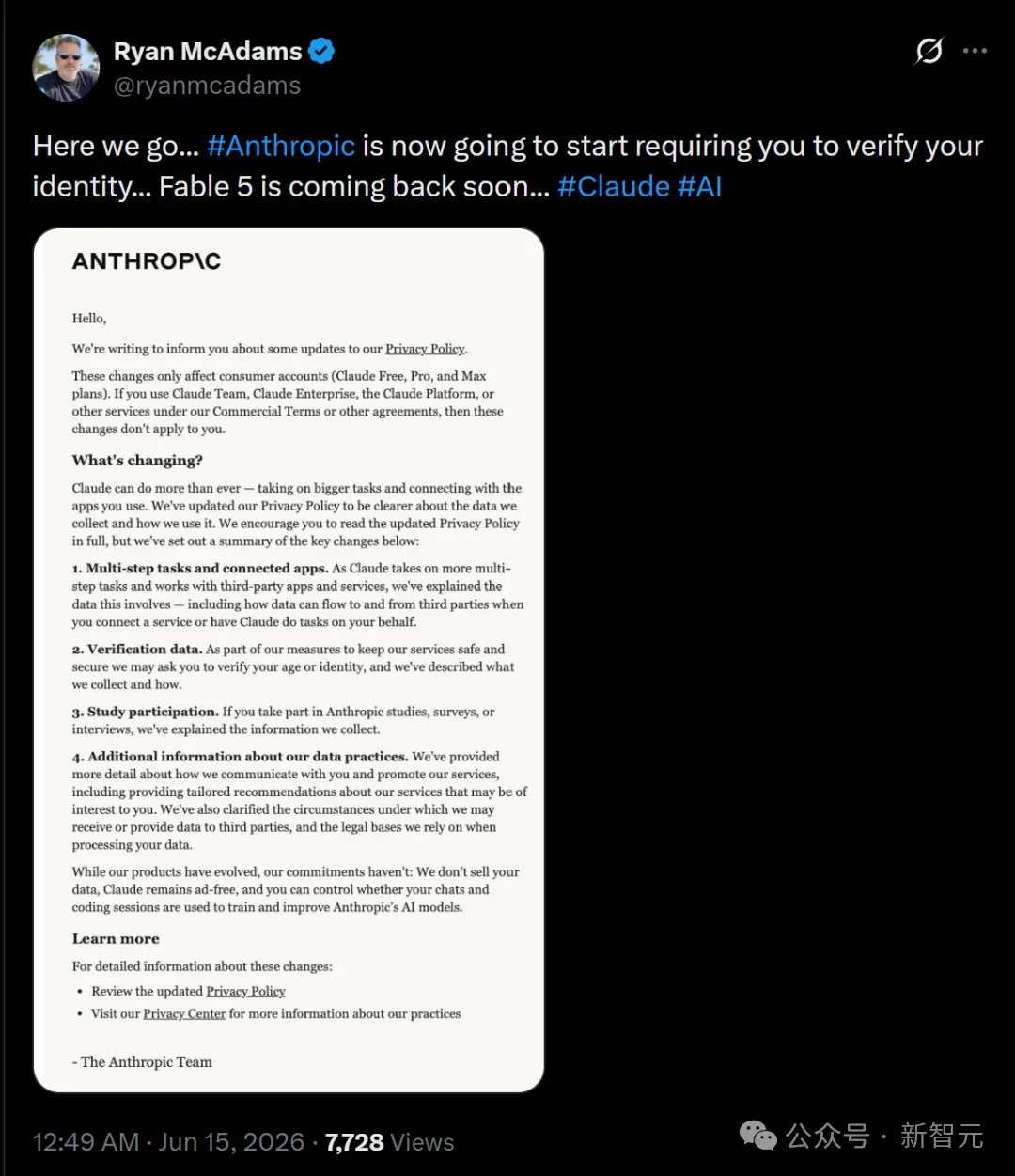
Anthropic Suddenly Announces, Is Real-Name Verification Really Coming?

On June 10th, many Claude users' inboxes received an email from Anthropic.
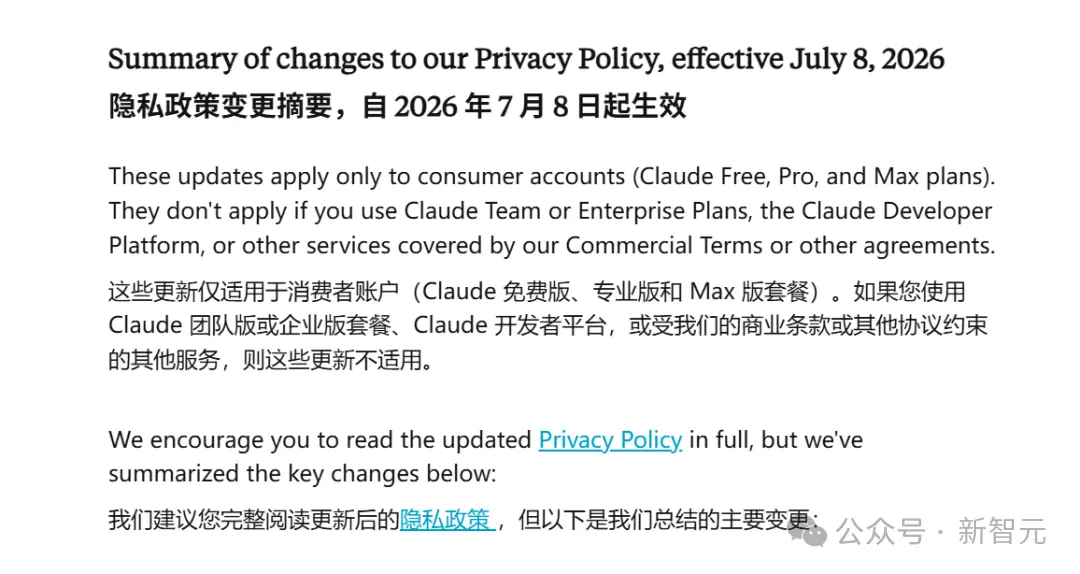
The email mentions that starting July 8th, Anthropic may ask users to verify their age or identity, citing the reason as "enhancing security." More interestingly, some found they just received this email today, while their other accounts hadn't received it at all before, suggesting it might be a batch rollout or an A/B test.

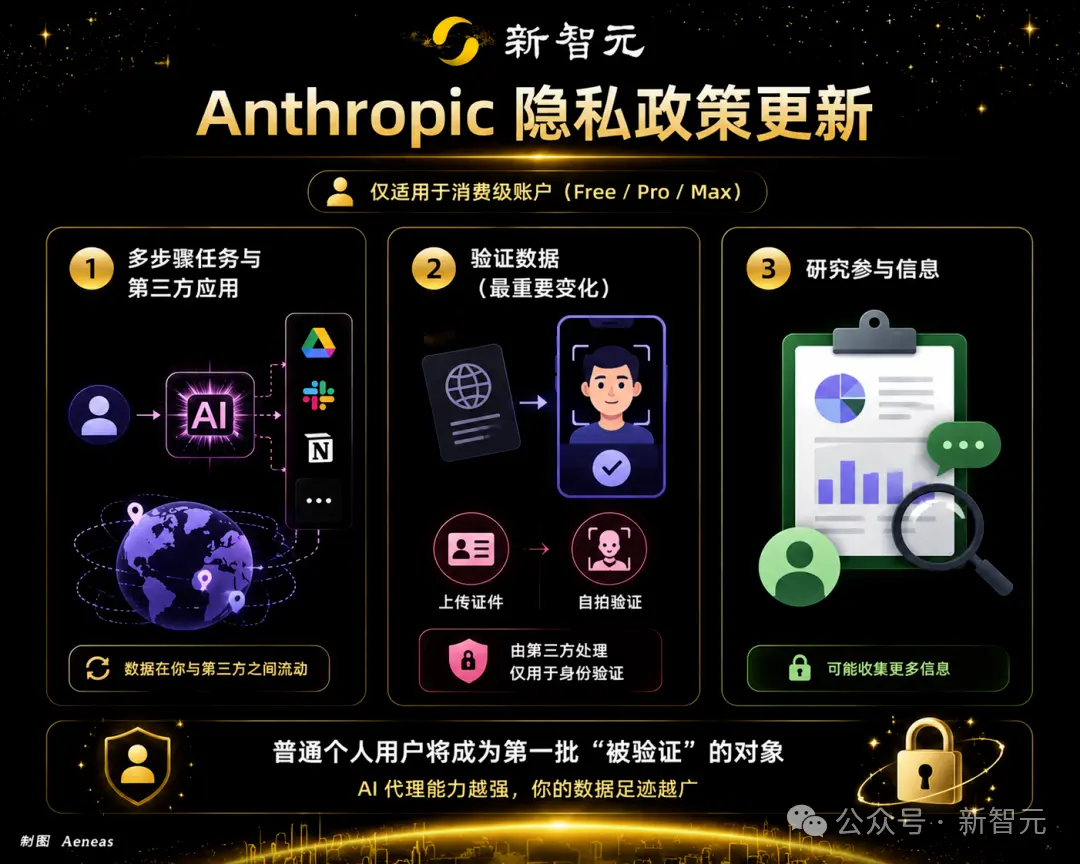
According to the officially updated privacy policy in the email, there are three core changes:
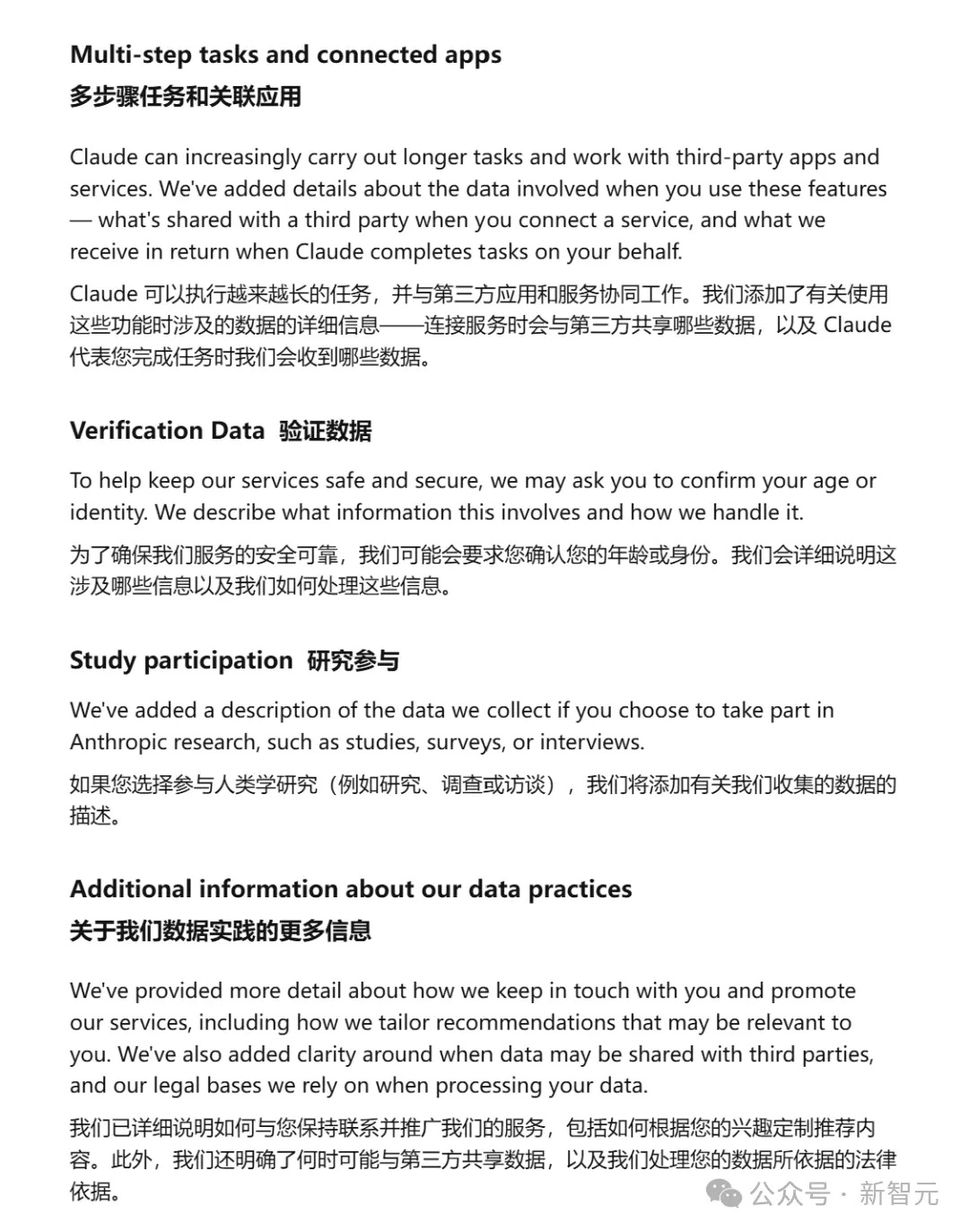
1. Data Flow for Multi-Step Tasks and Third-Party Apps

As Claude's capabilities improve, it can perform multi-step tasks on behalf of users (like helping you plan a full trip: checking flights, booking hotels, arranging itineraries), and can also connect to third-party apps (like Google Drive, Slack, Notion, etc.).

Moreover, your data no longer stays solely on Anthropic's servers. Anthropic explicitly states in the updated privacy policy: When you connect a service or have Claude perform tasks for you, data can flow between you and third parties.

This means your conversation content, uploaded files, and even your commands may leave Anthropic's servers and enter third-party app processing pipelines. For ordinary users, the more powerful the AI's "agentic capabilities," the broader your data footprint becomes.

2. Verification Data (Core Change)

This is the most impactful part of this update. The policy text reads:

As part of our efforts to maintain the security and reliability of our services, we may ask you to verify your age or identity. We are explaining here what information we collect and how.

How will verification be done?

According to Anthropic's official support page, verification will be conducted through the third-party service Persona. The specific process includes:

  • Uploading a government-issued, photo ID document (passport, driver's license, ID card, etc.)

  • Taking a real-time selfie (for comparison with the ID photo)

Anthropic attempts to reassure users, emphasizing that this data is only used to confirm identity, and will not be used for model training; data will not be stored on Anthropic's own servers (handled by Persona); and the entire process is only for specific security and compliance scenarios.

Nevertheless, this notification still shocked the user base. On platform X, one user shared an email screenshot with the caption: "Received on June 10th, thought it was just a regular update at the time... looking back now, terrifying to contemplate." Another user joked: They said they need to verify identity, so is Fable 5 coming back?

3. Research Participation Information

If you participate in Anthropic's research surveys or interviews, they will collect more information.
⚠️ Important Note:

The above three changes apply only to consumer accounts (Free, Pro, Max). Business customers (Team, Enterprise) are not affected. This means ordinary individual users will be the first batch to undergo "verification."

Anthropic explains on its official support page: Identity verification was previously only used in specific scenarios targeting minors, violators, or accounts in unsupported regions. In the future, as agent tasks become more complex, the scope of verification will gradually expand.

Identity verification is not something Anthropic is doing for the first time. Previously, when dealing with minor protection, violators, and accounts in some unsupported regions, similar verification methods have been used. The difference is that this time, the wording and scope are more explicit, and they specifically highlighted one sentence—in the future, as Agent tasks become increasingly complex, verification scenarios may continue to expand.

Many heavy Agent users worry: in the future, when using Claude to run automated tasks, will there be constant pop-ups asking for face scans? Currently, the official has not provided more detailed trigger conditions; after July 8th, there will likely be more specific explanations.

AI's "Wild West Era" Is Coming to an End

Thinking back to the recent uproar over the "Fable 5 Ban" incident, everything seems to have been foreshadowed.

When the Fable 5 account was banned by the authorities for crossing safety red lines, it shocked everyone. Many thought it might be a one-off disciplinary action for an extreme case, but now it appears that Fable 5's downfall is not an isolated incident, but rather a prelude to a comprehensive tightening by Anthropic and even the entire AI industry.

As AI's capabilities evolve from a "chat companion tool" to an "all-powerful agent" capable of operating third-party applications and executing complex tasks, the authorities will never allow another Fable 5 to run wild beyond legal boundaries.

The so-called "real-name system" and "face-scan verification" mark that on the eve of the full-scale explosion of AI Agents, major players must establish an unbreakable accountability tracing mechanism in advance. Once AI causes trouble while booking tickets, editing files, or even executing more complex business commands on your behalf, the platform must know exactly which real-life "person" is giving the orders behind the screen.

From July 8th onward, every time you attempt to have Claude help you complete multi-step complex tasks, it might be accompanied by a pop-up: Please upload your ID document.

Anthropic's message reveals—winter is coming. From now on, face-scan verification and account purging will likely become the norm for the AI industry in 2026.

In another month, when using Claude, one must be prepared to hold up their ID at any moment.

References:

  • https://x.com/ryanmcadams/status/2066201356034011370?s=20

  • https://privacy.claude.com/en/articles/10301952-updates-to-our-privacy-polic

Related Questions

QWhat is the main announcement Anthropic made to its users regarding Claude's privacy policy, and what change is expected starting July 8th?

AAnthropic announced an update to Claude's privacy policy, notifying users that starting July 8th, the company may require them to verify their age or identity to enhance security. This verification would be conducted through the third-party service Persona and could involve uploading a government-issued photo ID and taking a live selfie.

QAccording to the article, what are the three key changes outlined in the updated privacy policy?

AThe three key changes are: 1) Clarification on how user data flows during multi-step tasks and interactions with third-party apps connected to Claude. 2) The introduction of identity and age verification for users. 3) Clarification on the collection of information for users participating in Anthropic's research programs, such as surveys and interviews.

QWhich group of Claude users will primarily be affected by the new identity verification requirement?

AThe new identity verification requirement will primarily affect consumer-level accounts, including Free, Pro, and Max plans. Business customers using Team or Enterprise plans are not impacted by this change.

QWhat is the stated reason Anthropic is implementing identity verification, and how does the company claim to handle the collected data?

AAnthropic states the reason for implementing identity verification is to enhance the safety and reliability of its services. The company claims the data will only be used to confirm identity, not for model training. The verification process is handled by the third-party service Persona, and the data is not stored on Anthropic's own servers.

QHow does the article connect this policy change to the broader trend in the AI industry, specifically mentioning the 'Fable 5' incident?

AThe article suggests this policy change is part of a broader industry-wide tightening of regulations. It connects it to the 'Fable 5' incident, where an account was banned for safety violations, implying that as AI agents like Claude become capable of performing complex, multi-step tasks, companies must establish clear accountability and traceability to prevent misuse, marking the end of a more 'wild' era for AI.

Related Reads

Jane Street: The Most Powerful Behind-the-Scenes Operator in the Crypto Industry

Jane Street: Crypto's Most Powerful Behind-the-Scenes Operator A recent 13F filing revealed Jane Street, the secretive Wall Street quant giant, drastically reduced its Bitcoin ETF holdings while increasing stakes in Ethereum ETFs. This move highlights its role not as a directional investor, but as a critical infrastructure player extracting "tolls" from crypto's institutionalization. The firm, founded in 2000 and famously lacking a CEO, has systematically embedded itself across crypto markets. It acts as a key Authorized Participant (AP) and market maker for major Bitcoin and Ethereum ETFs, profiting from arbitrage between ETF shares and underlying assets. Its approach combines quantitative prowess with a willingness to hold positions for structural arbitrage, differing from pure high-frequency traders. Jane Street faces allegations related to the 2022 Terra (LUNA) collapse. A lawsuit claims it used non-public information to withdraw $85 million in UST minutes before a critical withdrawal by Terraform Labs, allegedly exacerbating the crash and avoiding over $200 million in losses. The company denies the claims. Further indicating its reach, a wallet suspected to be operated by Jane Street ("JaneStreetIndia") was identified on the prediction market Polymarket. This bot executed over 11,000 high-frequency trades on short-term crypto price movements with a near-perfect win rate, showcasing a套利 strategy divorced from traditional prediction. Beyond trading, Jane Street holds equity in crypto infrastructure like Kraken, 1inch, and Arbitrum, and mining stocks. Its strategy is clear: avoid betting on winners, but secure a position in the market's essential plumbing. By becoming a ubiquitous part of the liquidity infrastructure—from ETFs to OTC trading and potentially链上 markets—Jane Street operates as a market force itself, raising questions about whether crypto's decentralized,散户-friendly alpha is being permanently eroded by traditional finance's most sophisticated players.

Foresight News5m ago

Jane Street: The Most Powerful Behind-the-Scenes Operator in the Crypto Industry

Foresight News5m ago

U.S.-Iran Ceasefire: How Much of a Bitcoin Rally Can a Truce Agreement Support?

Headline: "U.S.-Iran Truce: How Much Can a Ceasefire Agreement Propel Bitcoin's Rebound?" On June 15th, Bitcoin rebounded to around $67,255, marking its first return to the $67,000 level since falling below $60,000 earlier in June. Ethereum and Solana also saw significant gains. The immediate driver for this market-wide recovery in crypto and global risk assets was the signing of a U.S.-Iran ceasefire memorandum, with a formal ceremony scheduled for June 19th. The agreement, which includes reopening the Strait of Hormuz, caused oil prices to plunge roughly 5%, easing inflation expectations and boosting prospects for Federal Reserve rate cuts. This macroeconomic shift fueled a rally in U.S. equities, with the Dow Jones hitting a record high. SpaceX's spectacular post-IPO performance further energized market sentiment. However, on-chain and derivatives data from Glassnode suggest this move is more indicative of a technical rebound from deeply oversold conditions rather than a confirmed trend reversal. The crypto market is undergoing noticeable capital rotation. While Bitcoin ETFs recently saw their worst outflows on record, the bleeding has slowed significantly. Meanwhile, new altcoin ETFs for assets like XRP and Solana are attracting substantial inflows, causing Bitcoin's market dominance to drop to 58%. Despite the rebound, the Crypto Fear & Greed Index remains in "Extreme Fear" territory at 22. The price quickly retreated after touching the $67,000 resistance level, indicating selling pressure persists. Analysis shows short-term speculative supply has been heavily washed out, with holder structure shifting toward a more long-term profile. While panic is subsiding and some on-chain metrics point to accumulation at lower prices, the market currently lacks the strong, sustained institutional buying needed to establish a new bullish trend.

Foresight News22m ago

U.S.-Iran Ceasefire: How Much of a Bitcoin Rally Can a Truce Agreement Support?

Foresight News22m ago

Copper, the Gold of 2026

Copper: The New Gold for 2026? Market focus has shifted from AI chips to underlying infrastructure, with copper emerging as a key narrative. Its role is evolving beyond "Dr. Copper"—a traditional indicator of economic cycles—due to structural demand growth from AI data centers (requiring massive electrical infrastructure), grid expansion, EVs, and re-industrialization. Estimates suggest data centers alone could require 300,000 tons of copper by 2050. The core bullish thesis is not just demand but a severe supply constraint. New copper mines take ~17 years to develop, while ore grades are declining and new discoveries are scarce, potentially leading to a 30% supply deficit by 2035. This supply rigidity, coupled with strategic importance, is giving copper a "gold-like" scarcity narrative. Major macro investors, including Stanley Druckenmiller, are allocating to copper as a hedge against dollar weakness and for its exposure to energy transition and geopolitics. Traders like Pierre Andurand have projected prices could reach $40,000/ton. Capital inflows are visible in surging futures trading volumes. Copper mining stocks act as leveraged plays on copper prices. Companies like Freeport-McMoRan (FCX) and Southern Copper (SCCO), as well as Chinese miners like CMOC, have seen significant volatility, offering high upside but also steep drawdowns, reflecting operational and geopolitical risks. While copper remains cyclical and won't fully replicate gold's monetary role, its long-term fundamentals have shifted. Its new scarcity premium, driven by a tightening supply structure and expanding electrical demand, suggests its "goldification" is just beginning.

marsbit29m ago

Copper, the Gold of 2026

marsbit29m ago

Trading

Spot
Futures

Hot Articles

How to Buy ID

Welcome to HTX.com! We've made purchasing SPACE ID (ID) simple and convenient. Follow our step-by-step guide to embark on your crypto journey.Step 1: Create Your HTX AccountUse your email or phone number to sign up for a free account on HTX. Experience a hassle-free registration journey and unlock all features.Get My AccountStep 2: Go to Buy Crypto and Choose Your Payment MethodCredit/Debit Card: Use your Visa or Mastercard to buy SPACE ID (ID) instantly.Balance: Use funds from your HTX account balance to trade seamlessly.Third Parties: We've added popular payment methods such as Google Pay and Apple Pay to enhance convenience.P2P: Trade directly with other users on HTX.Over-the-Counter (OTC): We offer tailor-made services and competitive exchange rates for traders.Step 3: Store Your SPACE ID (ID)After purchasing your SPACE ID (ID), store it in your HTX account. Alternatively, you can send it elsewhere via blockchain transfer or use it to trade other cryptocurrencies.Step 4: Trade SPACE ID (ID)Easily trade SPACE ID (ID) on HTX's spot market. Simply access your account, select your trading pair, execute your trades, and monitor in real-time. We offer a user-friendly experience for both beginners and seasoned traders.

3.0k Total ViewsPublished 2024.03.29Updated 2026.06.02

How to Buy ID

Discussions

Welcome to the HTX Community. Here, you can stay informed about the latest platform developments and gain access to professional market insights. Users' opinions on the price of ID (ID) are presented below.

活动图片