Public Version of Mythos Officially Launched: Analyzing the Advantages and Limitations of AI Smart Contract Auditing

marsbitPublished on 2026-06-11Last updated on 2026-06-11

Abstract

Publicly available Mythos, Anthropic's AI model, has officially launched, demonstrating both significant potential and limitations in smart contract security auditing. The article analyzes its capabilities through real-world cases. AI excels in identifying subtle, low-level vulnerabilities through pattern recognition and large-scale code screening. A key example is detecting a storage slot collision between a custom rewards mapping and a third-party library's ReentrancyGuard, a vulnerability easily missed in manual audits. In the recent Zcash incident, AI also rapidly discovered a critical soundness bug that had remained hidden for years. However, AI currently struggles with complex, interconnected scenarios. When tested on the Curve LlamaLend sDOLA exploit, which involved manipulating prices across multiple protocols (Curve pools, lending markets) to trigger liquidations, Fable 5 failed to identify the core cross-protocol attack vector. These scenarios require a deep understanding of DeFi economic models and multi-contract interactions. In conclusion, while AI tools like Mythos significantly boost efficiency in finding standardized, syntactic vulnerabilities, they cannot yet replace expert analysis for complex, business-logic, and cross-protocol attacks. An effective audit workflow combines AI's speed for initial screening with human expertise for in-depth, holistic analysis.

Original Source: Beosin

On June 9th, Anthropic officially launched the public version of Mythos, Claude Fable 5. Previously, Mythos demonstrated outstanding capabilities in security vulnerability discovery, rapidly identifying hidden vulnerabilities within systems, which garnered significant attention in the cybersecurity field.

The recent Zcash incident is a typical example of AI uncovering blockchain vulnerabilities. Security researcher Taylor Hornby, using the Anthropic Claude Opus 4.8 model, discovered a latent Orchard privacy pool soundness vulnerability within just a few hours. This vulnerability, which had gone unnoticed in multiple previous manual audits over four years, theoretically allowed the minting of unlimited undetected fake ZEC, directly causing the price of ZEC to plummet by nearly 40%.

Currently, AI has demonstrated astonishing efficiency in areas such as code pattern matching and batch preliminary screening. Integrating AI into the blockchain and smart contract security audit process is becoming a trend in the Web3 security industry. This article will analyze the strengths and weaknesses of AI in smart contract auditing based on real vulnerability cases and the actual performance of Fable 5.

Advantageous Scenarios for AI Auditing

Case Analysis: Storage Slot Collision

A certain contract used the following two components simultaneously:

1. A custom rewards mapping (used to record user claimable rewards)

2. The Solady library's ReentrancyGuard (to prevent reentrancy attacks)

However, the storage layouts of these two components conflicted.

Among them, Solady's ReentrancyGuard, for ultimate gas optimization, uses a fixed, low-numbered storage slot (typically a slot near constant obtained through specific calculations). The typical logic of the nonReentrant modifier is:

// A simplified versionmodifier nonReentrant() {    // when entering, write guard slot as 0xff...ff(Sentinel Value)    assembly {        if eq(sload(REENTRANCY_GUARD_SLOT), 2) { revert(...) }  // 2 represents locked        sstore(REENTRANCY_GUARD_SLOT, 2)  // locked    }    _;    // recover when function finishes    assembly { sstore(REENTRANCY_GUARD_SLOT, 1) }}

Custom rewards mapping:

mapping(address => uint256) public rewards;

According to Solidity storage layout rules (the first slot of a mapping is calculated from its declaration position), the first slot of the rewards mapping was exactly the same as the fixed guard slot of the ReentrancyGuard.

Attack process (detailed steps):

1. The attacker calls the getReward() function.

2. The nonReentrant modifier triggers, writing the guard slot as 0xffffffffffffffffffffffffffffffffffffffffffffffffffffffffffffffff (all 1s).

3. The contract code subsequently reads rewards[attacker's address] — but due to the slot collision, it actually reads the large value of 0xff...ff from the guard slot.

4. The contract assumes "there is a huge reward," thus transfers that amount of ETH to the attacker, while attempting to zero out rewards[attacker] (but writes back to the same guard slot).

5. Because the modifier restores the slot when the function ends, when the attacker calls getReward() again, the process repeats.

6. The attacker cyclically calls 200 times, successfully extracting a fixed amount of ETH each time, until the contract's available ETH is drained.

It's important to note that this is not a traditional "reentrancy attack" but rather the ReentrancyGuard's own protection mechanism being reverse-engineered by storage collision, turning into a vulnerability for infinite reward claims. Manual audits rarely dig line-by-line into the storage layout of third-party libraries, while AI can instantly perform library version comparison + precise storage slot mapping, directly hitting such "hidden collision" vulnerabilities.

Disadvantageous Scenarios for AI Auditing

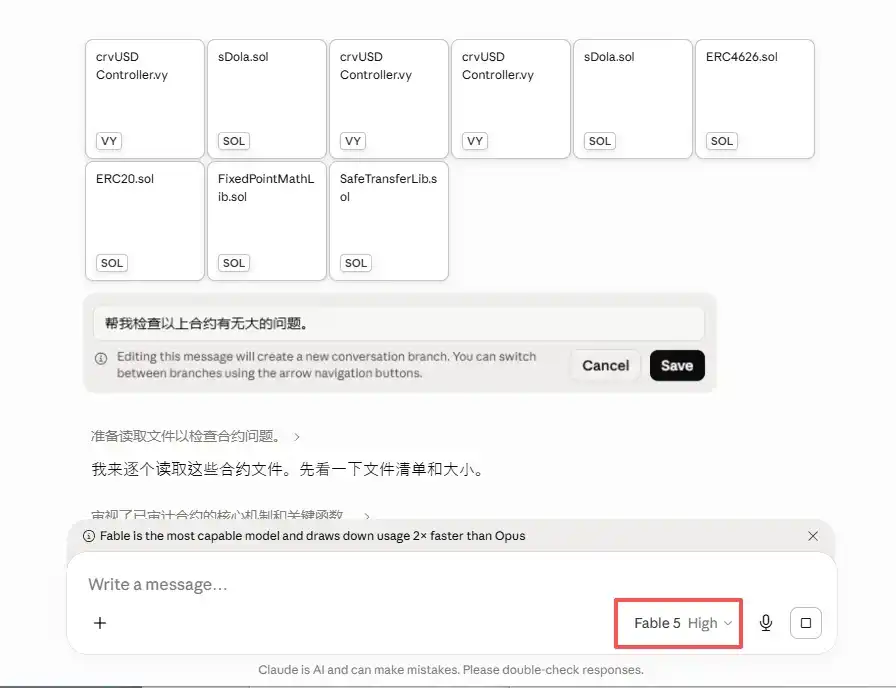
Fable 5 performs excellently in detecting single-contract, pure-code-syntax, low-level storage-class vulnerabilities. However, it still shows obvious limitations when facing cross-protocol combined semantics and multi-contract composite attacks. We used the latest public version Fable 5 to retest contracts related to the Curve LlamaLend sDOLA attack incident. The results confirmed this issue.

This audit involved the following contract list: crvUSD Controller.vy, sDOLA.sol, ERC4626.sol, and other series contracts. Fable 5 failed to identify the core risks corresponding to this attack:
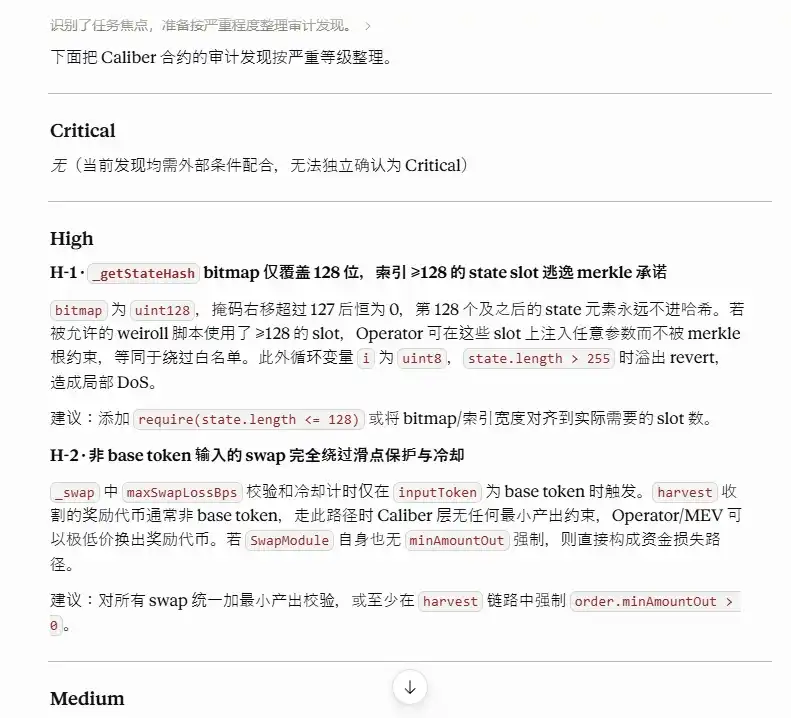
This incident belongs to a typical cross-protocol composite vulnerability. The syntax and logic of a single contract's code are flawless, but the attacker exploits multi-protocol linkage to construct an attack chain:

1. Utilizing flash loan tools to manipulate the price of the Curve liquidity pool, maliciously suppressing the asset price of sDOLA (an ERC-4626 vault share).

2. A large number of lending positions using sDOLA as collateral trigger the liquidation threshold.

3. The attacker executes liquidation operations in batches, profiting from them.

Such vulnerabilities are formed based on DeFi multi-protocol combinations, testing the comprehensive analysis capabilities of AI/audit experts regarding the overall business and protocol economic models. Currently, AI auditing still has shortcomings in cross-protocol combined semantics.

Conclusion

Through actual case testing, it can be seen that Fable 5 effectively uncovers hidden vulnerabilities that are easily missed in manual audits in standardized, detail-oriented scenarios such as storage slot conflicts, code pattern vulnerabilities, single-contract logic flaws, and batch code preliminary screening. However, when dealing with cross-protocol combined semantics, DeFi economic models, multi-contract linkage attacks, and complex business logic vulnerabilities, it struggles to understand the business nature of the on-chain ecosystem and discover composite attack paths. This part still requires analysis led by professional security auditors.

In daily audit work, Beosin has established a mature collaborative audit process combining AI and security audit experts. This not only significantly improves audit efficiency but also better identifies potential detailed risks and complex business logic vulnerabilities, making audit work more efficient, comprehensive, and in-depth.


Related Questions

QWhat major AI model was released for public use, and what specific capability in cybersecurity has it demonstrated?

AAnthropic officially released the public version of Mythos, specifically the Claude Fable 5 model. It has demonstrated a strong capability in proactively discovering hidden security vulnerabilities within systems, particularly in areas like storage slot collisions within smart contracts.

QWhat is the key limitation of AI like Claude Fable 5 in smart contract auditing, according to the article's analysis of the Curve LlamaLend sDOLA attack?

AThe key limitation is its difficulty in handling cross-protocol combinatorial semantics and multi-contract interaction attacks. While effective for single-contract, syntax-level vulnerabilities, it struggles to understand the overall business logic and economic models of DeFi protocols that involve interactions between multiple smart contracts.

QDescribe the storage slot collision vulnerability example given in the article. How did AI auditing help discover it?

AThe vulnerability involved a collision between a custom `rewards` mapping and the fixed storage slot used by the Solady library's `ReentrancyGuard`. This allowed an attacker to repeatedly drain ETH by tricking the contract into reading the guard's sentinel value as a massive reward balance. AI auditing excelled here by instantly comparing library versions and precisely mapping storage layouts, pinpointing this 'hidden collision' that manual audits often miss.

QWhat was the outcome of using Anthropic Claude Opus to analyze Zcash, as mentioned in the article?

ASecurity researcher Taylor Hornby used the Anthropic Claude Opus 4.8 model and discovered a critical 'soundness' vulnerability in Zcash's Orchard privacy pool within a few hours. This bug, which had gone undetected through multiple manual audits for four years, could theoretically allow the unlimited minting of undetectable fake ZEC, causing ZEC's price to drop nearly 40%.

QWhat workflow does Beosin advocate for in smart contract security auditing based on the article's conclusion?

ABeosin advocates for a mature, collaborative workflow that combines AI tools with human security audit experts. This synergy leverages AI for efficiency in standardized tasks and detail-oriented vulnerability detection (like pattern matching and initial screening) while relying on human experts to lead the analysis of complex business logic, cross-protocol interactions, and DeFi economic models, resulting in a more efficient, comprehensive, and in-depth audit process.

Related Reads

Female Crypto Mogul Survived Mining Crackdown and Market Plunge, but Paid a $60 Million Tuition to a U.S.-Style 'Pig-Butchering' Scam

An 80s-born Chinese entrepreneur, Fiona Lyu (also known as Lv Yongshuang), CEO of the mining firm Chengdu Valarhash Technology, was defrauded of over $9.4 million (approx. RMB 60 million) in the US, according to a Caixin report. Lyu's company once operated the 1THash and Bytepool mining pools, which collectively controlled about 9% of the global Bitcoin hash rate at their peak in early 2020. The scam began in 2021 after China's crackdown on crypto mining forced Lyu to seek overseas relocation for her operations. She was introduced to Zubair Al Zubair, who posed as an "UAE royal family member" with connections to Middle Eastern capital and US local government resources. He and his brother, who impersonated a hedge fund manager, orchestrated a fake contract signing for a mining facility in Ohio, witnessed by local officials. Lyu transferred millions in contract payments. The brothers, both US citizens with fabricated backgrounds, later fraudulently sold 1,067 of her miners for $6.17 million. The scheme involved bribing a mayor's chief of staff for legitimacy. In May 2026, US courts sentenced Zubair to 24 years in prison, his brother to 23 years, and the official to 8 years. Simultaneously, Lyu faced a separate legal battle in China. A subsidiary of listed company ST Zhongchang sued her firm, seeking refunds for a 2021 contract involving Bitcoin mining equipment. Chinese courts ruled the mining contract invalid and ordered a refund of nearly RMB 19.3 million. This dual blow marked a stark downturn for the once-prominent figure in the crypto mining industry.

Foresight News6m ago

Female Crypto Mogul Survived Mining Crackdown and Market Plunge, but Paid a $60 Million Tuition to a U.S.-Style 'Pig-Butchering' Scam

Foresight News6m ago

Trade.xyz Pricing Controversy Exposes Fatal Weakness of Pre-IPO Perpetual Contracts

The Trade.xyz pricing controversy surrounding its SPCX (SpaceX) pre-IPO perpetual contract on Hyperliquid has exposed a critical vulnerability in decentralized finance (DeFi) platforms offering such instruments. The dispute erupted after SpaceX's updated filing revealed its total shares outstanding were approximately 10% higher than market estimates. While centralized exchanges (CEXs) paused trading and repriced contracts based on the new data, Trade.xyz maintained its position that its "IPOP" contract tracks market expectations for the per-share price, not the company's fundamental valuation or share count. This discrepancy triggered cross-platform arbitrage and led to significant losses for leveraged long positions on Trade.xyz, as the contract price gaped down without a value-neutral adjustment mechanism. The incident highlights the absence of a "Rebase" function—a mechanism that proportionally adjusts contract prices and user positions to reflect corporate actions like share count changes—within many decentralized perpetual exchanges (Perp DEXs). Unlike CEXs, which can centrally execute such adjustments, implementing Rebase on-chain involves significant technical complexity, gas costs, and potential security risks. Trade.xyz's architecture, which allows independent market deployment, further complicates platform-wide Rebase implementation. The controversy underscores broader challenges for Perp DEXs venturing into real-world assets (RWA) like pre-IPO shares. It raises questions about pricing reliability, transparent rule disclosure, and the ability to handle corporate events, testing user trust and the long-term viability of these synthetic markets for price discovery before official listings.

链捕手22m ago

Trade.xyz Pricing Controversy Exposes Fatal Weakness of Pre-IPO Perpetual Contracts

链捕手22m ago

When AI Traffic Surpasses Humans, How Do You Prove You're Human?

As AI-generated web traffic now surpasses human activity, the internet's foundational business models—built on human attention, browsing, and advertising—face severe disruption. AI agents crawl websites at immense scale without generating ad revenue, while AI summaries divert traffic from original content sites. In response, over 2.5 million sites are blocking AI crawlers, and protections like Cloudflare's "honeypot" traps have emerged, though advanced AI can bypass these. The collapse of traditional CAPTCHAs, which assumed machines were weaker than humans, has led to a shift toward behavioral biometrics for human verification. Companies like IBM and BioCatch now analyze unique human patterns—cursor movements, typing rhythms, keystroke dynamics, and even cognitive delays like the Stroop effect—to distinguish real users from bots. These biometric signatures are difficult to fake or alter, offering a new layer of security but raising significant privacy concerns. Two competing visions for a reliable human verification system are emerging. One, exemplified by Sam Altman’s World (formerly Worldcoin), uses centralized iris scanning to generate unique credentials, though it faces bans and criticism over unauthorized data collection. The other employs cryptographic zero-knowledge proofs, allowing users to prove they are human without revealing identity or biometric data, as advocated by Vitalik Buterin. However, decentralized approaches risk exploitation through identity renting in economically unequal regions. The central dilemma is between a scalable but privacy-invasive centralized system that permanently controls users' biometric data, and a privacy-preserving cryptographic system vulnerable to real-world economic manipulation. The author expresses a preference for the cryptographic path, arguing that despite its flaws, it avoids the irreversible biometric surveillance inherent in centralized alternatives.

Foresight News30m ago

When AI Traffic Surpasses Humans, How Do You Prove You're Human?

Foresight News30m ago

Crypto Primary Market Investment and Financing Forward-Looking Weekly Report | Stablecoin Regulation Nears Implementation, ETF Funds Continue to Withdraw, Capital Begins Betting on Payment and Cash Flow

Crypto Market Weekly Report (Jun 1-7, 2026): Capital Shifts Focus to Payments & Cash Flow Market data indicates a significant divergence: while traditional institutional funds continue exiting via BTC and ETH ETFs (recording net outflows of $1.72B and $168M this week, respectively), stablecoin supply continues growing. This suggests capital is shifting from speculative asset allocation toward defensive positioning within on-chain liquidity, awaiting new, concrete opportunities. This trend is reflected in venture capital focus. Weekly fundraising fell 27% to $302M, with investments concentrating on infrastructure with tangible revenue potential: 1. **Stablecoin Infrastructure (28% of funding):** Projects like M0 Protocol ($35M raise) are gaining attention as regulatory clarity (e.g., the GENIUS Act) nears, shifting the focus from legitimacy to building payment and settlement networks. 2. **AI Agent Infrastructure (26%):** Investments are moving from conceptual AI Agents towards the execution and economic layers required for a functional "Agent economy." Key raises include OpenRouter ($40M) and Halliday ($20M). 3. **Real World Assets (RWA) (18%):** The search for on-chain yield and cash flow drives continued interest in RWA platforms like Ondo Finance. Security threats are evolving from smart contract exploits toward key management failures, permission control issues, and regulatory execution risks (e.g., court-ordered asset freezes). **Key Takeaways:** The investment thesis is shifting from narrative-driven bets to revenue and cash-flow-generating protocols. Future attention should be on the progression of stablecoin regulations, the commercial validation of AI Agent economies, and the performance of high-revenue protocols like derivatives platforms.

marsbit37m ago

Crypto Primary Market Investment and Financing Forward-Looking Weekly Report | Stablecoin Regulation Nears Implementation, ETF Funds Continue to Withdraw, Capital Begins Betting on Payment and Cash Flow

marsbit37m ago

Trading

Spot
Futures
活动图片