WeChat Looks to Overturn Qianwen's Table

marsbitPublished on 2026-06-10Last updated on 2026-06-10

Abstract

WeChat is entering the AI agent arena, directly challenging Alibaba's Qianwen. On June 8, WeChat opened its AI ecosystem to developers, allowing integration of its AI assistant into mini-programs. Users will soon be able to access this assistant by swiping right in the main WeChat interface, using natural language to perform tasks like hailing rides, ordering food, shopping, and making payments—essentially enabling actions like "one-sentence ride-hailing or food delivery" within WeChat. This capability targets the core strength of Alibaba's Qianwen, which has leveraged the broader Alibaba ecosystem (including Taobao, Amap, and Fliggy) to transform from a chatbot into a life-service assistant capable of handling real-world transactions. Qianwen has seen significant success, with hundreds of millions of orders processed during promotional events. WeChat's move is significant due to its massive ecosystem of millions of mini-programs covering various daily service scenarios and its over 1 billion monthly active users. This gives WeChat a potentially unparalleled advantage in user reach and habitual use compared to Qianwen's 166 million MAU. Major platforms like Meituan, JD.com, and Ctrip have already announced alliances with WeChat AI. In response, Qianwen announced on June 3 the opening of its platform to third-party agents and brands, aiming to expand its service network and solidify its competitive moat. The article frames this as the beginning of a new phase of intense com...


By Lan Meihui, Author: Ye Er, Editor: Wei Xiao

Qianwen's biggest rival has arrived.

On June 8th, WeChat officially opened up its AI ecosystem access capabilities to developers, allowing them to authorize and connect to WeChat AI from the Mini Program backend.

This means that the highly anticipated WeChat AI Agent is about to become a reality.

According to AI Lan Meihui, users can swipe right on the WeChat main interface to access the Agent's chat window and use natural language commands to automatically invoke Mini Programs to complete tasks such as hailing rides, ordering food, booking tickets, shopping, and making payments.
This enables "one-sentence ride-hailing, food ordering, shopping," and more within WeChat.

Those familiar with the current AI-native application industry know that this aligns directly with the Agent service and transaction closed-loop capabilities that Qianwen has been deeply cultivating.

One fact is that this year, in the battle for the AI super-entry point, Qianwen's core strategy has been to continuously integrate services like Taobao Flash Sales, Gaode Taxi, Fliggy, and Taobao Shopping by leveraging the Alibaba ecosystem. This not only makes Qianwen a unified AI entry point for users to access Alibaba's full range of services but also transforms Qianwen from a ChatBot into a life services assistant with the ability to serve the real, physical world.

For a long time, this kind of Agent service and transaction closed-loop has been seen as Qianwen's core moat, perhaps even a capability unique to Qianwen.

But now, with WeChat personally entering the fray, the situation looks very different.

Targeting Qianwen's Core Territory

Many have already experienced the service capabilities of Agents through Qianwen, perhaps for the very first time.

Ordering milk tea with a sentence, hailing a taxi with a sentence, or even completing e-commerce shopping directly through conversation with an AI—this interactive logic of AI Agents is quietly changing user habits and penetrating user minds.
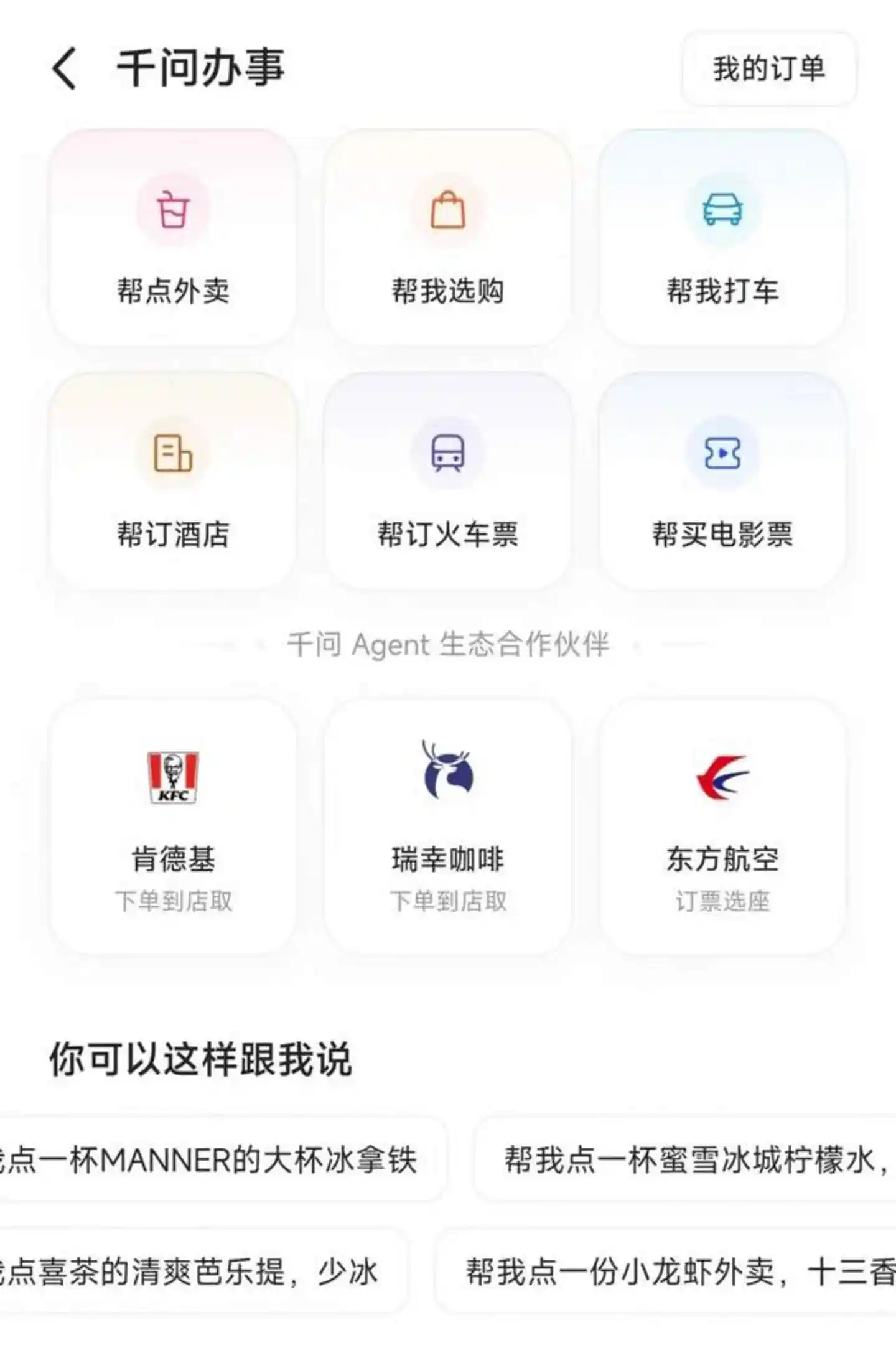
Data shows that during Qianwen's "Spring Festival Hosting" campaign alone, orders exceeded 10 million within 9 hours of launch, reaching 15 million actual orders on the first day, with AI completing nearly 200 million order placements.

This is regarded by the industry as the world's first large-scale commercialization verification of AI Agents, also making Qianwen a key window for the public to perceive the capabilities of AI Agents.

Why? The reason is quite understandable—Qianwen is uniquely positioned.

On one hand, the Alibaba ecosystem it relies on inherently possesses closed-loop service scenarios across e-commerce, mobility, local life, travel, and more. On the other hand, under Alibaba's AI strategy, Alibaba is fully supporting Qianwen, facing virtually no barriers and acting swiftly in integrating with various business units.

Having a rich ecosystem is one thing, but also needing sufficient willingness to cooperate from all parties—until now, only Qianwen met both conditions.

But now, WeChat must be added to the list.

Firstly, with WeChat taking the initiative this time, its ecosystem of millions of Mini Programs inherently covers daily life scenarios such as ride-hailing, food delivery, ticket booking, grocery shopping, and retail. This provides an ecological foundation comparable to Alibaba's.

According to the WeChat Open Class PRO disclosure in January 2026, the WeChat ecosystem has a stable monthly active user base of 1.07 billion, with Mini Programs covering 108 verticals. Although WeChat hasn't announced the exact number of Mini Programs, the market generally estimates that the number of active Mini Program principals is in the millions.

Even in the e-commerce field, the number of merchants on WeChat Shops is growing rapidly.

Data from 2025 shows that the monthly number of active merchants on WeChat Shops reached 1.7 times that of the same period last year, and the overall GPM (Gross Merchandise Volume per 1000 Impressions) also increased to 1.5 times. The scale of cross-platform sales via WeChat more than doubled compared to the previous year.

This is enough to show that in terms of AI Agents, WeChat's Mini Program ecosystem can indeed rival Alibaba's.

Secondly, Mini Program principals are willing to actively cooperate with WeChat AI.

Even though service providers of Mini Programs may risk being commoditized in the Agent service business model, none can resist the super traffic advantage of WeChat.

As of now, including JD.com, Meituan, Ctrip, and others have all taken the lead in expressing their embrace of WeChat AI, seemingly determined to secure their place on WeChat's massive ship in the AI era. It's worth noting that the current WeChat has indicated its intent to join the battle for the AI super-entry point. Under this opportunity, cooperation between Mini Program principals and WeChat naturally presents a viable shortcut.

Furthermore, compared to Qianwen, WeChat has another advantage: as a national-level infrastructure, it inherently possesses three underlying high-frequency scenarios—social interaction, life services, and Mini Programs—naturally offering user stickiness difficult for other products to replicate.

Other manufacturers need to continuously invest marketing costs to educate users to actively open AI software to cultivate AI usage habits. WeChat, however, can embed the AI Agent into the native paths of daily chatting, searching, and service invocation, completing the landing of AI through users' subtle, habitual use.

In comparison, QuestMobile data shows that as of March 2026, Qianwen's monthly active user scale was 166 million, with an average active rate of 17.1%. User stickiness is rapidly improving, but it's clearly not on the same scale as WeChat, which boasts over 1 billion monthly active users.

This means that once WeChat makes its move, it could directly breach Qianwen's moat, rush into its core territory, and compete with Qianwen for the Agent To Agent business.

Recruiting Allies to Their Circles

Of course, Qianwen is also reinforcing its moat.

On June 3rd, Qianwen announced the full opening of its platform to third-party Agents and Skill modules. All enterprises can operate their own branded Agents on the platform, with Luckin Coffee, KFC, Mixue Bingcheng, China Eastern Airlines, and others among the first batch of companies conducting service tests.

The purpose of this move is clear: to leverage the scenario capabilities of brand partners to complement Qianwen's service portfolio, further widen the industry gap, and solidify its competitive barriers.
More importantly, through this, Qianwen aims to signal openness and cooperation to the market.
The timing, just one day after WeChat's AI Agent was publicly revealed on June 2nd, clearly indicates that Qianwen sensed the threat posed by WeChat and reacted quickly.

In building the Agent To Agent closed-loop system, where the technical capabilities of major players are largely on par, the richness of the scenario landscape becomes the key area for intensified focus.

Qianwen's opening up is precisely a preemptive judgment against WeChat's powerful appeal.

And the facts bear this out.

Within just seven days, the commercial ecosystem of WeChat's AI Agent has begun to take shape. Smartphone manufacturers, local life giants, e-commerce platforms, and millions of Mini Program merchants have all been incorporated into the same map, showing very positive willingness to embrace WeChat's AI Agent.

They are even broadcasting it widely. As of now, platforms like Meituan, JD.com, Dewu, and Ctrip have all intensively and prominently announced their alliances with WeChat.
A vigorous campaign of recruitment and alignment is in full swing.
In the mobile internet era, Tencent, JD.com, and Meituan competed directly with Alibaba by exchanging 'half their lives.' Now, this story is playing out again in the AI era.


Related Questions

QWhat is the core strategic move Tencent's WeChat has recently made in the AI field according to the article?

AOn June 8, WeChat formally opened its AI ecosystem access capabilities to developers, allowing them to authorize and integrate with WeChat AI in the mini-program backend. This move signals the imminent launch of the highly anticipated WeChat AI Agent.

QWhat specific capability of Alibaba's Qianwen does WeChat's new AI initiative directly challenge?

AWeChat's initiative directly challenges Qianwen's Agent-based service and transaction闭环 (closed-loop) capability. This is Qianwen's core competitive moat, which allows users to complete tasks like hailing rides, ordering food, and shopping through natural language commands within its platform.

QWhat are the two key advantages the article highlights for WeChat in competing with Qianwen in the AI Agent arena?

AFirst, WeChat's ecosystem of millions of mini-programs provides a rich soil of services (ride-hailing, food delivery, shopping) comparable to Alibaba's. Second, as a national-level infrastructure with over 1 billion monthly active users, WeChat offers unparalleled user stickiness and can integrate AI Agents seamlessly into users' daily routines.

QHow did Alibaba's Qianwen respond to the potential threat from WeChat's AI move?

AOn June 3, Qianwen announced it would fully open its platform to third-party Agents and Skill modules. This allows enterprises to operate their own branded Agents on Qianwen's platform, aiming to expand its service landscape and reinforce its competitive barriers through open collaboration.

QWhat does the article suggest is the current state of the competitive landscape between WeChat and Qianwen regarding partner alliances?

AA fierce battle for alliances and partnerships is underway. Major platforms like Meituan, JD.com, and Ctrip have publicly announced their alliances with WeChat AI. Meanwhile, Qianwen is also opening its platform to brands like Luckin Coffee and China Eastern Airlines, mirroring the 'exchanging half their lives' competitive dynamic seen in the mobile internet era.

Related Reads

AI Investors' 2026 Anxiety: When Models Devour Everything, What Moat Is Left for Startups?

In 2026, a wave of investor anxiety questions the defensibility of AI startups as models improve, fearing that most companies are just "thin wrappers" destined to be absorbed by foundation models or chipmakers. The author argues against this despair, positing that true moats lie not in benchmark performance but in areas models cannot easily reach. The logic of despair is that if models excel at all measurable tasks, only compute and cutting-edge model weights hold lasting value. However, the essay contends that the most valuable work is inherently "untrainable." Benchmarks measure what can be measured and thus optimized for, but real-world correctness often resides in private, complex systems. Examples include legacy codebases, intricate legal transactions, or hospital workflows. This kind of correctness is proprietary, costly to establish, and cannot be validated quickly—it requires time and trust within an organization. As models commodify visible, measurable tasks from both above (labs absorbing scaffolding) and below (saturation by cheaper models), value shifts to "untrainable ground." This encompasses work where correctness is a private truth, locked behind integration barriers, licenses, liability frameworks, and entrenched user habits. Trust and adoption are slow, human-centric processes that smarter models cannot accelerate. Successful companies defend their position by embedding deeply into client operations, owning the definition of "good" within a specific domain (e.g., Harvey in law, OpenEvidence in medicine), and pricing on outcomes rather than tokens. While labs compete fiercely, they are incentivized to keep the application layer vibrant. The future belongs not to those competing on generic benchmarks but to those navigating unscoreable terrain, doing the "unsexy work" of translation between models and messy human realities. The most cited benchmark scores are thus maps of territory about to become worthless, signaling who will lose the right to define what counts as good.

marsbit7m ago

AI Investors' 2026 Anxiety: When Models Devour Everything, What Moat Is Left for Startups?

marsbit7m ago

Trump's Crypto Empire: A $2.3 Billion Wealth Transfer Experiment

In June 2026, Reuters investigations revealed that since Donald Trump's return to the White House, his family has accumulated roughly $2.3 billion in profits from four core crypto ventures: World Liberty Financial (WLFI), the $TRUMP meme coin, American Bitcoin, and ALT5 Sigma (later renamed AI Financial). Coincidentally, overall investor losses in these projects were estimated to be a similar amount. The businesses, spanning DeFi, stablecoins, meme coins, Bitcoin mining, and digital payments, largely relied not on technological innovation but on converting the political influence and notoriety of the Trump brand into financial assets sold to the market. This marks a dramatic shift from Trump's earlier skepticism of cryptocurrencies. The ventures operated on a similar logic: leveraging the Trump name to generate market hype and trust, attracting investment through token sales or public listings, and enabling the family to capture profits upfront through equity, token allocations, and fees, while later entrants often bore the brunt of the risk as markets cooled. WLFI, the most profitable venture, generated an estimated $1.6 billion for the family, primarily through sales of its locked, illiquid governance token and its USD1 stablecoin. The $TRUMP meme coin, a direct monetization of the presidential IP, brought in over $600 million for Trump-linked entities before its price crashed nearly 97% from its peak. American Bitcoin gained a "Trump stock" premium for its mining operations, and ALT5 Sigma/AI Financial combined Trump, AI, and crypto themes for a temporary valuation surge. The episode underscores how political influence can be packaged into financial assets, creating substantial wealth for promoters while highlighting the risks for investors who base decisions on hype and brand allegiance over fundamental business models and cash flows.

marsbit47m ago

Trump's Crypto Empire: A $2.3 Billion Wealth Transfer Experiment

marsbit47m ago

CFTC Proposes New Rules for Prediction Markets, Redefining Which Events Can Be Listed and Who Can Participate

The U.S. Commodity Futures Trading Commission (CFTC) has proposed new rules to establish a clearer regulatory framework for prediction markets. The proposal aims to modify how "event contracts" are reviewed, creating a structured process to determine if contracts involving terrorism, assassination, war, or illegal activities violate the public interest. This moves away from a blanket ban toward a case-by-case assessment of whether a contract's subject matter is acceptable for financial trading. A key focus is distinguishing between predicting the impact of risks and predicting the occurrence of harm. The proposal suggests that many sports-based prediction markets—such as those on game outcomes, scores, or season standings—may be permissible as they can provide price discovery and meaningful information. However, markets on easily manipulated events like specific player injuries, referee calls, or outcomes of youth sports would face stricter scrutiny. The rules directly target insider trading and manipulation risks, highlighting cases where individuals with non-public information or the ability to influence an event's outcome could unfairly profit. This underscores a shift toward ensuring market fairness. The proposal does not end the regulatory debate, particularly with state gambling regulators who argue that sports prediction markets are essentially sports betting and should fall under state jurisdiction. Nonetheless, the CFTC's action signals a move toward formalizing prediction markets, pushing the industry from a phase of rapid, often unregulated expansion into a more institutionalized, rule-based environment that more closely resembles traditional financial markets.

marsbit59m ago

CFTC Proposes New Rules for Prediction Markets, Redefining Which Events Can Be Listed and Who Can Participate

marsbit59m ago

Trading

Spot
Futures

Hot Articles

Discussions

Welcome to the HTX Community. Here, you can stay informed about the latest platform developments and gain access to professional market insights. Users' opinions on the price of S (S) are presented below.

活动图片