You may not be able to imagine that every time you ask ChatGPT to write a 100-word weekly report, or have Claude modify a few lines of code, somewhere on Earth, in a cooling water pipe, about 500 milliliters (equivalent to a bottle of Nongfu Spring) of pure fresh water turns into white steam and evaporates into thin air.
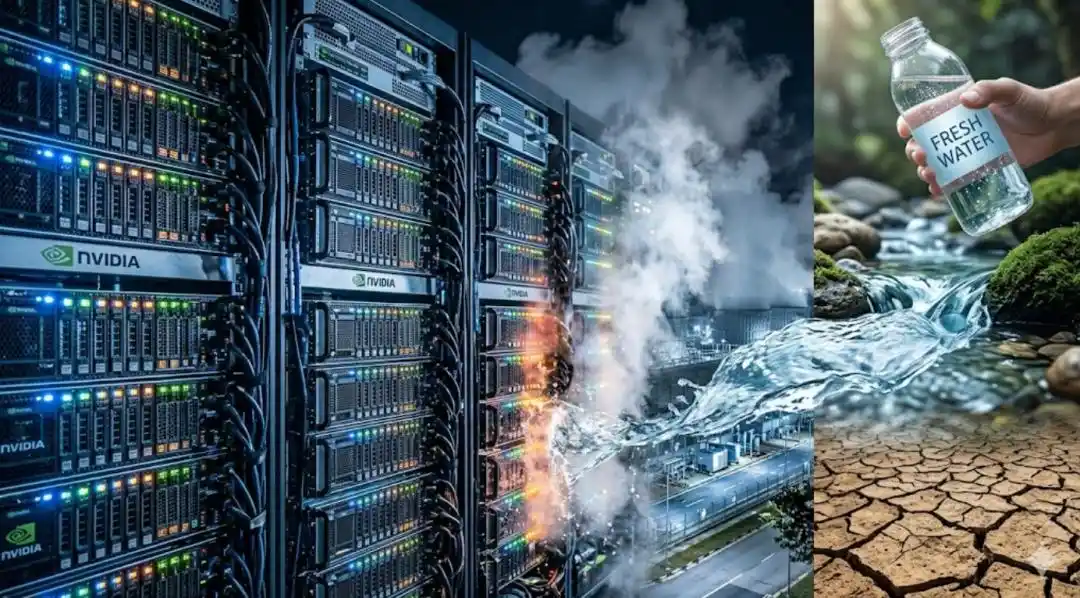
Over the past two years, the grand narrative of the AI arms race has been firmly locked into the logical loop of "chips, computing power, and nuclear power."
Huang Jen-hsun loudly proclaimed the terrifying computing power of clusters with tens of thousands of cards at the Taipei Computer Show; Musk raced day and night in Silicon Valley, acquiring land and building, stacking up the world's largest supercomputer, Colossus (with a throughput of 230,000 NVIDIA GPUs) in 122 days.
The capital market is betting frantically on these "silicon-based myths." However, everyone seems to have selectively forgotten the most fundamental,冷酷 physical limitation—these blazing hot silicon-based brains need to drink water, and it's the fresh water upon which human survival depends.
The latest global AI environmental cost research report from the United Nations University (UNU) tore off the veil of AI's virtual, low-carbon warmth with a set of cold data: the number of Prompts processed daily by global AI has soared to 2.5 billion.
It is estimated that by 2030, the annual water consumption of global AI infrastructure will reach a staggering 9.3 trillion liters (9.3 megaliters).
This figure is exactly enough to meet the basic annual living water needs of 1.3 billion people on Earth.
From the super server rooms on the banks of the Mississippi River in Memphis, USA, to the severely drought-stricken arid regions of Europe, a "freshwater plundering war" triggered by Physical AI and large model computing power demands has officially begun in the summer of 2026.
I. Silicon Devours Carbon: The "Binge Drinking" of Supercomputing Factories
Why has the AI large model become an insatiable "freshwater devouring monster"? The answer lies hidden in the heat dissipation architecture of data centers.
Currently, high-end GPUs like NVIDIA's latest Blackwell and even the next-generation Vera Rubin architecture have a power consumption as high as 700 to 1200 watts per chip when operating at full load.
When thousands of such chips are densely packed into a single server room, the entire data center is essentially a huge "high-heat boiler." If the heat cannot be removed within milliseconds, chips worth hundreds of millions of dollars can instantly burn out due to overheating.
In pursuit of the optimal cost solution, over 70% of data centers worldwide use "Evaporative Cooling Systems."
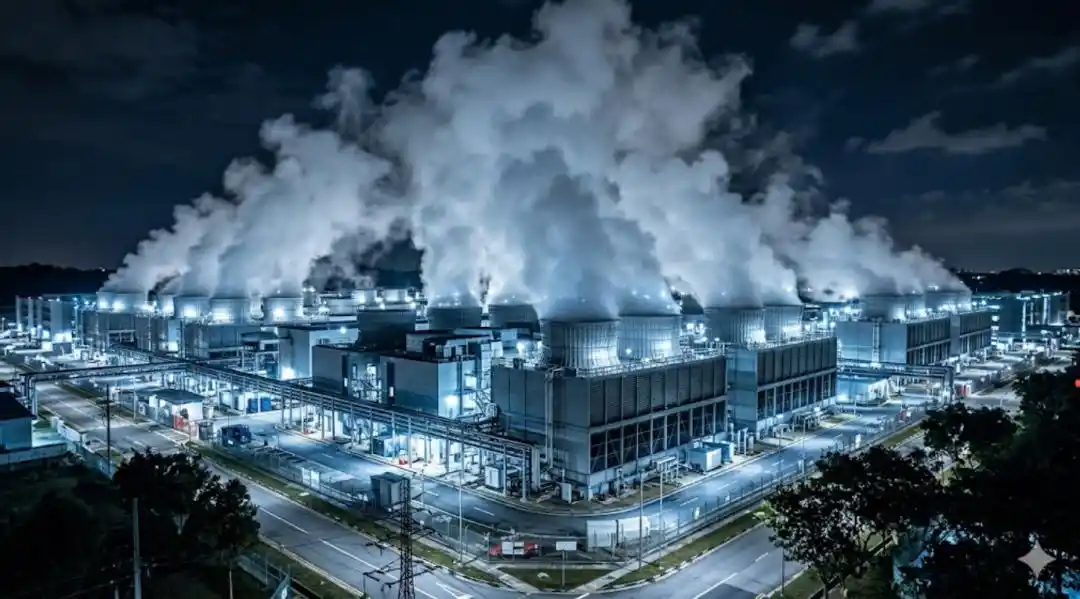
The principle of this system is extremely原始且野蛮: pumping large amounts of cold fresh water into the server room to absorb the heat emitted by the chips, then turning about 80% of that water into water vapor, which is directly discharged into the atmosphere.
This means that most of this consumed water cannot be recycled locally but simply "vanishes into thin air" from local groundwater and public water supply systems.
Let's look at a set of real figures that cannot be hidden in the sustainability reports of major companies:
OpenAI (GPT Series): According to independent scholars and investment bank tracking, just "training" GPT-4 once in the virtual world consumed approximately 600 million liters of pure water, enough to fill 237 Olympic-standard swimming pools; and the next-generation flagship large model currently being trained behind closed doors, due to an exponential explosion in computing power scale, will directly exceed a 1 billion liter water footprint for a single training run.
Google and Microsoft: In the latest environmental data disclosures, Google's annual water consumption has broken through 8.1 billion gallons (approximately 30 billion liters), a sharp year-on-year increase; while Microsoft, in its major model training hubs like West Des Moines, Iowa, has nearly doubled its water consumption in the past three years. Local residents in Iowa have already begun protesting because Microsoft's five data center campuses are fiercely competing for groundwater with local farmlands at a rate of millions of gallons per day.
The bottomless pit of large models is evolving into the physical exploitation of the Earth's real resources.
II. Memphis's "Watergate": Musk, Huang Jen-hsun, and the Angry Residents
The most intense正面冲突 of this "freshwater plundering war" occurred this year in Memphis, Tennessee, USA.
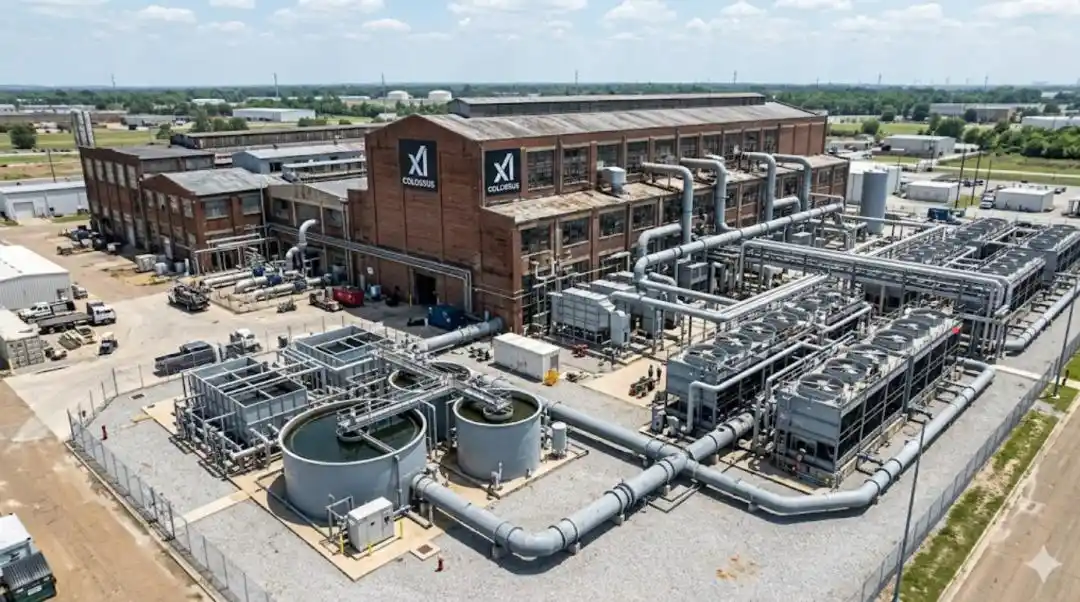
In 2024, Musk's xAI team, in order to train the Grok large model, forcibly built the Colossus supercomputer cluster in Memphis at breakneck Silicon Valley speed in 122 days. To keep this beast with 230,000 chips running, Colossus needs to extract up to 1 million gallons (approximately 3.8 million liters) of residential drinking water daily from Memphis's local underground aquifer.
Since Musk adopted the radical strategy of "acting first and reporting later, bypassing environmental hearings" during construction, when Memphis residents suddenly saw their water bills soar and abnormally low summer groundwater levels at the end of 2025, public resentment彻底引爆. Environmental groups and local communities sued xAI and local governments, accusing the tech giant of "stealing the next mouthful of clean water from children's lips."
Facing huge legal and public relations crises, Musk and Huang Jen-hsun were forced to make an extremely rare compromise in the spring of 2026: xAI urgently announced an $80 million investment to hastily construct a "Recycled Water Treatment Plant" (Colossus Water Recycling Plant) next to the data center.
Musk's solution is: 既然居民饮用水不给喝,那我的 AI 只能去“喝废水”. The plant plans to perform secondary filtration on the industrial wastewater and sewage discharged from Memphis's wastewater treatment plant to feed Colossus's cooling towers instead of pure fresh water.
Memphis's "Watergate" is a landmark turning point in the history of global Physical AI development. It proves to all狂热科技投资人: Starting in 2026, the ultimate bottleneck restricting AI expansion speed is no longer TSMC's production capacity, nor the dollars in Sam Altman's hands, but the "water access rights" approved by local governments.
III. Wall Street's "New Anxiety" and Tech Giants' "Zero-Water Lies"
Facing increasingly strong民间 protests and the severe旱灾 sweeping nearly 63% of North American land in 2026, tech giants' CEOs have started desperately "telling new stories" in earnings reports and tech summits to安抚华尔街.
At the just-concluded Microsoft Build 2026 conference at the end of May, CEO Satya Nadella dedicated a full ten-minute segment to explaining Microsoft's "Zero-Water Revolution."

Nadella proclaimed in his speech: "Microsoft's latest超大型数据中心 have completely abandoned evaporative cooling, adopting a new '全闭环无水循环冷链 (Closed-loop cooling).' We fill the cooling pipes with water once during construction, and then it circulates infinitely between the servers and condensers like a home refrigerator, with an average annual daily water consumption 'equivalent only to that of an ordinary restaurant.'"
But is this really the cure? In the eyes of自媒体 and academia, this seems more like a game of pass-the-parcel "power consumption sleight of hand."
The Cost of Closed-loop Systems: Closed-loop systems indeed do not evaporate water, but their cooling efficiency is far lower than that of open water evaporation. To achieve the same cooling effect, the server room must be connected to terrifyingly powerful giant fans and chillers, which causes the data center's power consumption to surge by 20% to 30%.
Transfer of Indirect Water Footprint: The暴增 in electricity demand means power plants must operate at full capacity. And globally, whether it's coal, gas, or nuclear power plants, their turbine generators also require astronomical amounts of cooling water. According to calculations by Lawrence Berkeley National Laboratory, if the water directly evaporated by data centers is 17.4 billion gallons, then the indirect water footprint generated due to their electricity consumption reaches 211 billion gallons!
Microsoft saves water inside the data center but causes power plants in another state to evaporate even more water. This "treating a headache by operating on the foot" green lie根本掩盖不了 the fact that AI is becoming an ecological disaster.
IV. Conclusion: The Key for Chinese AI, Smart Homes, and Embodied Intelligence to Break Through
When Western super data centers are being chased, surrounded, and forcibly踩下刹车 by environmental groups and laws due to water resources and carbon emission quotas, this brutal physical reality about "freshwater" sounds the alarm for China's rapidly advancing AI industry, but it also provides an极其清晰的roadmap for counter-attack.
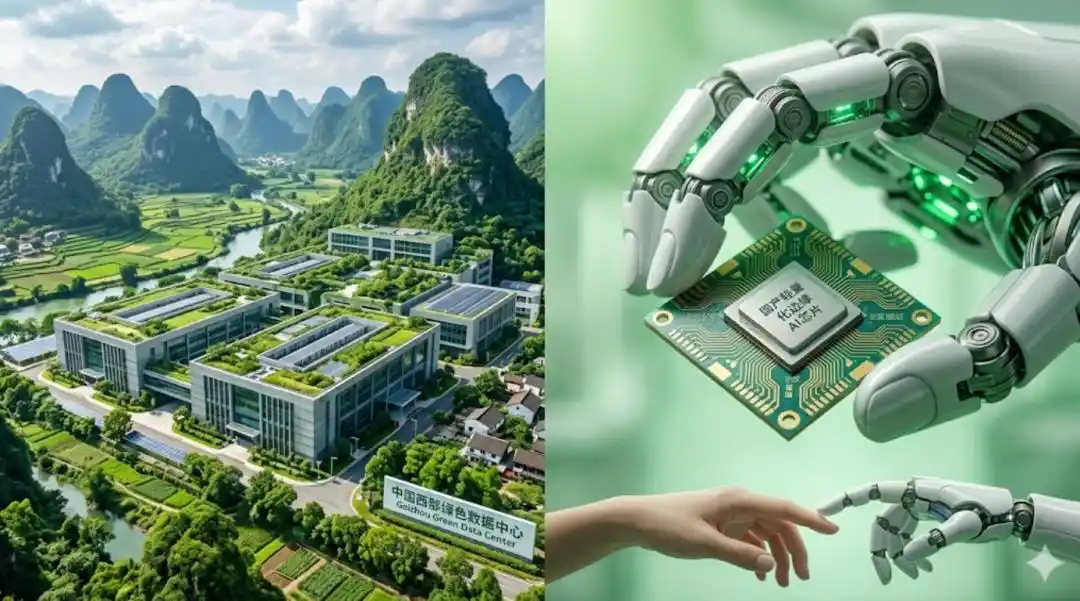
China's AI industry absolutely must not blindly复制硅谷's "heavy industry monster model" of疯狂堆砌几十万卡 in the cloud, consuming millions of gallons of freshwater daily. At the 2026 juncture, the solution we see should be more pragmatic and精巧:
First, there's the natural geographical hedging of computing power layout. China naturally possesses the foresight of the "East Data West Computing" national strategy. Anchor the large training data centers requiring vast amounts of cold water firmly in regions like Guizhou and Inner Mongolia, which naturally have karst underground rivers, or extremely low average annual temperatures allowing for natural air cooling, using geographical红利 to hedge against water resource anxiety.
Second, and also the core technical breakthrough point, lies in the hybrid computing power重构 we mentioned repeatedly earlier: "small brain at the edge, big brain in the cloud."
Represented by Haier's Casarte in smart homes, as well as Chinese embodied intelligence robot manufacturers like Agibot and Unitree, they are全面推进 the research and development of lightweight chips for edge devices.
If our cleaning robots, our vehicle smart cockpits, and our industrial screw-tightening robots can solve 90% of physical interaction problems locally using a dozen-watt edge chip,配合 light "spatial world models," without needing to send a high-energy multimodal Prompt to a cloud thousands of kilometers away every time they move a finger, then we will have fundamentally掐断了九成 of AI's water and electricity consumption.
Leave the soul of AI to the algorithms, and keep the burden of AI at the edge.
This "freshwater plundering war" that Musk and Huang Jen-hsun have already run headlong into is forcing global AI to shed its浮躁外衣.
Is AI the ladder for human civilization to reach higher dimensions, or a silicon-based monster that will ultimately compete with humans for the Earth's last drops of pure water? In the summer of 2026, the answer is becoming increasingly clear with that evaporating steam.
This article is from the WeChat public account "新芒xAI", author: 格林 董义振