South Korean Lawmakers Propose Bill To Abolish 22% Upcoming Crypto Tax

bitcoinistPublished on 2026-03-20Last updated on 2026-03-20

Abstract

South Korea's opposition People Power Party (PPP) has proposed a bill to abolish the upcoming 20% income tax (up to 22% with local taxes) on crypto assets, scheduled to take effect in 2027. The party argues that classifying crypto as a commodity, similar to recent US regulatory guidance, makes its taxation under the current system inappropriate and could lead to double taxation. They also raised concerns about fairness, consistency, and administrative challenges. The ruling Democratic Party of Korea (DPK), which had previously supported the tax with a higher deduction limit, has agreed to review the amendment but noted it had not been previously discussed and that their stance had been to proceed with the existing policy.

South Korea’s opposition party has proposed a bill to abolish the upcoming income tax on crypto assets, citing US regulators’ guidance on asset classification, concerns about double taxation, and inconsistencies with the current tax system.

SK Lawmakers Push To Repeal Crypto Taxation

On Thursday, local news outlet Digital Asset reported that South Korea’s People Power Party (PPP) proposed a bill to amend the long-delayed Income Tax Act, which is scheduled to take effect next year.

According to the report, PPP’s floor leader, Song Eun-seok, introduced the legislation on March 19, seeking to abolish the taxation of crypto assets. If approved, the amendment would remove all provisions governing the taxation of digital assets in the current Income Tax Act.

Under the current digital assets law, crypto assets will be subject to a 20% income tax rate, up to 22% including local taxes, starting January 1, 2027, with a deduction limit of 2.5 million won.

Originally, the government proposed implementing a 20% tax on crypto gains by January 2022. However, the rule change has been postponed three times, including a two-year delay to the January 1, 2025, implementation date in December 2024.

As the report noted, the People Power Party and the Democratic Party of Korea (DPK) clashed over the latest two-year delay, with the PPP and the government supporting the postponement. In contrast, the DPK advocated raising the tax deduction limit to 50 million won rather than postponing crypto taxation, ultimately agreeing to postpone it until 2027.

The proposed amendment mentioned recent joint guidance by the US Securities and Exchange Commission (SEC) and the Commodities Futures Trading Commission (CFTC). This guidance classified most digital assets as commodities rather than securities, which reportedly raised concerns in South Korea that “treating them under the same tax system as securities is inappropriate.”

“Since digital assets are already classified as commodities in Korea and subject to the value-added tax system, imposing an additional income tax on them would create issues of double taxation,” the report added, citing the bill.

The amendment contends that imposing a separate income tax on digital assets raises concerns regarding the fairness and consistency of the tax system, considering that the financial investment income tax has been abolished to promote capital market development and protect investors.

If income tax is imposed in the future, significant practical and administrative difficulties are expected, such as determining the acquisition cost for non-resident foreigners, which would limit the effectiveness of the system.

DPK To Review Tax Amendment Despite Long-Standing Policy

In response to the People Power Party’s push to abolish the 20% crypto taxes, the Democratic Party of Korea has affirmed that it will review the recently introduced amendment.

DPK’s Senior Deputy Floor Leader for Policy, Kim Han-kyu, acknowledged PPP’s concerns about tax equity between stocks and crypto assets and the consistency of the Korean tax system.

“I am aware that there are calls to strike a balance between the stock market and the digital asset market in terms of taxation,” he told reporters after a general meeting of lawmakers on Thursday.

Kim also revealed the South Korean ruling party had not considered a proposal or any measures to abolish the upcoming crypto taxation, as it had “not yet reached a level where it is being seriously discussed or where there is a consensus within the party.”

The PPP’s bill was not previously discussed between the ruling and opposition parties in advance, he stated, but affirmed that DPK lawmakers will discuss the bill in the Finance and Economy Committee now that it has been introduced.

Nonetheless, he noted that the party’s stance had previously been to proceed with the existing bill, previously advocating a higher deduction limit instead, which could signal the proposed amendment risks limited support from the DPK.
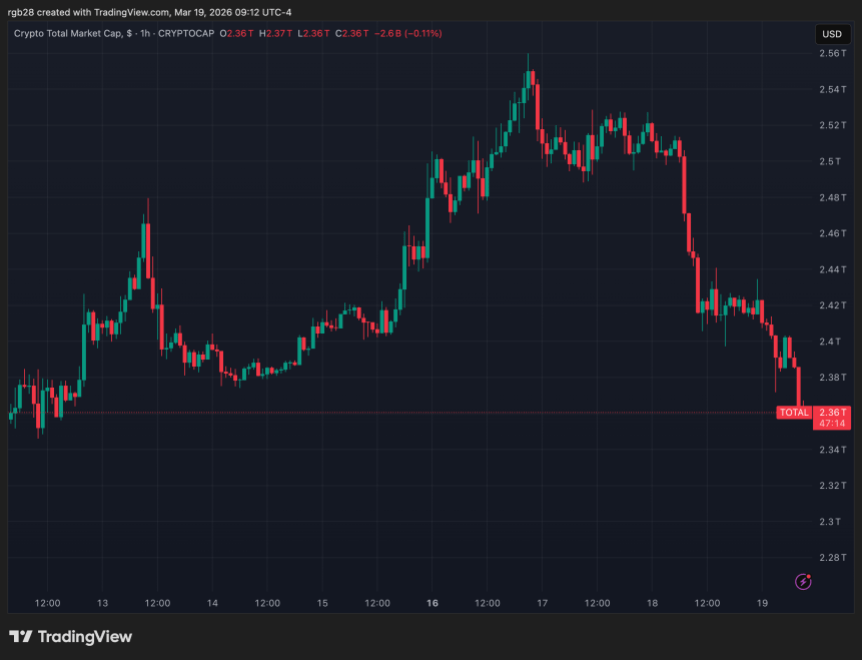
The total crypto market capitalization is at $2.36 trillion in the one-week chart. Source: TOTAL on TradingView


Related Questions

QWhat is the main purpose of the bill proposed by South Korea's People Power Party (PPP)?

AThe main purpose of the bill is to abolish the upcoming 20% income tax on crypto assets by removing all provisions governing their taxation in the current Income Tax Act.

QWhat are the key reasons cited by the PPP for proposing to abolish the crypto tax?

AThe key reasons include the US regulators' guidance classifying most digital assets as commodities (not securities), concerns about double taxation since crypto is already subject to value-added tax, and inconsistencies with the current tax system which abolished the financial investment income tax to promote capital markets.

QWhen was the current 20% crypto income tax (up to 22% with local taxes) originally scheduled to take effect, and what is its new implementation date?

AThe tax was originally proposed to take effect in January 2022 but has been postponed multiple times. Its current scheduled implementation date is January 1, 2027.

QHow did the Democratic Party of Korea (DPK) initially differ from the PPP regarding the crypto tax?

AThe DPK initially advocated for raising the tax deduction limit to 50 million won instead of postponing the tax, but they ultimately agreed to the postponement until 2027. Their long-standing policy has been to proceed with the tax.

QWhat was the response of the Democratic Party of Korea (DPK) to the PPP's newly proposed amendment?

AThe DPK affirmed that it will review the amendment in the Finance and Economy Committee. However, a senior DPK official noted that the party had not seriously discussed abolishing the tax and that its previous stance was to proceed with the existing bill, indicating limited support for the PPP's proposal.

Related Reads

The Second Half of Stablecoins No Longer Belongs to the Crypto World

The article discusses the shift in the stablecoin market from the crypto sector to traditional finance, highlighted by Mastercard's acquisition of BVNK for up to $1.8 billion in March 2026. This move came after Coinbase abandoned a $2 billion deal for BVNK months earlier, signaling intensified competition for stablecoin infrastructure. BVNK specializes in cross-border payments using a "stablecoin sandwich" model: converting fiat to stablecoins like USDC for blockchain transfer, then back to local currency, reducing transaction times and costs. Its key asset is a suite of global licenses, including EMI from the UK FCA and CASP under EU MiCA, enabling compliance across 130+ countries. Mastercard's acquisition aims to integrate BVNK into its Multi-Token Network (MTN), a private blockchain for tokenized assets, addressing MTN's lack of connectivity with public chains. This enables atomic settlements, 24/7 B2B transactions, and programmable payments. The strategy contrasts with Visa’s partnership-focused approach, emphasizing direct control over infrastructure. The U.S. GENIUS Act (July 2025) provided regulatory clarity, defining stablecoins as non-securities under OCC oversight, which facilitated Mastercard’s move. The deal pressures players like Ripple and traditional correspondent banks, as Mastercard’s global network could disrupt cross-border payment fees. Ultimately, stablecoin evolution is becoming invisible to users—embedded in traditional finance for efficiency, not crypto adoption. Mastercard’s investment secures a foothold in the next-generation payment ecosystem.

marsbit2h ago

The Second Half of Stablecoins No Longer Belongs to the Crypto World

marsbit2h ago

Trading

Spot
Futures

Hot Articles

Discussions

Welcome to the HTX Community. Here, you can stay informed about the latest platform developments and gain access to professional market insights. Users' opinions on the price of S (S) are presented below.

活动图片