Reuters Investigation: Trump Family's Crypto Empire Cashed Out $2.3 Billion, Investors Incurred Nearly Equal Losses

marsbitPublished on 2026-06-10Last updated on 2026-06-10

Abstract

Reuters Investigation: Trump Family's Crypto Empire Reportedly Cashed Out $2.3 Billion. A Reuters investigation reveals that from November 2024 to April 2026, entities linked to former US President Donald Trump earned approximately $2.3 billion in pretax revenue from four cryptocurrency projects. These projects are World Liberty Financial, the TRUMP meme coin, ALT5 Sigma (renamed AI Financial Corp.), and American Bitcoin. The revenue, derived largely from token sale royalties, founder allocations, and equity stakes, reportedly eclipsed the $2.1 billion profit posted by Coinbase during the same period. It also far exceeded earnings from major industry players like BlackRock's Bitcoin ETF business and top miner IREN. The report highlights an asymmetrical risk model where the Trump family allegedly invested minimal personal capital. However, over one million retail and public market investors are estimated to have absorbed nearly equivalent losses of about $2.25 billion. For instance, the TRUMP meme coin has lost around 98% of its value from its peak, and public companies like ALT5 Sigma and American Bitcoin have seen their stock prices collapse after raising funds linked to these ventures. The core leverage for these projects is identified as brand licensing and political influence rather than traditional business infrastructure.

Author: Claude, Deep Tide TechFlow

Deep Tide Intro: A Reuters investigation shows that between November 2024 and April 2026, the Trump family derived approximately $2.3 billion in pre-tax income from four crypto projects: World Liberty Financial, the TRUMP memecoin, ALT5 Sigma, and American Bitcoin, surpassing Coinbase's $2.1 billion profit during the same period. Over 1 million retail and secondary market investors suffered equivalent losses of about $2.25 billion.

A detailed investigative report published by Reuters on June 9 places the Trump family's crypto business empire under a precise financial microscope.

According to Reuters' cross-analysis based on on-chain data, corporate filings, public disclosures, and investor interviews, four crypto projects linked to the U.S. President collectively generated roughly $2.3 billion in pre-tax income from after the November 2024 election until April 2026.

This figure exceeds Coinbase's $2.1 billion profit during the same period and far outstrips the earnings of major industry players like BlackRock's Bitcoin ETF business (~$109 million) and the largest listed miner, IREN (~$127 million).

The data also reveals a near-zero-sum financial picture: the $2.3 billion gained by the Trump family almost perfectly mirrors the approximately $2.25 billion in net losses borne by retail and public market investors.

Asymmetric Risk Structure: Family Invested Minimal Personal Capital

The core finding of the Reuters investigation lies in the business model itself. Unlike Coinbase or BlackRock, which compete based on trading infrastructure, liquidity depth, and assets under management, the Trump family's crypto projects employed a highly asymmetric risk structure: the family invested minimal personal capital but reaped enormous upside through revenue-sharing from token sales, founder token allocations, and equity arrangements.

Among the four projects, World Liberty Financial contributed the largest share. The project began selling its governance token in October 2024, with Trump's two sons, Donald Trump Jr. and Eric Trump, participating in roadshows as core promoters. The project party signed a revenue-sharing agreement with DT Marks DEFI LLC, an entity linked to the Trump family, entitling it to 75% of token sale revenue after deducting costs. Reuters estimates that through this structure alone, the family received about $987 million in income.

The TRUMP memecoin was the second-largest revenue source. Launched on the Solana blockchain just before Trump's second inauguration, on-chain analysis shows total revenue exceeded $1.2 billion, with roughly $616 million attributed to the family.

Investors Incurred Equal Losses on the Mirror Side

The flip side of the family's gains is systematic investor losses.

Buyers of World Liberty Financial tokens incurred cumulative losses of approximately $674 million by the end of April. A significant portion of early holdings remained locked, with their pre-unlock book value close to zero. Investors in the TRUMP memecoin fared even worse. The token hit an all-time high of around $74.27 in January 2025; by June 9, its price had plummeted to about $1.65, a drop of roughly 98%. Reuters estimates losses for token holders exceed $700 million. A California investor told Reuters she invested $2,000 after seeing Trump's promotion; by the end of May, her holdings were worth less than $120.
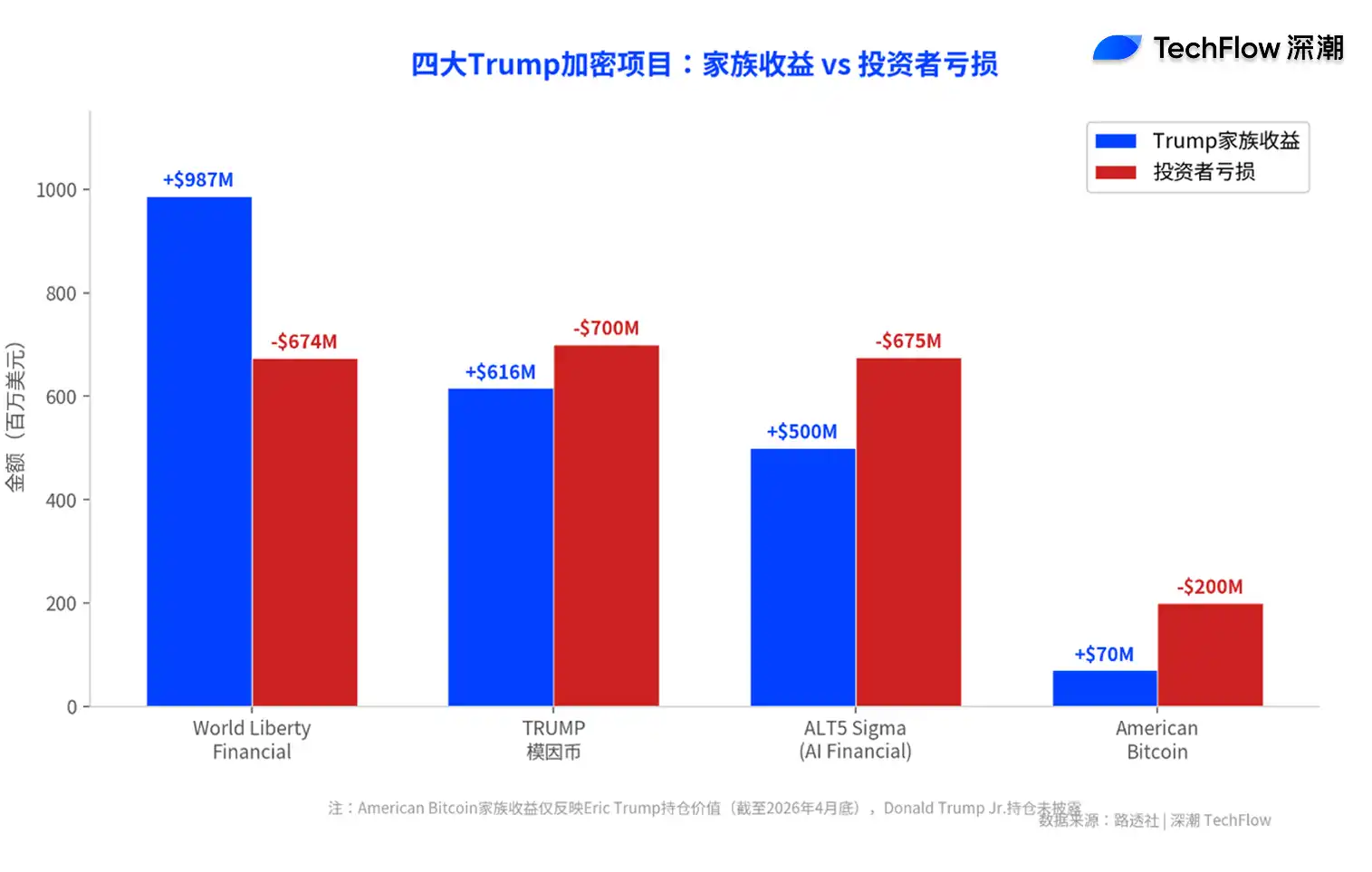
Investors through public company channels also suffered heavy losses. ALT5 Sigma (later renamed AI Financial Corp.) raised $750 million through a share issuance, with $717 million used to purchase World Liberty tokens, and over $500 million flowing to the Trump family via revenue sharing. The company's stock price fell from over $9 in August 2025 to about $0.75 by the end of April 2026, resulting in investor losses of roughly $675 million. American Bitcoin's stock price dropped from its $11 IPO price in September 2025 to about $1.15 by the end of April, causing investor losses exceeding $200 million. Both Eric Trump and Donald Trump Jr. received equity stakes without contributing capital, with Eric Trump's holdings still valued at over $70 million at the end of April.

Trump Crypto Revenue Exceeds Coinbase, Crushes Major Industry Players

Reuters' comparative data puts this scale into sharper perspective. During the same window from November 2024 to April 2026:

Coinbase revenue was approximately $2.1 billion; IREN (the largest listed Bitcoin miner by market cap) revenue was about $127 million; BlackRock's Bitcoin ETF business (IBIT) revenue was around $109 million; Circle (issuer of USDC) incurred a loss of $14 million; Galaxy Digital incurred a loss of $430 million.

The Trump family's $2.3 billion exceeds the totals for all the aforementioned companies. These companies built their commercial moats over years of technological accumulation, licensing/compliance, and market development. The core leverage for the Trump projects was brand licensing and political influence.


Related Questions

QAccording to the Reuters investigation, how much pretax revenue did projects linked to the Trump family generate from November 2024 to April 2026?

AAccording to the Reuters investigation, projects linked to the Trump family generated approximately $2.3 billion in pretax revenue from November 2024 to April 2026.

QWhat is the core finding of the Reuters report regarding the business model of the Trump family's crypto projects?

AThe core finding is that the business model employed a highly asymmetrical risk structure: the family invested very little of its own capital but captured enormous upside through mechanisms like token sale revenue sharing, founder token allocations, and equity arrangements.

QWhich two projects were the largest sources of revenue for the Trump family, according to the report?

AAccording to the report, World Liberty Financial was the largest source, providing an estimated $987 million, and the TRUMP memecoin was the second largest, providing approximately $616 million to the family.

QWhat was the approximate total net loss suffered by retail and secondary market investors in these projects?

ARetail and secondary market investors suffered approximately $2.25 billion in net losses, an amount nearly equal to the family's gains.

QHow did the Trump family's crypto revenue during this period compare to the profits of major industry players like Coinbase?

AThe Trump family's $2.3 billion in revenue exceeded the $2.1 billion profit reported by Coinbase during the same period, and also far surpassed the revenue of other major players like BlackRock's Bitcoin ETF business (~$109 million) and IREN (~$127 million).

Related Reads

AI Investors' 2026 Anxiety: When Models Devour Everything, What Moat Is Left for Startups?

In 2026, a wave of investor anxiety questions the defensibility of AI startups as models improve, fearing that most companies are just "thin wrappers" destined to be absorbed by foundation models or chipmakers. The author argues against this despair, positing that true moats lie not in benchmark performance but in areas models cannot easily reach. The logic of despair is that if models excel at all measurable tasks, only compute and cutting-edge model weights hold lasting value. However, the essay contends that the most valuable work is inherently "untrainable." Benchmarks measure what can be measured and thus optimized for, but real-world correctness often resides in private, complex systems. Examples include legacy codebases, intricate legal transactions, or hospital workflows. This kind of correctness is proprietary, costly to establish, and cannot be validated quickly—it requires time and trust within an organization. As models commodify visible, measurable tasks from both above (labs absorbing scaffolding) and below (saturation by cheaper models), value shifts to "untrainable ground." This encompasses work where correctness is a private truth, locked behind integration barriers, licenses, liability frameworks, and entrenched user habits. Trust and adoption are slow, human-centric processes that smarter models cannot accelerate. Successful companies defend their position by embedding deeply into client operations, owning the definition of "good" within a specific domain (e.g., Harvey in law, OpenEvidence in medicine), and pricing on outcomes rather than tokens. While labs compete fiercely, they are incentivized to keep the application layer vibrant. The future belongs not to those competing on generic benchmarks but to those navigating unscoreable terrain, doing the "unsexy work" of translation between models and messy human realities. The most cited benchmark scores are thus maps of territory about to become worthless, signaling who will lose the right to define what counts as good.

marsbit7m ago

AI Investors' 2026 Anxiety: When Models Devour Everything, What Moat Is Left for Startups?

marsbit7m ago

Trump's Crypto Empire: A $2.3 Billion Wealth Transfer Experiment

In June 2026, Reuters investigations revealed that since Donald Trump's return to the White House, his family has accumulated roughly $2.3 billion in profits from four core crypto ventures: World Liberty Financial (WLFI), the $TRUMP meme coin, American Bitcoin, and ALT5 Sigma (later renamed AI Financial). Coincidentally, overall investor losses in these projects were estimated to be a similar amount. The businesses, spanning DeFi, stablecoins, meme coins, Bitcoin mining, and digital payments, largely relied not on technological innovation but on converting the political influence and notoriety of the Trump brand into financial assets sold to the market. This marks a dramatic shift from Trump's earlier skepticism of cryptocurrencies. The ventures operated on a similar logic: leveraging the Trump name to generate market hype and trust, attracting investment through token sales or public listings, and enabling the family to capture profits upfront through equity, token allocations, and fees, while later entrants often bore the brunt of the risk as markets cooled. WLFI, the most profitable venture, generated an estimated $1.6 billion for the family, primarily through sales of its locked, illiquid governance token and its USD1 stablecoin. The $TRUMP meme coin, a direct monetization of the presidential IP, brought in over $600 million for Trump-linked entities before its price crashed nearly 97% from its peak. American Bitcoin gained a "Trump stock" premium for its mining operations, and ALT5 Sigma/AI Financial combined Trump, AI, and crypto themes for a temporary valuation surge. The episode underscores how political influence can be packaged into financial assets, creating substantial wealth for promoters while highlighting the risks for investors who base decisions on hype and brand allegiance over fundamental business models and cash flows.

marsbit47m ago

Trump's Crypto Empire: A $2.3 Billion Wealth Transfer Experiment

marsbit47m ago

CFTC Proposes New Rules for Prediction Markets, Redefining Which Events Can Be Listed and Who Can Participate

The U.S. Commodity Futures Trading Commission (CFTC) has proposed new rules to establish a clearer regulatory framework for prediction markets. The proposal aims to modify how "event contracts" are reviewed, creating a structured process to determine if contracts involving terrorism, assassination, war, or illegal activities violate the public interest. This moves away from a blanket ban toward a case-by-case assessment of whether a contract's subject matter is acceptable for financial trading. A key focus is distinguishing between predicting the impact of risks and predicting the occurrence of harm. The proposal suggests that many sports-based prediction markets—such as those on game outcomes, scores, or season standings—may be permissible as they can provide price discovery and meaningful information. However, markets on easily manipulated events like specific player injuries, referee calls, or outcomes of youth sports would face stricter scrutiny. The rules directly target insider trading and manipulation risks, highlighting cases where individuals with non-public information or the ability to influence an event's outcome could unfairly profit. This underscores a shift toward ensuring market fairness. The proposal does not end the regulatory debate, particularly with state gambling regulators who argue that sports prediction markets are essentially sports betting and should fall under state jurisdiction. Nonetheless, the CFTC's action signals a move toward formalizing prediction markets, pushing the industry from a phase of rapid, often unregulated expansion into a more institutionalized, rule-based environment that more closely resembles traditional financial markets.

marsbit59m ago

CFTC Proposes New Rules for Prediction Markets, Redefining Which Events Can Be Listed and Who Can Participate

marsbit59m ago

Trading

Spot
Futures

Hot Articles

Discussions

Welcome to the HTX Community. Here, you can stay informed about the latest platform developments and gain access to professional market insights. Users' opinions on the price of S (S) are presented below.

活动图片