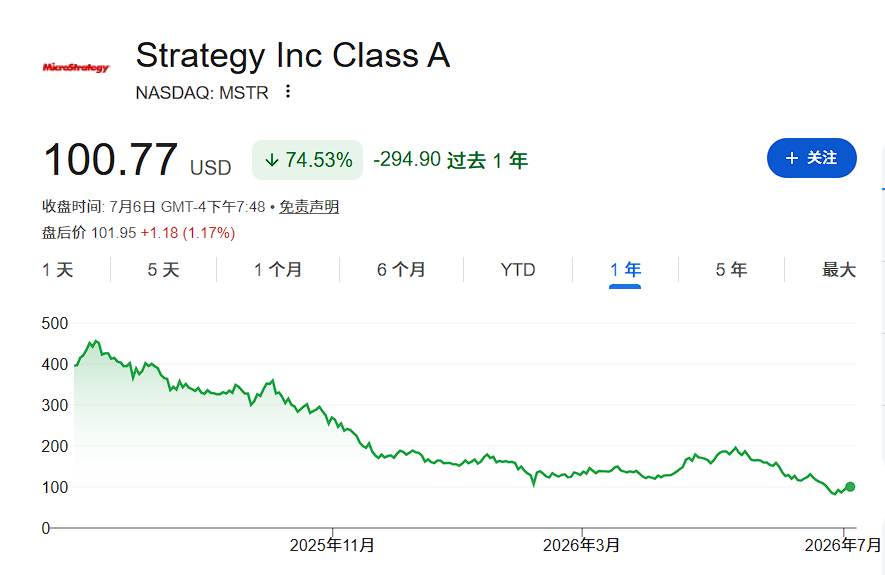
Holding 4% of Global Bitcoin! Market Closely Watches MSTR's "Bitcoin Selling Logic", Stock Price Has Fallen 75% in a Year

华尔街日报Published on 2026-07-07Last updated on 2026-07-07

Abstract

MicroStrategy, the world's largest corporate holder of Bitcoin (approx. 4% of supply), faces mounting liquidity pressures, forcing a shift from its "never sell" pledge. The company recently sold 3,588 BTC for $216 million, its largest sale ever, to cover preferred stock dividends, marking a significant scaling up from a small, symbolic sale in May. This move underscores a fundamental challenge to its business model: using stock premium as "currency" to buy Bitcoin continuously. A key metric, mNAV (enterprise value vs. Bitcoin holdings), has fallen below 1, indicating the market values the company below its Bitcoin stash, eroding its core acquisition logic. With annual dividend obligations around $1.5 billion and software cash flow insufficient, MicroStrategy is caught in a mathematical bind. Its $2.55 billion cash buffer provides ~17 months of coverage, but if financing remains tight and mNAV stays depressed, the company may face pressure for larger Bitcoin sales, posing a potential systemic risk to the crypto market given its massive holdings.

MicroStrategy is using Bitcoin to pay for its capital structure. This company, the world's largest corporate holder of Bitcoin, is facing a mathematical dilemma triggered by its own business model — as the stock price premium vanishes and the financing window narrows, the "never sell" promise has quietly given way to the pressure of real-world liquidity.

An article by Wall Street Journal writes that MicroStrategy disclosed on July 6th that it sold 3,588 Bitcoins between June 29th and July 5th, raising approximately $216 million, to pay dividends for its preferred shares. This is the company's largest single Bitcoin sale in history, and its third sale since launching its Bitcoin strategy in 2020.

Following this announcement, MSTR's stock price fell over 5% intraday, and Bitcoin dropped to around $61,800, below the company's average holding cost of approximately $75,700. The company confirmed an $8.32 billion digital asset impairment loss for Q2, as Bitcoin prices fell 14% during the same period.

Market caution stems not only from the sale itself but also from the underlying shift in logic. MicroStrategy holds 843,775 Bitcoins, accounting for about 4% of the global Bitcoin supply. Any large-scale selling could significantly impact the coin's price.

According to Wall Street Journal analysis, MicroStrategy's core valuation metric, mNAV, has fallen below 1, meaning the market values the company at less than the value of its Bitcoin holdings. This fundamentally undermines its business logic of "exchanging premium stock for Bitcoin."

"Never Sell" Promise Softens, Sale Scale Expands by a Hundredfold

MicroStrategy had long regarded "never selling Bitcoin" as the cornerstone of its business model, but this promise has developed significant cracks.

In late May, the company broke precedent for the first time, selling 32 Bitcoins for about $2.5 million to pay preferred stock dividends, emphasizing it was merely fulfilling its promise to preferred stock investors and did not represent a strategic shift.

However, the latest sale scale has expanded to 3,588 Bitcoins, roughly a hundred times the amount sold in May. According to the company's disclosure, 1,363 were sold at an average price of about $59,300, with the remaining 2,225 sold at around $60,800.

An article by Wall Street Journal writes that proceeds from this sale will be specifically used to pay the Q2 dividends for four preferred securities (STRF, STRE, STRK, STRD) and the June monthly dividend for STRC. Selling Bitcoin is no longer a one-time, symbolic operation but is gradually being integrated into the company's routine financing system.

Notably, on June 29th, MicroStrategy officially announced that its board had authorized the sale of up to $1.25 billion worth of Bitcoin for stock buybacks and to pay interest and preferred stock dividends. This marks the company's formal abandonment at the official level of its "hold Bitcoin at all costs" philosophy.

It's worth noting that the capital structure supporting this business model is under increasing pressure.

Analyst Zach Pandl points out that MicroStrategy's annual preferred stock dividend payout alone is about $1.5 billion, far exceeding what its software business cash flow can cover. When cash reserves are insufficient, the company can only continue financing or sell Bitcoin.

As of July 5th, MicroStrategy holds 843,775 Bitcoins with a cash reserve of $2.55 billion. The company estimates this cash buffer provides about 17 months of runway for interest and preferred stock dividend payments without needing to tap its crypto assets.

MicroStrategy's operational logic is becoming clearer: continuously buy Bitcoin when financing is smooth; sell small amounts of Bitcoin to pay dividends when financing tightens, maintaining the closed loop of its capital operations system.

Although after its first sale in late May, the company quickly bought another 1,550 Bitcoins, and also completed large-scale purchases of $2.54 billion and $2 billion in April and May respectively, the sustainability of this system is being questioned as Bitcoin prices face downward pressure.

mNAV Falls Below 1, Core Business Logic Faces Fundamental Challenge

The core of MicroStrategy's business model lies in using its stock premium as "currency" to continuously buy Bitcoin. The quantitative anchor for this logic is precisely the company's self-created mNAV metric.

According to Wall Street Journal analysis, MicroStrategy defines mNAV as the multiple of the company's enterprise value relative to the value of its Bitcoin holdings. During its peak, this metric remained at a high premium level for a long time, allowing the company to continuously issue stock to buy more Bitcoin, operating similarly to traditional acquisition-driven companies using highly valued stock as currency for serial acquisitions.

However, as MSTR's stock price has fallen about 75% over the past year, mNAV fell below 1 last month, meaning the market values MicroStrategy at less than the book value of its Bitcoin holdings. This "snowball" logic has started to work in reverse.
More alarmingly, this metric itself has a systematic overvaluation problem. The Wall Street Journal points out that when calculating enterprise value, MicroStrategy uses the principal amount of debt and the face value of preferred stock, not their market value. However, as the company's bonds and preferred stock prices have fallen sharply along with the stock price, this calculation method has become severely distorted.

Taking June 26th as an example, MicroStrategy reported its mNAV was about 0.99, but if calculated using the market value of debt and preferred stock, the actual mNAV was only about 0.89. At that time, the company's debt was trading at a 7% discount, and its various series of preferred stock had a combined discount of about 28%.

As of last Thursday's close, MicroStrategy's website showed an mNAV of 1.09, but the actual figure calculated using market values was only about 1.04, leaving the premium space extremely limited.

Selling Pressure and Market Chain Reaction

The scale of MicroStrategy's Bitcoin holdings gives any selling action systemic significance at the market level.

MicroStrategy holds about 4% of the global Bitcoin supply. Even the small-scale operation in May, selling just 32 Bitcoins for $2.5 million, had a noticeable downward pressure on Bitcoin's price and MSTR's stock price.

Analysis suggests that although this sale of 3,588 Bitcoins is still a tiny fraction of its holdings, market concern about potential large-scale selling has significantly intensified.

According to MicroStrategy's own logic, when mNAV remains in a discounted state, the company should sell Bitcoin to buy back its own securities. Investors are closely watching whether this signal will evolve into large-scale action.

To stabilize preferred stock prices, MicroStrategy increased the dividend rate on its largest preferred stock series, STRC, to 12% on June 29th, trying to attract buyers and push the price back to par value. This move itself indicates the company's focus on the market price of its preferred stock far exceeds the attitude presented in its mNAV calculation.

The Wall Street Journal notes that if the market once again fixes MicroStrategy's valuation in the discount range and it persists, the company will face a scenario where its cash runs out, forcing it to tap its Bitcoin reserves on a large scale. MicroStrategy may have bought itself some time, but no one can be sure just how long that time will last.


Trending Cryptos

Related Questions

QWhat is the core reason for MicroStrategy's recent change in its 'never sell bitcoin' policy?

AThe core reason is the increasing liquidity pressure stemming from its capital structure. With its stock premium disappearing and the financing window narrowing, MicroStrategy's commitment to holding bitcoin has given way to the reality of needing funds to pay substantial annual preferred stock dividends (approximately $1.5 billion), which its software business cash flow cannot cover.

QWhat is the mNAV metric, and why is it significant for understanding MicroStrategy's business model?

AmNAV (MicroStrategy Net Asset Value) is a company-created metric defined as the ratio of its enterprise value to the value of its bitcoin holdings. It is significant because MicroStrategy's core business model relies on using its stock as a 'currency' to buy more bitcoin, which only works when mNAV is above 1 (meaning the market values the company *more* than just its bitcoin). Its recent drop below 1 challenges this fundamental model.

QHow did the scale of MicroStrategy's latest bitcoin sale on July 6 compare to its first sale in May, and what was the purpose of the proceeds?

AThe latest sale of 3,588 bitcoin was approximately 100 times larger than the first sale of 32 bitcoin in May. The proceeds from the July sale, amounting to about $216 million, were specifically used to pay quarterly dividends on several series of its preferred securities (STRF, STRE, STRK, STRD) and a monthly dividend on the STRC preferred stock.

QAccording to the analysis in the article, what is the problem with MicroStrategy's calculation of its mNAV metric?

AThe article states that MicroStrategy's calculation of mNAV is systematically overestimated. It uses the face value (par value) of its debt and preferred stock in the enterprise value calculation, rather than their actual, lower market trading value. This inflates the mNAV figure. For example, when the official mNAV was 0.99, the 'real' mNAV calculated using market values was only about 0.89.

QWhy are market participants concerned about MicroStrategy's potential future bitcoin sales, despite its recent sale being a small fraction of its total holdings?

AMarket participants are concerned because MicroStrategy holds approximately 4% of the global bitcoin supply, making any significant sale potentially impactful on the price. Furthermore, if its mNAV remains below 1, the logical action for the company according to its own framework would be to sell bitcoin to buy back its discounted securities. The fear is that this could trigger a large-scale, sustained selling pressure.

Related Reads

Can Open USD Support Stripe's Ambitions?

Can Open USD support Stripe's ambition? The article argues that OUSD represents a pivotal strategic move for Stripe, shifting its narrative from being a superior payments API company to becoming a "money movement network." Unlike simply facilitating payments, this new model aims to organize and define the settlement layer, default assets, and economic distribution rules for future commerce. The analysis highlights OUSD's role in giving Stripe a potential default settlement asset, enabling deeper economics through reserve earnings, and providing a programmable money layer for emerging use cases like AI agentic commerce. Crucially, OUSD is presented not as a direct "USDC killer" but as an attempt to redefine the business model of stablecoins, proposing a collaborative governance structure where contributing partners share in the network's economic benefits and governance. For Stripe, this is about evolving from a powerful "abstraction layer" over traditional financial rails into an active participant and potential architect of the next-generation global settlement network. While OUSD alone cannot immediately realize this ambition, it signals Stripe's intent to move closer to the money layer itself, positioning itself at the center of future money flows in an increasingly automated, platform-driven, and AI-powered economy. The ultimate question is whether Stripe can transition from being a best-in-class payment processor to becoming the foundational infrastructure for internet-native money movement.

marsbit4m ago

Can Open USD Support Stripe's Ambitions?

marsbit4m ago

This Week's Crypto Watchlist|Jupiter, NEAR, Jito, and 7 Other Projects are Active. Understand Who's Worth Monitoring with a 'Catalyst Calendar'

This week brings a concentrated wave of catalysts for several crypto projects, based on a schedule compiled by an analyst. Jupiter (JUP) leads by launching a private testnet for its GUM unified market on July 6th, aiming to aggregate diverse assets on Solana. On July 7th, NEAR hosts a major livestream reveal focused on enterprise "black box" tech, likely detailing its SPICE upgrade. Also on July 7th-8th, Berachain executes its largest mainnet upgrade, "PoL Next," simplifying its tokenomics by retiring the BGT token and consolidating value into BERA. Zcash (ZEC) eyes recovery with its critical Ironwood network upgrade slated for July 21st, designed to restore trust after a recent privacy vulnerability scare. Looking ahead, Lighter (LIT) plans to launch tokenized stocks next week, leveraging its key position as the default perpetual DEX on the new Robinhood Chain. Jito (JTO) is rumored to launch its JTX trading platform in mid-July, targeting professional traders and promising substantial protocol revenue sharing. Lastly, Ether.fi (ETHFI) has proposed deploying a dedicated Aave V4 instance to power its EtherFi Cash Visa card, though this remains in the early governance stage. The week presents a mix of product launches, major upgrades, and strategic expansions, each carrying its own potential for momentum and associated risks like token unlocks or execution challenges.

marsbit17m ago

This Week's Crypto Watchlist|Jupiter, NEAR, Jito, and 7 Other Projects are Active. Understand Who's Worth Monitoring with a 'Catalyst Calendar'

marsbit17m ago

How Token Economy Reshapes the Business Rules of AI 'Measurement' | ToB Industry Observation

"Token Economy: How It Reshapes the Business Rules of AI's 'Metrics' | ToB Industry Observation" The article discusses how the token economy is fundamentally changing the business landscape for AI, moving from a phase of explosive technical supply to a focus on measurable value for enterprise demand. It highlights the astronomical growth in daily token usage in China, framing tokens as the new "measurement standard" or "electricity" of the intelligent era. A central challenge is determining a token's value, which varies drastically—up to 100,000x—across different applications, from drug discovery to casual chat. The concept of "high-quality tokens" that deliver real intelligence, versus "noise," is emphasized as crucial. Lenovo's Vice President shares three proposed "laws" of token economics: 1. **Law of Inertia:** The cost per token will continuously decline due to technological innovation, system optimization, and intelligent runtime scheduling. 2. **Law of Acceleration:** The value generated per token accelerates based on the depth of AI integration into business workflows, the level of engineering support, and organizational readiness. 3. **Law of the Singularity:** A tipping point where the value curve of AI application surpasses its cost curve, shifting from cost-saving to generating incremental, previously impossible value—enabling "innovation at scale." The article notes real-world struggles, such as companies exceeding AI budgets due to unpredictable token pricing and "token inflation" from agentic AI workflows. Solutions being explored include standardized metrics for token quality, transparent pricing, and new infrastructure like "Token Factories" for efficient, on-demand token production. The ultimate goal is for businesses to move past anxiety and reach the "singularity," where AI drives scalable innovation, akin to how electricity enabled countless modern appliances.

marsbit31m ago

How Token Economy Reshapes the Business Rules of AI 'Measurement' | ToB Industry Observation

marsbit31m ago

Trading

Spot

Hot Articles

How to Buy 4

Welcome to HTX.com! We've made purchasing 4 (4) simple and convenient. Follow our step-by-step guide to embark on your crypto journey.Step 1: Create Your HTX AccountUse your email or phone number to sign up for a free account on HTX. Experience a hassle-free registration journey and unlock all features.Get My AccountStep 2: Go to Buy Crypto and Choose Your Payment MethodCredit/Debit Card: Use your Visa or Mastercard to buy 4 (4) instantly.Balance: Use funds from your HTX account balance to trade seamlessly.Third Parties: We've added popular payment methods such as Google Pay and Apple Pay to enhance convenience.P2P: Trade directly with other users on HTX.Over-the-Counter (OTC): We offer tailor-made services and competitive exchange rates for traders.Step 3: Store Your 4 (4)After purchasing your 4 (4), store it in your HTX account. Alternatively, you can send it elsewhere via blockchain transfer or use it to trade other cryptocurrencies.Step 4: Trade 4 (4)Easily trade 4 (4) on HTX's spot market. Simply access your account, select your trading pair, execute your trades, and monitor in real-time. We offer a user-friendly experience for both beginners and seasoned traders.

4.5k Total ViewsPublished 2025.10.20Updated 2026.06.02

How to Buy 4

Discussions

Welcome to the HTX Community. Here, you can stay informed about the latest platform developments and gain access to professional market insights. Users' opinions on the price of 4 (4) are presented below.

活动图片