Auteur : Yokiiiya Stablehunter
Il y a cinq mois, j'ai écrit un article intitulé Stripe|AWS du monde financier : pourquoi il devient le grand gagnant à l'ère de l'IA + des stablecoins, où j'affirmais que "Money will run on Stripe". Stripe ne crée pas simplement un bouton de paiement plus facile à utiliser, mais transforme des capacités financières telles que l'encaissement, les paiements, l'émission de cartes, les comptes de fonds, la fiscalité et la facturation en infrastructures pouvant être appelées par les développeurs, telles des services cloud.
Mais après la sortie de Open USD, nous voyons que ce que Stripe veut prouver, ce n'est peut-être pas seulement que "money will run on Stripe". C'est plutôt :
L'argent ne circulera pas seulement via Stripe.
L'argent pourrait s'établir sur un réseau que Stripe a contribué à définir.
一、OUSD est une étape clé pour que Stripe devienne un réseau de mouvement d'argent
La signification de l'OUSD ne réside pas dans le fait que ce soit simplement un nouveau stablecoin, mais dans le fait qu'elle offre à Stripe une narration plus vaste : passer d'une société d'API de paiement à un réseau de mouvement d'argent.
À court terme, elle ne remplacera pas facilement l'USDC et ne contournera pas tous les systèmes financiers traditionnels. Mais elle donne à Stripe l'opportunité de ne pas seulement connecter les paiements, mais de réorganiser le règlement, la liquidité et la distribution des revenus. Auparavant, nous comprenions Stripe comme une meilleure entrée de paiement, mais plus précisément, Stripe est une couche d'agrégation reposant sur les réseaux de cartes, les systèmes de comptes bancaires, les réseaux de compensation locaux, les licences d'acquisition/émission et divers rails de paiement traditionnels.
C'est aussi sa limite.
Ce que Stripe veut vraiment dépasser, c'est la contrainte stratégique d'être "juste une API au-dessus des réseaux de paiement traditionnels". Si Stripe n'était qu'une API de paiement plus facile à utiliser, aussi grande soit-elle, elle pourrait facilement être rangée dans les cadres comparatifs d'Adyen, PayPal, Fiserv, Checkout.com, des acquéreurs ; le marché regarderait le volume de transactions qu'elle traite, son taux de prélèvement, si sa marge brute peut être maintenue, si les coûts des réseaux de cartes continuent d'augmenter, si la réglementation et les licences locales limiteront son expansion.
C'est toujours une très bonne entreprise, mais ce n'est pas encore un véritable réseau financier. La signification de l'OUSD est qu'elle donne à Stripe la possibilité de faire évoluer son récit de "nous aidons les commerçants à accéder aux méthodes de paiement" vers "nous participons à la définition du prochain réseau de règlement commercial".
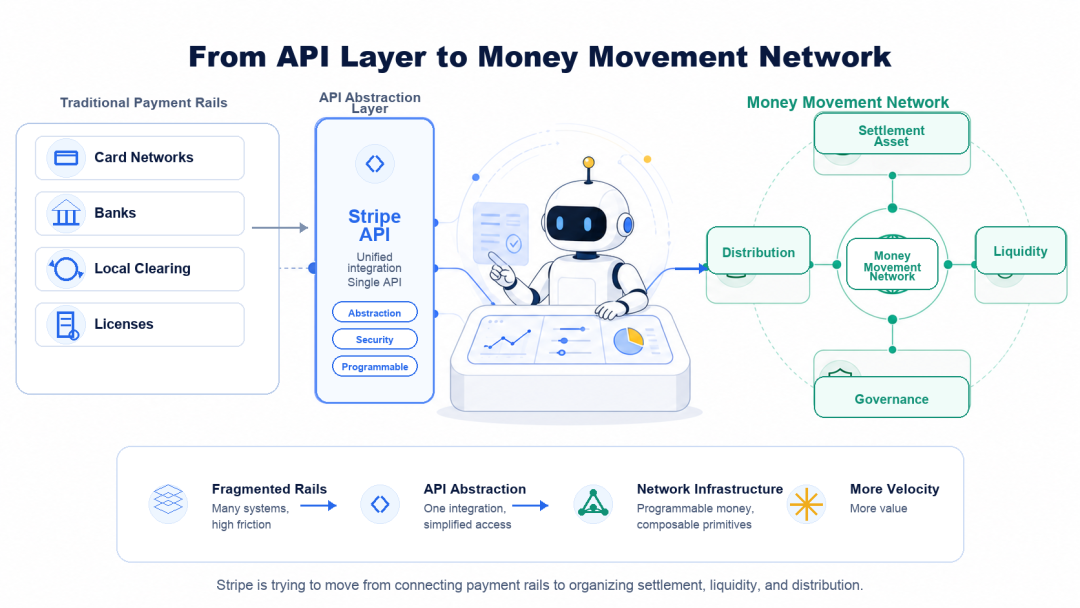
La logique de valorisation de ces deux choses est complètement différente : la première est un agrégateur de logiciels et de paiements, la seconde est un réseau.
Dans l'industrie des paiements, ce qui est le plus précieux, ce n'est jamais seulement l'API, mais les effets de réseau. Visa et Mastercard valent cher, non pas parce qu'elles ont un bouton de paiement plus joli, mais parce qu'elles organisent un réseau multipartite : émetteurs, acquéreurs, commerçants, consommateurs, règles de gestion des risques, traitement des litiges, chemins de compensation fonctionnent tous dans le même système de règles.
Si Stripe veut raconter une histoire plus grande que celle d'"API de paiement", elle doit répondre à une question :Est-il possible qu'elle ne se contente pas de connecter les réseaux des autres, mais qu'elle organise son propre réseau ? L'OUSD lui offre cette entrée narrative. L'attrait de l'OUSD pour Stripe ne réside pas dans le fait que ce soit un autre stablecoin en dollars, mais dans le fait qu'elle pointe simultanément vers quatre choses.
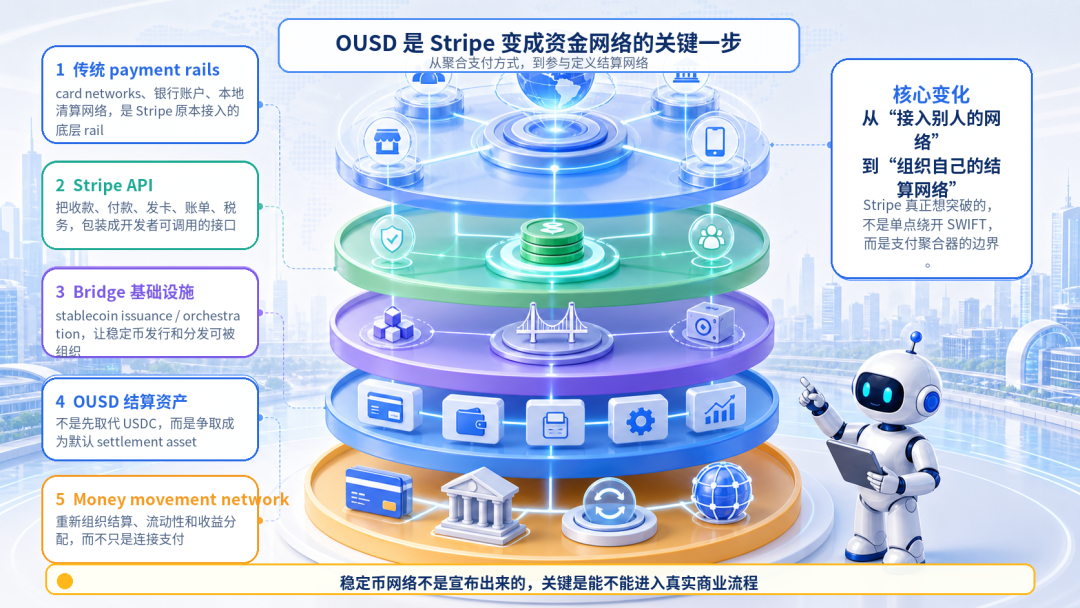
Premièrement, elle donne à Stripe la possibilité de posséder un actif de règlement par défaut.
Auparavant, Stripe aidait les commerçants à se connecter à Visa, Mastercard, ACH, aux portefeuilles locaux et aux virements bancaires. À l'avenir, si l'OUSD peut devenir l'actif de règlement par défaut des commerçants, plateformes, marketplaces et agents IA de Stripe, Stripe ne se contentera plus de se connecter aux réseaux des autres, mais organisera son propre réseau.
Deuxièmement, elle change la répartition économique.
Dans les paiements traditionnels, Stripe peut percevoir des frais de traitement, mais les frais de réseau sous-jacents, les frais bancaires, les frais des réseaux de cartes et une partie des revenus des fonds vont à d'autres. Si les revenus des réserves de stablecoins, l'émission/rachat, la liquidité, les portefeuilles, les cartes, les on/off-ramp sont tous organisés par le système Stripe / Bridge, Stripe aura l'opportunité d'entrer dans une économie plus profonde.
Troisièmement, elle fournit une couche de fonds programmable pour le commerce agentique.
Si la couche sous-jacente reste seulement les cartes de crédit et les virements bancaires, ce que les agents peuvent faire sera bloqué par l'autorisation, la gestion des risques, les délais de règlement, les coûts transfrontaliers et les processus de réconciliation. Les stablecoins ne résolvent pas tous les problèmes, mais ils se rapprochent davantage d'un rail monétaire que les machines peuvent appeler.
Quatrièmement, elle fait passer Stripe d'une société de logiciels à une société de réseau.
Si l'OUSD réussit, ce que Stripe pourra raconter ne sera plus seulement "nous facilitons les paiements", mais "nous organisons le prochain réseau de règlement commercial mondial". C'est là que réside son véritable importance. Mais il faut aussi regarder cela avec sang-froid.
Aujourd'hui, l'OUSD ressemble davantage au point de départ narratif de cette ambition, et non à une infrastructure déjà achevée. Un réseau de stablecoins ne se décrète pas, il nécessite une liquidité suffisamment profonde, un rachat stable et à faible friction, l'acceptation des banques et des régulateurs, la volonté des commerçants de détenir ou de régler automatiquement, la capacité d'intégration aux ERP, trésorerie, réconciliation des entreprises, une expérience stable inter-chaînes et inter-régions, et la gouvernance des participants ne peut pas devenir une alliance à décision lente.
Ainsi, à court terme, l'OUSD n'est pas un "tueur d'USDC". Elle ressemble davantage à une question que Stripe pose au marché :Si les flux de capitaux futurs ne dépendent plus seulement des réseaux de paiement traditionnels, qui organisera le nouvel actif de règlement, le réseau de distribution et le mécanisme de répartition économique ?
二、Que cherche vraiment à faire l'OUSD : pas un USDC Killer, mais une réécriture de la répartition des bénéfices des stablecoins
Open USD, abrégé OUSD, est le nouveau stablecoin en dollars annoncé par Open Standard le 30 juin 2026. La définition officielle est :un stablecoin partagé pour l'activité financière mondiale, c'est-à-dire un stablecoin partagé pour les activités financières mondiales.
Ce n'est pas un "stablecoin privé" émis uniquement par Stripe. Il est géré et exploité par la société indépendante Open Standard, avec la participation d'un groupe de sociétés de paiement, banques, fintechs, infrastructures cryptographiques et plates-formes de commerçants. Les participants officiellement listés incluent Stripe, Visa, Mastercard, BlackRock, BNY, Coinbase, Shopify, Bridge, Tempo, Privy, etc.
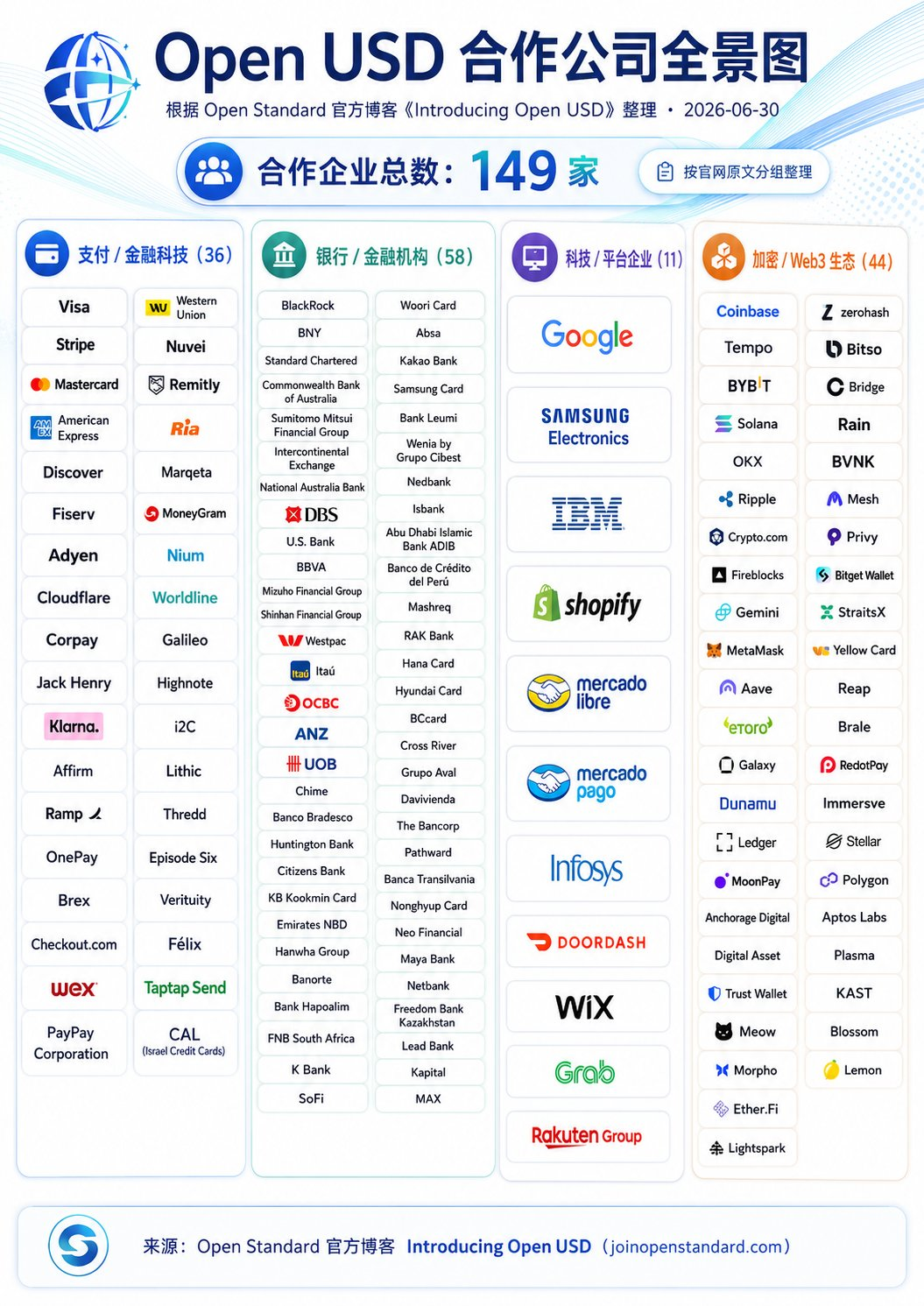
Il y a aussi un détail très intéressant : l'OUSD n'a pas été directement lancé par Stripe officiellement. Il a été annoncé par Open Standard, et le PDG fondateur d'Open Standard est Zach Abrams. Zach Abrams est également le cofondateur / PDG de Bridge, qui a été racheté par Stripe.
Ainsi, d'un point de vue organisationnel, l'OUSD n'est pas sans rapport avec Stripe. Au contraire, elle se situe clairement dans le prolongement de la stratégie stablecoin de Stripe / Bridge. Mais d'un point de vue narratif produit et gouvernance, elle ne peut être présentée comme un stablecoin privé de Stripe.
C'est là que réside la subtilité de l'OUSD :elle a besoin des capacités d'exécution, de la compréhension du réseau de paiement et du futur potentiel de distribution de Stripe et Bridge, mais elle doit, à travers l'entité indépendante Open Standard, se présenter comme un réseau de stablecoins géré par une participation multipartite, une gouvernance commune et un partage des bénéfices économiques.
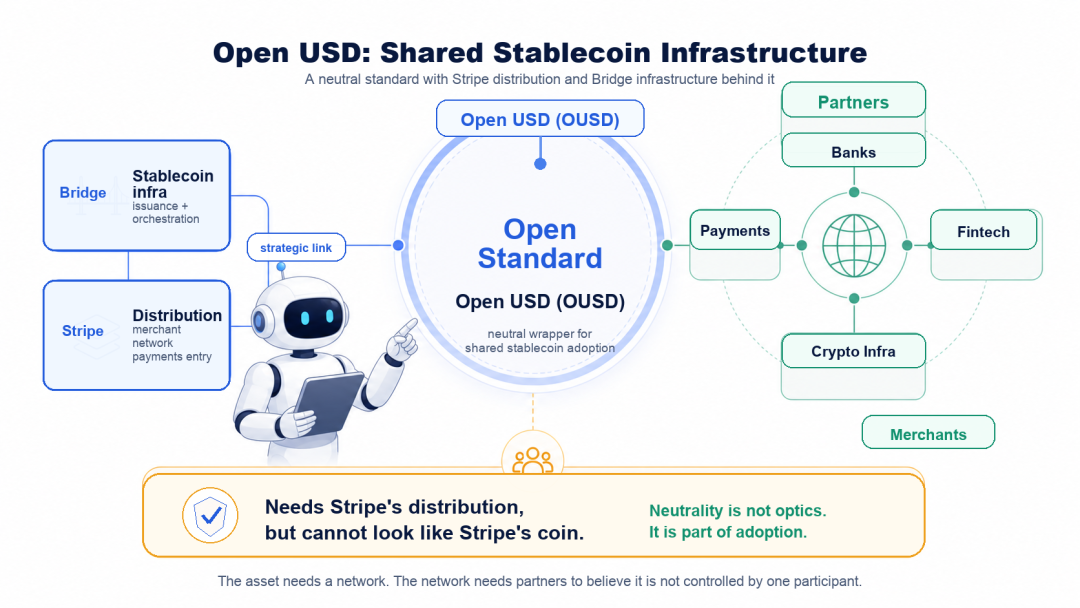
En d'autres termes, elle a besoin de la force de Stripe, mais ne doit pas sembler n'être que la pièce de Stripe. L'OUSD se concentre sur trois aspects de conception.
Premièrement, l'émission et le rachat ne sont pas facturés, et il n'y a pas de limite de taille fixée arbitrairement.
Deuxièmement, les revenus générés par les actifs de réserve de l'OUSD, après déduction d'une petite partie des frais de gestion, seront distribués aux partenaires qui promeuvent son adoption et sa distribution.
Troisièmement, elle adopte une gouvernance collaborative. Le conseil d'administration d'Open Standard est composé des partenaires de l'OUSD, l'objectif officiel étant qu'il ne s'agisse pas d'un réseau privé d'une seule entreprise, mais d'une infrastructure de stablecoin façonnée conjointement par les participants. L'OUSD n'est pas seulement un nouveau stablecoin en dollars, c'est une tentative de répondre à une question plus commerciale :
Si les stablecoins deviennent l'infrastructure sous-jacente des flux de capitaux mondiaux, les entreprises qui les utilisent, les distribuent et apportent des scénarios de transaction ne devraient-elles pas également participer à la gouvernance et à la répartition des revenus ?
Alors, que cherche vraiment à faire l'OUSD ? Je ne pense pas qu'il s'agisse à court terme d'un tueur d'USDC.
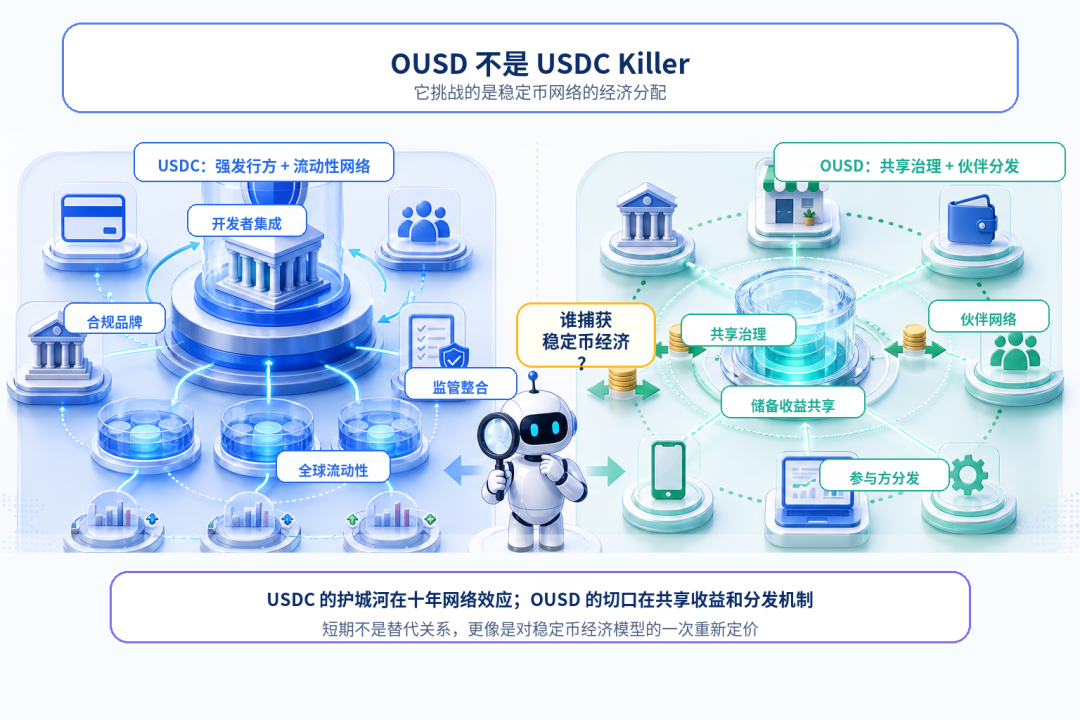
L'avantage de pionnier de l'USDC est très réel. Elle a de la liquidité, des scénarios d'échanges et de DeFi, la confiance des institutions, une marque conforme et de nombreuses intégrations déjà réalisées. Un stablecoin n'est pas quelque chose que l'on peut migrer simplement en changeant de nom, il y a derrière la confiance dans le rachat, la profondeur de liquidité, l'acceptation par les contreparties et l'inertie opérationnelle.
Après le lancement de l'OUSD, Jeremy Allaire, PDG de Circle, a rapidement répondu aux questions sur la concurrence posée par l'OUSD. Son idée principale n'était pas que "n'importe qui peut émettre un stablecoin", mais tout le contraire : les stablecoins sont une activité de plateforme et d'effets de réseau qui s'accumulent sur le long terme.
Il a souligné que les principaux atouts de l'USDC proviennent de trois choses :l'intégration des développeurs et des applications, la liquidité mondiale, et l'intégration réglementaire et du système financier.
Dans les données officielles de Circle pour le T1 2026, la quantité en circulation de l'USDC est de 770 milliards de dollars, et le volume de transactions trimestrielles sur chaîne est de 21,5 billions de dollars. Ce chiffre ne reflète pas nécessairement complètement le taux de pénétration réel des paiements commerciaux, mais il suffit à montrer une chose : l'USDC n'est pas un ticker facilement remplaçable, c'est déjà un réseau de stablecoins en fonctionnement.
C'est pourquoi, présenter l'OUSD comme un "tueur d'USDC" serait une vision réductrice. Ce qui est vraiment intéressant avec l'OUSD, ce n'est pas qu'elle puisse immédiatement remplacer qui que ce soit, mais qu'elle ait choisi une autre voie :elle ne cherche pas d'abord à conquérir la liquidité transactionnelle dans le monde crypto-natif, mais elle s'immisce par les paiements entre entreprises, le règlement des plateformes, la distribution aux commerçants et la répartition des revenus de réserve.
Dans le modèle actuel des stablecoins, de nombreux utilisateurs ne sont en fait que des distributeurs ou des canaux. Plus un stablecoin est utilisé, plus l'émetteur peut obtenir les revenus générés par les actifs de réserve. Et les sociétés de paiement, plateformes, commerçants, portefeuilles, banques, fintech qui contribuent à la distribution et aux scénarios ne participent pas nécessairement pleinement à l'économie sous-jacente.
C'est cela que l'OUSD veut changer. Elle tente de convaincre les entreprises : vous n'utilisez pas seulement des stablecoins, vous pouvez également participer à la gouvernance et à la répartition économique de ce réseau de stablecoins.
Ainsi, ce que l'OUSD remet en cause, ce n'est pas seulement la part de marché de l'USDC. Elle remet en cause une question plus fondamentale dans l'industrie des stablecoins :qui contribue aux scénarios d'utilisation des stablecoins, et qui devrait donc partager combien des bénéfices économiques des stablecoins ?
Sous cet angle, les avantages de l'USDC restent solides, mais ce que propose l'OUSD n'est pas une simple relation de substitution, mais un nouveau modèle de répartition des bénéfices. Cela explique également pourquoi elle met l'accent sur l'ouverture, la gouvernance neutre et l'économie partagée.
L'ouverture vise à réduire les coûts psychologiques d'accès et de sortie des entreprises. La gouvernance neutre vise à faire croire aux participants qu'il ne s'agit pas d'un stablecoin privé d'une seule entreprise. L'économie partagée vise à permettre aux entreprises qui apportent réellement la distribution et le volume de transactions de participer à la répartition des revenus de réserve et de la valeur du réseau.
Ce n'est pas un problème purement technique, c'est un problème d'organisation commerciale. Bien sûr, cette voie est aussi plus difficile. Plus l'alliance est grande, plus les coûts de coordination sont élevés. Plus il y a de participants, plus la gouvernance est complexe. Plus un stablecoin veut devenir une infrastructure publique, plus il doit traiter les questions de responsabilité, de bénéfice, de responsabilité et de prise de décision finale.
La réponse d'Allaire au "partage des revenus pour tous" a également mis en lumière cette contradiction : si tous les revenus sont distribués, qui investira continuellement dans l'infrastructure ? Cette question n'est pas seulement un argument défensif de Circle. C'est effectivement une question à laquelle l'OUSD devra répondre à l'avenir.
La logique de Circle est la suivante : un émetteur fort doit conserver suffisamment de bénéfices pour pouvoir continuer à construire une infrastructure financière mondiale conforme, liquide, rachetable.
La logique de l'OUSD est la suivante : si les stablecoins doivent devenir une infrastructure partagée, les participants qui contribuent à la distribution, aux scénarios et au volume de transactions devraient également partager davantage l'économie de réserve et les droits de gouvernance.
Il ne s'agit donc pas d'une simple concurrence sur le thème "qui est moins cher". C'est une concurrence entre deux modes d'organisation des stablecoins. À court terme, l'OUSD n'est pas un tueur d'USDC.
Elle ressemble davantage à une remise en question commerciale du modèle de l'USDC :si les stablecoins deviennent vraiment la prochaine infrastructure de paiement mondiale, devraient-ils être dirigés par un émetteur fort, ou gouvernés conjointement par un groupe de réseaux commerciaux qui contribuent réellement au trafic, aux scénarios et à la confiance ?
三、Ce dont Stripe a besoin, ce n'est pas seulement de croissance, mais d'une narration d'entreprise plus large
Stripe est déjà une très grande entreprise, elle sert un grand nombre de sociétés Internet mondiales, SaaS, entreprises de plateforme, marketplaces et nouvelles sociétés d'IA. Ses produits ne se limitent plus depuis longtemps à un bouton de paiement, mais couvrent toute une gamme d'infrastructures financières : encaissement, paiements, facturation, fiscalité, gestion des risques, émission de cartes, comptes de fonds et enregistrement d'entreprises.
Mais le problème est que le marché des capitaux ne se contente pas de demander si une entreprise est grande. Il demande aussi : qu'est-ce que cette entreprise exactement ? C'est une question à laquelle Stripe a toujours dû répondre.
Si Stripe est perçue comme une société de paiement, elle sera évaluée dans le cadre des sociétés de paiement. Le marché examinera son volume de traitement des transactions, son taux de prélèvement, sa marge brute, ses coûts auprès des réseaux de cartes, l'intensité de la concurrence, les pressions réglementaires et sa capacité à maintenir une croissance élevée à long terme.
Si Stripe est perçue comme une société de logiciels, elle rencontre un autre problème : sa structure de revenus comporte une part importante liée au volume de paiements, contrairement au SaaS pur qui a un modèle de revenus d'abonnement et de marge logicielle très clair.
Ainsi, la narration la plus imaginative de Stripe n'a jamais été "nous sommes une société de paiement", ni simplement "nous sommes une société SaaS".
Mais plutôt :nous sommes l'infrastructure financière de l'économie Internet. Il y a cinq mois, j'ai écrit qu'elle était l'"AWS du monde financier", c'est ce que je voulais dire.
Le cœur d'AWS n'est pas qu'il ait beaucoup d'API, mais que les entreprises placent sur lui leurs processus de calcul, de stockage, de base de données, de réseau, de sécurité et de déploiement. Il fournit non pas un outil ponctuel, mais un environnement d'exécution par défaut.
Ce que Stripe veut devenir, ce n'est pas non plus un outil de paiement ponctuel. Elle veut devenir l'environnement d'exécution financier par défaut du commerce Internet, c'est pourquoi l'OUSD est si important pour Stripe.
Parce que si Stripe continue simplement à encapsuler davantage de capacités financières traditionnelles sous forme d'API, elle ne fait qu'une abstraction du système financier existant. Elle peut devenir de plus en plus facile à utiliser, de plus en plus complète, de plus en plus semblable à un OS financier, mais l'actif de règlement sous-jacent, le réseau de compensation et une partie des revenus économiques dépendent toujours des autres.
L'OUSD lui donne l'opportunité de descendre dans la couche monétaire. Sous cet angle, les actions de Bridge, Open Issuance, OUSD, Privy, le commerce agentique, Tempo ne sont pas isolées. Bridge permet à Stripe d'acquérir la capacité d'émission/orchestration de stablecoins. Open Issuance permet aux entreprises d'émettre et de gérer leurs propres stablecoins. L'OUSD fournit une entrée vers un stablecoin partagé et un réseau d'alliance. Privy rapproche Stripe des portefeuilles, de l'identité et de l'onboarding crypto-natif côté utilisateur. Tempo est la blockchain axée sur les paiements incubée par Stripe et Paradigm, pointant vers les rails de paiement et de règlement en stablecoins. Le commerce agentique fournit un nouveau scénario d'utilisation pour tout cela : à l'avenir, si les agents IA représentent réellement les utilisateurs, les entreprises et les systèmes logiciels pour initier des achats, des abonnements, l'utilisation de services et effectuer des règlements, alors le paiement ne sera plus seulement une action de clic sur un bouton de checkout par un humain, mais deviendra un flux de fonds continu entre logiciels.
En reliant ces actions,l'histoire que Stripe veut raconter n'est pas seulement : nous facilitons les paiements. Mais plutôt : nous permettons aux flux de capitaux dans la prochaine économie Internet d'être appelés par les logiciels, gérés par les entreprises et réglés mondialement.
C'est la narration du réseau de mouvement d'argent. Elle est plus large que l'API de paiement, et plus large que "supporter les paiements en stablecoins".
Bien sûr, cette histoire n'est pour l'instant qu'une histoire. L'OUSD n'est pas encore devenu un actif de règlement par défaut réel, le commerce agentique n'est pas encore entré dans une phase de commercialisation à grande échelle. La volonté des entreprises de détenir des stablecoins, la capacité des systèmes financiers à s'y connecter, la façon dont les régulateurs les percevront, la réaction des réseaux de paiement traditionnels, tout cela n'a pas encore de réponse.
Mais la narration d'entreprise n'apparaît généralement pas après que tout ait été accompli, elle apparaît souvent lorsqu'une entreprise est sur le point de franchir ses limites existantes.
La limite que Stripe doit franchir aujourd'hui est de passer de "je vous aide à accéder aux paiements" à "je vous aide à organiser les flux de capitaux".
L'OUSD n'est pas seulement un concurrent de plus sur le marché des stablecoins. C'est un signal que Stripe se pousse d'une société de paiement vers un réseau de mouvement d'argent.
四、La concurrence des paiements agentiques ne concerne pas l'entrée de paiement, mais la couche de règlement des transactions machine
Il vaut la peine de regarder l'OUSD et les paiements agentiques ensemble, non pas parce que les agents IA n'utiliseront à l'avenir que l'OUSD pour payer.
En fait, aujourd'hui, l'actif stablecoin le plus courant et le plus mature dans les paiements agentiques reste l'USDC. De nombreuses solutions de portefeuilles d'agents, x402, micropaiements sur chaîne, sont plus facilement développées autour de l'USDC par défaut. L'avantage de l'USDC n'est pas seulement sa marque conforme, mais le fait qu'elle est déjà entrée dans le réseau des développeurs, portefeuilles, échanges, infrastructures de paiement et de liquidité sur chaîne.
Visa et Mastercard ne sont pas non plus des spectateurs. Elles n'attendront pas que les stablecoins les remplacent, une situation plus réaliste est que les réseaux de cartes se transforment également en réseaux de paiement utilisables par les agents : autorisation plus granulaire, informations d'identification tokenisées plus fortes, règles de gestion des risques, de limites et de règlement plus adaptées aux transactions machine.
En juin 2026, Visa a annoncé un ensemble d'innovations en IA, stablecoins et jetons, pour soutenir des transactions commerciales plus intelligentes et programmables. Mastercard a également lancé Agent Pay for Machines, en soutenant explicitement le règlement multi-rails par cartes, comptes et stablecoins.
Ainsi, l'avenir des paiements agentiques ne sera pas une simple histoire de "remplacement des réseaux de cartes par les stablecoins".
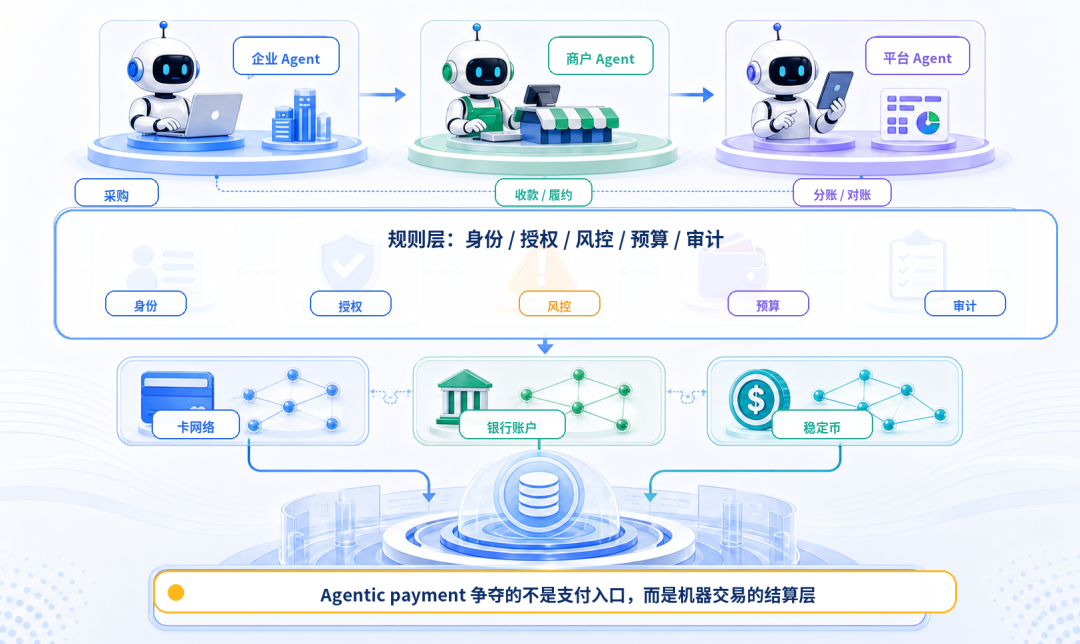
Ce qui est plus susceptible de se produire, c'est que les réseaux de cartes, les comptes bancaires, les stablecoins, les portefeuilles, les règlements sur chaîne et les systèmes de commerçants vont simultanément concurrencer la même position :qui deviendra la couche de règlement que les agents peuvent appeler, que les entreprises peuvent contrôler, que les commerçants peuvent accepter, et que la comptabilité peut réconcilier ?
C'est aussi pourquoi les actions de Stripe méritent d'être vues ensemble :
L'OUSD est une tentative d'actif de règlement.
Tempo est une tentative de chaîne de paiement et de rail de règlement en stablecoins.
Bridge est l'infrastructure d'émission/orchestration de stablecoins.
Privy est l'entrée vers les portefeuilles, l'identité et l'onboarding des utilisateurs.
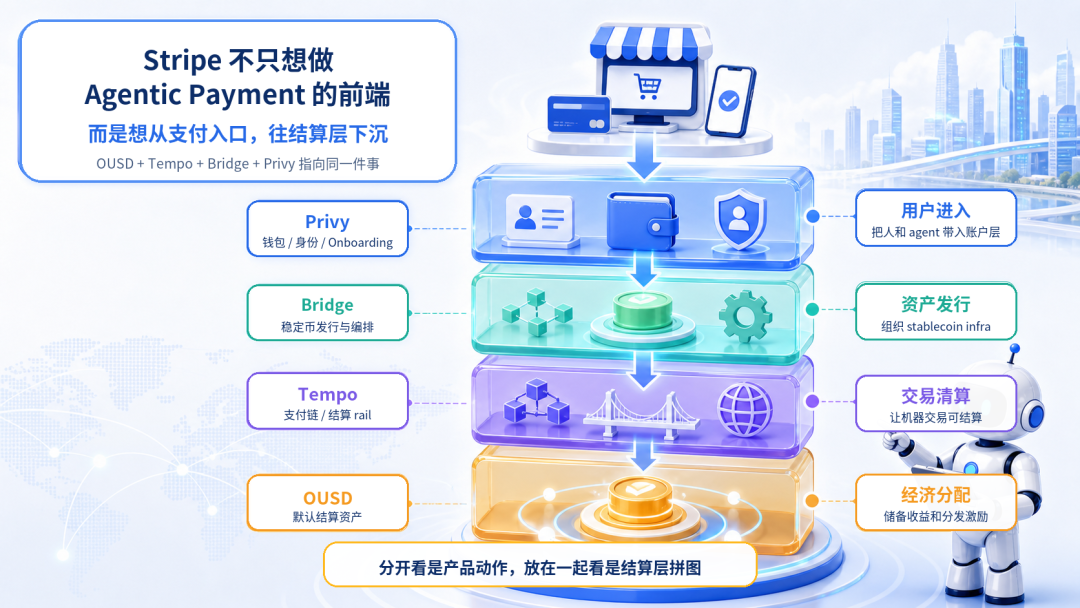
Si l'on regarde ces choses séparément, ce ne sont que des actions produits. Mais vues ensemble, elles pointent vers la même question :Stripe ne veut pas seulement participer au checkout frontal des paiements agentiques. Elle veut descendre de l'entrée de paiement vers la couche de règlement, c'est aussi là que réside l'intérêt entre Stripe et les réseaux de cartes traditionnels.
L'avantage de Visa et Mastercard est qu'elles possèdent déjà un réseau mondial de commerçants, un réseau d'émetteurs, des règles de gestion des risques et un système de traitement des litiges. Leur chemin le plus naturel est de transformer leur réseau existant en un réseau de paiement que les agents peuvent également appeler.
Le point fort de Stripe n'est pas de posséder le réseau de cartes lui-même, mais de se tenir du côté des commerçants, développeurs, plateformes et nouvelles sociétés de logiciels, en encapsulant des capacités financières complexes sous forme d'API. Elle est plus proche de la couche applicative et des commerçants, et peut plus facilement entrer dans les flux de travail des sociétés AI-natives, des outils d'agents, des SaaS et des marketplaces.
Donc, si les paiements agentiques se développent vraiment, Stripe ne se contentera pas d'aider les agents à appeler Visa ou Mastercard.
Ce qu'elle veut faire, c'est plutôt : permettre aux agents d'utiliser de l'argent en toute sécurité dans le système de règles de Stripe. La clé ici n'est pas "pouvoir payer ou non", mais toute une série de problèmes après le paiement :
Qui autorise ? Qui fixe le budget ? Qui assume le risque ? Qui fait le KYC ? Qui traite les remboursements et litiges ? Qui synchronise la transaction dans le système comptable de l'entreprise ? Qui décide combien un agent peut dépenser, sur quels services, avec quel actif de règlement ?
C'est là que réside la véritable complexité des transactions machine. Un agent qui achète des API, utilise des données, s'abonne à des outils, paie de la puissance de calcul, accomplit des tâches transfrontalières, semble être un paiement, mais en réalité, derrière, il y a un ensemble de questions de permissions, d'identité, de gestion des risques, de budget, d'audit et de réconciliation.
Les stablecoins peuvent résoudre une partie du problème d'efficacité du règlement, mais ils ne peuvent pas résoudre seuls tous les problèmes de paiement commercial. Les réseaux de cartes peuvent continuer à fournir autorisation, gestion des risques et acceptation par les commerçants, mais ils doivent aussi s'adapter à des formes de transactions à faible montant, haute fréquence, multiplateformes, initiées automatiquement par des logiciels.
Ce que Stripe veut conquérir, c'est précisément la couche intermédiaire entre ces deux éléments :
d'un côté connecter les commerçants et développeurs, de l'autre organiser les stablecoins, portefeuilles, identité, gestion des risques, règlement et réconciliation.
Sous cet angle, l'OUSD n'est pas la réponse complète aux paiements agentiques, c'est une pièce du puzzle de Stripe descendant vers la couche de règlement.
La véritable ambition est de faire des paiements agentiques un réseau de mouvement d'argent que Stripe peut organiser.
五、Alors, l'OUSD peut-elle soutenir l'ambition de Stripe?
Revenons à la question initiale : Open USD peut-il soutenir l'ambition de Stripe ? Ma réponse est : à court terme, pas encore, mais cela rend cette ambition plus concrète pour la première fois.
Elle ne peut pas immédiatement libérer Stripe des réseaux de paiement traditionnels, Visa, Mastercard, ACH, les banques locales, les réseaux de cartes, les acquéreurs, les émetteurs, les licences réglementaires, KYC, AML, la fiscalité, la réconciliation, ces choses ne disparaîtront pas avec le lancement d'un stablecoin. Les paiements commerciaux du monde réel n'ont jamais été aussi simples que "l'argent va de A à B".
Les stablecoins peuvent résoudre une partie du problème de transmission, ils peuvent rendre les flux de capitaux plus rapides, moins chers et plus programmables, mais ils ne peuvent pas résoudre automatiquement le problème de l'atterrissage.
Une fois l'argent arrivé, qui est responsable de la comptabilisation ? Qui fait le KYC ? Qui assume le risque de fraude ? Qui traite les remboursements et litiges ? Qui garantit que le commerçant reçoit des fonds qu'il peut utiliser ? Qui intègre cette transaction dans les processus ERP, financiers et fiscaux de l'entreprise ?
Ces problèmes nécessitent encore beaucoup d'infrastructures financières et commerciales traditionnelles, c'est pourquoi Stripe ne deviendra pas une entreprise purement crypto à cause de l'OUSD.
Elle est plus susceptible de prendre une autre voie :faire des stablecoins une partie de son infrastructure financière existante, c'est-à-dire que si l'OUSD réussit, ce n'est pas parce qu'elle fait quitter Stripe du système financier traditionnel, mais parce qu'elle donne à Stripe, en dehors du système financier traditionnel, une couche de réseau de règlement supplémentaire qu'elle peut participer à définir.
Cette couche de réseau ne remplace pas nécessairement tout, mais elle peut changer la position de Stripe dans le flux des capitaux.
Par le passé, Stripe ressemblait davantage à un excellent traducteur, traduisant le système financier complexe en API que les développeurs peuvent appeler, transformant des capacités telles que paiements, facturation, fiscalité, émission de cartes, gestion des risques, comptes de fonds en modules que les entreprises peuvent intégrer dans leurs produits.
Mais l'OUSD pointe vers autre chose : Stripe ne se contente plus de traduire le système financier existant. Elle commence à participer à la définition d'un nouveau système financier, c'est pourquoi je pense que cela mérite d'être écrit. Non pas parce que l'OUSD va forcément gagner, mais parce qu'elle révèle la question stratégique la plus importante de Stripe pour la prochaine étape :
Stripe veut-elle vraiment devenir un meilleur processeur de paiement, ou veut-elle devenir le réseau de mouvement d'argent de la prochaine génération de commerce Internet ?
Ces deux choses semblent ne différer que légèrement, mais en réalité elles diffèrent beaucoup. La valeur d'un processeur de paiement provient du traitement des transactions, de la gestion des risques, de l'efficacité d'accès et de la couverture des commerçants. La valeur d'un réseau de mouvement d'argent provient des effets de réseau, de l'actif de règlement par défaut, de la capacité à établir des règles, à organiser la liquidité et des mécanismes de répartition économique.
Le premier est un service, le second est une infrastructure.
Ce que Stripe a fait de mieux ces quinze dernières années, c'est de transformer les services financiers en interfaces logicielles, mais si à l'avenir elle veut soutenir le commerce IA, l'économie de plateforme mondiale, les paiements transfrontaliers, le règlement en stablecoins et les paiements agentiques, elle ne peut pas rester uniquement au niveau de l'interface.
Elle doit se rapprocher de l'argent lui-même, l'OUSD lui en donne l'entrée. Bien sûr, que cette entrée devienne un véritable réseau dépendra des prochaines années. Il faudra voir si l'OUSD a des scénarios d'utilisation réels, si Stripe l'intégrera profondément dans les outils des commerçants, des plateformes et des développeurs, si les participants apporteront réellement de la distribution, et pas seulement mettront leur logo sur la page de lancement, si les régulateurs accepteront cette structure de stablecoin en alliance, et aussi comment réagiront Circle, Tether, les banques, les réseaux de cartes et les autres sociétés de paiement.
Il n'y aura pas de réponse rapide à cela, mais cela a déjà rendu une question claire :les stablecoins ne sont plus seulement des actifs transactionnels dans le monde crypto. Ils deviennent des outils pour les sociétés de paiement, banques, plateformes, commerçants et sociétés d'IA pour conquérir l'entrée du réseau de capitaux de la prochaine génération.
Sous cet angle, l'OUSD n'est pas la destination de Stripe, c'est un signal que Stripe tente de se pousser d'une société d'API de paiement vers un réseau de mouvement d'argent.
Il y a cinq mois, j'ai écrit :Money will run on Stripe.

Aujourd'hui, cette phrase peut être poussée un peu plus loin. Ce que Stripe veut prouver, c'est :
L'argent pourrait s'établir sur un réseau que Stripe a contribué à définir.