Is Trump using the CLARITY Act as leverage in broader negotiations?

ambcryptoPublished on 2026-07-01Last updated on 2026-07-01

Abstract

The July 4 deadline for the CLARITY Act's passage appears set to lapse without approval, following nearly a year of delays since the House passed it in July 2025. The current holdup stems from President Donald Trump using the bill as leverage in broader negotiations. He recently called off the signing ceremony for the bipartisan 21st Century ROAD to Housing Act, having previously stated he would not sign other bills until Republicans pass the SAVE America Act. This creates a Senate scheduling crunch, squeezing the CLARITY Act's chances before the August recess. Despite Trump's move, Senator Tim Scott and others express hope for advancing the crypto market structure bill quickly, citing a bipartisan Senate Banking Committee proposal. The urgency is driven by concerns that prolonged regulatory uncertainty could push the crypto ecosystem to other nations. However, the bill risks losing momentum if Republicans cannot secure the required 60 votes before the recess, potentially delaying it until 2027. Galaxy Research has consequently lowered its outlook for the Act's passage from 60% to 50%.

The July 4 deadline for the CLARITY Act’s passage looks set to lapse without approval. Nearly a year has already passed since the U.S. House of Representatives approved the bill in July 2025.

Since then, it has encountered numerous obstacles in Congress. This includes opposition from the stablecoin industry regarding rewards and ethical concerns from lawmakers. Interestingly, the current delay is because the bill is now being used as leverage in larger negotiations by U.S. President Donald Trump.

Trump’s move sent shockwaves

According to the latest update, President Trump called off the signing ceremony for the 21st Century ROAD to Housing Act.

The bill featured a ban on a central bank digital currency (CBDC) and was supported by both parties in both chambers of Congress. In March, Trump had declared that he would “not sign other bills” until Republicans in Congress passed the SAVE America Act.

This has created a Senate scheduling crunch, directly squeezing the CLARITY Act’s chances of passage before the August recess.
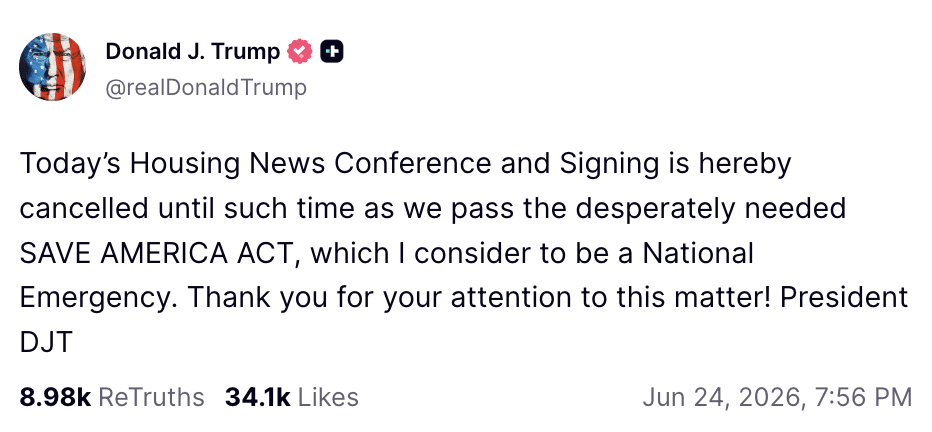
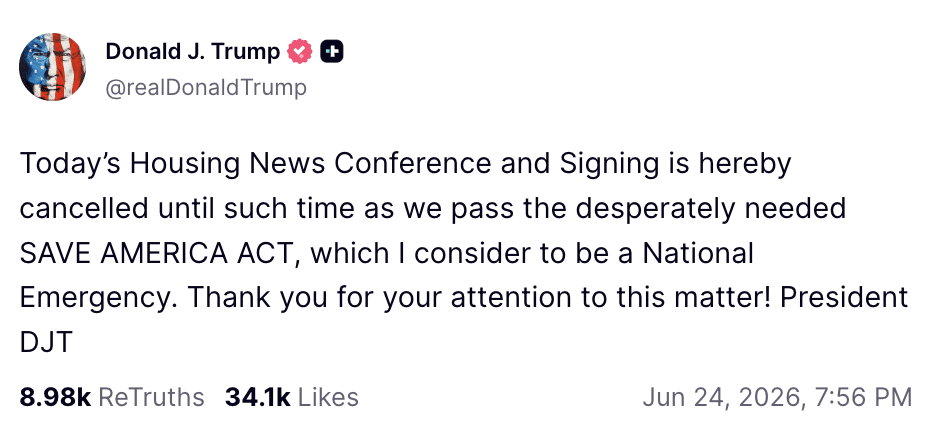
Source: Truth Social

Senators are hopeful of the CLARITY Act

Even though Trump has retreated, Senator Tim Scott has stated his support for advancing the bill as soon as possible.
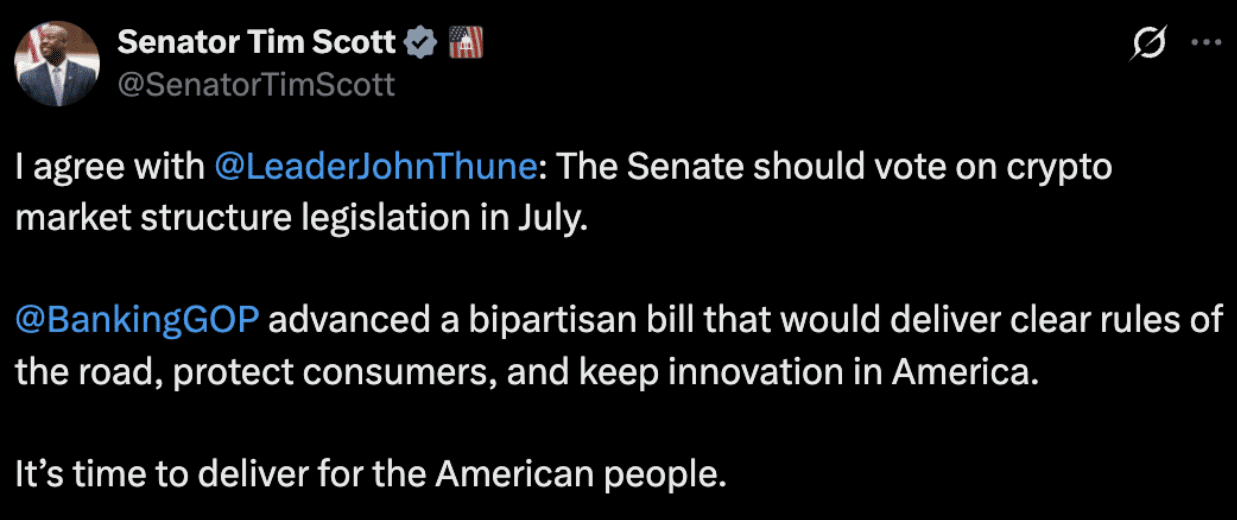
Source: Senator Tim Scott/X

The push also comes from the fact that Republicans on the Senate Banking Committee have already put forward a bipartisan proposal.

Taken together, the urgency stems from worries that extended regulatory ambiguity may push crypto’s ecosystem to nations with more defined legal systems. Because of this, Scott contends that the Senate should move quickly to pass the legislation.

Is the 4th July deadline realistic?

That said, the bill might also lose steam if Republicans are unable to obtain the required sixty votes before the Senate’s August recess. It’s possible that congressional priorities will shift as a result of many lawmakers refocusing on reelection campaigns. This, in turn, would delay the CLARITY Act’s consideration until the following session of Congress in 2027.

Galaxy Research has lowered its outlook for the CLARITY Act from 60% to 50%. This marks a sharp contrast to early June, when optimism was high, even within the White House, that the crypto market structure bill would be passed by its original July 4 deadline.


Final Summary

  • Donald Trump called off the signing ceremony for the 21st Century ROAD to Housing Act.
  • With this blocker, the 4th of July deadline looks dicey for the approval of the CLARITY Act.

Trending Cryptos

Related Questions

QWhat is the primary reason the CLARITY Act is now unlikely to meet its July 4 deadline for passage?

AThe primary reason is that U.S. President Donald Trump is using the CLARITY Act as leverage in broader negotiations, particularly by calling off the signing ceremony for the 21st Century ROAD to Housing Act and creating a Senate scheduling crunch.

QWhich other bill's cancellation by President Trump directly impacted the CLARITY Act's timeline?

AThe cancellation of the signing ceremony for the 21st Century ROAD to Housing Act, a bipartisan bill featuring a ban on a central bank digital currency (CBDC), directly impacted the CLARITY Act's timeline.

QAccording to the article, what is one major concern driving the urgency for passing the CLARITY Act?

AOne major concern is that extended regulatory ambiguity may push the cryptocurrency ecosystem to nations with more defined legal systems.

QWho has publicly stated support for advancing the CLARITY Act as soon as possible despite the current delays?

ASenator Tim Scott has stated his support for advancing the CLARITY Act as soon as possible.

QAccording to Galaxy Research, how has the outlook for the CLARITY Act's passage changed?

AGalaxy Research has lowered its outlook for the CLARITY Act's passage from 60% to 50%.

Related Reads

Crypto Payment Cards with $1.5 Billion Monthly Transaction Volume, Stuck in the 1990s

Monthly crypto payment card transaction volume has reached $15 billion, but the industry's development stage is comparable to debit cards in the 1990s, before they became a mainstream financial staple. A key limitation is the lack of established daily financial relationships, such as direct salary deposits and recurring bill payments, with crypto wallets. Despite annualized transaction volumes of approximately $18 billion, the market is concentrated and immature. The leading provider, RedotPay, commands over half the market share. User adoption is heavily skewed towards emerging markets like Bangladesh, India, and Nigeria, where access to USD and stable financial services is limited, rather than developed economies. The sector features four primary business models: 1) Card-issuing infrastructure providers, 2) Exchange-affiliated cards for user retention, 3) Decentralized wallet/DeFi cards with self-custody but high complexity, and 4) Stablecoin-focused digital banks, which dominate transaction volume by offering integrated financial services. The article argues that a pure payment functionality is insufficient for long-term success, mirroring the historical trajectory of traditional debit cards. Future winners will need to: 1) Control the upstream flow of funds, 2) Secure defensible niches in underserved markets, and 3) Most crucially, build core account relationships that integrate into users' daily financial lives. Without this evolution, crypto cards risk remaining niche prepaid tools rather than becoming universal financial infrastructure.

Foresight News6m ago

Crypto Payment Cards with $1.5 Billion Monthly Transaction Volume, Stuck in the 1990s

Foresight News6m ago

$7.8 Billion in Theft and Losses Reveals the Truth: Security Costs Have Become an Unavoidable Liquidity Tax for DeFi

"7.8 Billion in Thefts Reveals the Truth: Security Costs Have Become DeFi's Unavoidable 'Liquidity Tax'" A summary of Q2 2026 data reveals that security risks are now a fundamental capital cost in DeFi, directly impacting user returns and liquidity decisions. DeFiLlama recorded 88 hacking incidents with quantified losses totaling $780.3 million in Q2. April was the worst month with $644.8 million lost. DeFi protocol attacks accounted for $735.8 million, while cross-chain bridge exploits resulted in $354.4 million in losses (note: some event categorizations overlap). Cumulatively, DeFi hacks have reached $7.85 billion, with bridge losses at $3.26 billion. The quarter highlighted two primary risk categories: high-value infrastructure vulnerabilities (e.g., bridges, oracles, admin keys) causing massive single losses, and more frequent contract logic bugs. This signals a critical market shift: from post-incident analysis to preemptive pricing of risk. Users and liquidity providers now implicitly factor in the security of the entire asset pathway—not just pool APY—into their decisions. This hidden "risk premium" manifests through wider spreads, higher liquidity incentives, and capital migration towards perceived safer routes. Cross-chain bridge risks, responsible for over $353 million in Q2 losses, exemplify this change. Asset routing credibility is now part of the transaction. Following incidents like KelpDAO and THORChain, markets are demanding safer bridges, asset insurance, and clearer risk disclosure, increasing the cost of capital for riskier pathways. Consequently, security spending is transforming from a defensive cost into a core distribution cost for attracting liquidity. Protocols must invest more in audits, bug bounties, real-time monitoring, and insurance to remain competitive. Users are increasingly demanding transparency about fund flow paths, associated risks, and contingency plans. The key indicators for the industry's direction will be whether capital continues consolidating in trusted channels, if projects delay launches for enhanced audits, if insurance premiums rise, and if aggregators start displaying security risk metrics. Q2 2026 may be remembered not just as a bad period, but as the point when DeFi underwent a fundamental asset risk repricing, where security became a persistent,隐性 tax on all on-chain activity.

Foresight News35m ago

$7.8 Billion in Theft and Losses Reveals the Truth: Security Costs Have Become an Unavoidable Liquidity Tax for DeFi

Foresight News35m ago

Breaking News: The "Worker's Edition" Claude 5 Is Here, Everyone Can Use It

BREAKING: Claude Sonnet 5, dubbed "Fennec," is now the default model for all Free and Pro users. This mid-tier model boasts the strongest Agent capabilities in the Sonnet line yet, with performance rivaling the flagship Opus 4.8. It features autonomous planning and can utilize browser and terminal tools—capabilities previously exclusive to costly, large models. Key benchmarks highlight significant gains over its predecessor, Sonnet 4.6, in reasoning, tool use, coding, and knowledge work. Sonnet 5 scores 63.2% on SWE-bench Pro (surpassing GPT-5.5's 58.6%), 80.4% on Terminal-Bench 2.1, and 57.4% on Humanity's Last Exam (just 0.5% behind Opus 4.8). It even slightly outperforms Opus 4.8 in some knowledge tasks. Anthropic positions it as delivering ~90% of Opus's capability at a fraction of the cost. Pricing is aggressive: a limited-time promotional rate of $2 per million input tokens and $10 per million output tokens (reverting to $3/$15 after August 31). This undercuts Opus 4.8 ($5/$25) and GPT-5.5 ($5/$30). However, a new tokenizer may increase token counts by 1.0-1.35x, affecting final costs post-promotion. Notably, Sonnet 5 excels in security, with a mere 0.93% browser injection attack success rate, outperforming Mythos 5 and Opus 4.8. Its prompt injection defense matches Opus 4.8 at 0.19%. Launching amid uncertainty around the region-restricted Fable 5, Sonnet 5 is globally available. It targets the mid-market, offering near-flagship performance at a competitive price, effectively lowering the barrier for multi-Agent development and presenting a compelling alternative for cost-conscious developers.

marsbit51m ago

Breaking News: The "Worker's Edition" Claude 5 Is Here, Everyone Can Use It

marsbit51m ago

Trading

Spot

Hot Articles

How to Buy 4

Welcome to HTX.com! We've made purchasing 4 (4) simple and convenient. Follow our step-by-step guide to embark on your crypto journey.Step 1: Create Your HTX AccountUse your email or phone number to sign up for a free account on HTX. Experience a hassle-free registration journey and unlock all features.Get My AccountStep 2: Go to Buy Crypto and Choose Your Payment MethodCredit/Debit Card: Use your Visa or Mastercard to buy 4 (4) instantly.Balance: Use funds from your HTX account balance to trade seamlessly.Third Parties: We've added popular payment methods such as Google Pay and Apple Pay to enhance convenience.P2P: Trade directly with other users on HTX.Over-the-Counter (OTC): We offer tailor-made services and competitive exchange rates for traders.Step 3: Store Your 4 (4)After purchasing your 4 (4), store it in your HTX account. Alternatively, you can send it elsewhere via blockchain transfer or use it to trade other cryptocurrencies.Step 4: Trade 4 (4)Easily trade 4 (4) on HTX's spot market. Simply access your account, select your trading pair, execute your trades, and monitor in real-time. We offer a user-friendly experience for both beginners and seasoned traders.

4.4k Total ViewsPublished 2025.10.20Updated 2026.06.02

How to Buy 4

Discussions

Welcome to the HTX Community. Here, you can stay informed about the latest platform developments and gain access to professional market insights. Users' opinions on the price of 4 (4) are presented below.

活动图片