Breaking News: The "Worker's Edition" Claude 5 Is Here, Everyone Can Use It

marsbitPublished on 2026-07-01Last updated on 2026-07-01

Abstract

BREAKING: Claude Sonnet 5, dubbed "Fennec," is now the default model for all Free and Pro users. This mid-tier model boasts the strongest Agent capabilities in the Sonnet line yet, with performance rivaling the flagship Opus 4.8. It features autonomous planning and can utilize browser and terminal tools—capabilities previously exclusive to costly, large models. Key benchmarks highlight significant gains over its predecessor, Sonnet 4.6, in reasoning, tool use, coding, and knowledge work. Sonnet 5 scores 63.2% on SWE-bench Pro (surpassing GPT-5.5's 58.6%), 80.4% on Terminal-Bench 2.1, and 57.4% on Humanity's Last Exam (just 0.5% behind Opus 4.8). It even slightly outperforms Opus 4.8 in some knowledge tasks. Anthropic positions it as delivering ~90% of Opus's capability at a fraction of the cost. Pricing is aggressive: a limited-time promotional rate of $2 per million input tokens and $10 per million output tokens (reverting to $3/$15 after August 31). This undercuts Opus 4.8 ($5/$25) and GPT-5.5 ($5/$30). However, a new tokenizer may increase token counts by 1.0-1.35x, affecting final costs post-promotion. Notably, Sonnet 5 excels in security, with a mere 0.93% browser injection attack success rate, outperforming Mythos 5 and Opus 4.8. Its prompt injection defense matches Opus 4.8 at 0.19%. Launching amid uncertainty around the region-restricted Fable 5, Sonnet 5 is globally available. It targets the mid-market, offering near-flagship performance at a competitive price, e...

Just now, Claude Sonnet 5 has arrived!

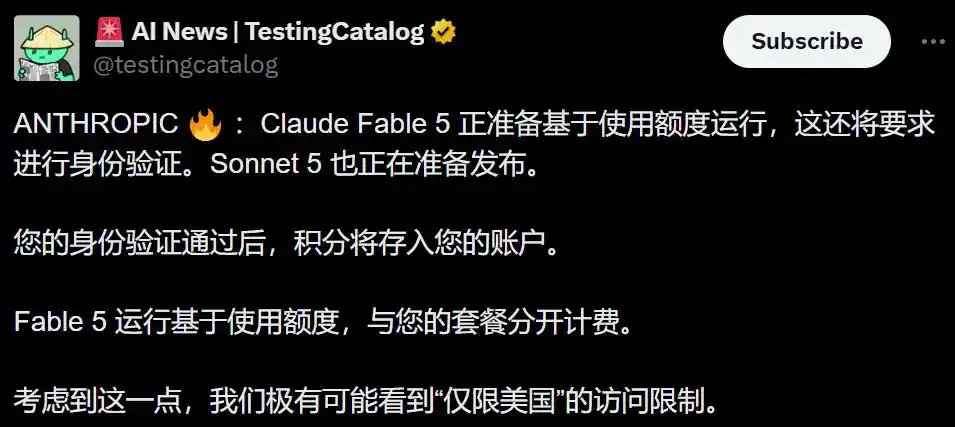
Code name: Fennec, the fennec fox, the smallest fox in the Sahara Desert.

This is Anthropic's Sonnet model with the strongest Agent capabilities to date, with performance close to that of the flagship Opus 4.8.

Effective immediately, Sonnet 5 becomes the default model for all Free and Pro users.
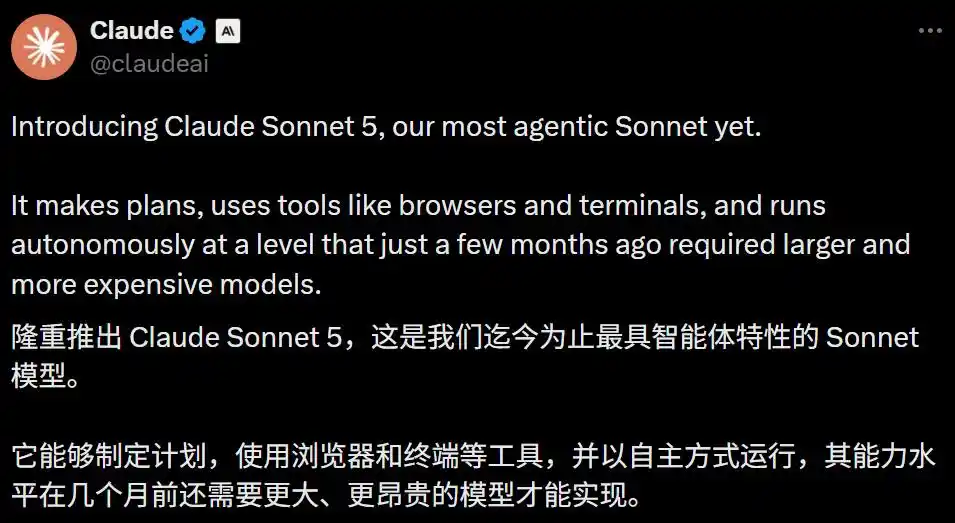
It can autonomously plan and invoke browser and terminal tools.

Just a few months ago, this required spending a lot of money to invoke super-large models; now, Sonnet easily achieves it.

Compared to the previous generation Sonnet 4.6, Sonnet 5 shows significant performance improvements in reasoning, tool use, programming, and knowledge work tasks.

Key points:

SWE-bench Pro score of 63.2%, surpassing GPT-5.5's 58.6%, slightly behind Opus 4.8's 69.2%

'Humanity's Last Exam' score of 57.4%, only 0.5 percentage points behind Opus 4.8

Standard pricing: $3 per million input tokens / $15 per million output tokens, only 60% of Opus 4.8's price

Browser injection defense: 0.93% success rate, beating both Mythos 5 and Opus 4.8
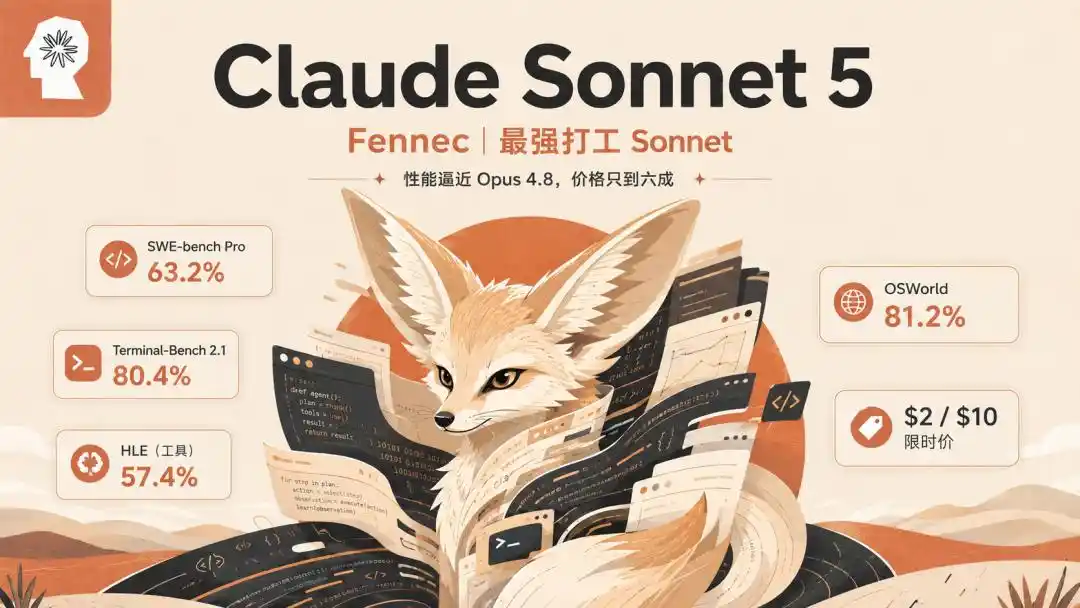
Interestingly, Fable 5 was also revealed to be making a comeback on the same day. But the cost is mandatory real-name verification, and it will most likely be limited to US users.

Sonnet 5, on the other hand, promises to hold nothing back, and is available globally for all users to use openly starting today.
On Par with Opus 4.8 Across the Board, the Strongest Worker AI Launches a Surprise Attack

This sudden launch of Sonnet 5 also helps fill the void left by the unavailability of Fable 5.

For many developers, the year one of the Agent era began with Sonnet.

Claude Sonnet 3.5, 3.6, and 3.7 were among the earliest models to demonstrate astonishing abilities in writing code and using tools.

In other words, the concept of "letting AI do the work itself" was first proven feasible by the Sonnet "medium cup" series.

But over the past year or so, the most dramatic leaps in capability have been concentrated on the Opus "large cup" line. Sonnet was left directly behind by the flagship.

What Sonnet 5 aims to do is close this gap!

Anthropic sets the tone with one sentence – Claude Sonnet 5 is the most capable "worker" Sonnet in history.

Looking at its real-world performance scores best illustrates this point.
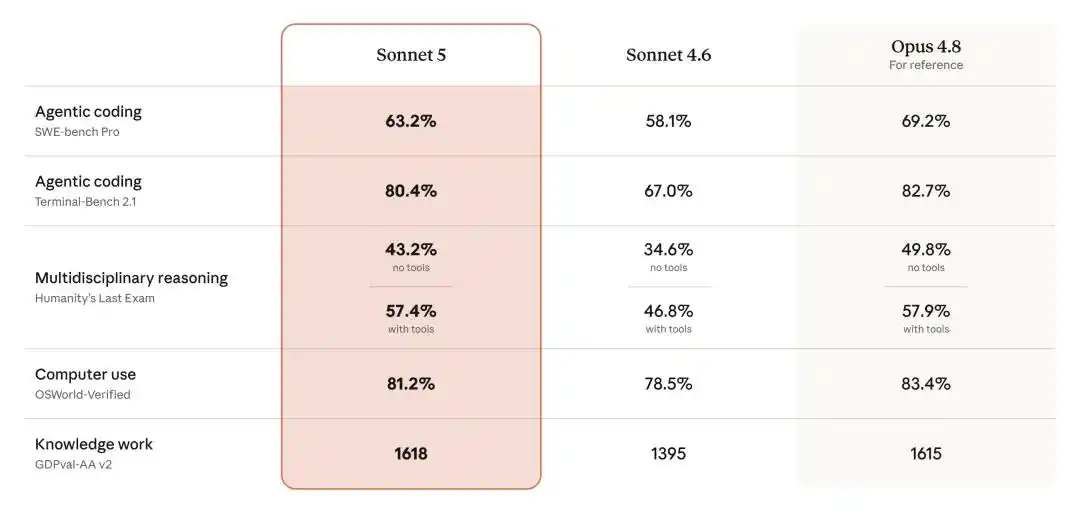
In its traditional stronghold of programming, Sonnet 5 impressively scores 63.2% on SWE-bench Pro. The previous Sonnet 4.6 only managed 58.1%, while Opus 4.8 currently leads with 69.2%.

In contrast, OpenAI's flagship GPT-5.5 only scores 58.6% on the same benchmark, and Google's Gemini 3.5 Flash scores just 55.1%.

Terminal-Bench 2.1 performance is even more ferocious. Sonnet 5 skyrockets to 80.4%, leaving Sonnet 4.6's 67.0% far behind with a huge 13 percentage point jump. It's less than 2 points away from Opus 4.8's 82.7%.

On the cross-disciplinary reasoning benchmark dubbed 'Humanity's Last Exam', Sonnet 5 with tools achieves 57.4%, compared to Opus 4.8's 57.9%—a mere 0.5 percentage point difference. GPT-5.5 scores only 52.2% on the same test, and Gemini 3.1 Pro scores 51.4%.

In computer control capabilities, Sonnet 5 scores 81.2% on OSWorld-Verified, again surpassing GPT-5.5's 78.7% and closely trailing Opus 4.8's 83.4%.

More surprisingly, in knowledge work, Sonnet 5 scores 1618 on GDPval-AA v2, directly overtaking Opus 4.8's 1615.

In agent search and tool use performance, Sonnet 5 provides Opus 4.8-level capabilities at the lowest cost.
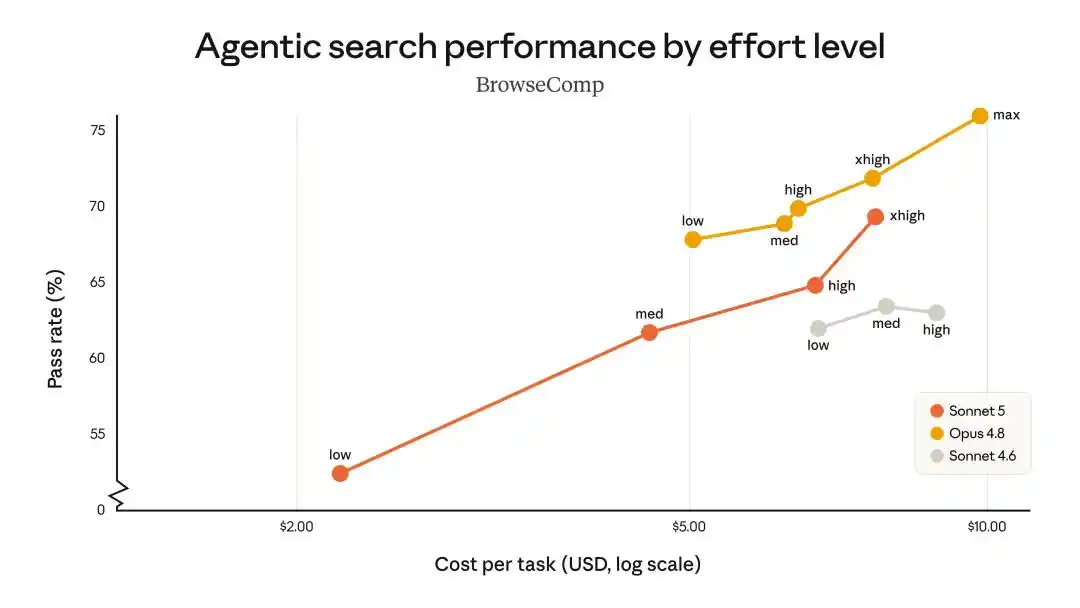
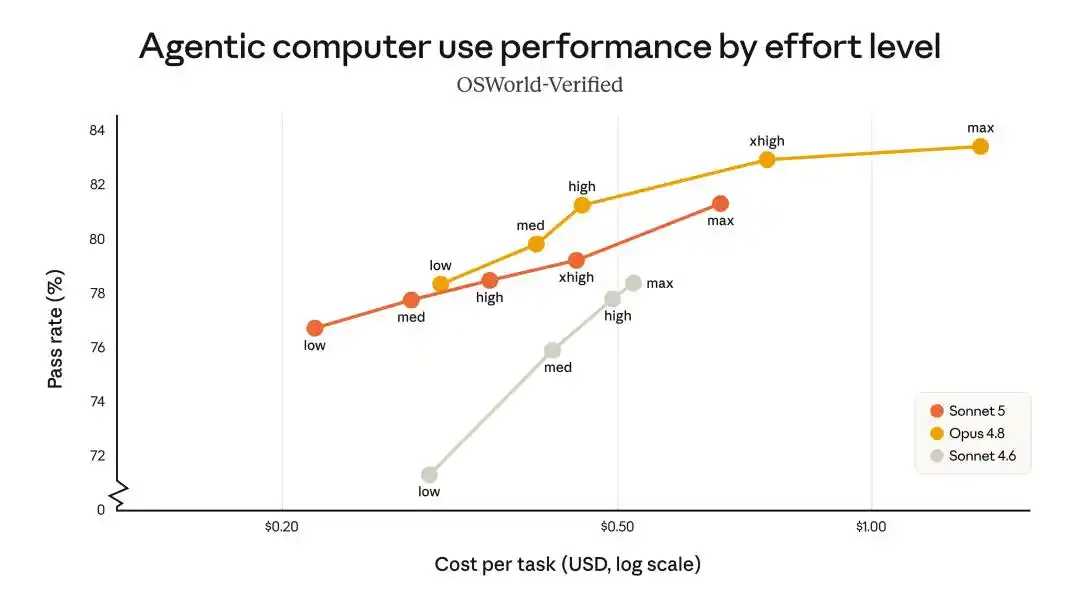
It can be said that in almost every benchmark, Sonnet 5's performance falls within the 90% to 100% range of Opus 4.8's scores.

It's practically like paying Sonnet's price for 90% of Opus's brainpower.

$2 Limited-Time Promotion, But With a Hidden Pitfall

The price is this release's real "killer feature".

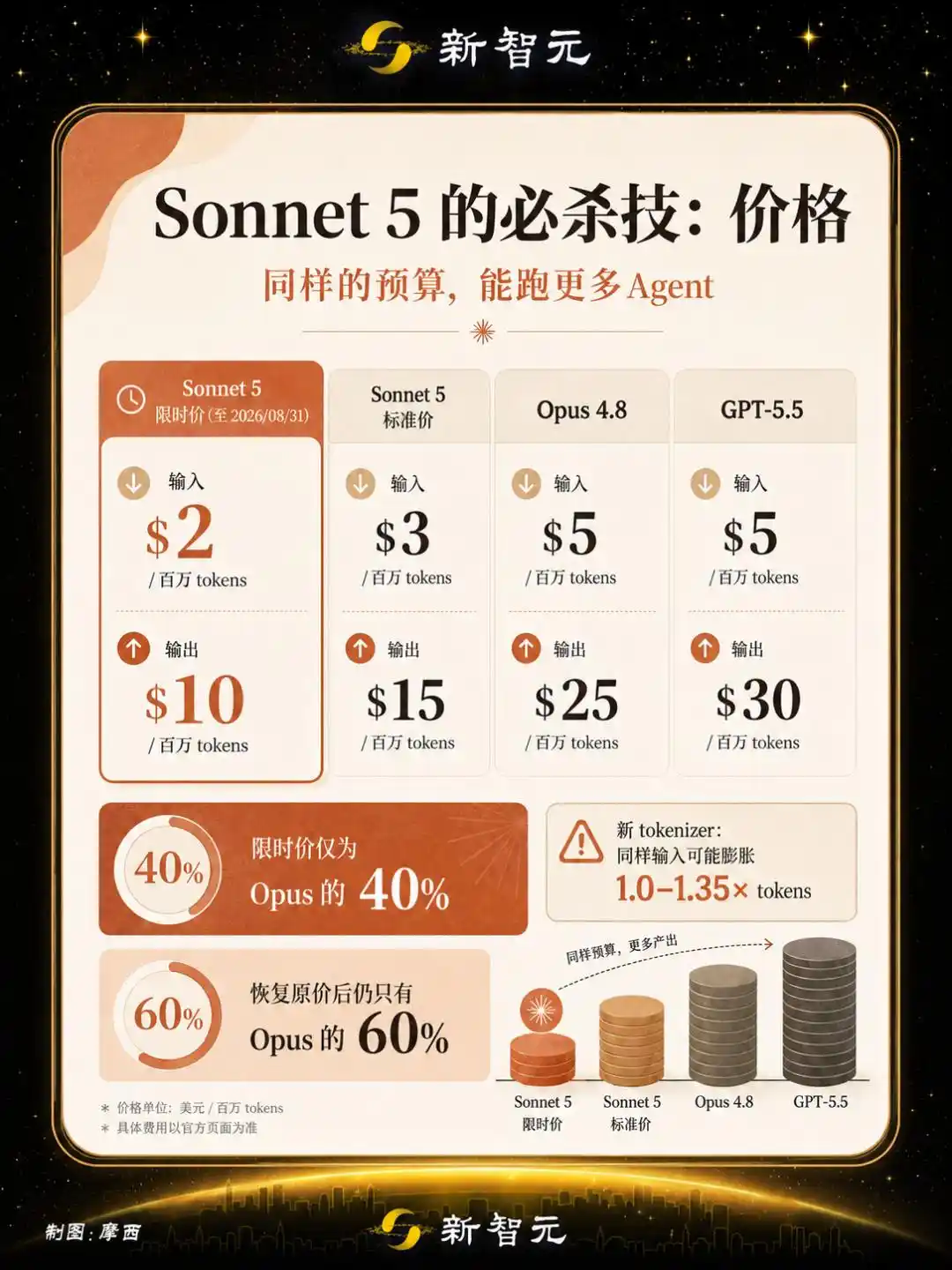
For API pricing, Anthropic is offering a limited-time promotion: $2 per million tokens for input, $10 per million tokens for output.

After August 31st, the price reverts to the original $3 for input and $15 for output.

In comparison, Opus 4.8 is priced at $5 and $25, and GPT-5.5 Standard is $5 and $30.

During the promotion period, both input and output prices are only 40% of Opus 4.8's. Even after the standard price resumes, it's only 60%.
However, while Anthropic appears full of sincerity on the surface, there's a little trick hidden in the details.

The reason is that Sonnet 5 uses a completely new tokenizer. The number of tokens for the same input text may inflate by a factor of 1.0 to 1.35.

Once the promotion period ends, the original price of $3/$15 combined with the tokenizer inflation effect will definitely make the real spending sting a bit more than using Sonnet 4.6.

But even so, compared to Opus, it's still a crushing difference.

Counterattacking All Flagship Models in the Family

The System Card hides one of Sonnet 5's most underestimated aspects.

Prompt injection attack success rate: 0.19%, on par with Opus 4.8. GPT-5.5 is at 3.08%, Gemini 3.5 Flash is at 6.66%.
In browser injection defense, the attack success rate is only 0.93%, while Mythos 5 is at 29.7% and Opus 4.8 at 31.5%.

A $2 mid-range model has counterattacked and defeated all flagship models in the family; with protective measures enabled, it drops directly to 0%.

For malicious code injection, Sonnet 4.6 had a high attack success rate of 45.26%. Sonnet 5 has reduced this to 0.29%, an improvement of 150 times.

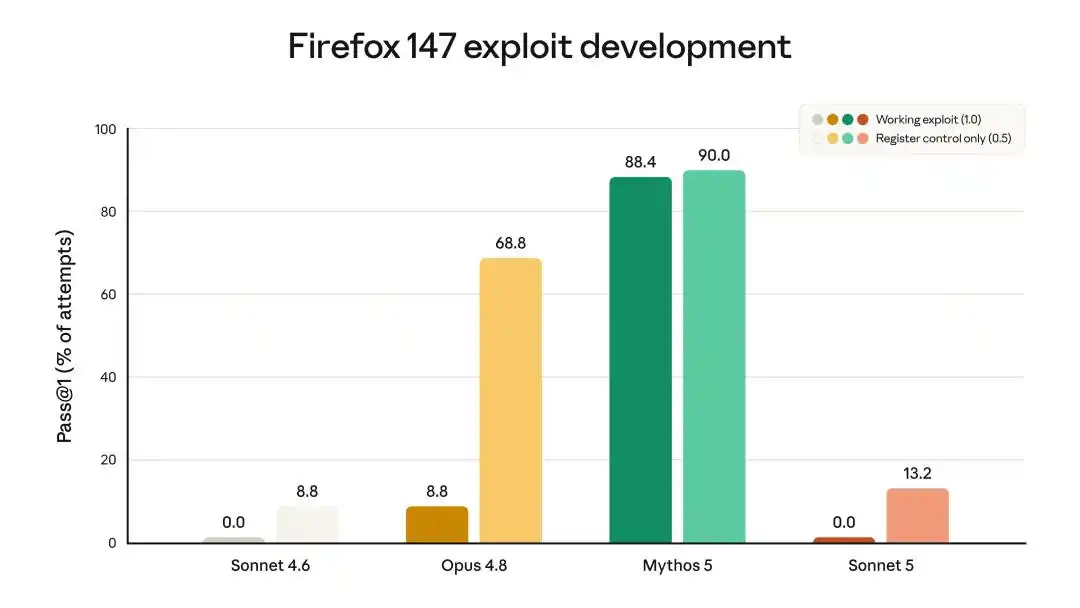
In the Firefox 147 vulnerability exploitation test, Mythos 5 could write usable exploits 88.4% of the time, Opus 4.8 at 8.8%, and Sonnet 5 at 0.0%. It can write top-tier business code, but can't write a single usable exploit.
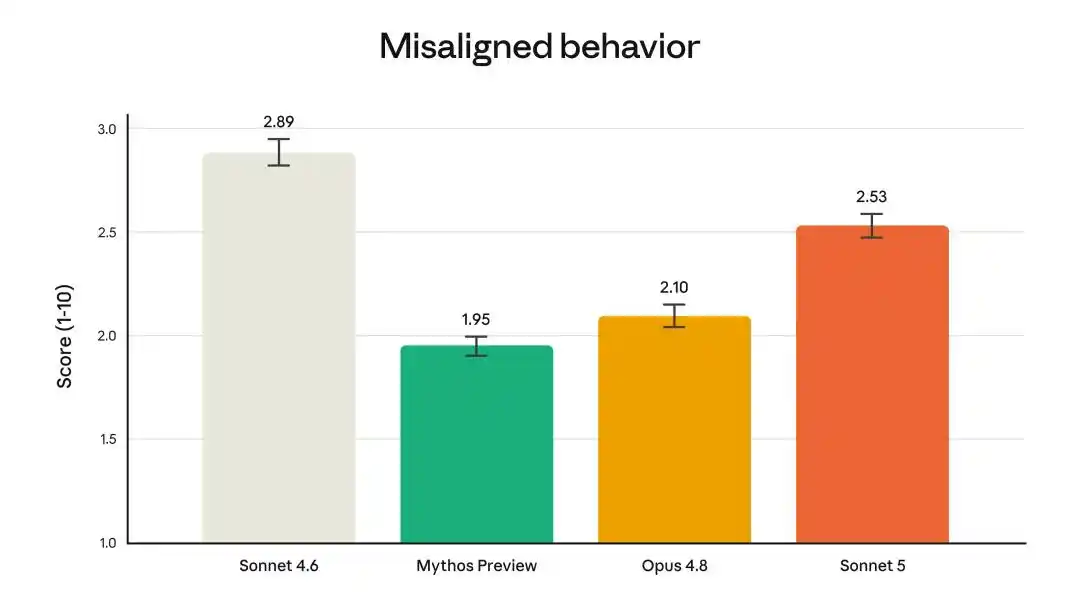
A side effect is a misalignment behavior score of 2.53 (out of 10), an improvement over Sonnet 4.6's 2.89, but higher than Opus 4.8's 2.10 and Mythos Preview's 1.95.

It has become stronger, and also more opinionated.
Not Competing for the Crown, Specializing in Cutting Down the Mid-Tier

Sonnet 5 occupies an incredibly precise position. Its upward-facing capabilities approach those of Opus 4.8 and GPT-5.5, while its downward-facing price is close to the level of Gemini 3.5 Flash.

Just as OpenAI doubled its prices compared to the previous generation, Anthropic turned around and pushed Sonnet 5's entry price down to $3.

Developers who were previously hesitant about paying for a flagship now have a lethally powerful alternative.

While everyone else is focusing on fighting at the top, Anthropic has fired a shot at the mid-tier.

Developer Wallets Voted Tonight

Now, Sonnet 5's performance has stepped into the flagship range; most tasks like fixing bugs, adding tests, or refactoring can be handled in one go.

The awkward situation where Opus felt too expensive to use, but Sonnet wasn't good enough, is gone as of today.

It's more cost-effective. The same budget that could previously run only one Opus-level Agent can now run two or three parallel Sonnets.

The cost barrier for multi-Agent architectures has been kicked lower by Sonnet 5.

When Fable 5 will make its kingly return is still unknown.

But Sonnet 5 is already standing firmly here right now, with its performance pushed right up to Opus's doorstep.

For the vast majority of developers, it is the most capable and most usable Claude to have on hand for quite some time to come.

References:

https://x.com/claudeai/status/2072017450611142835

https://www.anthropic.com/news/claude-sonnet-5

This article is from the WeChat public account "New Zhiyuan", author: ASI Revelation

Related Questions

QWhat is the main announcement in the article regarding Claude Sonnet 5?

AThe main announcement is the immediate release of Claude Sonnet 5, codenamed 'Fennec,' as the default model for all Claude Free and Pro users. It is described as Anthropic's most capable Sonnet model for Agent tasks, with performance approaching that of the flagship Opus 4.8.

QHow does Claude Sonnet 5's pricing compare to Opus 4.8 and GPT-5.5?

ADuring a promotional period until August 31, Sonnet 5's API pricing is $2 per million input tokens and $10 per million output tokens. After that, it becomes $3 and $15. This is 40% of Opus 4.8's price ($5/$25) during the promotion and 60% afterwards. It is also significantly cheaper than GPT-5.5 standard ($5/$30).

QIn what key benchmark did Sonnet 5 reportedly outperform GPT-5.5?

ASonnet 5 outperformed GPT-5.5 on the SWE-bench Pro benchmark for coding, achieving a score of 63.2% compared to GPT-5.5's 58.6%.

QWhat security advantage does Sonnet 5 have over models like Opus 4.8 and Mythos 5, according to the article?

ASonnet 5 has a significantly lower browser prompt injection success rate of 0.93%, compared to 29.7% for Mythos 5 and 31.5% for Opus 4.8. With mitigation measures enabled, this rate drops to 0% for Sonnet 5.

QWhat strategic market position does the article suggest Claude Sonnet 5 occupies?

AThe article suggests Sonnet 5 occupies a strategic position in the mid-tier market. It offers performance approaching flagship models like Opus 4.8 and GPT-5.5, but at a price point closer to more affordable models like Gemini 3.5 Flash, effectively targeting the 'middle' segment of the market.

Related Reads

Crypto Payment Cards with $1.5 Billion Monthly Transaction Volume, Stuck in the 1990s

Monthly crypto payment card transaction volume has reached $15 billion, but the industry's development stage is comparable to debit cards in the 1990s, before they became a mainstream financial staple. A key limitation is the lack of established daily financial relationships, such as direct salary deposits and recurring bill payments, with crypto wallets. Despite annualized transaction volumes of approximately $18 billion, the market is concentrated and immature. The leading provider, RedotPay, commands over half the market share. User adoption is heavily skewed towards emerging markets like Bangladesh, India, and Nigeria, where access to USD and stable financial services is limited, rather than developed economies. The sector features four primary business models: 1) Card-issuing infrastructure providers, 2) Exchange-affiliated cards for user retention, 3) Decentralized wallet/DeFi cards with self-custody but high complexity, and 4) Stablecoin-focused digital banks, which dominate transaction volume by offering integrated financial services. The article argues that a pure payment functionality is insufficient for long-term success, mirroring the historical trajectory of traditional debit cards. Future winners will need to: 1) Control the upstream flow of funds, 2) Secure defensible niches in underserved markets, and 3) Most crucially, build core account relationships that integrate into users' daily financial lives. Without this evolution, crypto cards risk remaining niche prepaid tools rather than becoming universal financial infrastructure.

Foresight News21m ago

Crypto Payment Cards with $1.5 Billion Monthly Transaction Volume, Stuck in the 1990s

Foresight News21m ago

$7.8 Billion in Theft and Losses Reveals the Truth: Security Costs Have Become an Unavoidable Liquidity Tax for DeFi

"7.8 Billion in Thefts Reveals the Truth: Security Costs Have Become DeFi's Unavoidable 'Liquidity Tax'" A summary of Q2 2026 data reveals that security risks are now a fundamental capital cost in DeFi, directly impacting user returns and liquidity decisions. DeFiLlama recorded 88 hacking incidents with quantified losses totaling $780.3 million in Q2. April was the worst month with $644.8 million lost. DeFi protocol attacks accounted for $735.8 million, while cross-chain bridge exploits resulted in $354.4 million in losses (note: some event categorizations overlap). Cumulatively, DeFi hacks have reached $7.85 billion, with bridge losses at $3.26 billion. The quarter highlighted two primary risk categories: high-value infrastructure vulnerabilities (e.g., bridges, oracles, admin keys) causing massive single losses, and more frequent contract logic bugs. This signals a critical market shift: from post-incident analysis to preemptive pricing of risk. Users and liquidity providers now implicitly factor in the security of the entire asset pathway—not just pool APY—into their decisions. This hidden "risk premium" manifests through wider spreads, higher liquidity incentives, and capital migration towards perceived safer routes. Cross-chain bridge risks, responsible for over $353 million in Q2 losses, exemplify this change. Asset routing credibility is now part of the transaction. Following incidents like KelpDAO and THORChain, markets are demanding safer bridges, asset insurance, and clearer risk disclosure, increasing the cost of capital for riskier pathways. Consequently, security spending is transforming from a defensive cost into a core distribution cost for attracting liquidity. Protocols must invest more in audits, bug bounties, real-time monitoring, and insurance to remain competitive. Users are increasingly demanding transparency about fund flow paths, associated risks, and contingency plans. The key indicators for the industry's direction will be whether capital continues consolidating in trusted channels, if projects delay launches for enhanced audits, if insurance premiums rise, and if aggregators start displaying security risk metrics. Q2 2026 may be remembered not just as a bad period, but as the point when DeFi underwent a fundamental asset risk repricing, where security became a persistent,隐性 tax on all on-chain activity.

Foresight News50m ago

$7.8 Billion in Theft and Losses Reveals the Truth: Security Costs Have Become an Unavoidable Liquidity Tax for DeFi

Foresight News50m ago

Trading

Spot
活动图片