Ethereum at $1.5K: A tense stand-off forms, with ETH shorts under pressure

ambcryptoPublished on 2026-07-01Last updated on 2026-07-01

Abstract

Ethereum faces a tense standoff, trading around $1,500 after a nearly 50% decline in the first half of 2026. While technicals and bearish derivatives positioning signal downside risk, key on-chain data suggests a potential trap for short sellers. Large transfers to exchanges are accompanied by significant stablecoin inflows, indicating whales may be preparing to buy rather than sell. Furthermore, strong user retention and rising ETH staking activity are reducing available supply. This clash between heavy bearish bets and solid holder conviction creates conditions for a possible short squeeze, making the current consolidation risky for those positioned for further downside.

One look at the technicals is enough to show how bearish the market has turned. Nothing reflects this better than Ethereum.

According to CoinGlass data, ETH closed Q2 down 25.28%, extending Q1’s 29.26% drop. That puts the altcoin down nearly 50% in the first half of 2026, leaving holders who bought the top deep underwater.

The price structure tells the same story. As the chart below shows, ETH has lost two major support levels. It first broke below $3,200 in mid-January, then lost the $2,000 level in early June.

Since then, the next base has formed around $1,500, where ETH has been chopping sideways for more than four straight weeks.
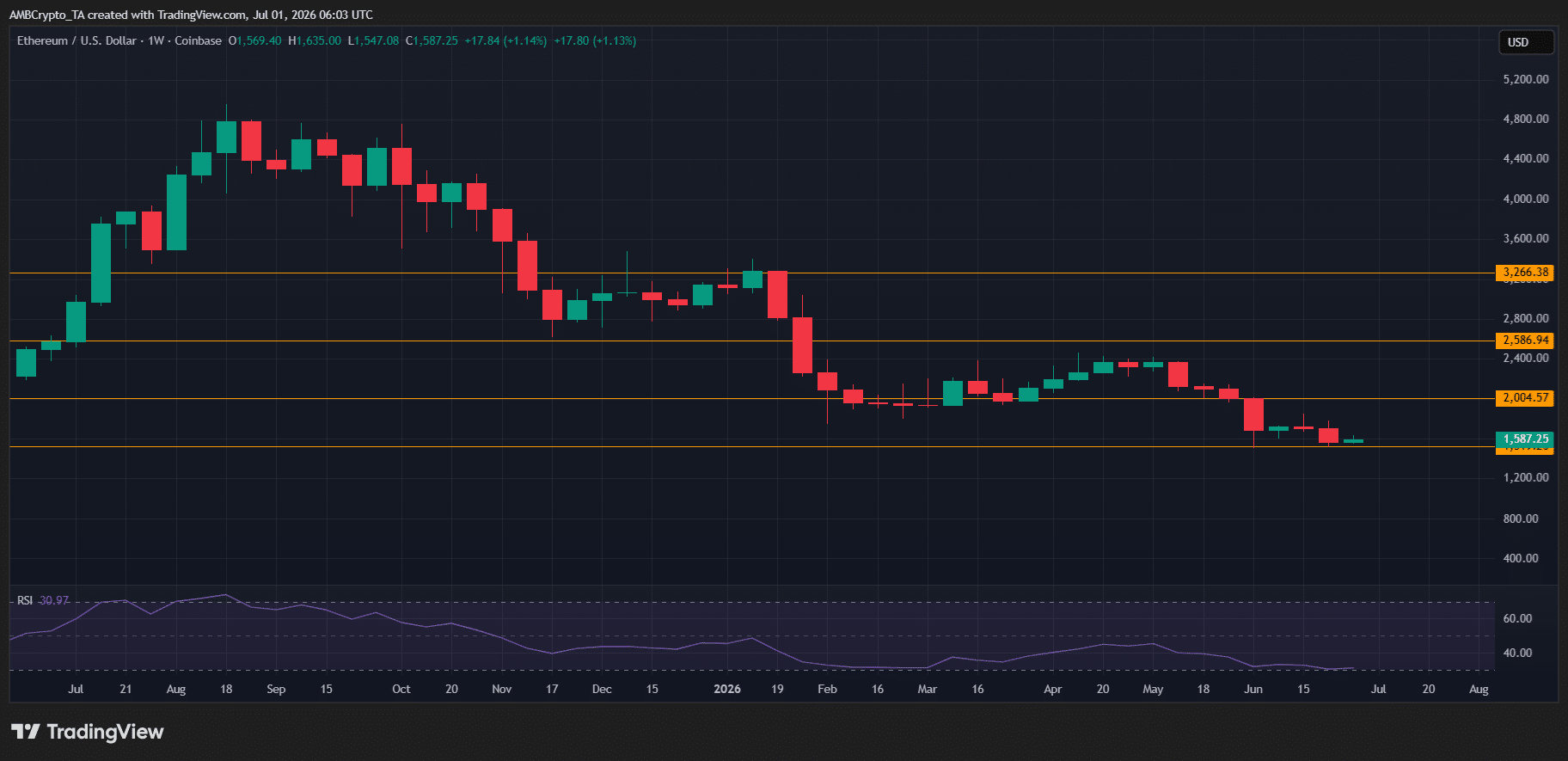
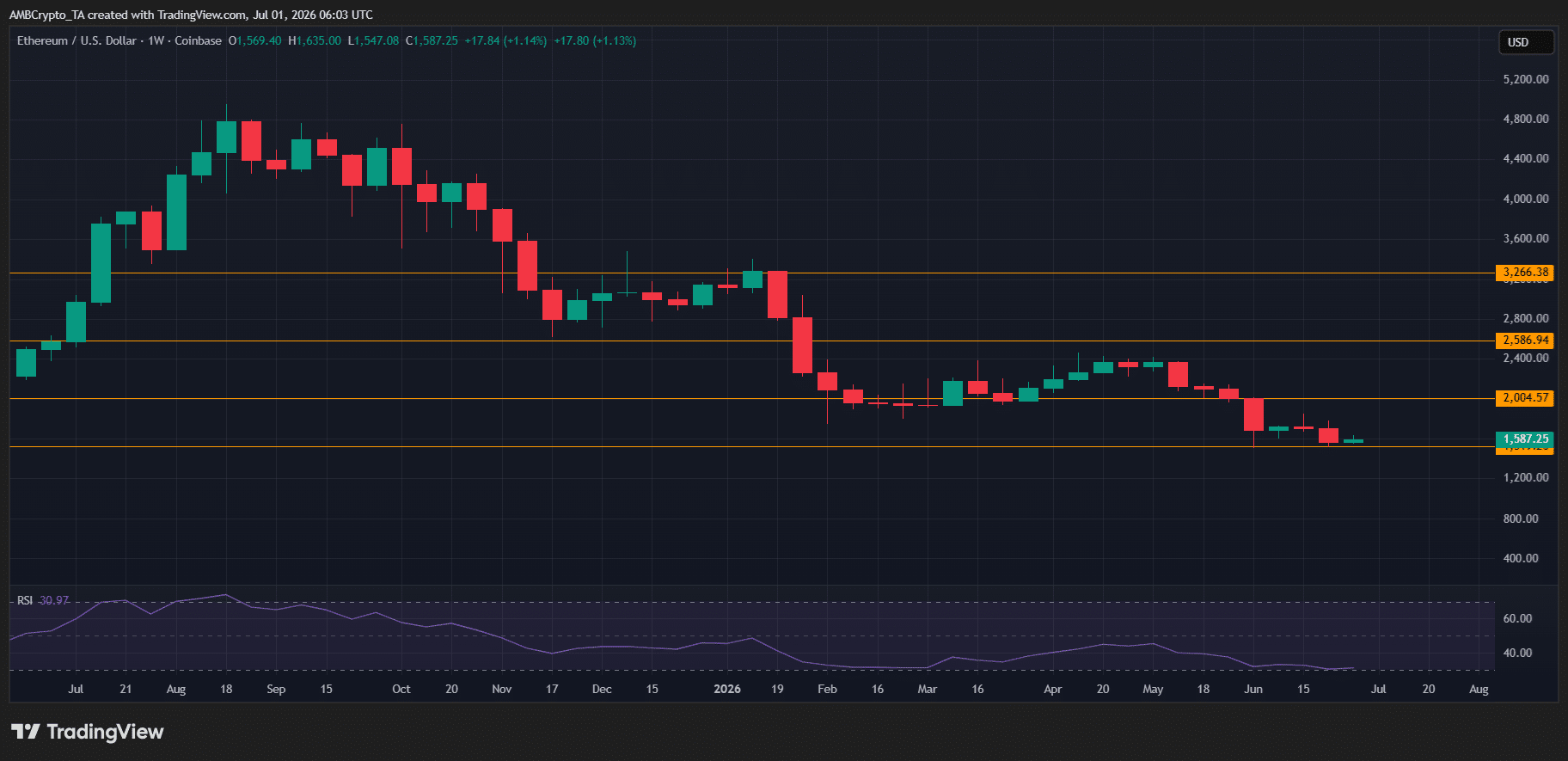
Source: TradingView (ETH/USDT)

Now, looking at Santiment’s latest report, it seems another breakdown could be on the cards.

According to the report, large Ethereum transfers to CEXs usually point to higher selloff risk, as whales tend to move coins onto exchanges before selling, hedging, or rebalancing. However, this time there’s a catch.

Those ETH inflows have been accompanied by strong stablecoin inflows, suggesting whales are also moving dry powder onto exchanges. That points to large players keeping capital ready, potentially to buy the dip rather than simply offload their ETH.

And the data already hints at where that capital could be moving. The timing looks deliberate, with Ethereum [ETH] trading right on top of a key support zone. A clean break below this level could trigger another round of panic selling as more HODLers fall deeper underwater. But so far, the cycle is telling a different story.

Ethereum’s chop may be a trap for short sellers

Every time the market consolidates in uncertainty, it tends to set a trap for traders.

Looking at Ethereum’s current flows, its chop around $1.5k could be building pressure for a short squeeze, with many traders still positioned for downside in a broader risk-off environment. But ETH is starting to diverge from the rest of the market based on key on-chain signals.

According to CryptoQuant, Ethereum is going through a sentiment reset, with negative Coinbase Premium and funding rates showing bearish positioning across both U.S. Spot and derivatives markets.

Even so, price is holding steady as exchange liquidity declines and ETH staking inflows continue to rise. This creates a “wall of worry” setup, where traders stay bearish while long-term holders keep locking up supply.
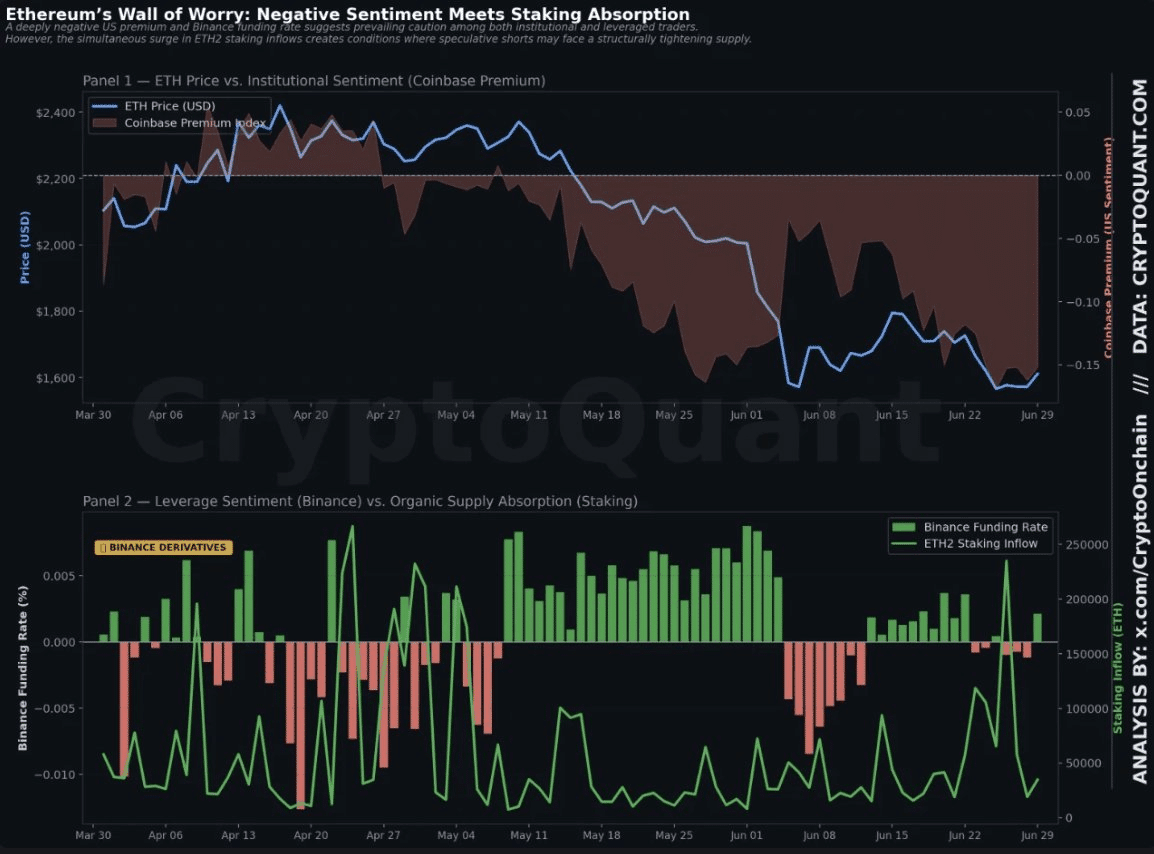
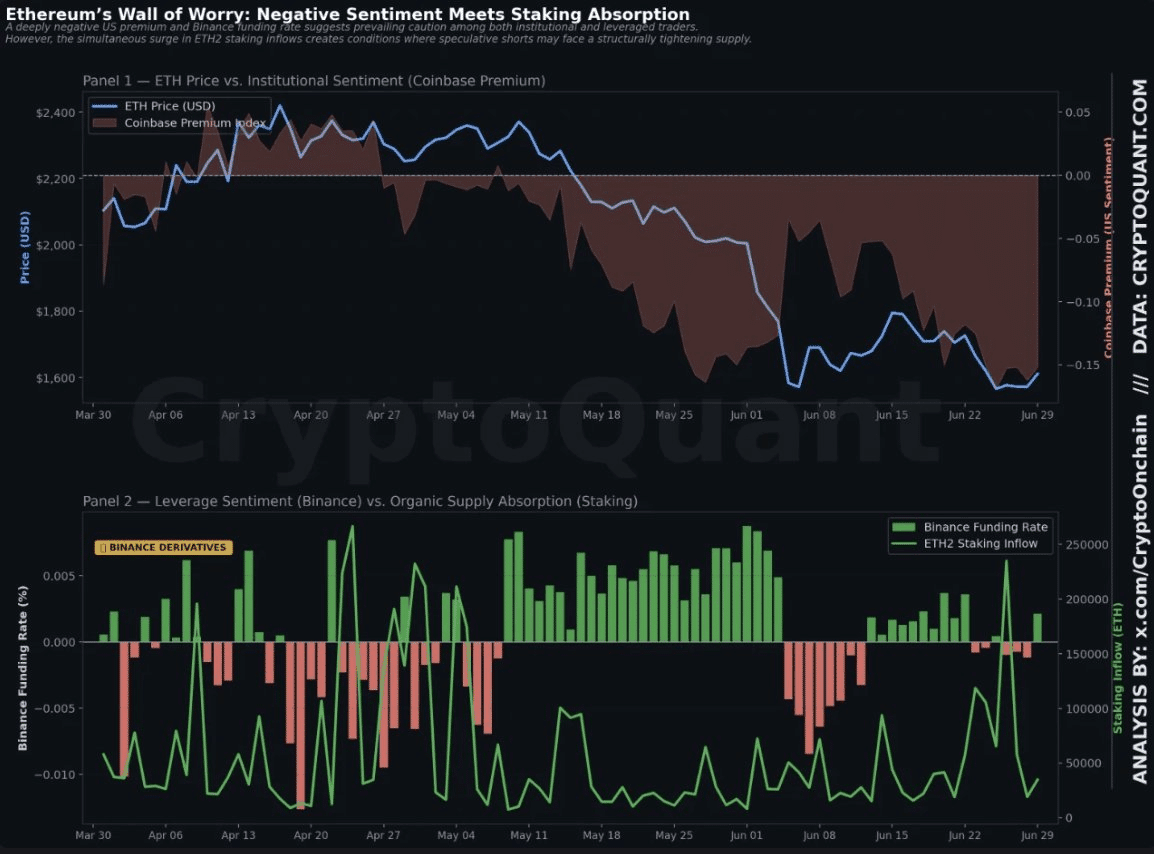
Source: CryptoQuant

In essence, Ethereum is in a high-conviction standoff.

This divergence is creating a potential trap for short sellers, as heavy bearish positioning in derivatives is clashing with strong holder conviction. In fact, Ethereum recorded the highest user retention rate among major blockchains at 26.2%, according to CoinGecko’s Q1 2025 to Q1 2026 cohort study.

Hence, with strong retention, rising staking activity, and ongoing deleveraging, Ethereum’s current chop could be risky for those still positioned short.


Final Summary

  • Ethereum bears are positioned heavily, but staking and retention remain strong.
  • Price is chopping near $1.5k, increasing the risk of a squeeze.

Trending Cryptos

Related Questions

QWhat is the current price level that Ethereum is chopping around, according to the article?

AEthereum is currently chopping sideways around the $1,500 level.

QWhat key on-chain signals suggest Ethereum may be diverging from broader market sentiment?

AKey signals include declining exchange liquidity, rising ETH staking inflows, and strong user retention, which contrast with negative funding rates and Coinbase Premium indicating bearish market positioning.

QWhy does the article suggest that large ETH transfers to CEXs might not necessarily lead to a selloff this time?

ABecause these ETH inflows were accompanied by significant stablecoin inflows, suggesting whales are moving 'dry powder' onto exchanges, potentially to buy a dip rather than just sell their ETH.

QWhat is the 'wall of worry' setup described in the article regarding Ethereum's market?

AThe 'wall of worry' setup refers to a situation where traders remain bearish (as shown in derivatives positioning), while long-term holders demonstrate strong conviction by continuing to lock up supply through staking, creating potential for a price squeeze.

QWhat risk does the article highlight for traders who are still positioned short on Ethereum?

AThe article highlights the risk of a short squeeze, as heavy bearish positioning in derivatives clashes with strong holder conviction, rising staking, and high user retention, potentially forcing short sellers to cover their positions if the price moves up.

Related Reads

The Invisible Force in Bitcoin's Bear Market: Accelerating On-Chain Payments and Institutional Adoption

Amidst ongoing Bitcoin price volatility, the quiet acceleration of on-chain payments and tokenized trading holds significant importance for investors and policymakers, especially with legislation like the CLARITY Act on the horizon. Major traditional financial institutions adopting these technologies are driving crucial discussions on compliance, security, and transparency, which are vital for broader market adoption. Key developments are shaping this evolution. First, blockchain traceability is moving beyond a simple "public vs. private" debate. New frameworks aim to standardize how financial data from immutable ledgers is analyzed and interpreted, making it as crucial as standardized financial reporting for building institutional trust. Second, while traditional finance supports clear digital asset regulation, they emphasize that an asset's economic function should dictate its regulatory treatment, advocating for robust consumer protections over broad exemptions. Furthermore, the growth of on-chain deposits at regulated institutions signals a shift. Major banks are leveraging blockchain not to replace but to upgrade existing services—like deposits and cross-border settlements—with benefits like 24/7 operations and programmable treasury management. This trend focuses more on modernizing financial infrastructure than creating speculative assets. Despite market turbulence, these underlying advancements in on-chain infrastructure point toward a more robust foundation for the industry's future.

Foresight News29m ago

The Invisible Force in Bitcoin's Bear Market: Accelerating On-Chain Payments and Institutional Adoption

Foresight News29m ago

Crypto Payment Cards with $1.5 Billion Monthly Transaction Volume, Stuck in the 1990s

Monthly crypto payment card transaction volume has reached $15 billion, but the industry's development stage is comparable to debit cards in the 1990s, before they became a mainstream financial staple. A key limitation is the lack of established daily financial relationships, such as direct salary deposits and recurring bill payments, with crypto wallets. Despite annualized transaction volumes of approximately $18 billion, the market is concentrated and immature. The leading provider, RedotPay, commands over half the market share. User adoption is heavily skewed towards emerging markets like Bangladesh, India, and Nigeria, where access to USD and stable financial services is limited, rather than developed economies. The sector features four primary business models: 1) Card-issuing infrastructure providers, 2) Exchange-affiliated cards for user retention, 3) Decentralized wallet/DeFi cards with self-custody but high complexity, and 4) Stablecoin-focused digital banks, which dominate transaction volume by offering integrated financial services. The article argues that a pure payment functionality is insufficient for long-term success, mirroring the historical trajectory of traditional debit cards. Future winners will need to: 1) Control the upstream flow of funds, 2) Secure defensible niches in underserved markets, and 3) Most crucially, build core account relationships that integrate into users' daily financial lives. Without this evolution, crypto cards risk remaining niche prepaid tools rather than becoming universal financial infrastructure.

Foresight News59m ago

Crypto Payment Cards with $1.5 Billion Monthly Transaction Volume, Stuck in the 1990s

Foresight News59m ago

Trading

Spot

Hot Articles

Discussions

Welcome to the HTX Community. Here, you can stay informed about the latest platform developments and gain access to professional market insights. Users' opinions on the price of ETH (ETH) are presented below.

活动图片