After Two Years of Waiting, Apple's AI for China Finally Passes Regulatory Filing, Integrates with Qwen

marsbitPublished on 2026-07-15Last updated on 2026-07-15

Abstract

China's cyberspace authority has approved seven mobile on-device generative AI services for public offering, including Apple Intelligence, Huawei Celia AI, OPPO AndesGPT, vivo BlueOS AI, Xiaomi Hyper AI, Samsung Galaxy AI, and Nubia's Doubao model. This marks the largest single batch of such approvals in China. Apple's AI service, arriving two years after its global announcement at WWDC 2024, will integrate Alibaba's Qwen model for Chinese users on iOS, iPadOS, macOS, and visionOS, offering text/image understanding and content generation without switching apps. An accidental early release of Apple Intelligence in China in March revealed its strengths in on-device speed and privacy, but also limitations in handling complex tasks compared to cloud-based models. The official approval resolves the compliance hurdle. Apple's delay in launching AI features in China has been cited as a factor affecting its recent competitive pressure in the market, where local rivals have already integrated advanced AI. While the global version of Apple's new Siri AI uses Google's Gemini, the China version will be powered by Alibaba Qwen. The final step for users is awaiting the actual integration of these features in future iOS updates.

Just now, the Cyberspace Administration of China announced: Apple Intelligence, Huawei Celia AI Model, OPPO AndesGPT Model, vivo BlueVivo On-Device Model, Xiaomi HyperMind AI, Samsung Galaxy AI, and Nubia Doubao Mobile Model — 7 on-device generative AI services for mobile phones have passed the regulatory filing.
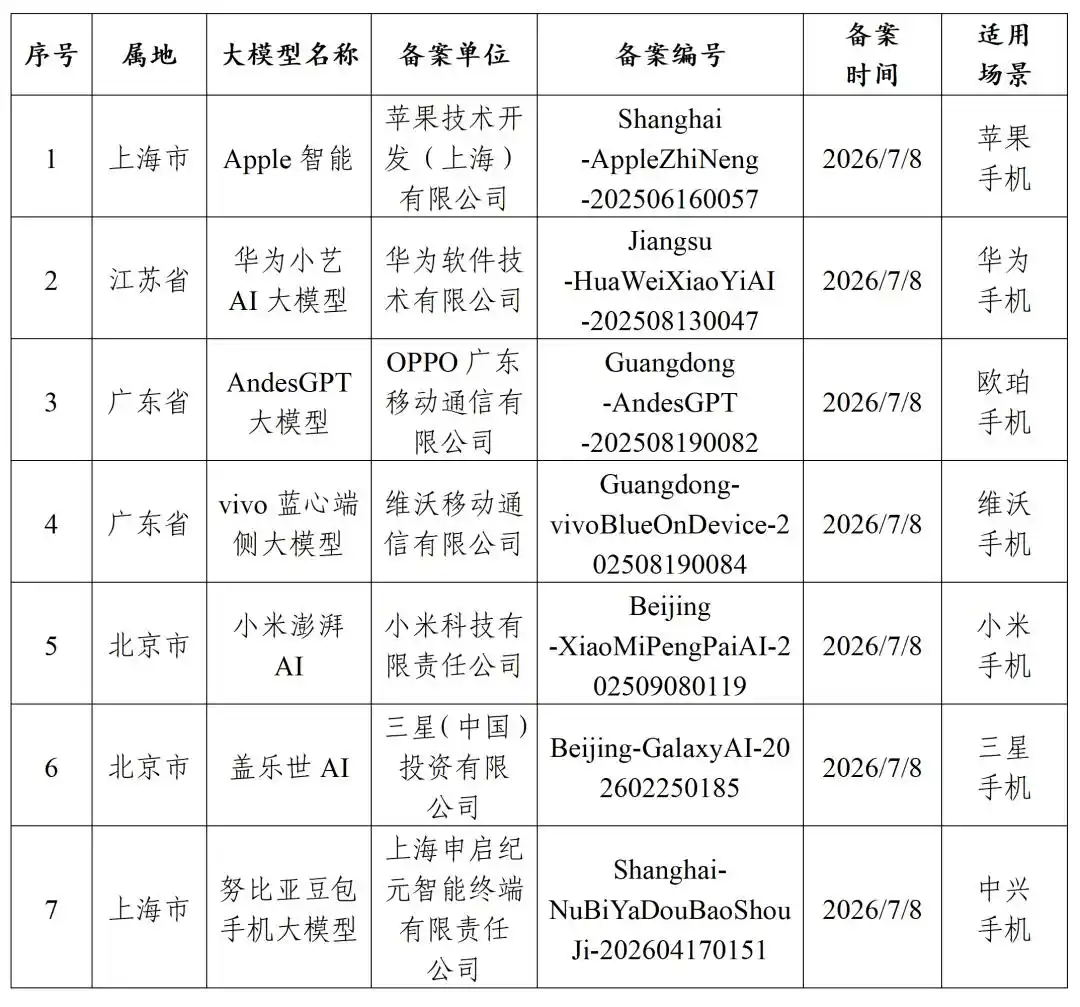
Announcement on Releasing Filing Information for 7 On-Device Generative AI Services for Mobile Phones

This is the largest collective approval in the domestic on-device mobile AI field to date.

Counting from its debut at WWDC in June 2024, Chinese users have waited two years for Apple AI.

Alibaba's Qwen will be integrated as the AI capability into Apple Intelligence, providing Chinese users of iOS, iPadOS, macOS, and visionOS with abilities like text and image understanding, content generation, and more.

In response to this news, Alibaba stated:

Alibaba's Qwen will be integrated as the AI capability into Apple Intelligence, delivering intelligent experiences to Chinese users of iOS, iPadOS, macOS, and visionOS.

Users can directly experience Qwen's text and image understanding, content generation, and other capabilities on Apple devices without needing to switch between apps.

The filing is the compliance admission ticket, but even before Apple obtained this ticket, Chinese users had experienced a brief, preliminary version.

The Previously Leaked Test Version of Apple AI Left Much to Be Desired

On March 31 this year, the day before Apple's 50th anniversary, an "Apple Intelligence and Siri" entry appeared in the Settings page of iPhones in China.

There was no launch event, no press release. The feature went live and was quickly taken down.

Bloomberg journalist Mark Gurman judged it to be an accidental push: Apple wouldn't launch its AI for China without any promotional activity, wouldn't choose the early hours of the morning in China to go live, and the visual recognition was calling on a Google engine rather than a domestic one, which is also unreasonable for China. Regulatory approval had not yet been granted at that time.
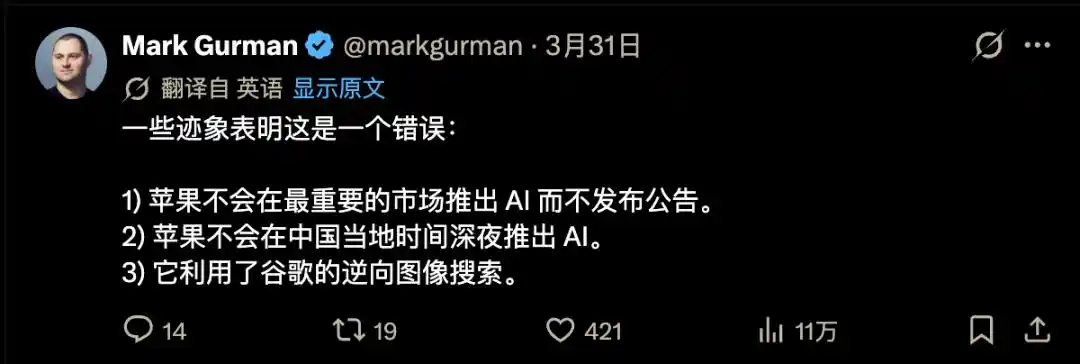
https://x.com/markgurman/status/2038701276699967554

The hands-on results from that brief appearance can be summarized in two words: fast, but rough.
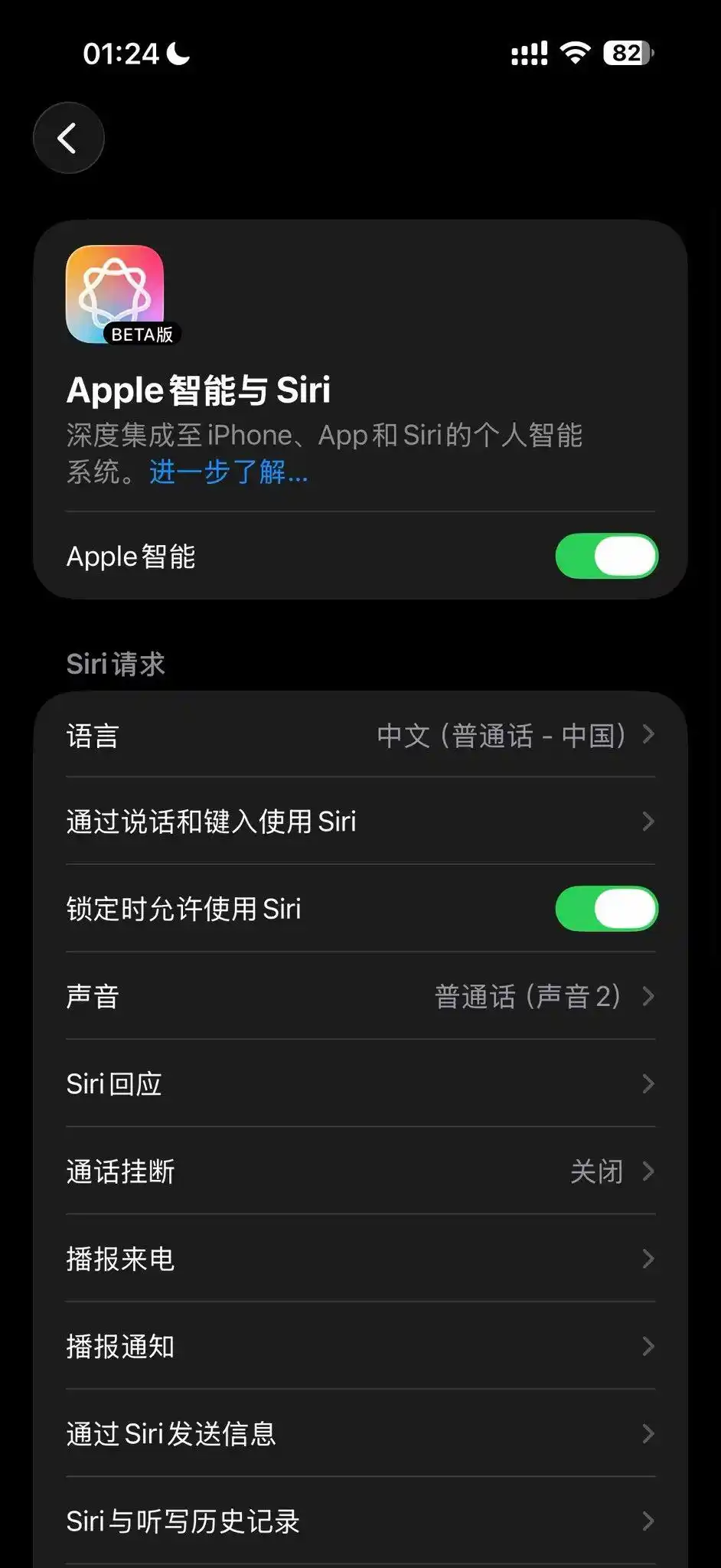
The speed of the on-device model was the most immediate perception.

Text polishing, information summarization, AI erasure — responses were almost instantaneous.

A 200-word draft clicked to "Change to Professional Tone" produced results in less than two seconds.

The Image Playground supported generating images from text descriptions, producing images in three to five seconds, but the phone noticeably heated up.

All processing was done locally, with no data uploaded to the cloud, ensuring privacy — at the cost of accuracy.

Summarizing complex long texts would miss key information; tone rewriting occasionally produced unnatural expressions.

AI erasure worked okay on simple backgrounds, but with complex scenes, it showed issues like residual shadows, blurred edges, and broken textures.

Writing tools, translation, visual recognition — each was usable, each had a noticeable gap compared to competitors using cloud-based large models.

Apple made a trade-off between privacy and performance, choosing the former.

Although the leaked version in March was taken down at lightning speed in less than a day, it prematurely revealed the capability boundaries of Apple Intelligence for China: on-device models are fast, protect privacy, but depth and accuracy require supplementation by cloud models.

Previously, there was no clear, reliable information confirming which model was actually integrated.

Seven Approved, Apple Late by Two Years

Apple wasn't alone in passing the filing.

Also receiving admission tickets on the same day were Huawei, OPPO, vivo, Xiaomi, Samsung, and Nubia — the on-device AI of 7 phone manufacturers collectively approved.

Nubia's Doubao Mobile Model is expected to debut during WAIC.

For Apple, the cost of being late is already written in its financial reports.

iPhone sales in the Chinese market have been under continuous pressure. Cook previously admitted in an earnings call that the absence of Apple Intelligence was a reason for the decline in competitiveness.

Huawei, Xiaomi, and OPPO have long made AI features standard on flagships. Some brands have even integrated models like DeepSeek , widening the experience gap.

Previously, at WWDC 26, Apple showcased the new-generation Siri AI developed in collaboration with Google and based on Gemini, supporting cross-app contextual awareness and natural conversation, even capable of pulling up email and calendar information in real-time during calls.

However, at that time, Apple also made it clear: the new Siri AI would not immediately land in the Chinese market.
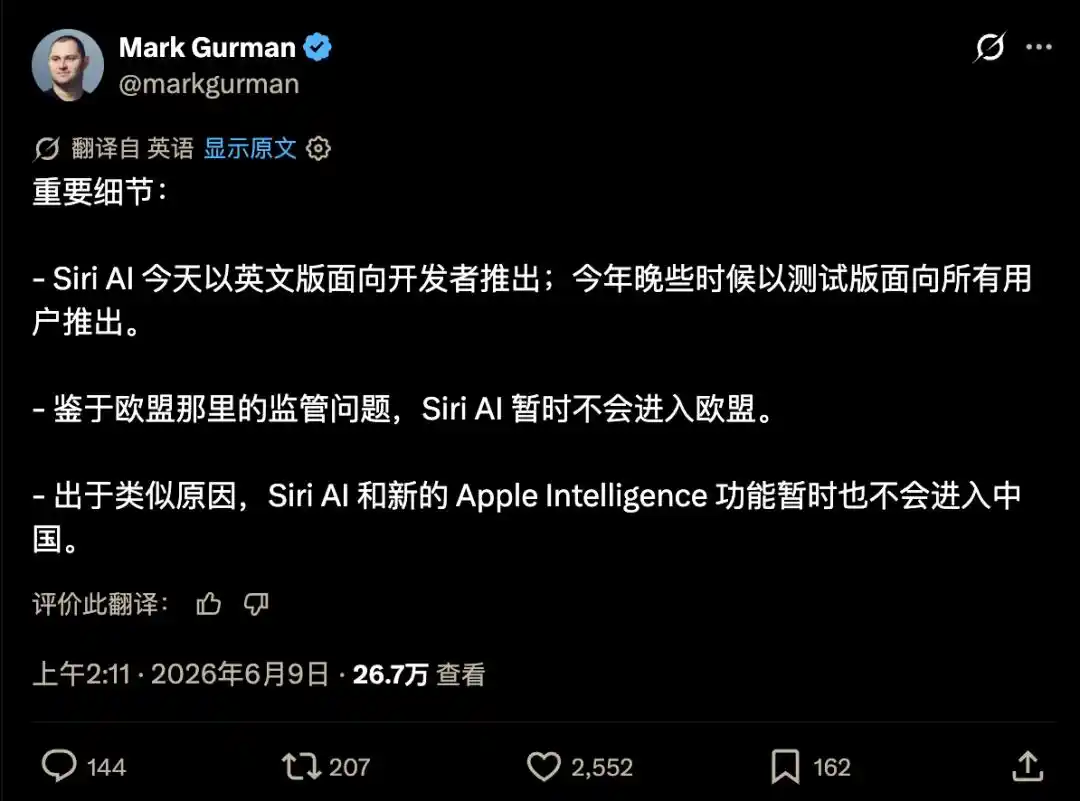
https://x.com/markgurman/status/2064047700488655019

The foundational AI capability for the Chinese version is Alibaba's Qwen , which is different from the technology stack used in the overseas version.

Apple has not given any promises regarding the official launch timeline or the completeness of features.

The filing resolves the compliance issue, but between filing and product launch, there are still engineering steps like version adaptation, feature tailoring, and model optimization to complete.

For users of iPhones in China, judging the true value of this AI admission ticket simply requires attention to: whether Apple Intelligence appears in the next iOS update log and how many features are retained.

Until then, the two-year wait is just one step away from being over.

This article is from the WeChat public account "New Zhiyuan", author: ASI Apocalypse

Trending Cryptos

Related Questions

QWhat is the main news regarding Apple's AI services in China as reported in the article?

AThe main news is that Apple's 'Apple Intelligence' AI service for the Chinese market, along with AI services from six other smartphone manufacturers, has officially passed regulatory filing in China. Its capabilities will be integrated with Alibaba's Tongyi Qianwen model.

QWhich Chinese company's AI model will power Apple Intelligence for users in China?

AAlibaba's Tongyi Qianwen (Qianwen) AI model will provide the AI capabilities for Apple Intelligence on iOS, iPadOS, macOS, and visionOS devices for users in China.

QWhat was the issue with the Apple AI test version that briefly appeared on iPhones in China in March?

AThe test version, which was likely an accidental release, was characterized as fast but rough. It performed operations on-device for privacy, but this resulted in lower accuracy and depth compared to cloud-based models, with issues like missing key information in summaries and imperfect AI object removal.

QWhy did Apple's AI delay pose a problem for the company in China according to the article?

AAccording to the article, the delay in launching Apple Intelligence in China negatively impacted iPhone sales. Apple CEO Tim Cook acknowledged that the absence of competitive AI features was a reason for the declining competitiveness of iPhones in the Chinese market, where rivals like Huawei and Xiaomi had already integrated advanced AI into their flagships.

QHow is the Apple Intelligence service for China different from the version announced for other markets?

AThe Chinese version of Apple Intelligence uses Alibaba's Tongyi Qianwen as its AI foundation, whereas the version showcased for other markets at WWDC 26 is based on a partnership with Google and its Gemini model. The technical stacks and capabilities are therefore different.

Related Reads

Wall Street Unanimously Bullish: ASML's Capacity Surge, The 'Peak Theory' for Memory Can Be Put to Rest

Wall Street is collectively bullish on ASML after the company reported a far-better-than-expected Q2 and significantly raised its full-year guidance, while providing a rare 2027-2028 capacity expansion roadmap. Key financials surpassed consensus: Q2 revenue of €9.3B beat estimates, with gross margin at 54%. The company raised its 2026 revenue outlook to €43-€45B and expects Q3 revenue of €11-€12B. Most notably, management outlined aggressive capacity increases for both Low-NA EUV and immersion DUV systems. EUV capacity is projected to reach ~85 units in 2027 (up ~30% from 2026) and potentially ~110 in 2028. DUV capacity is set to rise to ~169 units in 2027 and ~220 in 2028. These targets exceed prior market expectations, leading analysts to significantly revise up 2028 earnings estimates, with JPMorgan suggesting EPS could surpass €65. Major banks including Goldman Sachs, JPMorgan, and Barclays maintained Buy/Overweight ratings. Analysts view the roadmap as a direct rebuttal to narratives about an AI-driven demand peak or an imminent memory price top. ASML stated that AI demand is accelerating expansion in both logic (for nodes like 2nm) and memory segments (driven by DDR/HBM shortages and the transition to more EUV-intensive nodes like 1c/1d DRAM). This structural shift, alongside the high wafer intensity of HBM production, is seen extending the memory upcycle. While most reactions were positive, some nuance existed on whether the 2027 EUV guidance was sufficiently aggressive versus heightened expectations. Overall, the results are seen as validating sustained AI-driven demand and ASML's unrivaled position as the key beneficiary of the industry's advanced node transition.

链捕手6m ago

Wall Street Unanimously Bullish: ASML's Capacity Surge, The 'Peak Theory' for Memory Can Be Put to Rest

链捕手6m ago

The Invisible Crypto Empire of Japan's Financial Giant SBI

In a series of concentrated moves, Japanese financial conglomerate SBI Holdings is aggressively expanding its digital asset footprint. Over three weeks, it executed three major strategic investments: a 46.7 billion yen ($289 million) full acquisition of Japanese licensed exchange Bitbank, a $76 million lead investment in the institutional crypto platform EDX Markets' Series C round, and an exclusive $125 million investment in DeFi risk analytics firm Gauntlet. This was followed by a strategic partnership announced on July 13 with the Solana Foundation to build Japan's on-chain financial markets. SBI, a long-time crypto industry participant through joint ventures and minority stakes, has recently shifted to a lead investor role, signaling a more assertive strategy. These investments target three distinct segments: the retail market in Japan (via Bitbank), U.S. institutional infrastructure (via EDX), and on-chain asset management and risk control (via Gauntlet). Concurrently, SBI is solidifying its position in the stablecoin and settlement layer space. It launched Japan's first trust-structured yen stablecoin, JPYSC, and secured the exclusive distribution for Ripple's RLUSD stablecoin on its SBI VC Trade platform. The partnership with Solana aims to leverage the blockchain's scalability for tokenizing real-world assets (RWA) and building cross-border payment networks. Analysts interpret SBI's moves as building the essential "pipes" for a next-generation, end-to-end digital asset financial system, spanning issuance, settlement, infrastructure, and distribution. Some view the timing—during a market downturn—as a strategic long-term play to acquire assets at lower valuations ahead of anticipated regulatory shifts in Japan. SBI's stated goal is a comprehensive on-chain transformation, providing a full suite of services from exchange to tokenization. By leading investments rather than fully acquiring companies like EDX and Gauntlet, SBI aims to secure a pivotal strategic position while preserving their neutrality to collaborate with other global financial giants.

链捕手37m ago

The Invisible Crypto Empire of Japan's Financial Giant SBI

链捕手37m ago

Primit Season 1 Officially Launches: $100,000 Avalanche On-Chain Perp Trading Incentive Event Now Live

Primit, in collaboration with Avalanche, has officially launched "Season 1: On-Chain Perp Frenzy," a large-scale incentive event for on-chain perpetual trading on the Avalanche network. The campaign features a total prize pool equivalent to 100,000 USDT in AVAX, distributed across four concurrent reward mechanisms. Key components of the event include: * **Daily Random User Rewards ($7,000 pool):** Over 14 days, 20 users daily with at least $200 in trading volume are randomly selected to share a $500 daily pool. * **Twitter Contributor Rewards ($5,200 pool):** Rewards of $300–$500 for high-quality community content about Primit on Twitter/X using #PrimitAvalanche. * **Referral Rebate Mechanism ($50,000 pool):** A proportional share of the pool is distributed based on valid referral volume, with no individual cap. Referred users must register via a code and achieve ≥$500 cumulative volume with ≥5 trades. * **Volume Leaderboard ($37,800 pool):** Top 120 traders by cumulative volume receive rewards ranging from $100 to $4,000. The event runs from July 15 to July 28. Trading volume from AVAX-related pairs or using native gas receives a 1.5x multiplier, incentivizing engagement with Avalanche's core ecosystem. According to the Primit team, the season serves as a product stress test to demonstrate the readiness of on-chain perpetuals for high-frequency, professional trading demand, facilitated by Avalanche's high-performance infrastructure. Relevant links to the official Twitter and event portal are provided.

TheNewsCrypto2h ago

Primit Season 1 Officially Launches: $100,000 Avalanche On-Chain Perp Trading Incentive Event Now Live

TheNewsCrypto2h ago

Trading

Spot

Hot Articles

Discussions

Welcome to the HTX Community. Here, you can stay informed about the latest platform developments and gain access to professional market insights. Users' opinions on the price of S (S) are presented below.

活动图片