QCP Capital Analysts Explained Why Bitcoin Stalled at $63,000

cryptonews.ruPublished on 2026-08-15Last updated on 2026-08-15

Abstract

QCP Capital's latest report explains that Bitcoin has stalled around $63,000, testing the lower boundary of its recent trading range ($62,500–$64,000). The retreat wasn't due to a single catalyst but stems from several cross-market pressures: heightened geopolitical risks, rising oil prices, uncertainty around global liquidity, and a muted reaction to positive U.S. macroeconomic data. While U.S. inflation and jobs data softened, reducing expectations of imminent Fed tightening, Bitcoin's price response has been subdued. This highlights the importance of other factors like trader positioning, liquidity conditions, and overall risk appetite. The regulatory landscape is progressing on two tracks: congressional legislation (like the CLARITY Act) is delayed, but SEC rulemaking continues. Corporate treasury activity, exemplified by Strategy's new Bitcoin monetization program, now creates a potential two-way flow, adding complexity to supply dynamics. Geopolitical tensions around the Strait of Hormuz keep oil prices elevated, impacting crypto indirectly through inflation expectations and financial conditions. Historical seasonality shows August and September are typically weak for Bitcoin, but this is descriptive, not predictive, in today's ETF-driven market. In conclusion, Bitcoin has shown resilience by absorbing multiple negative forces without a decisive breakdown. However, it has failed to convert improving macro fundamentals into sustained upward momentum. The market await...

QCP Capital published a fresh report for traders, noting that Bitcoin's range has been tested for resilience but not broken. The asset retreated to the $63,000 mark, abandoning its earlier move towards $64,000, and returned to the lower boundary of its recent trading range. The company's analysts note that this pullback was not triggered by any single dominant industry catalyst—instead, digital assets are simultaneously facing several cross-market pressures: heightened geopolitical risks, rising oil prices, uncertainty surrounding global liquidity, and a weak response to generally favorable U.S. macroeconomic data.
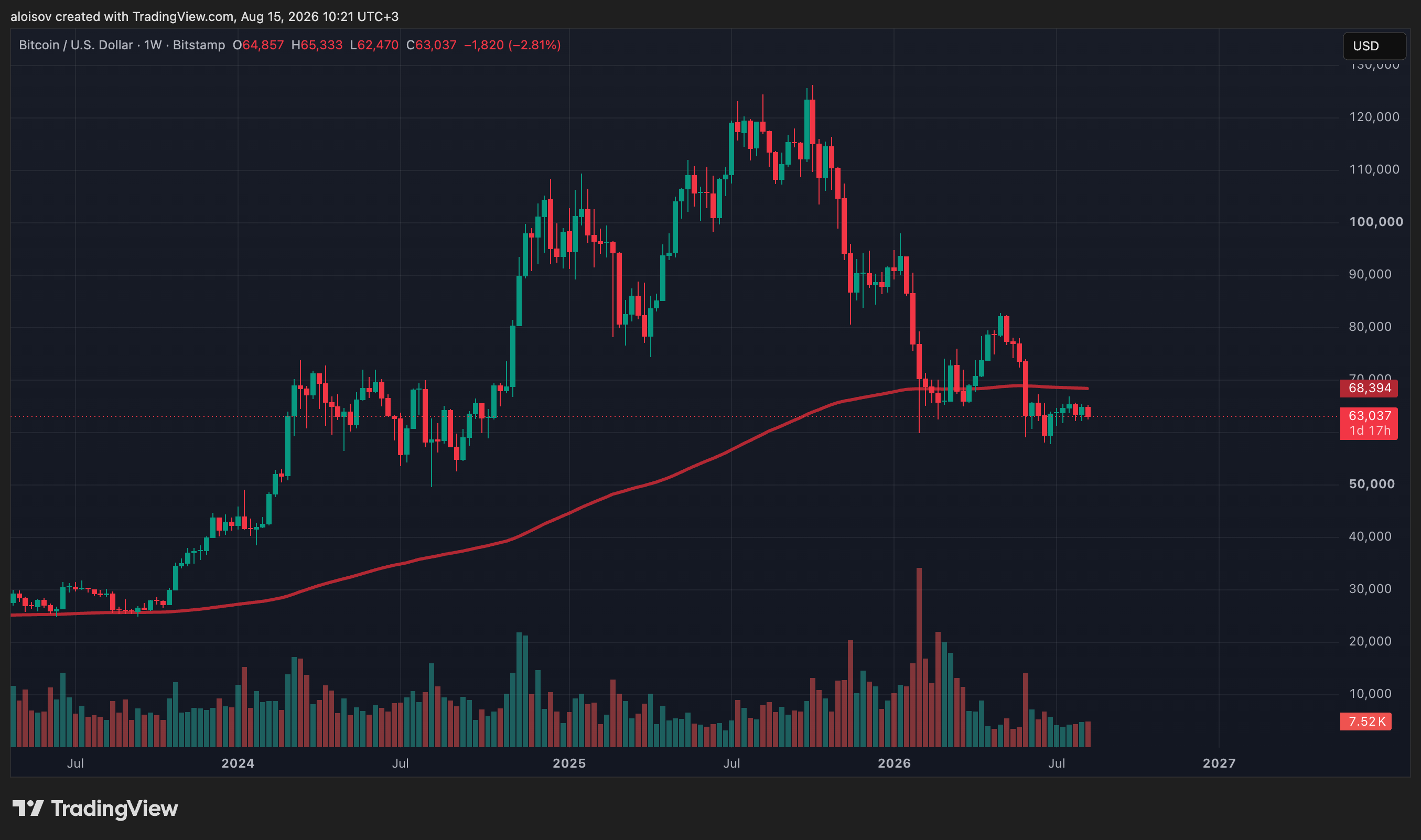
1-week chart of $BTC/USD and 200EMA. Source: Bitstamp

Range Held but Lacked Momentum

According to QCP Capital's observation, last week Bitcoin demonstrated resilience, absorbing several negative headlines without a sharp breakdown. This week, as noted in the report, reinforced the distinction between resilience and momentum: the range remains unchanged, but softer inflation data has so far elicited only a muted response from the market.

The $62,500–63,000 area continues to act as the lower boundary of the recent trading range. Whether this range holds will increasingly depend on the interplay of macroeconomic data, liquidity conditions, and asset-specific fund flows, rather than any single trigger.

Inflation Slows, Bitcoin Remains in Sideways Trend

U.S. inflation data this week provided further confirmation that price pressures are easing. According to the report, the annual Consumer Price Index (CPI) for July fell to 3.4% from 3.5% in June, while core CPI slowed to 2.5% from 2.6%. The Producer Price Index (PPI) also came in softer than expected: the figure remained unchanged in July against a forecast of 0.2% growth, following a 0.3% decline in June.

This data came after a notably weaker July employment report, which showed a decline of 23k in non-farm payrolls and downward revisions to figures for the two previous months. Together, these releases have reduced market expectations for imminent monetary policy tightening, although inflation still exceeds the Fed's long-term target.

Bitcoin's response, however, remained subdued. QCP Capital emphasizes that this should not be interpreted as a directional signal—the divergence between softening macro data and a sluggish price reaction points to the importance of other variables: trader positioning, the state of liquidity, and overall risk appetite, which determine how macro data is translated into crypto asset prices.

Market attention is now shifting to the U.S. Personal Consumption Expenditures (PCE) index, due on August 26, and the September meeting of the Federal Open Market Committee (FOMC). Investors appear likely to focus on whether the slowdown in inflation is accompanied by sufficient economic resilience to keep financial conditions stable.

Regulation Progresses Along Two Trajectories

The report notes that U.S. digital asset policy is increasingly developing along two parallel paths. In Congress, Senate consideration of the CLARITY Act has moved beyond the August recess. Senate Majority Leader John Thune stated that the bill will return for House consideration in September, though disagreements over ethics provisions and banking issues remain unresolved.

Simultaneously, regulatory work continues independently of the legislative schedule. The Securities and Exchange Commission's (SEC) 2026 agenda includes further work on capital raising through crypto assets and tokenized securities, with the agency already taking steps this year regarding trading of tokenized stocks.

QCP Capital emphasizes that this is an important distinction: delays in passing comprehensive legislation do not mean regulatory development has stopped—individual elements of the regulatory framework continue to take shape through agency rulemaking, guidance, and existing legislative procedures.

Strategy Now Both Buys and Sells

Corporate treasury activity also remains significant for Bitcoin's supply dynamics. According to the report, Strategy disclosed another sale of 1,690 $BTC for $109 million last week, using the proceeds for preferred stock buybacks. Additionally, the company raised approximately $653 million through an issuance of common stock to replenish dollar reserves.

These transactions follow the launch of a formal Bitcoin Monetization Program, which Strategy introduced this summer. Under this program, the company can sell Bitcoin to support dollar reserves and other balance sheet needs. JPMorgan notes that this creates a risk of "two-way" fund flows, as Strategy can now act as both a major buyer and seller of Bitcoin—depending on its financing needs.

QCP Capital clarifies: this does not mean corporate treasuries should be viewed as a constant source of supply in the market. However, it makes the flow picture more conditional than in earlier stages of the cycle. For the market, it's now not only the volumes that corporate treasuries acquire that matter, but also their liquid position, financing conditions, and disclosed asset sale policies.

Negotiations Around the Strait of Hormuz Continue, Oil Remains High

Geopolitical uncertainty remains another source of pressure across several asset classes. According to the report, Oman-mediated negotiations on the framework conditions for commercial shipping through the Strait of Hormuz are ongoing, with Qatar and Pakistan still participating in the broader mediation process between the U.S. and Iran. Negotiators have made progress on possible shipping agreements, but full and sustainable resumption of passage is not yet secured.

This uncertainty is reflected in energy markets. Brent crude traded around $88 on the morning of August 14 and is heading for a significant weekly gain—limited shipping through the Strait of Hormuz and the absence of a sustainable agreement maintain a geopolitical risk premium.

For cryptocurrencies, QCP Capital notes, the macroeconomic transmission channel remains relevant. Sustained increases in energy prices can impact overall inflation, inflation expectations, and long-term bond yields—all of which, in turn, affect financial conditions for liquidity-sensitive assets.

As long as physical shipping does not normalize on a sustainable basis, the situation around the Strait of Hormuz remains significant for cryptocurrencies primarily through oil, interest rates, and global liquidity, rather than through a direct channel of influence on digital assets.

Seasonality as Context, Not as a Guide

The calendar also provides historical context for the current price dynamics. According to data from Bespoke Investment Group cited in the QCP Capital report, Bitcoin's median return for August historically stands around -7.5%, with positive returns occurring in roughly 30% of observations. September has also traditionally been weaker—with a median decline of about 5.3%. Bitcoin posted negative returns in August each year from 2022 through 2025.

QCP Capital emphasizes: historical seasonality is descriptive, not predictive, especially considering how the structure of the crypto market has changed due to exchange-traded funds (ETFs) and increased institutional participation. Nevertheless, seasonality provides useful context for periods when thinner late-summer liquidity may coincide with reduced trading activity and heightened sensitivity to trader positioning.

More relevant, according to the company's analysts, is not the question of whether history will repeat itself, but whether the current range will hold as the market moves through the seasonally calmer part of the calendar.

Resilience Exists, Momentum Not Yet Present

In the concluding part of the report, QCP Capital notes that Bitcoin is not reacting to any single dominant negative catalyst. Instead, it continues to absorb several competing forces simultaneously: easing U.S. inflation, a weakening labor market, elevated oil prices, evolving regulation, and the more conditional nature of flows from corporate treasuries.

The analysts' conclusion largely reiterates their conclusion from a week ago. Bitcoin has demonstrated the ability to absorb negative news without a sustained breakdown, but the market has so far failed to convert improving elements of the macroeconomic backdrop into sustained upward momentum.

An exit from the current range in either direction, according to QCP Capital, would give the market much more information than intraday fluctuations within it. Until then, resilience remains the market's main characteristic—but not momentum.

Key Events in the Coming Weeks

  • August 19 — Publication of FOMC meeting minutes

  • August 26 — U.S. PCE index for July, second estimate of Q2 GDP

  • August 27–29 — Economic Symposium in Jackson Hole

  • September 15–16 — FOMC meeting

Bitcoin's current range resembles a tightly coiled spring: pressure is building from all sides, but the form holds for now. The market is testing the strength of this structure from both sides, finding no immediate reason for a sharp move.

The coming weeks—with the release of PCE data, the Jackson Hole symposium, and the September Fed meeting—will test whether this structure can withstand the seasonally weaker period or whether the accumulated pressure finally finds an outlet.

AI Opinion

From the perspective of machine data analysis, the current linkage of "oil—liquidity—Bitcoin" is not new to the crypto market. Earlier this year, the asset already faced similar pressure: when Brent exceeded $119 per barrel, Bitcoin unexpectedly held firm and moved upward, breaking the usual correlation with risky assets. This shows that the transmission channel "oil → inflation expectations → yields → crypto market," described in the QCP Capital report, does not work mechanically—in practice, Bitcoin's behavior depends on whether the asset is perceived in the moment as a risky instrument or a defensive one.

A technical aspect not covered in the report: the narrow range of $62,500–64,000 amid declining realized volatility statistically increases the probability of a sharp, directional move—regardless of macro news. Will the current compression maintain directional uncertainty until the September FOMC meeting, or will the market find a reason to exit earlier?


Trending Cryptos

Related Questions

QAccording to the QCP Capital report, what are the main cross-market factors currently pressuring Bitcoin and digital assets?

AAccording to the QCP Capital report, Bitcoin and digital assets are facing simultaneous pressure from several cross-market factors: heightened geopolitical risks, rising oil prices, uncertainty around global liquidity, and a weak reaction to generally favorable U.S. macro data.

QHow did Bitcoin react to the latest U.S. inflation and employment data, according to the analysis?

AAccording to the analysis, Bitcoin's reaction to the softening U.S. inflation data (CPI, PPI) and weaker employment report has been restrained or muted. The report states this divergence highlights the importance of other variables like trader positioning, liquidity conditions, and overall risk appetite in translating macro data into crypto asset prices.

QWhat risk does the company Strategy's new Bitcoin Monetization Program introduce to the market, as mentioned by JPMorgan?

AJPMorgan points out that Strategy's formal Bitcoin Monetization Program creates a risk of 'two-way' fund flows. This means Strategy can now act as both a major buyer and a major seller of Bitcoin, depending on its funding and balance sheet needs, making the supply flow picture more conditional.

QBeyond legislation, how is U.S. crypto regulation continuing to evolve, as noted in the report?

AThe report notes that U.S. crypto regulation is progressing independently of the legislative calendar. The SEC's 2026 agenda includes further work on capital raising via crypto assets and tokenized securities, and the agency has already taken steps this year regarding trading of tokenized securities. This shows regulatory development continues through agency rulemaking, guidance, and existing legislative procedures.

QWhat is the historical seasonal performance context for Bitcoin in August and September, and how should it be viewed according to QCP?

AHistorically, Bitcoin's median return in August is around -7.5% and in September around -5.3%, with positive August returns occurring only about 30% of the time. QCP Capital emphasizes that this seasonality is descriptive, not predictive, especially given structural market changes like ETFs. It provides context for periods of thinner late-summer liquidity and reduced trading activity, but the key question is whether the current trading range will hold during this seasonally quieter period.

Related Reads

Elon Musk Building Terafab: The Largest Chip Factory for AI, Robots, and Space Data Centers

Elon Musk's SpaceX and Tesla have launched the Terafab project to build a massive semiconductor facility in Grimes County, Texas. The plant, exceeding 9.3 million square meters, aims to integrate logic chip manufacturing, memory production, advanced packaging, and testing. The initial phase requires $16.8 billion in capital investment, with a long-term goal of producing over 1 terawatt of computing power annually. This capacity will support Tesla's Optimus robots and Cybercab autonomous vehicles, as well as SpaceX's orbital data centers. Texas Governor Greg Abbott confirmed the project's start in August 2026, highlighting 3,000 new jobs and a $30 million state grant. Elon Musk emphasized the strategic advantage of combining logic, memory, and packaging under one roof. Musk called the future complex the "largest and most valuable building on Earth," with an area roughly 50 times that of the Pentagon. Intel is the key technology partner, with plans to use its 14A process node for chip production. This partnership aims to diversify supply chains currently dominated by TSMC. The project aligns with the U.S. Pax Silica initiative to secure semiconductor supply chains. An AI analysis notes the project's scale and potential challenges, comparing it to delays seen in other U.S. megafab projects like Intel's Ohio facility. It questions whether Terafab can avoid similar pitfalls related to timelines, budgets, workforce, and supply chain stability. The facility's success could significantly shift the global semiconductor balance and strengthen the U.S. position in the tech race.

cryptonews.ru2h ago

Elon Musk Building Terafab: The Largest Chip Factory for AI, Robots, and Space Data Centers

cryptonews.ru2h ago

Elon Musk is Building Terafab: The Largest Chip Plant for AI, Robots, and Space Data Centers

Elon Musk's SpaceX and Tesla have launched the massive Terafab project to build a semiconductor plant in Grimes County, Texas. Spanning over 9.3 million square meters, the facility will integrate logic chip and memory production, advanced packaging, and testing. The initial phase requires $16.8 billion in capital investment, with a long-term goal of producing over 1 terawatt of computing power annually. This output is intended to supply Tesla's Optimus robots and Cybercab autonomous vehicles, as well as SpaceX's orbital data centers. Texas Governor Greg Abbott confirmed the project's start on August 6, 2026, highlighting the creation of 3,000 jobs and a $30 million grant from the Texas Enterprise Fund. Musk emphasized the strategic advantage of combining chip design, memory production, and packaging under one roof to accelerate hardware development. He stated the fully built complex would be "the largest and most valuable building on Earth," about 50 times larger than the Pentagon. An estimated 25% of production is earmarked for Tesla's robotics, with 75% for SpaceX's space-based AI systems. Earlier tax documents suggested a total project cost of up to $119 billion, but this has not been officially confirmed. Intel is the key technology partner, with plans to use its 14A process node for chip manufacturing. This partnership aims to diversify supply chains and reduce dependence on dominant foundries like TSMC. The initiative aligns with the broader U.S. Pax Silica program, which seeks to build secure international semiconductor supply chains with allied nations. An AI-driven analysis notes that megafab projects, such as Intel's delayed Ohio facility, often face schedule and budget overruns. While Terafab represents a significant step toward U.S. semiconductor self-sufficiency and could shift the global tech balance, its success will depend on factors like skilled labor availability, energy supply, and supply chain stability. The final outcome may not be clear until the late 2030s.

cryptonews.ru2h ago

Elon Musk is Building Terafab: The Largest Chip Plant for AI, Robots, and Space Data Centers

cryptonews.ru2h ago

Trading

Spot

Hot Articles

What is $BITCOIN

DIGITAL GOLD ($BITCOIN): A Comprehensive Analysis Introduction to DIGITAL GOLD ($BITCOIN) DIGITAL GOLD ($BITCOIN) is a blockchain-based project operating on the Solana network, which aims to combine the characteristics of traditional precious metals with the innovation of decentralized technologies. While it shares a name with Bitcoin, often referred to as “digital gold” due to its perception as a store of value, DIGITAL GOLD is a separate token designed to create a unique ecosystem within the Web3 landscape. Its goal is to position itself as a viable alternative digital asset, although specifics regarding its applications and functionalities are still developing. What is DIGITAL GOLD ($BITCOIN)? DIGITAL GOLD ($BITCOIN) is a cryptocurrency token explicitly designed for use on the Solana blockchain. In contrast to Bitcoin, which provides a widely recognized value storage role, this token appears to focus on broader applications and characteristics. Notable aspects include: Blockchain Infrastructure: The token is built on the Solana blockchain, known for its capacity to handle high-speed and low-cost transactions. Supply Dynamics: DIGITAL GOLD has a maximum supply capped at 100 quadrillion tokens (100P $BITCOIN), although details regarding its circulating supply are currently undisclosed. Utility: While precise functionalities are not explicitly outlined, there are indications that the token could be utilized for various applications, potentially involving decentralized applications (dApps) or asset tokenization strategies. Who is the Creator of DIGITAL GOLD ($BITCOIN)? At present, the identity of the creators and development team behind DIGITAL GOLD ($BITCOIN) remains unknown. This situation is typical among many innovative projects within the blockchain space, particularly those aligning with decentralized finance and meme coin phenomena. While such anonymity may foster a community-driven culture, it intensifies concerns about governance and accountability. Who are the Investors of DIGITAL GOLD ($BITCOIN)? The available information indicates that DIGITAL GOLD ($BITCOIN) does not have any known institutional backers or prominent venture capital investments. The project seems to operate on a peer-to-peer model focused on community support and adoption rather than traditional funding routes. Its activity and liquidity are primarily situated on decentralized exchanges (DEXs), such as PumpSwap, rather than established centralized trading platforms, further highlighting its grassroots approach. How DIGITAL GOLD ($BITCOIN) Works The operational mechanics of DIGITAL GOLD ($BITCOIN) can be elaborated on based on its blockchain design and network attributes: Consensus Mechanism: By leveraging Solana’s unique proof-of-history (PoH) combined with a proof-of-stake (PoS) model, the project ensures efficient transaction validation contributing to the network's high performance. Tokenomics: While specific deflationary mechanisms have not been extensively detailed, the vast maximum token supply implies that it may cater to microtransactions or niche use cases that are still to be defined. Interoperability: There exists the potential for integration with Solana’s broader ecosystem, including various decentralized finance (DeFi) platforms. However, the details regarding specific integrations remain unspecified. Timeline of Key Events Here is a timeline that highlights significant milestones concerning DIGITAL GOLD ($BITCOIN): 2023: The initial deployment of the token occurs on the Solana blockchain, marked by its contract address. 2024: DIGITAL GOLD gains visibility as it becomes available for trading on decentralized exchanges like PumpSwap, allowing users to trade it against SOL. 2025: The project witnesses sporadic trading activity and potential interest in community-led engagements, although no noteworthy partnerships or technical advancements have been documented as of yet. Critical Analysis Strengths Scalability: The underlying Solana infrastructure supports high transaction volumes, which could enhance the utility of $BITCOIN in various transaction scenarios. Accessibility: The potential low trading price per token could attract retail investors, facilitating wider participation due to fractional ownership opportunities. Risks Lack of Transparency: The absence of publicly known backers, developers, or an audit process may yield skepticism regarding the project's sustainability and trustworthiness. Market Volatility: The trading activity is heavily reliant on speculative behavior, which can result in significant price volatility and uncertainty for investors. Conclusion DIGITAL GOLD ($BITCOIN) emerges as an intriguing yet ambiguous project within the rapidly evolving Solana ecosystem. While it attempts to leverage the “digital gold” narrative, its departure from Bitcoin's established role as a store of value underscores the need for a clearer differentiation of its intended utility and governance structure. Future acceptance and adoption will likely depend on addressing the current opacity and defining its operational and economic strategies more explicitly. Note: This report encompasses synthesised information available as of October 2023, and developments may have transpired beyond the research period.

1.9k Total ViewsPublished 2025.05.13Updated 2025.05.13

What is $BITCOIN

Discussions

Welcome to the HTX Community. Here, you can stay informed about the latest platform developments and gain access to professional market insights. Users' opinions on the price of BTC (BTC) are presented below.

活动图片