Bitcoin Sentiment Back To Extreme Fear As Price Slips Under $76,000

bitcoinistPublished on 2026-05-28Last updated on 2026-05-28

Abstract

The Bitcoin Fear & Greed Index has fallen back into "extreme fear" territory with a value of 25, following a recent price retracement. Bitcoin's price has slipped below $75,500 after briefly recovering above $77,000. Historically, such extreme fear levels have been associated with potential market bottoms, though the indicator can remain in this zone for extended periods before a reversal. Concurrently, social media sentiment analysis shows bearish commentary currently outweighing bullish sentiment, reflecting broader market pessimism.

Data shows the Bitcoin Fear & Greed Index has slipped back into the extreme fear territory following the latest retrace in the asset’s price.

Bitcoin Fear & Greed Index Is Signaling Extreme Fear Again

The “Fear & Greed Index” is an indicator created by Alternative that tells us about the average sentiment present among investors in the Bitcoin and wider cryptocurrency markets.

To represent the market mentality, the index make use of a numerical scale running from zero to hundred. When the metric has a value under 47, it means the average investor is showing fear toward digital assets. On the other hand, the indicator being above 53 suggests the dominance of greed in the sector. Values between these two cutoffs naturally correspond to a net neutral sentiment.

Besides these three main zones, there are also two ‘extreme’ regions called the extreme fear (values of 25 and below) and extreme greed (above 75). Currently, the index is in the former of these two zones.
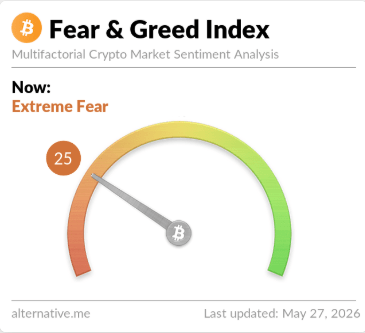
Looks like the index has a value of 25 at the moment | Source: Alternative

As is visible, the Bitcoin Fear & Greed Index has a value of 25, which is right on the boundary of the extreme fear territory. Earlier in the week, the indicator had managed to escape out of this zone, but the latest level suggests that the improvement in sentiment couldn’t last.
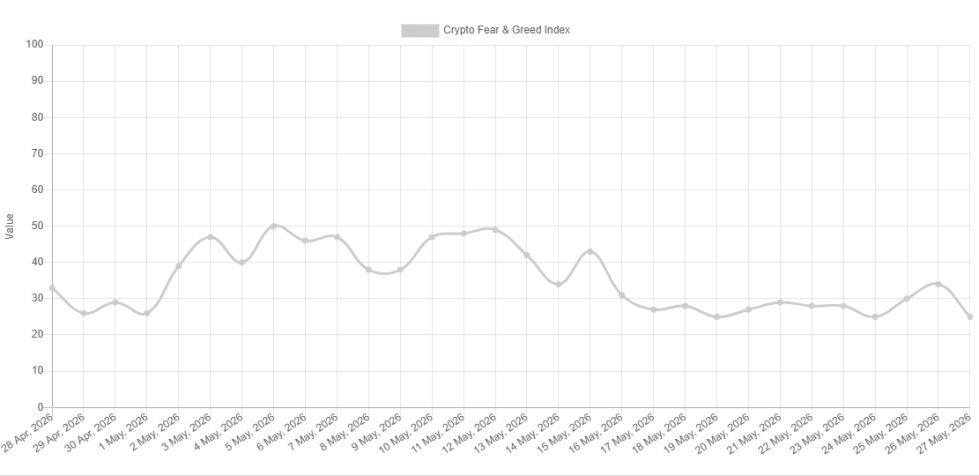
The trend in the BTC Fear & Greed Index over the past month | Source: Alternative

The latest decline in the index has come as the various cryptocurrencies have faced a pullback. Bitcoin, which had recovered into the high $77,000 levels earlier, is now back below $75,500.

Historically, the extreme sentiment zones have held much significance for the sector as they have been where major price tops and bottoms have tended to form. The relationship between sentiment and the market’s trajectory has been an inverse one, however, meaning that extreme fear is where bottoms have appeared while extreme greed has facilitated top formations.

Considering this, the return to extreme fear may not exactly be a negative for the market. That said, just entry into the zone alone isn’t enough to force a bottom, as in the past, the index has often stayed in the region for long periods before Bitcoin and others have reversed their course.

The Fear & Greed Index incorporates a variety of metrics related to the sector to determine the market sentiment. One factor included in the index is social media sentiment. In an X post, analytics firm Santiment has talked about how bullish and bearish comments related to digital assets have compared on the major social media platforms recently.
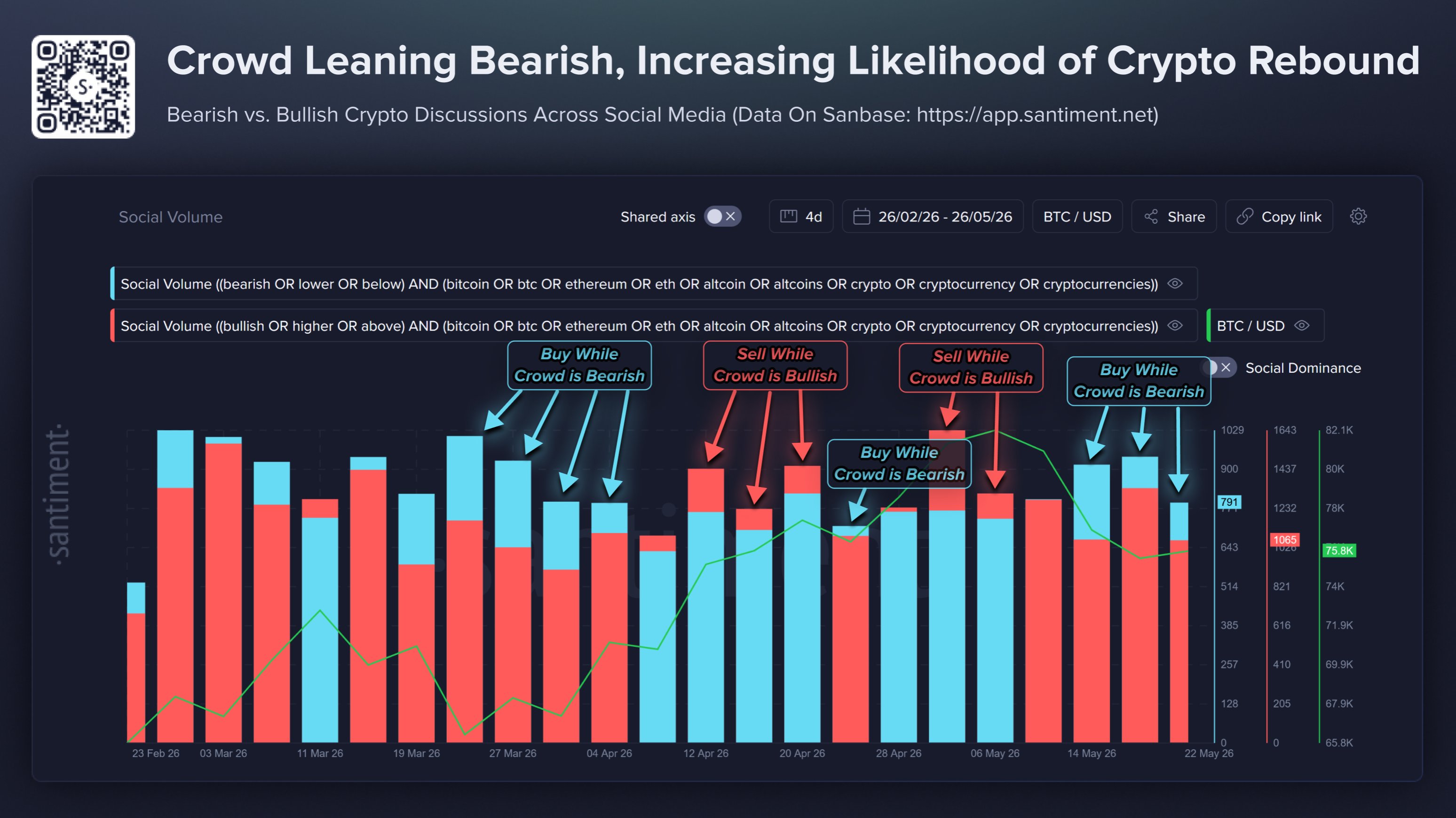
A bearish sentiment seems to have been more dominant in recent days | Source: Santiment on X

From the chart, it’s apparent that bearish sentiment has outweighed the bullish one on social media recently, indicating that the crowd on these platforms has also been pessimistic toward Bitcoin and others.

BTC Price

At the time of writing, Bitcoin is floating around $75,400, down almost 3% in the last seven days.

The price of the coin seems to have been consolidating | Source: BTCUSDT on TradingView


Related Questions

QWhat is the current value of the Bitcoin Fear & Greed Index and what sentiment zone does it represent?

AThe current value of the Bitcoin Fear & Greed Index is 25, which places it in the 'extreme fear' territory.

QAccording to the article, what is the general historical relationship between extreme sentiment zones and Bitcoin's price?

AHistorically, an inverse relationship exists where extreme fear has been associated with price bottoms forming, while extreme greed has been associated with price tops forming.

QWhat is Bitcoin's price at the time of the article's writing and how much has it changed over the past week?

AAt the time of writing, Bitcoin's price is floating around $75,400, which is down almost 3% over the last seven days.

QBesides social media sentiment, what general approach does the Fear & Greed Index use to determine market sentiment?

AThe Fear & Greed Index incorporates a variety of metrics related to the cryptocurrency sector to determine the overall market sentiment.

QWhat does the data from Santiment show about the recent sentiment on social media regarding cryptocurrencies?

AThe data from Santiment shows that bearish sentiment has recently outweighed bullish sentiment on major social media platforms, indicating a pessimistic crowd towards Bitcoin and other cryptocurrencies.

Related Reads

The Truth About Global Payments, Exposed by Airwallex

Airwallex's founder, Jack Zhang, outlines the three primary paths in the global payments industry and explains why the company chooses the most demanding one: building its own global financial infrastructure. The article begins by highlighting a common industry problem: payment platforms appear homogenized on the surface, offering similar features like global acquiring and multi-currency accounts. However, their underlying capabilities differ vastly. Customers truly care about payment stability, compliance robustness, and reliable market entry support. Zhang identifies three strategic paths: 1. **Bypassing Traditional Systems (Web3/Crypto):** This path promises efficiency via stablecoins and blockchain settlement but struggles with mainstream adoption, significant regulatory friction, and a lack of competitive edge against established players, often leaving it with niche or non-compliant markets. 2. **Packaging Existing Infrastructure:** The most common route, where companies layer a modern interface over legacy banking and partner networks. While enabling fast expansion, it fails to solve core issues like dependency on correspondent banks and intermediary risk, merely postponing the need for solid foundations. 3. **Building Own Global Infrastructure:** The path chosen by Airwallex, Ant International, and others. It involves obtaining local licenses, establishing direct regulatory relationships, building local teams, and controlling the full technology stack. This "heavy" approach is slow and capital-intensive but aims to internalize complexity, providing customers with a "lighter" experience. The core argument is that for business clients, the highest cost isn't transaction fees but hidden risks like frozen accounts, payment delays, and regulatory shocks. By investing heavily in its own infrastructure, Airwallex seeks to absorb these complexities, offering customers greater stability, cost savings (beyond fees), and long-term certainty. This foundational investment, though initially slow, enables compound growth, as evidenced by Airwallex's accelerated revenue scaling. In conclusion, while shortcuts enable faster growth, mastering the most difficult aspects—owning the underlying infrastructure—creates durable value for customers and sustainable advantage for the payment provider.

marsbit1h ago

The Truth About Global Payments, Exposed by Airwallex

marsbit1h ago

The Truth About Global Payments, Revealed by Airwallex

The article discusses Airwallex's approach to global payments, highlighting the key challenges and different strategic paths in the industry. It begins by addressing common user questions about platform reliability, cryptocurrency payments, and the necessity of Airwallex's "heavy" infrastructure model. The core argument is that while many payment platforms appear similar on the surface—offering features like global acquiring and multi-currency accounts—their underlying capabilities differ drastically. The piece identifies three primary paths for global payment providers: 1. **Bypassing Traditional Infrastructure (Web3/Crypto):** This path promises efficiency through stablecoins and on-chain settlements but faces significant regulatory hurdles and offers little advantage over established players for mainstream use, often serving only niche or non-compliant markets. 2. **Aggregating/Packaging Existing Infrastructure:** The most common route, where companies layer a better user experience over legacy banking and partner networks. While fast to market, this approach does not solve fundamental issues like dependency on intermediaries, correspondent banking risks, and compliance fragility. 3. **Building Proprietary Global Infrastructure:** The path chosen by Airwallex and similar firms. This involves obtaining local licenses, building direct regulatory relationships, establishing local teams, and controlling the compliance and technology stack. This is the most difficult and capital-intensive route but aims to internalize complexity. Airwallex's strategy of "heavy" investment in its own infrastructure is framed not as inefficiency, but as a long-term bet to provide clients with greater stability, cost savings beyond fees, and certainty. The platform's "heaviness" absorbs risk and operational complexity, aiming to deliver a "lighter" experience for business customers. The article concludes that in global payments, while shortcuts enable faster growth, mastering the most difficult aspects—the underlying infrastructure—is what creates durable value for clients and sustainable competitive advantage.

链捕手1h ago

The Truth About Global Payments, Revealed by Airwallex

链捕手1h ago

Trading

Spot
Futures

Hot Articles

What is $BITCOIN

DIGITAL GOLD ($BITCOIN): A Comprehensive Analysis Introduction to DIGITAL GOLD ($BITCOIN) DIGITAL GOLD ($BITCOIN) is a blockchain-based project operating on the Solana network, which aims to combine the characteristics of traditional precious metals with the innovation of decentralized technologies. While it shares a name with Bitcoin, often referred to as “digital gold” due to its perception as a store of value, DIGITAL GOLD is a separate token designed to create a unique ecosystem within the Web3 landscape. Its goal is to position itself as a viable alternative digital asset, although specifics regarding its applications and functionalities are still developing. What is DIGITAL GOLD ($BITCOIN)? DIGITAL GOLD ($BITCOIN) is a cryptocurrency token explicitly designed for use on the Solana blockchain. In contrast to Bitcoin, which provides a widely recognized value storage role, this token appears to focus on broader applications and characteristics. Notable aspects include: Blockchain Infrastructure: The token is built on the Solana blockchain, known for its capacity to handle high-speed and low-cost transactions. Supply Dynamics: DIGITAL GOLD has a maximum supply capped at 100 quadrillion tokens (100P $BITCOIN), although details regarding its circulating supply are currently undisclosed. Utility: While precise functionalities are not explicitly outlined, there are indications that the token could be utilized for various applications, potentially involving decentralized applications (dApps) or asset tokenization strategies. Who is the Creator of DIGITAL GOLD ($BITCOIN)? At present, the identity of the creators and development team behind DIGITAL GOLD ($BITCOIN) remains unknown. This situation is typical among many innovative projects within the blockchain space, particularly those aligning with decentralized finance and meme coin phenomena. While such anonymity may foster a community-driven culture, it intensifies concerns about governance and accountability. Who are the Investors of DIGITAL GOLD ($BITCOIN)? The available information indicates that DIGITAL GOLD ($BITCOIN) does not have any known institutional backers or prominent venture capital investments. The project seems to operate on a peer-to-peer model focused on community support and adoption rather than traditional funding routes. Its activity and liquidity are primarily situated on decentralized exchanges (DEXs), such as PumpSwap, rather than established centralized trading platforms, further highlighting its grassroots approach. How DIGITAL GOLD ($BITCOIN) Works The operational mechanics of DIGITAL GOLD ($BITCOIN) can be elaborated on based on its blockchain design and network attributes: Consensus Mechanism: By leveraging Solana’s unique proof-of-history (PoH) combined with a proof-of-stake (PoS) model, the project ensures efficient transaction validation contributing to the network's high performance. Tokenomics: While specific deflationary mechanisms have not been extensively detailed, the vast maximum token supply implies that it may cater to microtransactions or niche use cases that are still to be defined. Interoperability: There exists the potential for integration with Solana’s broader ecosystem, including various decentralized finance (DeFi) platforms. However, the details regarding specific integrations remain unspecified. Timeline of Key Events Here is a timeline that highlights significant milestones concerning DIGITAL GOLD ($BITCOIN): 2023: The initial deployment of the token occurs on the Solana blockchain, marked by its contract address. 2024: DIGITAL GOLD gains visibility as it becomes available for trading on decentralized exchanges like PumpSwap, allowing users to trade it against SOL. 2025: The project witnesses sporadic trading activity and potential interest in community-led engagements, although no noteworthy partnerships or technical advancements have been documented as of yet. Critical Analysis Strengths Scalability: The underlying Solana infrastructure supports high transaction volumes, which could enhance the utility of $BITCOIN in various transaction scenarios. Accessibility: The potential low trading price per token could attract retail investors, facilitating wider participation due to fractional ownership opportunities. Risks Lack of Transparency: The absence of publicly known backers, developers, or an audit process may yield skepticism regarding the project's sustainability and trustworthiness. Market Volatility: The trading activity is heavily reliant on speculative behavior, which can result in significant price volatility and uncertainty for investors. Conclusion DIGITAL GOLD ($BITCOIN) emerges as an intriguing yet ambiguous project within the rapidly evolving Solana ecosystem. While it attempts to leverage the “digital gold” narrative, its departure from Bitcoin's established role as a store of value underscores the need for a clearer differentiation of its intended utility and governance structure. Future acceptance and adoption will likely depend on addressing the current opacity and defining its operational and economic strategies more explicitly. Note: This report encompasses synthesised information available as of October 2023, and developments may have transpired beyond the research period.

363 Total ViewsPublished 2025.05.13Updated 2025.05.13

What is $BITCOIN

Discussions

Welcome to the HTX Community. Here, you can stay informed about the latest platform developments and gain access to professional market insights. Users' opinions on the price of BTC (BTC) are presented below.

活动图片