Warsh's First Day in Office, Markets Deliver a 'Wake-up Call': Rate Hike Expected This Year

marsbitОпубликовано 2026-05-23Обновлено 2026-05-23

Введение

On his first day in office, newly inaugurated Federal Reserve Chairman Warsh received a stark market warning, with expectations now fully pricing in a 25-basis-point interest rate hike this year. The shift was triggered by hawkish remarks from Fed Governor Waller, who stated that inflation is now the key policy "driver" and that the odds of a hike or cut are evenly split. This sent short-term Treasury yields higher. Waller signaled a significant pivot in his stance, citing disappointing inflation and labor data. He suggested removing "easing bias" language from Fed statements and did not rule out future rate increases if inflation fails to recede, though he noted immediate action isn't warranted without signs of unanchored inflation expectations. Chairman Warsh faces immediate pressure at his first FOMC meeting in June. With the preferred inflation gauge at a three-year high, analysts warn that failing to hike could be interpreted as an implicit easing of policy. The geopolitical situation in the Middle East is adding to existing price pressures. The market's expectation for a hike contrasts sharply with earlier forecasts for multiple cuts. While long-term Treasury yields have been contained by lower energy prices recently, analysts note they remain under structural upward pressure. Warsh's swearing-in at the White House highlights political scrutiny over Fed independence. However, the market has made it clear that inflation is the most urgent challenge, leaving the new c...

Written by: Bao Yilong

Warsh formally took the helm of the Federal Reserve, only to be met with a sharp market rebuke on his very first day.

On Friday, May 22, Trump presided over a swearing-in ceremony at the White House, formally handing over the Fed's reins to Warsh. Warsh assumes leadership of the Fed at a time when soaring energy and transportation costs triggered by the Iran war are persistently feeding into inflation.

As noted by Wall Street News, on the same day, Fed Governor Waller delivered hawkish remarks, clearly stating that inflation is the "driving force" for future policy decisions, and said the likelihood of future rate hikes and cuts is "fifty-fifty." This statement directly spurred a sharp surge in rate hike expectations.

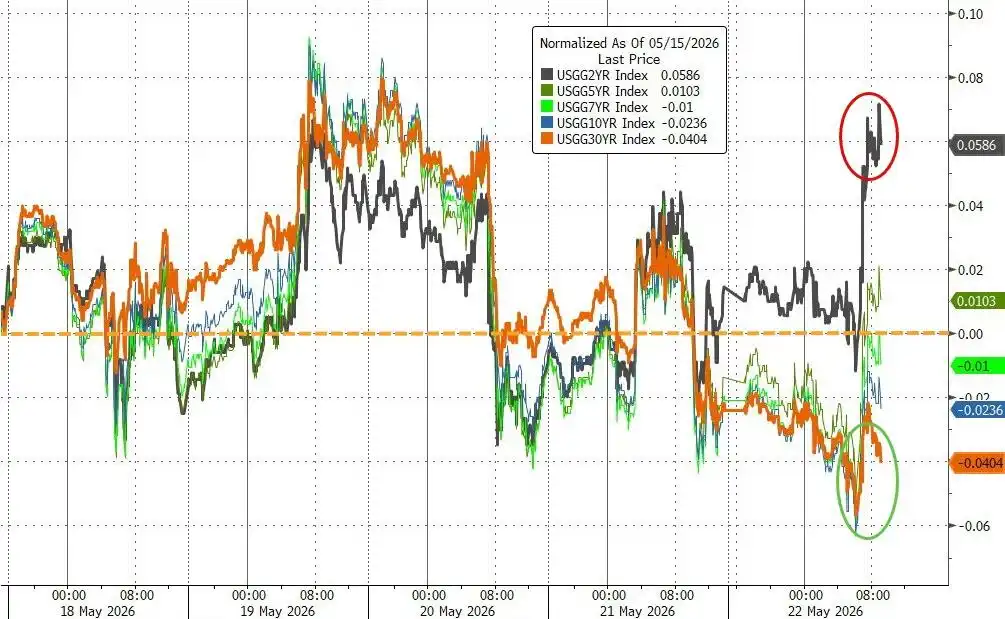
The U.S. Treasury market was sold off that day, with the interest-rate-sensitive 2-year Treasury yield rising 4 basis points to its highest level since February this year.

(Weekly performance of key U.S. Treasury yields)
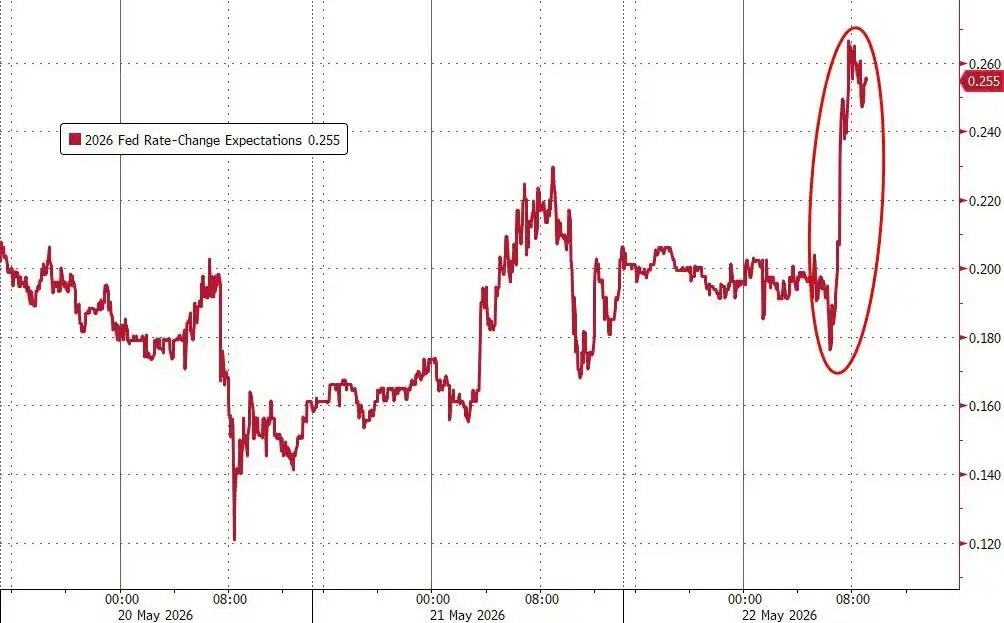
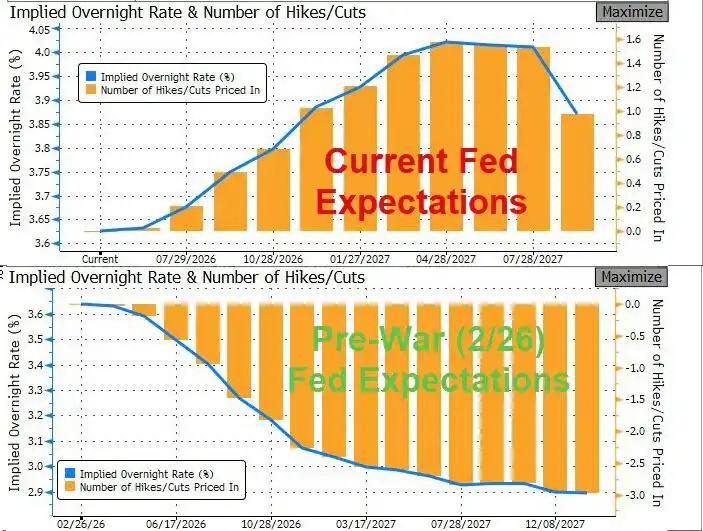
The futures market has now fully priced in a 25-basis-point rate hike expectation for this year.

(Market expects Fed to hike rates by 25 basis points within the year)
TS Lombard economist Steven Blitz bluntly stated that if Warsh chooses not to raise rates at his first monetary policy meeting in June, the market will grant him no leeway.

Waller's Sharp Pivot, Inflation Becomes Policy "Driving Force"

At the very moment Warsh was sworn in, Fed Governor Waller delivered his most hawkish signal to date in a speech titled "Policy Risks Have Changed" in Frankfurt, the significance of his shift in stance capturing the market's attention.

Waller stated:

Inflation is not moving in the right direction. I support removing the 'easing bias' wording from the policy statement to clearly convey that the likelihood of rate cuts and hikes is now roughly equal.

He further pointed out:

I can no longer rule out that future rate hikes may be necessary if inflation does not recede soon.

Waller admitted that recent labor market reports and inflation data have changed his previously long-held accommodative stance.

He also noted that the oil price shock might soon fade, but emphasized this does not mean "considering a rate hike in the near term is appropriate," and that rate hikes would require conditions where inflation expectations become "unanchored."

Previously, the Fed's April meeting minutes showed that "many" officials were already inclined to drop the easing bias, including three regional Fed presidents who had dissented on this issue in the April statement. Waller's latest remarks echo this trend.

Warsh's Debut Nears, Immense Pressure for June Meeting

Warsh will chair his first Federal Open Market Committee (FOMC) meeting in mid-June, and market observers are not optimistic about the situation he will face.

The Fed's preferred inflation gauge has risen to its highest level in three years, with the overall price growth rate reaching 6% in April. Market-implied one-year inflation expectations are around 4%.

TS Lombard economist Blitz added that if Warsh decides against a rate hike in June, even if economic growth remains solid and far from overheating at that time, the market will interpret it as de facto easing. Blitz said:

Against a backdrop of broadly rising inflation risks, failing to hike in June is effectively a form of easing.

Diane Swonk, chief economist at KPMG US, pointed out that the Middle East situation is adding pressure on top of already existing price pressures. She said:

This is one of many reasons why the Fed cannot ignore the war and its inflationary effects.

The current market expectation of a 25-basis-point Fed rate hike stands in stark contrast to the widespread market bets on multiple rate cuts at the beginning of the year.

(Comparison of market expectations for Fed rate path around February this year)
Although influenced by falling energy prices this week, the 10-year Treasury yield did not see a significant rise.

However, Goldman Sachs' George Cole noted that while long-end Treasuries appear slightly cheaper relative to fair value, the valuation has not deviated enough to support a deeper rebound.

(Long-end Treasuries slightly cheap relative to fair value)
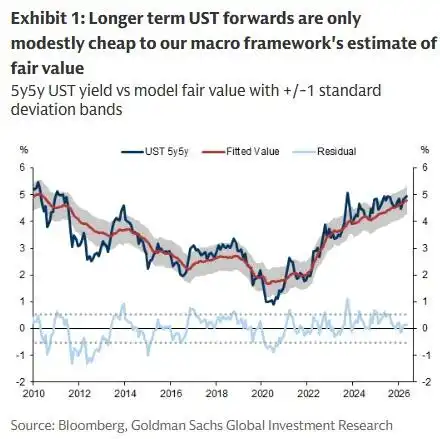
George Cole emphasized that until the macro risk landscape undergoes a substantive shift, long-end yields still face structural upward pressures from supply and the debt financing cycle.

Test of Independence, Underlying Concerns Behind Historic Inauguration Moment

Warsh is the first Fed chair since Greenspan to be sworn in at the White House, a detail itself seen by the market as a signal.

Trump hopes that this former Fed governor, whom he nominated in January this year, will be more amenable to demands for rate cuts. Warsh previously defeated White House economist Hassett, Waller, and BlackRock executive Rick Rieder in the nomination race.

The pressure on the Fed's independence has been particularly pronounced recently.

As noted by Wall Street News, Trump ally, Washington D.C. federal prosecutor Jeanine Pirro, had launched a criminal investigation into Powell regarding a $2.5 billion Fed headquarters renovation project. The investigation has been dropped, but Powell stated it was a pretext to pressure officials for rate cuts.

Warsh now begins a four-year term, becoming the 17th Chair of the Federal Reserve Board of Governors.

However, the market has already made it clear: regardless of the political environment, inflation is the most pressing issue at hand, and this new chair has little time for a measured approach.


Связанные с этим вопросы

QWhat major market reaction occurred on the day Kevin Warsh formally assumed the role of Federal Reserve Chair?

AOn the day Kevin Warsh formally assumed the role of Federal Reserve Chair, the market delivered a 'warning shot.' U.S. Treasury bonds were sold off, with the yield on the interest rate-sensitive 2-year Treasury note rising by 4 basis points to its highest level since February. Futures markets fully priced in expectations for a 25 basis-point rate hike within the year.

QWhat was the core message of Fed Governor Christopher Waller's speech on the same day, and how did it impact market expectations?

AFed Governor Christopher Waller delivered a strongly hawkish speech, stating that inflation is the 'driver' of future policy decisions and that the likelihood of rate hikes and cuts is now 'evenly balanced.' He explicitly said he could not rule out future rate increases if inflation does not fall promptly. This speech directly caused a sharp rise in market expectations for a rate hike.

QAccording to economists cited in the article, what would be the market interpretation if Chair Warsh does not raise interest rates at the June FOMC meeting?

AEconomists cited in the article believe that if Chair Warsh does not raise interest rates at the June FOMC meeting, the market will interpret it as an act of policy easing, even if economic growth remains solid and not overheated. In the context of rising inflation risks, failing to hike would be seen as a de facto loosening of policy.

QWhat significant pressure on the Federal Reserve's independence is mentioned in the article?

AThe article mentions that Trump ally, federal prosecutor Jeanine Pirro, launched a criminal investigation into former Chair Jerome Powell over a $2.5 billion headquarters renovation project. Although the investigation was dropped, Powell stated it was a pretext to pressure officials to cut interest rates, highlighting concerns about the Fed's political independence.

QHow have market expectations for the Federal Reserve's interest rate path changed from the beginning of the year to the time of the article?

AMarket expectations have reversed dramatically. At the beginning of the year, the market was widely betting on multiple rate cuts. By the time of the article, futures markets had completely priced in expectations for a 25 basis-point rate hike within the year, forming a stark contrast.

Похожее

Has Microsoft Lost Its Way in the AI Race, and Can Copilot Bring It Back on Track?

Microsoft, once seen as an early AI frontrunner due to its investment in OpenAI, is navigating a strategic shift amid increased competition. Its initial reliance on OpenAI’s GPT models has been complicated by OpenAI’s growing ambitions as a direct competitor, rapid advancements from rivals like Claude and Gemini, and the disruptive rise of AI agents, which challenge its traditional SaaS business model. These factors contributed to stock declines and slower-than-expected adoption of its flagship Copilot products. In response, CEO Satya Nadella has taken a hands-on role in product development, signaling the urgency of change. Microsoft is pivoting from a model-centric strategy to a "model-agnostic" enterprise platform approach. It aims to become the foundational layer connecting various AI models—from OpenAI, Anthropic, or its own new "Superintelligence" team—with enterprise workflows, data, security, and cloud services. Recent organizational changes merged consumer and enterprise Copilot teams to accelerate innovation, exemplified by new products like Copilot Tasks and Copilot Cowork. However, this transformation comes at a high cost. Microsoft faces massive capital expenditures, potentially reaching ~$190 billion by 2026, to support AI infrastructure. While its platform strategy shows early signs of traction with growing Azure AI revenue, it must balance startup-like agility with the reliability expected by enterprise clients. The core challenge is no longer being the sole AI winner but defending its position as the essential enterprise software entry point amidst rapid technological commoditization and the shift towards always-on AI agents.

marsbit5 ч. назад

Has Microsoft Lost Its Way in the AI Race, and Can Copilot Bring It Back on Track?

marsbit5 ч. назад

Why Haven't Forex Stablecoins Taken Off?

Why FX Stablecoins Never Took Off: A Path Forward via Synthetic FX Despite the explosive growth of stablecoin-powered digital banking, which has seen ~$6B in VC investment and a 24x surge in crypto card spending in under a year, a major limitation persists: these banks are essentially dollar-only accounts. This leaves 95-99% of global accounts, which are denominated in non-USD currencies, underserved. Attempts to create native foreign currency (FX) stablecoins (like EURC) have largely failed, with total FX stablecoin TVL at ~$600M compared to $400B for USD stablecoins—a 700x gap. These FX tokens face critical challenges: fragile pegs due to low liquidity, limited exchange/FinTech acceptance, poor on/off-ramps, complex regional compliance, and a chicken-and-egg adoption problem. The article argues that the solution lies not in competing with entrenched USD stablecoin networks (USDT/USDC), but in adopting a synthetic FX model inspired by traditional finance. Specifically, it advocates for Mark-to-Market Non-Deliverable Forwards (NDFs)—cash-settled FX derivatives that allow users to maintain underlying USD stablecoin holdings while having their account balance and P&L denominated in a foreign currency. This approach offers key advantages: strong oracle-based pegs, retention of deep USD stablecoin liquidity and yield, superior on/off-ramps, scalability to any currency with a reliable feed, and capital efficiency. It mirrors how modern institutional FX markets operate. Primary use cases for on-chain NDFs include: 1. **Digital Banks/Wallets:** Enabling multi-currency accounts for international users without leaving the USD stablecoin ecosystem, boosting deposits and retention. 2. **FX Carry Trade Vaults:** Offering access to sovereign interest rate differentials (e.g., earning yield on BRL) in a more stable and scalable format than crypto-native products like Ethena. 3. **Global Enterprise Payments:** Allowing merchants to receive payments in local currency equivalents while settling in USD stablecoins, similar to services offered by Stripe for fiat. The conclusion is that synthetic FX, not native FX stablecoins, is the viable path to integrating foreign exchange into the growing stablecoin digital banking landscape, potentially unlocking the next phase of institutional DeFi and multi-trillion-dollar global adoption.

链捕手5 ч. назад

Why Haven't Forex Stablecoins Taken Off?

链捕手5 ч. назад

Торговля

Спот
Фьючерсы

Популярные статьи

Как купить S

Добро пожаловать на HTX.com! Мы сделали приобретение Sonic (S) простым и удобным. Следуйте нашему пошаговому руководству и отправляйтесь в свое крипто-путешествие.Шаг 1: Создайте аккаунт на HTXИспользуйте свой адрес электронной почты или номер телефона, чтобы зарегистрироваться и бесплатно создать аккаунт на HTX. Пройдите удобную регистрацию и откройте для себя весь функционал.Создать аккаунтШаг 2: Перейдите в Купить криптовалюту и выберите свой способ оплатыКредитная/Дебетовая Карта: Используйте свою карту Visa или Mastercard для мгновенной покупки Sonic (S).Баланс: Используйте средства с баланса вашего аккаунта HTX для простой торговли.Третьи Лица: Мы добавили популярные способы оплаты, такие как Google Pay и Apple Pay, для повышения удобства.P2P: Торгуйте напрямую с другими пользователями на HTX.Внебиржевая Торговля (OTC): Мы предлагаем индивидуальные услуги и конкурентоспособные обменные курсы для трейдеров.Шаг 3: Хранение Sonic (S)После приобретения вами Sonic (S) храните их в своем аккаунте на HTX. В качестве альтернативы вы можете отправить их куда-либо с помощью перевода в блокчейне или использовать для торговли с другими криптовалютами.Шаг 4: Торговля Sonic (S)С легкостью торгуйте Sonic (S) на спотовом рынке HTX. Просто зайдите в свой аккаунт, выберите торговую пару, совершайте сделки и следите за ними в режиме реального времени. Мы предлагаем удобный интерфейс как для начинающих, так и для опытных трейдеров.

1.3k просмотров всегоОпубликовано 2025.01.15Обновлено 2025.03.21

Как купить S

Sonic: Обновления под руководством Андре Кронье – новая звезда Layer-1 на фоне спада рынка

Он решает проблемы масштабируемости, совместимости между блокчейнами и стимулов для разработчиков с помощью технологических инноваций.

2.2k просмотров всегоОпубликовано 2025.04.09Обновлено 2025.04.09

Sonic: Обновления под руководством Андре Кронье – новая звезда Layer-1 на фоне спада рынка

HTX Learn: Пройдите обучение по "Sonic" и разделите 1000 USDT

HTX Learn — ваш проводник в мир перспективных проектов, и мы запускаем специальное мероприятие "Учитесь и Зарабатывайте", посвящённое этим проектам. Наше новое направление .

1.8k просмотров всегоОпубликовано 2025.04.10Обновлено 2025.04.10

HTX Learn: Пройдите обучение по "Sonic" и разделите 1000 USDT

Обсуждения

Добро пожаловать в Сообщество HTX. Здесь вы сможете быть в курсе последних новостей о развитии платформы и получить доступ к профессиональной аналитической информации о рынке. Мнения пользователей о цене на S (S) представлены ниже.

活动图片