The Post-Plunge Panorama: Institutions Cry 'Buy the Dip' as Traders Turn to U.S. Stocks

Foresight NewsPublished on 2026-06-08Last updated on 2026-06-08

Abstract

Amidst a significant market correction, Bitcoin (BTC) briefly fell below the $60,000 mark to around $59,130 on June 6th. While it later rebounded to near $63,000, breaking the key psychological level severely impacted market confidence, with the current sentiment index indicating "extreme fear." Altcoins followed the broader downturn. Market participants offer mixed views on whether this is a buying opportunity. On the bullish side, analysts from Glassnode and Strive Asset Management point to Bitcoin touching its 200-week moving average—a historically reliable buy signal—and suggest a higher-probability bottom zone between $46k and $54k. Standard Chartered's digital assets head believes the bottom is "almost in," anticipating large-scale buybacks. Analysts Darkfost and trader Killa also see current levels as a generational or long-term accumulation opportunity, citing deeply oversold technical models. Conversely, NYDIG's research highlights capital rotation from crypto into outperforming AI stocks as a headwind, noting the current ~53% drawdown is milder than historical cycles. Polymarket prediction data shows a 72% probability of BTC falling below $55k, though odds for a drop below $35k-$40k are seen as lower. Notably, some traders, like Eugene Ng, have pivoted away, citing more attractive opportunities in equities and unresolved systemic risks (referencing a major entity's BTC sales), and are avoiding attempts to "catch a falling knife." In summary, while several institu...


Written by: Ma He, Foresight News


On June 6, BTC briefly lost the $60,000 level, dropping as low as $59,130. By June 8, the price of Bitcoin had recovered to around $63,000. Although the price had rebounded several thousand dollars, the earlier breach of the critical integer support level continued to weigh heavily on market confidence and sentiment in the cryptocurrency space. Its Fear & Greed Index currently sits at 15, indicating the market mood remains 'Extreme Fear.' Most altcoins have moved in lockstep with the broader market, also experiencing deep pullbacks.


Is this the buying zone? Institutions, traders, and others have shared their views.


Glassnode Co-founder: $46k to $54k as Key Bottom Range


Rafael, co-founder of Glassnode, stated that Bitcoin has retraced roughly 50% from its all-time high. On-chain data shows BTC is currently trading near a significant support zone formed by the Realized Price Median ($64.1k) and the 200-week moving average ($61.7k). Historically, Bitcoin has traded below this level for only about 7% of the time.
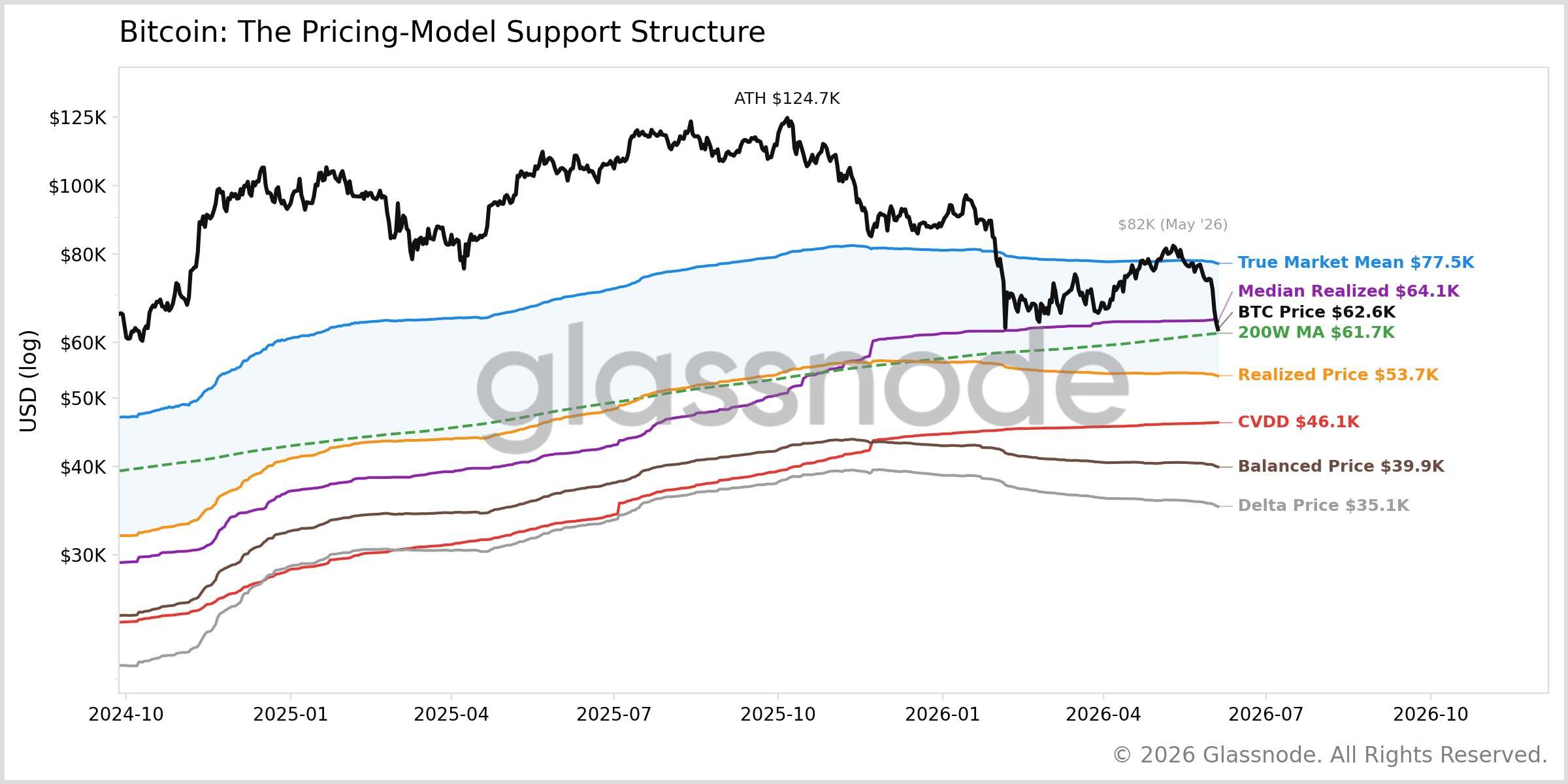


Looking at long-term valuation models, below the 200-week moving average lie the Realized Price (~$54k), CVDD (~$46.2k), Balanced Price (~$40k), and Delta Price (~$35k) in descending order. Previous bear market bottoms have all touched this cost range before reversing, with CVDD considered the historically most accurate bottom anchor point. Based on current model projections, the $46k to $54k range constitutes a higher-probability bottom area, while the $35k to $40k range belongs to a deep capitulation zone under extreme panic scenarios, historically representing less than 3% of trading days.


However, as the Bitcoin market matures, the magnitude of cyclical drawdowns shows a narrowing trend. Previous bear market maximum drawdowns were 85%, 84%, and 77%, respectively, while this cycle has only seen a decline of about 50% from the all-time high so far. This suggests the potential for further downside exists, but a more probable bottom may lie in the $46k to $54k range. In the event of a subsequent rebound, the $75k to $79k zone will become the first significant recovery region, with greater resistance near the 50-week moving average at approximately $93k and the previous all-time high.


NYDIG Global Head of Research: AI Siphoning Significant Crypto Capital


Greg Cipolaro, Global Head of Research at NYDIG, stated in a research report that he believes the overlap between AI and crypto investors is far greater than many realize. Both attract investors seeking exposure to emerging technologies and excess returns. As AI-related stocks continue to outperform the broader market, capital flows follow, rotating out of the crypto market. Investors are also preparing for what could be the largest tech IPO cycle in years. Quantum computing, Strategy selling BTC have also intensified market concerns.


Greg Cipolaro noted in his report that several metrics are approaching levels historically coincident with major bottoms. Bitcoin's MVRV ratio has dropped to 1.2, and the percentage of supply in profit recently fell below 50%, another metric often associated with capitulation. However, the magnitude of this retracement remains relatively mild by historical standards. He pointed out that Bitcoin is down about 53% from its peak ($126k in October), significantly shallower than the 75%-90% drawdowns of past cycles. Whether the low is already in likely depends on whether institutional demand has structurally altered the cycle or merely delayed a deeper realignment.


Standard Chartered Bank's Head of Digital Assets Research: Bitcoin Bottom Is Almost Formed


Geoffrey Kendrick, Head of Digital Assets Research at Standard Chartered Bank, stated that the Bitcoin bottom is "almost certainly in," and the current price range could be the long-awaited buying opportunity for investors. An important catalyst for this decline was Strategy's sale of 32 BTC, but referencing historical experience from late 2022, Strategy is likely to soon engage in much larger-scale repurchases, potentially 10 or even 100 times the amount previously sold. If such buy-side pressure is confirmed, it could be a significant signal of a market bottom.


Strive CEO: Bitcoin Touches 200-week Moving Average (Fifth Time in History), Previous Four Times Were Perfect Buying Opportunities
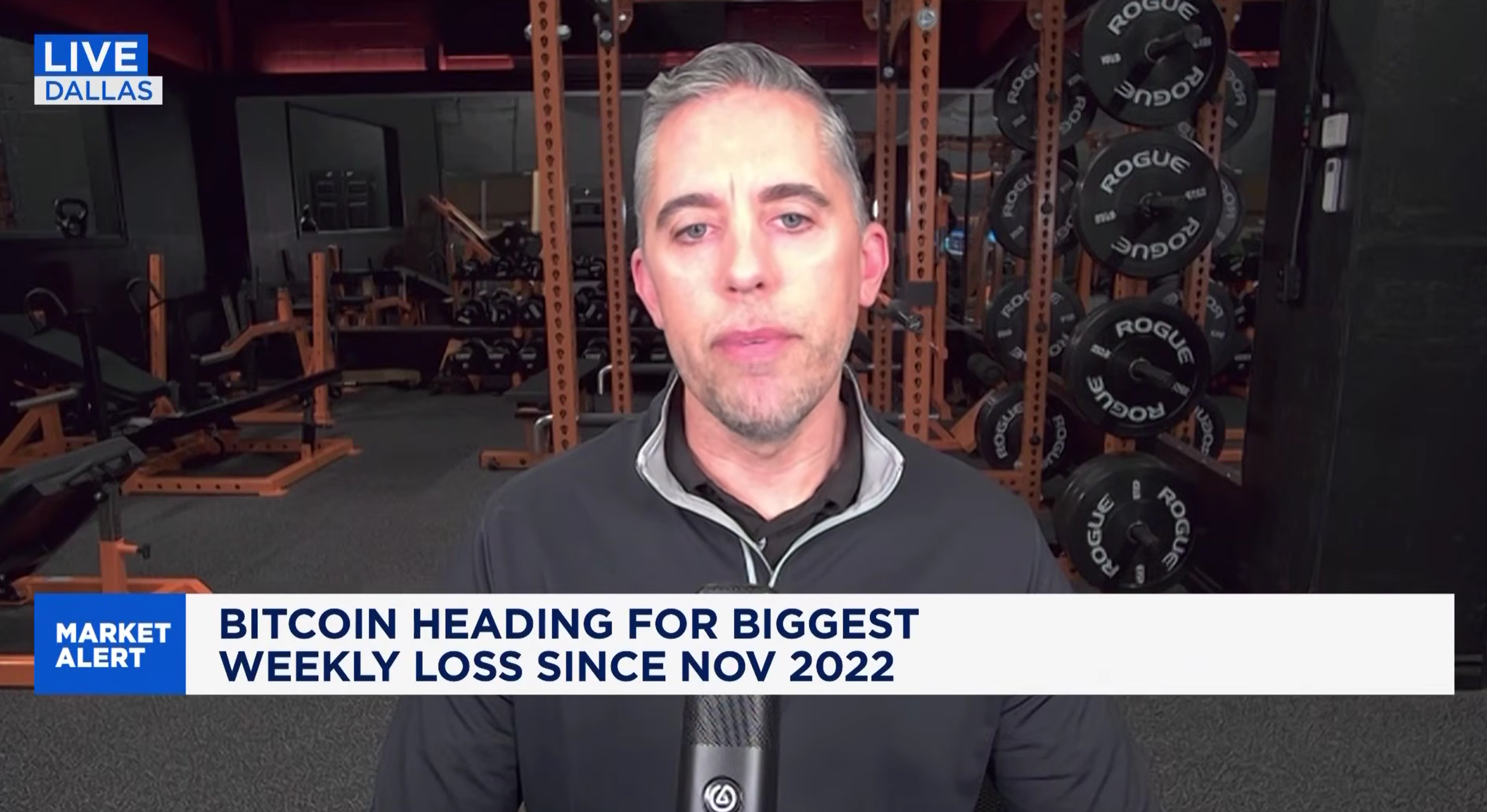


Matt Cole, CEO of asset management firm Strive, told CNBC's Squawk Box Europe that Bitcoin has touched the 200-week moving average (the fifth time in history), with the previous four times being "perfect buying opportunities." He also emphasized that Bitcoin fundamentals have "never been better" and views this touch of the 200-week MA as a historic buying opportunity.


Trader Eugene: Temporarily Left Crypto for U.S. Stocks, Won't Attempt to Catch Bitcoin's Falling Knife


Trader Eugene Ng Ah Sio posted on his personal channel that he has largely exited the cryptocurrency market since May 13 this year, shifting his main focus to stock market research. He believes that compared to the current crypto market, the stock market offers greater depth of research, cognitive challenge, and trading and investment opportunities. Based on his assessment of the industry's current state, he expects to maintain this strategy for the foreseeable future, only continuing to monitor crypto industry developments without active trading participation.


Eugene further stated that unless the market presents a highly attractive risk-reward opportunity, he has no plans to return to the crypto market for now, and such conditions have not yet emerged. He believes the trajectory of the crypto market is diminishing its appeal as a trading and investment arena, thus he will continue to focus on traditional stock markets in the near term. Discussing Strategy, Eugene believes the associated risks are just beginning to surface. He noted that even if Strategy sold more Bitcoin recently, it merely postpones the problem rather than solving it. Until the high correlation between Strategy and Bitcoin is broken, he is not bullish on long opportunities for Bitcoin. Regarding the market bottom, he admitted he cannot predict it but stated he has stopped attempting "catching a falling knife" trades.


Trader Killa: This Is a Generational Buying Opportunity


Trader Killa tweeted during Bitcoin's decline on June 6 that this is a generational buying opportunity. On June 8, he stated that BTC has entered the "final phase" and "final extension," and he has deployed 90% of his capital. Additionally, Killa mentioned that the "protective buy walls" that appeared during last weekend's crash have not been withdrawn, and he believes the likelihood of quickly hitting those support levels in the short term is low. Killa is a quantitative trader focused on BTC, having previously predicted the peak of this bull cycle in May 2025.


Analyst Darkfost: Bitcoin Has Entered Extremely Undervalued Territory


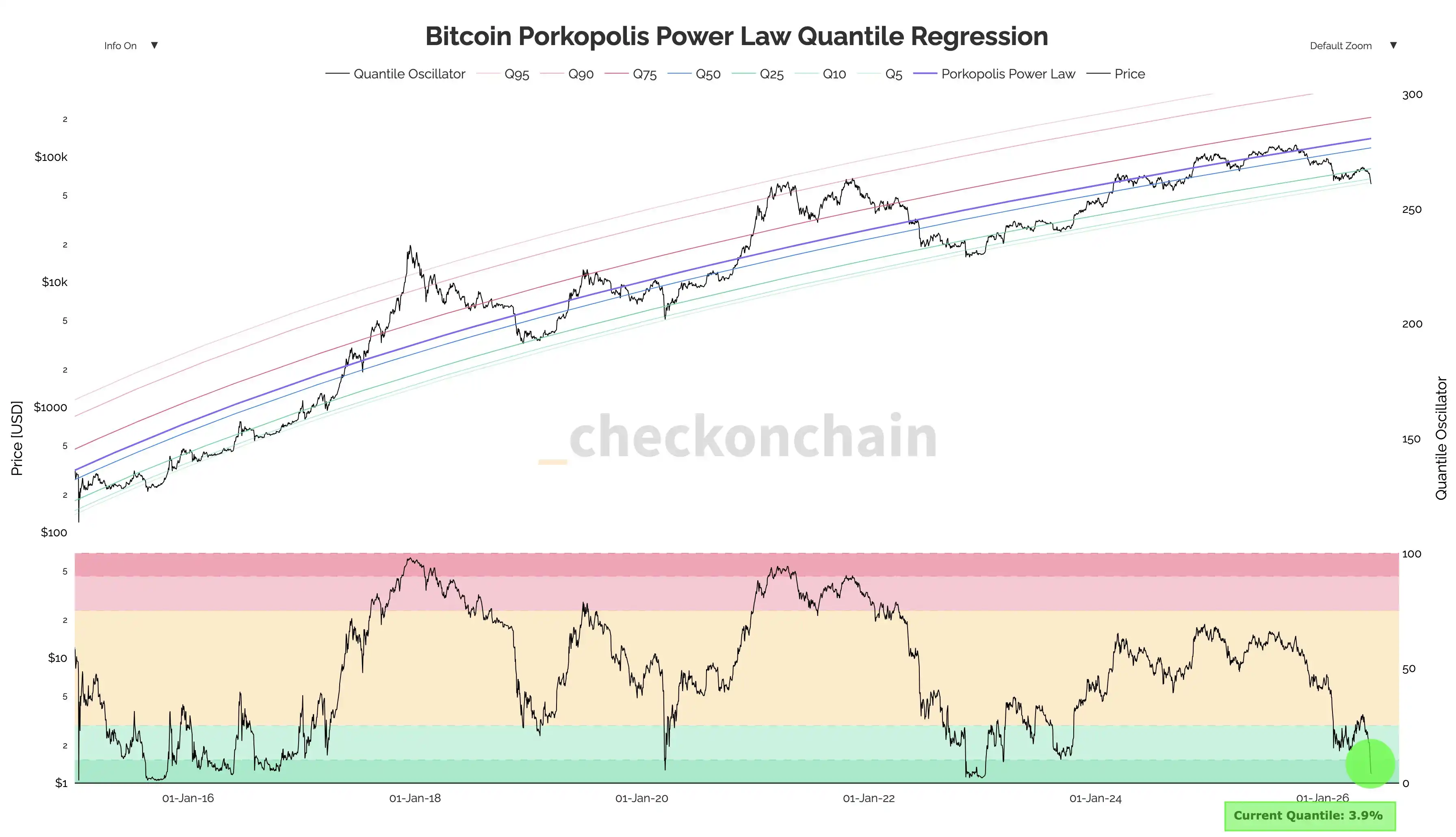
According to analyst Darkfost's data, Bitcoin has retested and broken below the 4th percentile line of the Power Law model, entering an extreme undervaluation zone. Historically, it has spent only 4% of the time at such valuation levels. Darkfost emphasized that this is a suitable period for long-term accumulation, not a short-term price prediction.


Polymarket Data: 72% Chance BTC Falls Below $55k


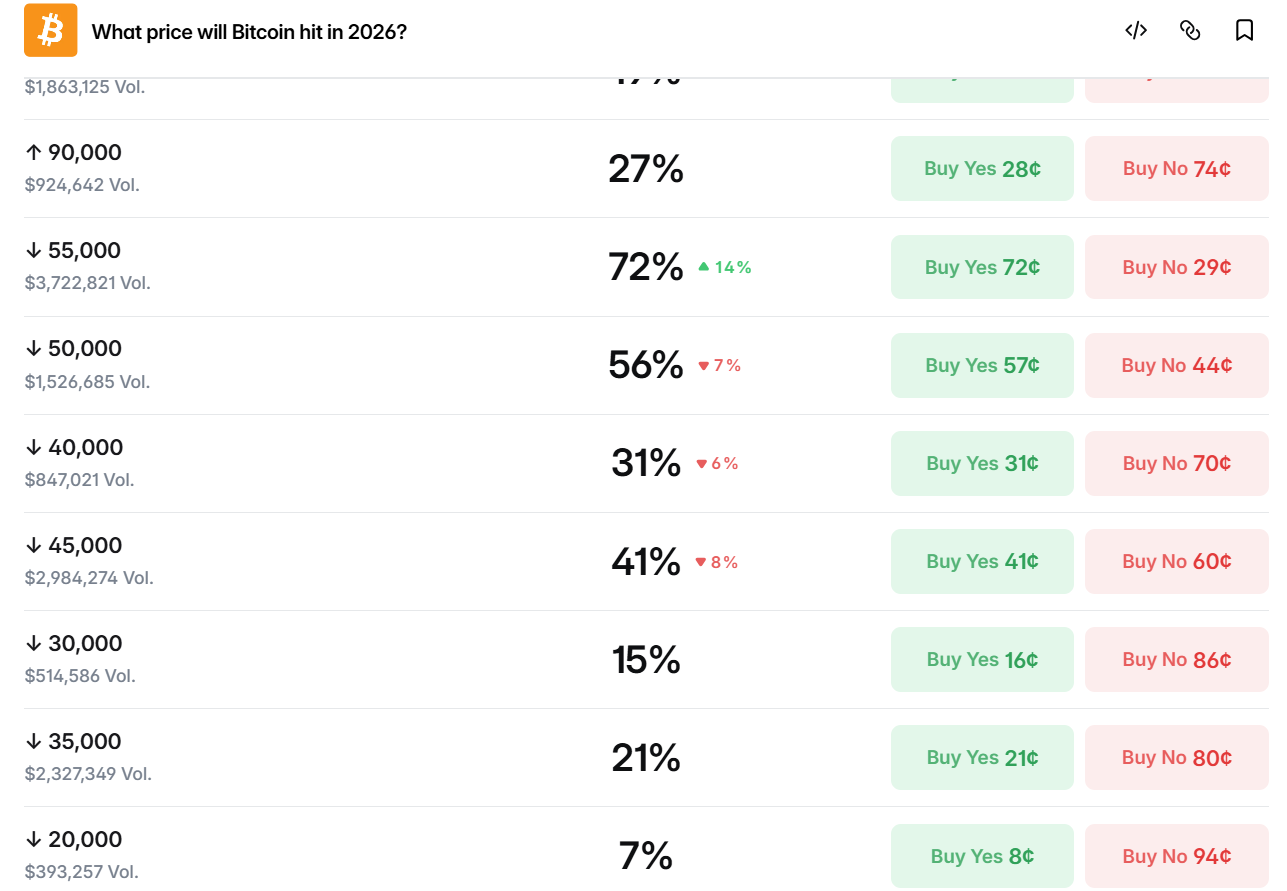
Latest data on Polymarket shows the probability of BTC falling below $45k is 41%, below $50k is 56%, and below $55k is 72%. The probability of falling below $40k is 31%, and below $35k is only 21%.


Most market participants currently believe the probability of BTC falling to the $35k – $40k range is not high.


Related Questions

QAccording to the article, what is Rafael from Glassnode's forecast for the potential bottom range of Bitcoin, and why?

ARafael forecasts a higher probability bottom range of $46,000 to $54,000 for Bitcoin. He bases this on long-term valuation models like the Realized Price (around $54,000) and the CVDD (around $46,200), which have historically been accurate bottom anchors. An extreme panic scenario could see a deeper correction to the $35,000-$40,000 range.

QWhat key factor does NYDIG's Greg Cipolaro identify as drawing capital away from the crypto market and contributing to the downturn?

AGreg Cipolaro identifies the outperformance of AI-related stocks as a key factor. He states that both AI and crypto attract investors seeking exposure to emerging tech and alpha. As AI stocks continue to outperform, capital is rotating out of the crypto market into this sector.

QWhat event does Geoffrey Kendrick from Standard Chartered cite as a major trigger for the recent Bitcoin sell-off, and what potential positive signal does he see?

AGeoffrey Kendrick cites the sale of 32,000 BTC by Mt. Gox (referred to as 'Strategy' in the article) as a major trigger for the sell-off. He sees a potential positive signal if Mt. Gox trustees initiate large-scale buybacks, which could indicate the market bottom is forming.

QHow does the trader Eugene Ng Ah Sio's current view and strategy regarding the crypto market differ from the 'buy the dip' sentiment?

ATrader Eugene Ng Ah Sio has largely exited the crypto market since mid-May, shifting his focus to the stock market. He finds more research depth and opportunity there. He does not plan to re-enter crypto unless a highly attractive risk-reward opportunity appears, which he hasn't seen, and is no longer attempting to catch a falling knife (buy the dip).

QWhat does the Polymarket prediction data, as mentioned in the article, suggest about market expectations for Bitcoin's price floor?

APolymarket data suggests most market participants do not expect a catastrophic crash to the lowest historical levels. It shows a 72% probability of BTC falling below $55,000, but only a 21% probability of it falling below $35,000. This indicates the market consensus sees a higher probability floor above the $35,000-$40,000 extreme panic zone.

Related Reads

Different Choices After the Plunge: Institutions Buy the Dip, Traders Shift to US Stocks

Title: Diverging Strategies After the Crash: Institutions Buying the Dip, Traders Shifting to US Stocks Following a sharp decline where Bitcoin briefly fell below $60,000 on June 6th, market sentiment remains "extreme fear" despite a partial recovery. This has led to varied responses from major market participants. Several institutional figures and analysts present a cautiously optimistic long-term view for Bitcoin. Glassnode's co-founder identifies $46k-$54k as a probable key bottom range based on historical on-chain models, while a Standard Chartered executive suggests the bottom is nearly formed. Strive's CEO points to Bitcoin touching its 200-week moving average as a historically reliable buy signal. Analysts highlight metrics like MVRV ratio and the "Power Law" model indicating Bitcoin is in an extremely undervalued zone. Conversely, some traders are exiting the crypto space. One trader cited a more attractive risk/reward profile and deeper research opportunities in US stocks, particularly with AI-related equities outperforming and capital rotating away from crypto. This shift is partly attributed to perceived ongoing risks, including those related to Strategy's Bitcoin sales. Market prediction data suggests a high probability (72%) of Bitcoin falling below $55,000, but lower odds for a deeper crash below $35k-$40k. The overall picture is one of division: institutions and long-term analysts see a accumulating opportunity, while some active traders are seeking alpha elsewhere amidst the volatility and shifting capital flows.

marsbit20m ago

Different Choices After the Plunge: Institutions Buy the Dip, Traders Shift to US Stocks

marsbit20m ago

Tech Stocks in the Midst of Deleveraging: Rather Than Rushing to Buy the Dip, Wait for the Macro Environment to Stabilize First

"Technology Stocks in Deleveraging Phase: Wait for Macro Stability Before Buying the Dip" The current sell-off in tech/AI stocks is primarily driven by macro headwinds, not a breakdown in AI fundamentals. After a parabolic rise, the market faced a perfect storm: an overcrowded trade, a massive SpaceX IPO draining liquidity, pre-CPI/PPI/FOMC hedging, and strong jobs data renewing "higher-for-longer" rate fears. This triggered a concentrated deleveraging in hot tech names. Key historical context: Unlike the December 2023 sell-off focused on AI capex returns, the current correction centers on the "denominator" – rising concerns over rates, inflation, the Fed, geopolitics, and liquidity. Leading memory stocks like Micron have seen ~20% pullbacks, significant but not yet at panic levels seen in March. The intense selling wave may be largely over, but a quick V-shaped recovery is unlikely. The market will likely churn in high volatility, awaiting clarity. The immediate catalyst needed for a sustainable reversal is a "stop-bleeding" signal from macro conditions. This doesn't require a major positive shock (like the April Iran ceasefire), but simply a halt to further deterioration: CPI not surprising hotter, Treasury yields stabilizing, the Fed not turning more hawkish, and post-SpaceX IPO liquidity easing. Once macro pressure plateaus, the intact AI investment thesis – centered on persistent compute/memory shortages and accelerating commercialization – can quickly regain market focus. The strategy is clear: prioritize monitoring macro stabilization over rushing to bottom-fish individual AI stories. Patience is key.

marsbit27m ago

Tech Stocks in the Midst of Deleveraging: Rather Than Rushing to Buy the Dip, Wait for the Macro Environment to Stabilize First

marsbit27m ago

South Korean Stocks Plunge, Global Funds Liquidate: Has the Semiconductor Fundamentals Really Changed?

South Korean stocks experienced their sharpest decline of the year, with the KOSPI index plunging nearly 9% on Monday, triggering a market circuit breaker. Leading semiconductor firms Samsung Electronics and SK Hynix were heavily sold off, raising questions about whether the AI-driven bull market has reached an inflection point. This sell-off was largely triggered by a significant drop in the U.S. semiconductor sector late last week. Concurrently, NVIDIA CEO Jensen Huang visited Seoul over the weekend, meeting with top executives from SK Group, Samsung, LG, and NAVER. He announced a new multi-year partnership with SK Hynix to co-develop next-generation memory products for AI data centers. Huang emphasized that AI infrastructure build-out remains in its early stages, creating a stark contrast between market panic and ongoing, strengthened industry collaboration. The article argues that South Korea has become one of the most sensitive markets for global AI-related capital flows, functioning like a large AI memory ETF due to the heavy weighting of its chipmakers. The current market turmoil reflects a shift in investor focus: from simply betting on overall AI growth to scrutinizing which companies will actually capture the profits from that growth. This "profit pool reassessment" phase is causing high volatility based on supply chain news and earnings guidance. Ultimately, the direction of the Korean market will be determined by external factors—NVIDIA's orders, HBM supply-demand dynamics, and capital expenditures from cloud service providers—rather than domestic conditions. The disconnect between sharp price corrections and continued strong signals from the industry core leaves the market at a crossroads, awaiting clearer data on the durability of AI infrastructure demand.

marsbit1h ago

South Korean Stocks Plunge, Global Funds Liquidate: Has the Semiconductor Fundamentals Really Changed?

marsbit1h ago

Trump in Talks with AI Companies Over Profit Sharing, A Narrative Pressure of Industrial Revolution Scale Begins

In recent AI market discussions, a new dimension beyond growth and profits has emerged: the question of how the immense wealth potentially generated by AI should be shared with the wider public. Triggered by reports of White House officials discussing "voluntary equity transfers" with top AI firms, similar to models like Alaska's Permanent Fund, the conversation focuses on public wealth funds. OpenAI's own whitepaper proposes such funds, allowing households without direct tech stock ownership to benefit from AI gains. More radical proposals, like Bernie Sanders' call for high public equity stakes and board seats, represent an extreme end of the spectrum. Currently, these are early-stage policy probes, not enacted laws. OpenAI's initiative is seen as an attempt to secure "social license" for its future expansion, mitigating risks of public backlash, stricter regulation, or anti-trust actions as AI's economic impact grows. The core market implication is the introduction of a "policy discount" to AI valuations, particularly for private model companies like OpenAI, Anthropic, and xAI. Investors must now consider not just future earnings but also what portion might be allocated to public mechanisms. The impact varies greatly based on the mechanism. A small, voluntary transfer of non-voting economic rights (e.g., 5%) acts as a quantifiable long-term cost. Government acquisition of economic rights via warrants tied to support differs from direct equity with governance power. The most disruptive scenario would be forced high-percentage public ownership affecting control and innovation incentives. Key signals to watch include whether other AI companies follow suit, if the White House formalizes proposals, related disclosures in future IPO documents, and any market price reactions. For now, this represents a shift from pricing pure AI growth to pricing its potential distribution. A manageable, voluntary economic share is akin to an insurance cost for societal acceptance, while a forced shift toward control and governance would fundamentally alter valuation logic.

marsbit1h ago

Trump in Talks with AI Companies Over Profit Sharing, A Narrative Pressure of Industrial Revolution Scale Begins

marsbit1h ago

From Record Highs to a Two-Week Low: Why Did AI Concept Stocks Suddenly Pull Back?

From Record Highs to Two-Week Lows: Why Did AI Stocks Suddenly Pull Back? U.S. stock indices, led by the tech-heavy Nasdaq 100, fell sharply to two-week lows. This marked a reversal from earlier in the week when AI infrastructure and semiconductor stocks had propelled major indices to record highs. Investors are rotating out of these previously high-flying tech sectors into other areas. The sell-off was driven by profit-taking and concerns that the AI rally had become overextended, exacerbated by chipmaker Broadcom's sales outlook falling short of lofty market expectations. The decline accelerated following a stronger-than-expected U.S. May nonfarm payrolls report, which showed 172,000 jobs added versus an estimated 88,000. This data sparked a jump in bond yields, with the 10-year Treasury yield rising to 4.553%, as it reinforced market speculation that the Federal Reserve's next move could be a rate hike rather than a cut. Globally, equities also declined, with European and Asian markets falling. Within the U.S. market, chip and AI-related stocks like Super Micro Computer and Arm Holdings led the losses, dropping over 7%. Cryptocurrency-linked stocks and mining shares also fell sharply amid drops in Bitcoin and commodity prices. While the overall Q1 earnings season remained solid, with 83% of S&P 500 companies beating estimates, the weakness was concentrated in tech. Excluding the tech sector, Q1 earnings growth was around 3%, the weakest in two years.

marsbit1h ago

From Record Highs to a Two-Week Low: Why Did AI Concept Stocks Suddenly Pull Back?

marsbit1h ago

Trading

Spot
Futures

Hot Articles

What is $BITCOIN

DIGITAL GOLD ($BITCOIN): A Comprehensive Analysis Introduction to DIGITAL GOLD ($BITCOIN) DIGITAL GOLD ($BITCOIN) is a blockchain-based project operating on the Solana network, which aims to combine the characteristics of traditional precious metals with the innovation of decentralized technologies. While it shares a name with Bitcoin, often referred to as “digital gold” due to its perception as a store of value, DIGITAL GOLD is a separate token designed to create a unique ecosystem within the Web3 landscape. Its goal is to position itself as a viable alternative digital asset, although specifics regarding its applications and functionalities are still developing. What is DIGITAL GOLD ($BITCOIN)? DIGITAL GOLD ($BITCOIN) is a cryptocurrency token explicitly designed for use on the Solana blockchain. In contrast to Bitcoin, which provides a widely recognized value storage role, this token appears to focus on broader applications and characteristics. Notable aspects include: Blockchain Infrastructure: The token is built on the Solana blockchain, known for its capacity to handle high-speed and low-cost transactions. Supply Dynamics: DIGITAL GOLD has a maximum supply capped at 100 quadrillion tokens (100P $BITCOIN), although details regarding its circulating supply are currently undisclosed. Utility: While precise functionalities are not explicitly outlined, there are indications that the token could be utilized for various applications, potentially involving decentralized applications (dApps) or asset tokenization strategies. Who is the Creator of DIGITAL GOLD ($BITCOIN)? At present, the identity of the creators and development team behind DIGITAL GOLD ($BITCOIN) remains unknown. This situation is typical among many innovative projects within the blockchain space, particularly those aligning with decentralized finance and meme coin phenomena. While such anonymity may foster a community-driven culture, it intensifies concerns about governance and accountability. Who are the Investors of DIGITAL GOLD ($BITCOIN)? The available information indicates that DIGITAL GOLD ($BITCOIN) does not have any known institutional backers or prominent venture capital investments. The project seems to operate on a peer-to-peer model focused on community support and adoption rather than traditional funding routes. Its activity and liquidity are primarily situated on decentralized exchanges (DEXs), such as PumpSwap, rather than established centralized trading platforms, further highlighting its grassroots approach. How DIGITAL GOLD ($BITCOIN) Works The operational mechanics of DIGITAL GOLD ($BITCOIN) can be elaborated on based on its blockchain design and network attributes: Consensus Mechanism: By leveraging Solana’s unique proof-of-history (PoH) combined with a proof-of-stake (PoS) model, the project ensures efficient transaction validation contributing to the network's high performance. Tokenomics: While specific deflationary mechanisms have not been extensively detailed, the vast maximum token supply implies that it may cater to microtransactions or niche use cases that are still to be defined. Interoperability: There exists the potential for integration with Solana’s broader ecosystem, including various decentralized finance (DeFi) platforms. However, the details regarding specific integrations remain unspecified. Timeline of Key Events Here is a timeline that highlights significant milestones concerning DIGITAL GOLD ($BITCOIN): 2023: The initial deployment of the token occurs on the Solana blockchain, marked by its contract address. 2024: DIGITAL GOLD gains visibility as it becomes available for trading on decentralized exchanges like PumpSwap, allowing users to trade it against SOL. 2025: The project witnesses sporadic trading activity and potential interest in community-led engagements, although no noteworthy partnerships or technical advancements have been documented as of yet. Critical Analysis Strengths Scalability: The underlying Solana infrastructure supports high transaction volumes, which could enhance the utility of $BITCOIN in various transaction scenarios. Accessibility: The potential low trading price per token could attract retail investors, facilitating wider participation due to fractional ownership opportunities. Risks Lack of Transparency: The absence of publicly known backers, developers, or an audit process may yield skepticism regarding the project's sustainability and trustworthiness. Market Volatility: The trading activity is heavily reliant on speculative behavior, which can result in significant price volatility and uncertainty for investors. Conclusion DIGITAL GOLD ($BITCOIN) emerges as an intriguing yet ambiguous project within the rapidly evolving Solana ecosystem. While it attempts to leverage the “digital gold” narrative, its departure from Bitcoin's established role as a store of value underscores the need for a clearer differentiation of its intended utility and governance structure. Future acceptance and adoption will likely depend on addressing the current opacity and defining its operational and economic strategies more explicitly. Note: This report encompasses synthesised information available as of October 2023, and developments may have transpired beyond the research period.

363 Total ViewsPublished 2025.05.13Updated 2025.05.13

What is $BITCOIN

Discussions

Welcome to the HTX Community. Here, you can stay informed about the latest platform developments and gain access to professional market insights. Users' opinions on the price of BTC (BTC) are presented below.

活动图片