More Popular Than SpaceX, Oversubscribed by Over 6586 Times, What's the Meme Power Behind Liuliumei (06658.HK)?

Odaily星球日报Published on 2026-06-15Last updated on 2026-06-15

Abstract

Titled "More Popular than SpaceX, Over 6586 Times Oversubscribed: What's the Meme Power Behind Liuliumei (06658.HK)?", this article discusses the phenomenon of "stock memefication" through the case of Liuliumei's IPO. The Chinese snack company saw its stock price surge over 190% on its Hong Kong debut, fueled not by fundamentals but largely by a viral meme. Its stock ticker abbreviation "06658.HK" was humorously linked to "LLM" (Large Language Model), coinciding with a rally in AI-related stocks like Zhipu AI. This mirrors a broader trend where stocks gain traction based on internet jokes,谐音梗 (homophonic puns), celebrity mentions, or cultural moments—similar to meme coins in crypto. Examples include Gamestop's 2021 short squeeze, Trump-related stock movements ("川大智胜"), and "孚日股份" (interpreted as "capture Japan"). The article argues global markets are entering an era where attention and social media narratives can drive significant capital flows, blurring lines between traditional finance and meme culture. While offering quick gains, this trend also carries risks like pump-and-dump schemes. Liuliumei's explosive IPO, surpassing even蜜雪冰城's subscription record, exemplifies how meme-driven attention is being converted into market volatility and liquidity in today's fragmented, emotion-driven investment landscape.

Original|Odaily Planet Daily(@OdailyChina)

Author|Wenser(@wenser2010 )

"Are you okay? Okay? Okay? Then eat some Liuliumei!"

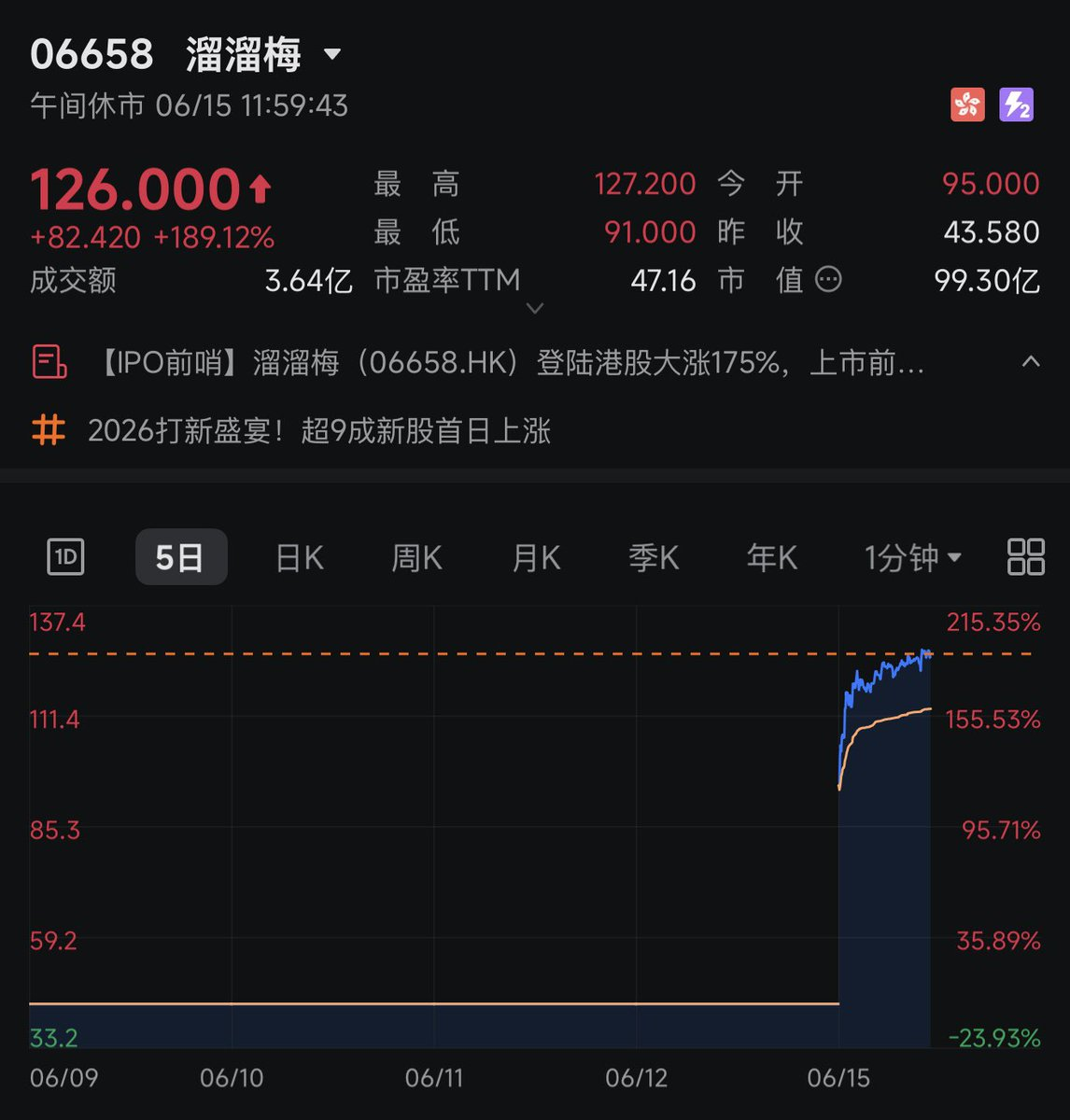
Once upon a time, a brainwashing commercial line from actress Yang Mi brought Liuliumei into thousands of households. Today, after decades of accumulation, the company behind it finally officially listed on the Hong Kong Stock Exchange, becoming the "first stock of plum snacks" on HKEx. It is reported that its issue price was HKD 43.58, the opening price was HKD 95, a surge of approximately 116% from the offering price of HKD 42; the intraday high reached HKD 127.50, an increase of over 190%; it has now pulled back to HKD 125, still up over 186%.

But contrary to many expectations, the stock price surge of Liuliumei (06658.HK) is not a revival of the concepts of "new consumption, new retail, new snacks." Instead, its name initials coincidentally align with the hot topic of "LLM" (Large Language Model), riding on the wave of today's 45% surge in Zhipu AI (02513.HK).

Many call it an "authentic AI Large Language Model stock," attracting countless hot money and capital inflows. Whether acknowledged or not, global stock markets may be entering the "Stock Meme-ification Era."

The New Era of Global Stock Markets: When Stocks Collide with Memes

First, the basics of Liuliumei's IPO: This was Liuliumei's fourth attempt at a capital market listing.

In 2019, its attempt to list on the A-share market failed; in 2025, its two applications to list on HKEx lapsed; it wasn't until May 21 this year, after updating its listing application materials for the third time and changing its main entity name from "Liuliumei Group Co., Ltd." to "Liuliumei Co., Ltd.," that it successfully listed in less than a month. It must be said, sometimes naming can be a mysterious thing.

According to the company's allocation results announcement, the public offering portion of this IPO recorded an oversubscription of approximately 6586.73 times. The final number of shares offered publicly was 1.1465 million, accounting for approximately 10% of the total global offering. There were approximately 180,500 valid applications received, with about 11,465 applications accepted. The ratio of allotment for one lot application was only 1.5%, meaning the one-lot winning rate was as low as 1.5%, indicating extremely fierce competition for subscription. Regarding the international placement, Liuliumei received a subscription of 2.64 times. The final number of international offering shares was 10.3176 million, accounting for 90% of the total offering shares. Comparing this data, the popularity of Liuliumei's IPO has surpassed that of "the first stock of milk tea stores by outlet number" Mixue Ice City, which listed on HKEx in March last year with a public offering oversubscription multiple of 5258.21 times.

In other words, institutions were not optimistic but held 90% of the shares; retail investors were optimistic but only held 10% of the shares. The main driving force behind the opening surge came more from the free market play of "retail investors and market makers dancing together." And this is precisely the power of "Meme stocks"—transforming the attention attracted by memes into buying power in the capital market.

Some netizens even compared Liuliumei's opening performance to SpaceX, finding its market gains far more dazzling.
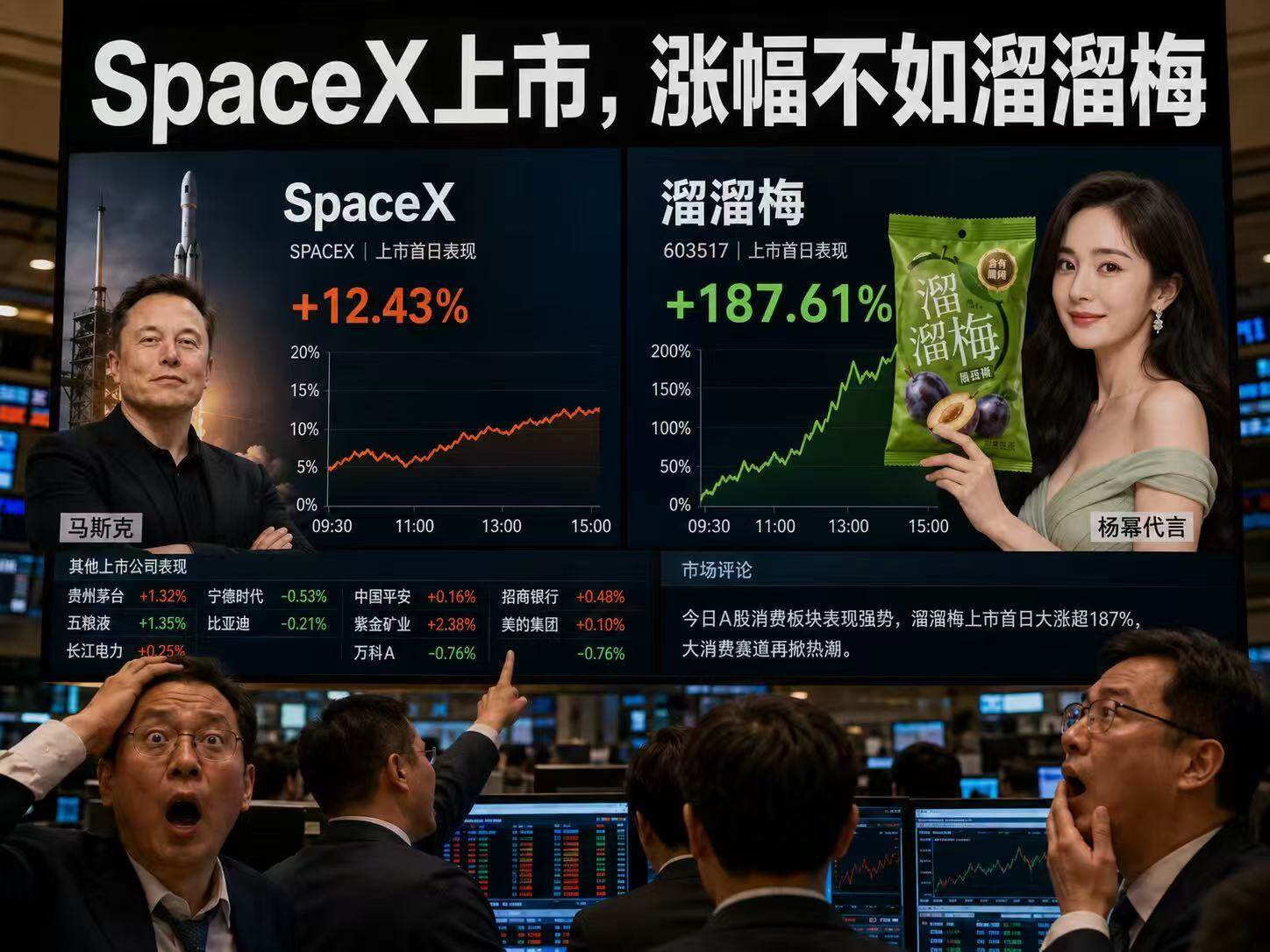
It is worth mentioning that "Meme stocks" is not a new term that recently appeared; they are an objectively existing category of stocks in major capital markets like the US, Hong Kong, and A-shares. However, the "Stock Meme-ification Era" is undoubtedly the latest trend emerging in the past 1-2 years, and its driving factors are also somewhat related to the crypto market.

The earliest Meme stocks are untraceable, so we'll only discuss some representative individual stock targets in recent years.

2021's Gamestop might be the starting point of Meme stock enlightenment for many in the US market. Led by well-known retail investors like Roaring Kitty, global retail investors united against Wall Street institutional capital, forcing a short squeeze that led many brokerage platforms and exchanges to "pull the plug" to avoid the storm. Recently, rumors of Gamestop acquiring eBay also caused market fluctuations and a temporary surge in its stock price.

Tesla and the recently IPO'd SpaceX have also been viewed as a type of Meme stock because both companies and stocks are strongly associated and deeply bound with the highly topical "world's first trillionaire" Elon Musk. Before the companies' businesses provided strong performance proof, they were considered "narrative-driven companies with sky-high dream valuations."

Before Donald Trump won the US presidential election in 2024, the A-share market had already started moving. "Chuanda Zhisheng" frequently topped platform trending lists and even experienced multiple limit-up days. That year, during Trump's campaign, an assassination attempt left his ear scratched by flying glass from a bullet. Stock "Goertek" (homophone for "cut ear") was also affected and saw a surge during trading.

Last year, when Sino-Japanese diplomatic relations deteriorated, the defense stock "Furi Shares" experienced a dramatic stock price surge due to the patriotic homophone pun "capturing Japan" (孚日 sounds like 'capture Japan'), pulling up for eight consecutive trading days, with cumulative gains exceeding 100%, becoming one of the short-term "monster stocks" in the A-share market.

In today's capital markets, similar to the crypto market with its fragmented attention and concentrated emotions, individual stock targets and sector themes that can spark the widest discussion and attention have become "attention foci" that stir up funds and liquidity.
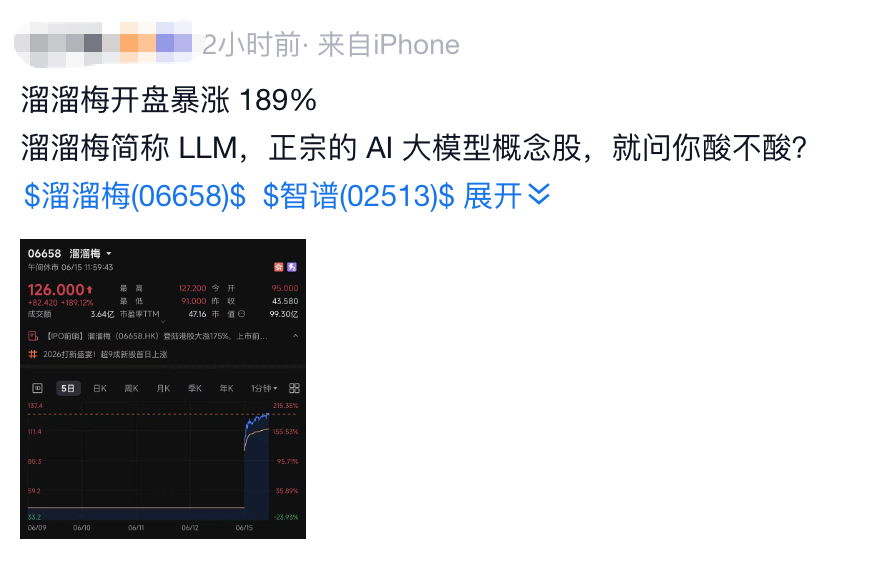
Liuliumei's surge is also a prime example of the "Stock Meme-ification" era.

The Stock Meme-ification Era Begins: Homophone Puns, Abbreviations, AI Era Dividends

As the valuations of OpenAI and Anthropic rise close to the trillion-dollar scale, companies and stocks related to the AI industry chain—such as optics, communications, materials, and computing power—have successively entered an explosive growth period:

  • NVIDIA became the first listed company with a market cap exceeding $5 trillion;
  • Micron, SanDisk, etc., saw their stock prices break new highs consecutively, with institutions raising their bullish price targets;
  • The stock price fluctuations of SK Hynix and Samsung Electronics dictate the rises and falls of South Korea's KOSPI index;
  • A single statement from Nvidia's founder about "seeing Marvell as a future trillion-dollar giant" caused Marvell (MRVL) stock to rise accordingly;
  • Innolight (Zhongji Xuchuang) mentioned by the new stock god Serenity was misread due to translation issues as "Inno Laser," causing the latter's stock price to surge 10% due to an influx of 300 million hot money.

In the great tide of the "Stock Meme-ification" era, being associated with AI,蹭上 (catching the heat) of "large language models," having homophones with popular targets, or receiving mentions from celebrities have all become reasons for market attention and the best stage for the simultaneous influx of attention and capital.
"Trump concept stocks," "US stock government concept stocks," "TACO-style trading beneficiary targets," etc., are also manifestations of this industry trend. This is precisely the common play in the "attention-intensive industry" highly advocated by the crypto market—the Meme coin sector.

However, the capital markets are different now, the market rules are different, and the scale of funds and liquidity is also incomparable to the crypto market. After all, compared to the trading scale of the US, Hong Kong, A-share, and Japan/South Korea stock markets, the crypto market's total size of less than $3 trillion looks somewhat pitiful.

SpaceX, upon listing, immediately jumped into the top 10 of global major asset rankings. In contrast, BTC has fallen to the 17th position on that list. It must be said, numerical comparisons always look this cruel—over a decade of diligent development in the crypto industry is worth less than the market cap of one company's IPO.

Now, the emergence and increase of Meme stocks may have become an industry trend. The earlier incident where Joyoung Company produced corresponding products and saw its stock price rise due to the viral meme "North-South Mung Beans Hachimi" already illustrates one thing: for the younger generation and investor groups in today's society, investment targets that can trigger emotional fluctuations, attract market attention, and stir liquidity are more worthy of buying.

Even if this fleeting chasing sentiment is just a momentary frenzy, for most people, if you can't beat them, join them is the better choice. Of course, objectively speaking, the emergence of Meme stocks does not mean one-sided benefits, such as wealth creation effects or industry booms. Sometimes, this process is accompanied by negative phenomena like pump-and-dump schemes, one-sided harvesting, and emotional marketing.

Just like Liuliumei's opening surge, some angrily criticize it as a "pump to dump" scheme; others analyze that perhaps it's because Liuliumei joined the "Stock Connect" program, allowing A-share market funds to buy in, that pushed its stock price up. The truth and reasons are certainly multidimensional and chaotic. For us, perhaps all we can do is go with the flow of this era and find our own path to prosperity.


Trending Cryptos

Related Questions

QAccording to the article, what is the main reason behind the surge in Liuliumei's stock price on its IPO day?

AThe main reason is that its stock ticker abbreviation 'LLM' coincidentally matches the acronym for 'Large Language Model', allowing it to ride the hype of the AI and LLM trend, making it a so-called 'Meme stock'.

QHow does the article describe the level of oversubscription for Liuliumei's IPO public offering?

AThe article states that the IPO's public offering portion was oversubscribed by approximately 6586.73 times, indicating extremely high retail investor demand.

QWhat comparison does the article make to illustrate the concept of 'Meme stocks' besides Liuliumei?

AThe article mentions several examples: GameStop in 2021, Tesla and SpaceX associated with Elon Musk, '川大智胜' and '歌尔股份' in the A-share market related to Donald Trump events, and '孚日股份' due to a patriotic homophonic pun.

QWhat is the article's view on the relationship between the rise of 'Meme stocks' and the cryptocurrency market?

AThe article suggests that the trend of 'stock Meme-ization' is partly influenced by the cryptocurrency market, which pioneered the 'attention-intensive' model of meme coins. However, it notes that traditional stock markets have vastly larger capital scales than the crypto market.

QWhat potential risks or negative aspects does the article associate with the 'Meme stock' phenomenon?

AThe article points out that the Meme stock trend is not without downsides. It can be accompanied by negative phenomena such as 'pump and dump' schemes, one-sided harvesting of retail investors, and emotional marketing, rather than representing genuine value creation or industry growth.

Related Reads

My Coding Betting Dashboard is Profiting, but Polymarket is Truly Not a Good Place for 'Arbitrage'

The author built a custom monitoring dashboard for Polymarket, a prediction market platform, and tested it with $1,600, achieving over 30% returns. However, the core argument is that Polymarket is not a good venue for traditional arbitrage. The dashboard has two main sections: a "Portfolio Dashboard" for tracking active positions with key metrics like total capital, P&L, and a risk-control module using a tier system (T1, T2, T3), and an "Opportunity Watchlist" for monitoring markets. The article details a critical structural trap in binary markets: a bet with a high perceived probability of success still carries a 100% loss risk if wrong. The author's T1/T2/T3 system is designed to manage this by limiting position sizes based on conviction and time horizon, emphasizing that high confidence should not equal high concentration. A key insight is the danger of "pseudo-diversification"—betting on different markets driven by the same underlying variable. The author concludes that Polymarket offers few true low-risk, arbitrage opportunities. It is instead a high-risk environment where wins can create a false sense of mastery, leading to large losses. The platform is better viewed as a training ground for honing judgment through disciplined, framework-driven betting rather than a reliable income source. The tools help transform intuition into structured, rule-based decisions to mitigate the risk of catastrophic errors.

marsbit2h ago

My Coding Betting Dashboard is Profiting, but Polymarket is Truly Not a Good Place for 'Arbitrage'

marsbit2h ago

WeChat AI Card Hands-On Guide: Has the AI Shopping Era Arrived?

**"WeChat AI Card" Practical Test Guide: Has the Era of AI Shopping Arrived?** WeChat has officially launched the "AI Exclusive Card," a feature integrated into its Workbuddy AI assistant. This card is designed to handle payments for AI-initiated purchases. Our hands-on test reveals it's not yet a tool for fully autonomous AI shopping, but rather a controlled payment layer for AI agents. The AI Card functions as an isolated sub-wallet within WeChat Pay. Users must bind the card and transfer funds into it from their main wallet. Crucially, every transaction requires explicit user confirmation via smartphone scan; AI cannot spend autonomously. Currently accessible through the Workbuddy agent, the card targets specific digital consumption scenarios: purchasing paid content (reports, data), calling paid APIs/tools, and subscribing to services. Its design prioritizes security and control by separating funds and mandating approval for each payment. We tested a real-world scenario: ordering bubble tea via Workbuddy using a "Meituan Life Assistant" skill. The process encountered multiple hurdles: high "skill" usage costs (exceeding daily free credits), and most importantly, while a payment was successfully initiated, the AI purchased an incorrect product (a mismatched group-buy coupon instead of the desired drink). This highlights the current limitation: the **AI Card only solves the payment step**. The broader challenge lies in the **AI agent's execution chain**—accurately understanding intent, navigating third-party platforms, selecting the right product, and ensuring proper fulfillment. The payment succeeded, but the purchase failed to meet the user's need. In conclusion, the WeChat AI Exclusive Card is a cautious, early-step experiment in AI commerce. It provides a secure, user-controlled payment method for agent interactions but is not yet capable of reliable, end-to-end complex purchases. For now, it's best used for low-value, low-risk digital services with careful user verification at each step. The vision of AI handling complete shopping tasks remains a work in progress.

marsbit5h ago

WeChat AI Card Hands-On Guide: Has the AI Shopping Era Arrived?

marsbit5h ago

Deconstructing Notion's Growth: From a Note-taking Tool to 100 Million Users—How Notion Built a Triple Growth Flywheel Through Product, Templates, and Community

Notion's growth from a niche note-taking tool to a platform with 100 million users is powered by three interconnected flywheels: Product-Led Growth (PLG), a Template Economy, and Community-Driven Growth. First, Notion's PLG strategy relies on a highly flexible, "plastic" product that users can adapt to countless personal and team workflows. Its freemium model lowers the barrier to entry, while features like page sharing and collaboration drive organic, usage-based viral growth as users naturally invite others. Second, the Template Economy solves the "blank page" problem. Templates, created by both Notion and its community, transform abstract product capabilities into concrete, copyable solutions for specific scenarios (e.g., project management, content calendars). This dramatically lowers activation costs for new users and fuels SEO-driven discovery. Third, a vibrant Community acts as a distributed growth engine. Users and official Ambassadors create tutorials, share use cases, and host local events. This community not only educates users but also fosters a sense of identity around pursuing "better ways of working," strengthening loyalty and enabling global, low-cost expansion. Together, these flywheels create a self-reinforcing ecosystem: a great product attracts users who create templates and community content, which in turn attracts more users and deepens engagement. This system allowed Notion to scale from individuals to teams and enterprises through a bottom-up adoption path. Looking ahead, AI integration promises to accelerate these flywheels further by making templates smarter and the platform a potential AI-native work operating system. Ultimately, Notion's defensible advantage is not just its features, but this deeply entrenched network of user assets, creators, and community trust.

marsbit5h ago

Deconstructing Notion's Growth: From a Note-taking Tool to 100 Million Users—How Notion Built a Triple Growth Flywheel Through Product, Templates, and Community

marsbit5h ago

$10 Billion, Qualcomm to Acquire Chip Legend Jim Keller's Company

Global mobile chip giant Qualcomm is in advanced talks to acquire AI chip startup Tenstorrent in a deal valued between $8-10 billion, according to media reports. This potential acquisition would be one of the largest in the AI chip sector in recent years. Tenstorrent, led by legendary chip architect Jim Keller, has gained prominence for its RISC-V architecture and AI accelerator designs. The move highlights Qualcomm's strategic push to diversify beyond its core smartphone chip business. As the smartphone market matures, Qualcomm is aggressively targeting growth in automotive, data center, and cloud AI. Acquiring Tenstorrent would allow Qualcomm to rapidly enter the high-end AI computing market, bypassing lengthy in-house development cycles. Tenstorrent's cost-effective system architecture, which avoids expensive HBM memory and relies on standard Ethernet for clustering, offers a potential alternative to Nvidia's costly solutions. Furthermore, Tenstorrent's high-performance RISC-V CPU technology and its focus on the automotive and edge computing segments align with Qualcomm's strategic goals, including its "Snapdragon Digital Chassis" platform. Despite the strategic rationale, the high valuation has sparked some investor caution. The successful integration of Tenstorrent's open-source culture and independent team into Qualcomm's organization, along with the commercialization of its technology, remains a key challenge.

marsbit6h ago

$10 Billion, Qualcomm to Acquire Chip Legend Jim Keller's Company

marsbit6h ago

Trading

Spot
Futures

Hot Articles

Discussions

Welcome to the HTX Community. Here, you can stay informed about the latest platform developments and gain access to professional market insights. Users' opinions on the price of MEME (MEME) are presented below.

活动图片