Ray Dalio: The Revival of a China-led 'Tribute System', and the AI Industry Will Develop Like the EV Industry

Odaily星球日报Published on 2026-06-08Last updated on 2026-06-08

Abstract

Ray Dalio, founder of Bridgewater Associates, discusses shifting global power dynamics and the AI competition between the U.S. and China. He argues U.S. credibility as a global power willing to fight for its interests is declining, while China is accumulating wealth and influence. Dalio observes a trend where world leaders visit China, which he compares to a modern "tribute system"—not oppressive, but a hierarchy where nations acknowledge China's strength, affecting trade and security. This shift creates market uncertainty, prompting investors to seek asset diversification, including gold. Regarding AI, Dalio contrasts the U.S. and Chinese approaches. U.S. companies like OpenAI focus on monetization and subscriptions for revenue. In contrast, China treats AI as a public utility, akin to electricity or water, aiming for widespread worker accessibility over immediate profitability. He draws a parallel to China's electric vehicle industry success, where companies like BYD achieved rapid market growth. Dalio and JPMorgan's Mary Callahan Erdoes note China lacks U.S.-style fear of AI displacing jobs; instead, it focuses on leveraging AI for development and dominance in next-generation industries like robotics.

Source:"Wall Street Week" Program: Dalio's Warning&Ray Dalio on China-U.S. AI Development

Compiled | Odaily Planet Daily (@OdailyChina)

Translator | Wenser (@wenser2010)
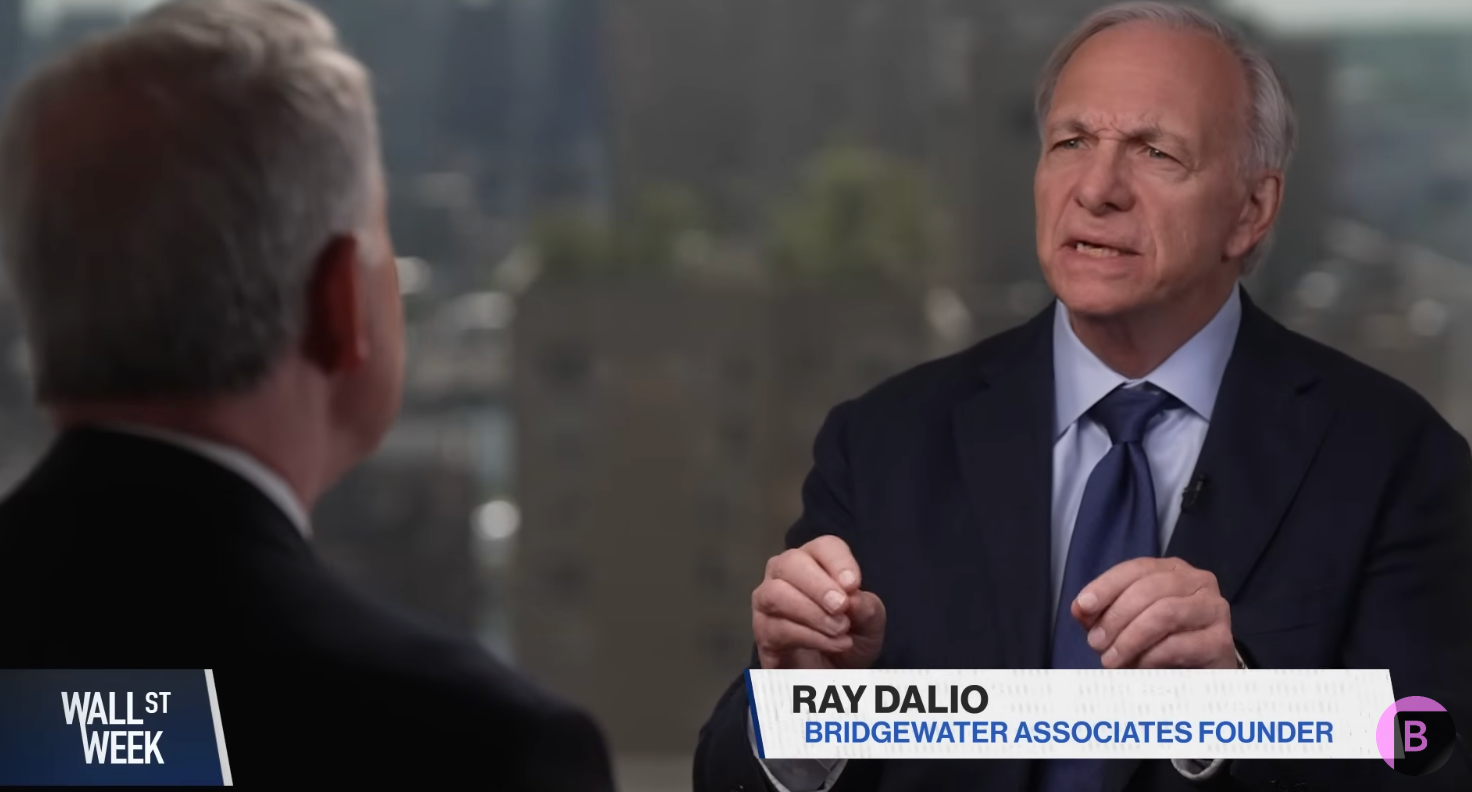
Editor's Note: As the founder of Bridgewater Associates, the world's largest hedge fund, Ray Dalio's remarks have always garnered significant attention from various sectors of society. His insights into the global macroeconomic landscape and different industries, in particular, are a frequent topic of discussion. Following the visits to China last month by leaders including US President Donald Trump and Russian President Vladimir Putin, Ray Dalio has put forward a new perspective – "The world structure is changing, a China-led tribute system is being established." Recently, regarding the "competition landscape between AI giants in China and the US," he has also offered his targeted views. The following content is compiled and translated by Odaily Planet Daily, with some details edited for brevity.

Ray Dalio on a "China-led World": The Reappearance of the Tribute System

Last month, after US President Donald Trump and Russian President Vladimir Putin visited China, Ray Dalio was interviewed by David Westin for Bloomberg's "Wall Street Week" program.

In the interview, Ray Dalio stated directly, "America's credibility as a global power willing to fight for its own interests is declining, while China is continually accumulating its own global wealth and world influence. This situation is fundamentally changing how other countries view these two nations."

"Currently, the United States has about 750 military bases in over 80 countries worldwide, and thus has long been seen as a trustworthy ally when facing (war) attacks." However, after concluding a roughly one-month trip to Asia (which included about 10 days of meetings with multiple leaders in China), Ray Dalio sensed an important shift: a growing number of countries are gradually coming to believe – "America cannot be counted on to win wars."

Dalio's remarks further elaborate on his long-held view: "America's strength is gradually waning, while China's strength is correspondingly increasing." Thanks to Bridgewater's significant engagement with China, this perspective has gained considerable acceptance. On the other hand, due to his relatively close relationship with Chinese leaders, these views have also drawn criticism.

Dalio then stated that international recognition is very important for China. Currently, China's economic scale is about 60% to 70% that of the United States, a proportion that has more than tripled over the past 20 years. He said that while China does not seek to conquer or occupy other countries, it places great emphasis on recognition from political leaders worldwide. "You can see leaders from many countries visiting China one after another, which is akin to the 'tribute system' in Chinese history – countries come to acknowledge and respect China's formidable strength, but this system is not an oppressive or controlling one." (Odaily Planet Daily Note: The original term used was 'tribute system')

"So, this tribute system is essentially a hierarchical structure. When dealing with other countries, what's important is how such a system affects trade and national security between the parties. I believe, from a political perspective, we are now entering a period where arrangements resembling a tribute system will form between (China and) various countries, and the relative strength between nations will become the determining factor (in the world's political landscape)." During the discussion, Ray Dalio also mentioned that concepts like the nation-state and borders only gradually emerged in Western societies around the mid-17th century. Before that, power structures in Western societies were constituted by different royal families, which is fundamentally different from the concept of frontiers consistently maintained throughout Chinese history.

He believes this change will directly impact (global capital and financial) markets. Because investors must navigate the current turbulent situation: currency values are at risk, and (global) uncertainty demands that investors maintain liquidity and diversify their asset allocations, including investments in gold.

Ray Dalio on the "Competition Landscape in AI Between China and the US": China's AI Industry Will Develop Like the EV Industry

In June, Business Insider reported Ray Dalio's views on the competition in the AI sector between China and the United States, similarly highlighting the vast differences and potential implications between the two.

Ray Dalio stated that China views artificial intelligence as an important tool that should be accessible to all workers. "It's like electricity and tap water, something everyone should have access to,"

As a prominent entrepreneur who first visited China as early as 1984, Ray Dalio has long been optimistic about China's development. He previously told attendees at a Forbes magazine conference in New York: "China has earned enormous profits through exports, and these funds are being widely utilized for research and development in the field of artificial intelligence, thereby driving economic growth through improved production efficiency."

It is worth noting that Ray Dalio emphasized that while American companies like OpenAI and Anthropic are adjusting (AI model) subscription package structures, striving to increase revenue in preparation for public listings, Chinese companies are committed to making their models accessible to as many ordinary employees as possible. "It doesn't necessarily have to be expensive, and it doesn't even necessarily have to be profitable (right now)."

"To some extent," Dalio believes, "it mimics the country's successful path in sectors like the electric vehicle industry – where domestic Chinese enterprises like BYD have achieved rapid growth in markets such as Europe."

In a guest discussion following Dalio's speech, JPMorgan Chase executive Mary Callahan Erdoes pointed out that unlike the social atmosphere in the US, where "employment issues are treated as political topics," executives of Chinese AI companies and political figures, when mentioning AI, show "no fear of AI displacing jobs." Instead, the country focuses more on "leveraging AI to drive various developments" and is committed to identifying the next industrial sector where it can achieve dominance. "The robotics sector can basically be seen as China's 'next-generation electric vehicle industry,'" she stated.


Related Questions

QWhat does Ray Dalio mean by the 'tribute system' returning under Chinese leadership?

ARay Dalio suggests that as China's global influence grows, many countries' leaders are visiting China to acknowledge and respect its power. He likens this dynamic to a historical 'tribute system,' where other states recognize a dominant power's strength. He clarifies this is not an oppressive or controlling system, but rather a hierarchical arrangement that influences trade and national security between nations.

QAccording to Ray Dalio, what is the primary difference between U.S. and Chinese AI companies' current goals?

ARay Dalio states that while U.S. AI companies like OpenAI and Anthropic are adjusting subscription models and focusing on increasing revenue for potential IPOs, Chinese AI companies are primarily focused on making their AI models accessible and affordable for as many ordinary workers as possible, even if they are not immediately profitable.

QHow does Ray Dalio compare the development of China's AI industry to its electric vehicle industry?

ARay Dalio draws a parallel by suggesting that China's approach to AI development is mimicking its successful path in the electric vehicle industry. Just as Chinese companies like BYD achieved rapid growth in markets like Europe, the focus in AI is on widespread adoption and technological advancement as a tool for national development, potentially leading to a similar dominant position in the global market.

QWhat key change in global perception does Ray Dalio identify after his recent travels in Asia?

ARay Dalio identifies a significant shift in perception among many countries: a growing belief that they 'cannot count on the U.S. to win a war.' He contrasts this with the past view of the U.S. as a trustworthy ally willing to fight for its interests, noting that this change is fundamental to how nations view both the U.S. and the rising power of China.

QWhat investment advice does Ray Dalio offer in light of the current global geopolitical shifts?

AIn response to the turbulent global situation marked by currency risks and uncertainty, Ray Dalio advises investors to maintain liquidity and diversify their asset allocations. He specifically mentions including investments in gold as part of this strategy to hedge against the prevailing risks.

Related Reads

The First Case on AI Agents: What Was Adjudicated?

"The First 'Agent' Ruling: What Was Decided?" On April 30, the Guangzhou Internet Court issued a ruling—China's first behavior preservation order in the intelligent agent (AI agent) field. The defendant, an open-source AI agent software, was ordered to stop downloads, cease actions that bypassed a platform's technical protection measures, and delete related tutorials and data. The core issue: the software used the operating system's "accessibility service" permissions to automate user interactions within other apps without those platforms' authorization. This mirrors a recent US case where Amazon sued Perplexity for similar reasons—bypassing Amazon's API to directly scrape and interact with its pages—and won a preliminary injunction. Both rulings establish a crucial legal boundary for the AI agent era: agents cannot operate unchecked. The article argues the fundamental legal principle emerging is one of **dual authorization**. An AI agent requires both **user consent** AND **platform consent** to operate legitimately within that platform's ecosystem. Bypassing platform rules through system-level permissions, even with user permission, undermines platform responsibilities for content moderation, data security, and user privacy, creating liability issues. The piece uses the evolution of "Doubao Phone" (an AI-integrated smartphone) as a case study. Its initial, aggressive version that bypassed platform controls faced roadblocks. Its upcoming 2.0 version is reportedly pivoting to negotiate API access and authorization deals with major platforms (like Alibaba's ecosystem), seen as a strategic adaptation to the new regulatory reality. A global trend is identified: the era of unregulated, "wild west" growth for AI agents is ending, replaced by a **compliance race**. This raises barriers to entry, as securing platform authorizations becomes a new cost. Open-source status is also not a legal shield if the code facilitates bypassing technical protections. In conclusion, these first rulings target not the largest, but the most **aggressive and representative** cases. By setting precedent with them, regulators are efficiently steering the entire industry towards a new, more regulated operating paradigm defined by dual authorization and platform cooperation.

marsbit4m ago

The First Case on AI Agents: What Was Adjudicated?

marsbit4m ago

Fired by Google Over a 14-Page Paper, Over 4,000 Rallied for Her. 6 Years Later: She Almost Predicted the Entire AI Era Back Then.

In late 2020, Google AI researcher Timnit Gebru was effectively dismissed following a conflict over a 14-page, unpublished research paper she co-authored titled "On the Dangers of Stochastic Parrots." The paper, which has since been cited over 14,000 times, raised critical early warnings about the risks of large language models (LLMs). It argued that these models, trained on vast, biased internet data, are essentially "stochastic parrots" that mimic language without true understanding, potentially amplifying societal biases, generating plausible but false information (later termed "AI hallucination"), consuming massive energy, and obscuring their training data contents. Gebru's stance led to a clash with Google management, who requested the paper's withdrawal. Her subsequent internal criticism of the company's diversity efforts and handling of the matter culminated in her termination, which sparked protests from over 4,000 Google employees and researchers. Six years later, the paper's predictions have proven remarkably prescient. Issues like AI hallucination, embedded bias (evident in resume screening and healthcare algorithms), soaring energy consumption from AI data centers, unvetted training data containing harmful content, and the risk of "model collapse" from AI-generated internet content have become central industry challenges. The incident also highlighted concerns about AI development being driven primarily by commercial competition within a handful of powerful tech companies, often at the expense of ethical considerations. After leaving Google, Gebru founded the Distributed AI Research Institute (DAIR) to explore these issues independently. The controversy underscores how her early, critical insights into the fundamental limitations and societal impacts of LLMs anticipated many of the most pressing dilemmas in today's AI era.

marsbit5m ago

Fired by Google Over a 14-Page Paper, Over 4,000 Rallied for Her. 6 Years Later: She Almost Predicted the Entire AI Era Back Then.

marsbit5m ago

Elderly Borrow Money to Trade Stocks, Entire Nation Adds Leverage: 'Ant Army' Panics as South Korean Stock Market Plunges

Titled "Panic Among 'Ant Army' as South Korean Stocks Plunge After Elders Borrow to Invest, Everyone Leverages Up," this article details a dramatic reversal in South Korea's red-hot stock market. After a sustained rally toward 9,000 points driven by AI semiconductor hype, the KOSPI index recently crashed, triggering circuit breakers. The sell-off was led by major chipmakers Samsung Electronics and SK Hynix, whose combined weight in the index is over 50%. The plunge exposed the extreme leverage and speculative behavior that fueled the boom. Individual investors, dubbed the "ant army," had borrowed heavily or used leverage ETFs to chase gains, with trading accounts outnumbering the population. A significant portion of this leveraged money came from older citizens, some of whom reportedly cashed out insurance policies to invest. ETF trading became dominated (over 90%) by high-risk leveraged and inverse products. The correction was triggered by a pullback in U.S. tech stocks, leading to a foreign capital exodus and a weakening Korean won, creating a vicious cycle. While President Lee Jae-myung attempted to reassure markets and NVIDIA's CEO signaled support during a visit, officials like Finance Minister Ju Yeong-geun expressed concern over the dangerous "herd mentality." The article highlights a pervasive, high-risk investment culture where everyone from office workers to retirees and even parents opening accounts for newborns sought quick profits, largely concentrated in a few tech stocks, setting the stage for a sharp and painful correction.

marsbit11m ago

Elderly Borrow Money to Trade Stocks, Entire Nation Adds Leverage: 'Ant Army' Panics as South Korean Stock Market Plunges

marsbit11m ago

From Hunyuan to WeChat AI: Tencent's Slow Paced Journey Reaches the Delivery Juncture

On June 8, 2026, WeChat's developer platform announced the internal testing of "WeChat AI," an AI assistant integrated into the WeChat ecosystem. It allows users to invoke, access, and operate Mini Programs through natural language conversation. The platform offers two access modes: an "Automatic Mode" where developers authorize platform access to their source code for zero-configuration AI operation, and a "Developer Mode" for building custom skills. While the name "WeChat AI" is provisional, this marks WeChat's first step in opening its vast Mini Program ecosystem—comprising over 400,000 developers and hundreds of millions of daily active users—to AI-driven conversational interaction. This move represents the latest step in Tencent's deliberate AI strategy, moving from technical R&D and standalone product validation to integration within its super-app. The underlying foundation is Tencent's self-developed Hunyuan large language model. Ranked first domestically in application-oriented capabilities like Agent task execution in 2025, Hunyuan's focus on stability and precision over raw parameter count aligns with WeChat AI's need for reliable, low-latency operations involving sensitive tasks like payments and bookings. Prior C-side validation came from "Yuanbao," a standalone AI app whose Monthly Active Users (MAU) surpassed 114 million during the 2026 Chinese New Year红包 campaign, though daily activity later subsided. This "pulse growth" highlighted the challenge of user retention for standalone apps, informing the decision to integrate AI natively into WeChat's high-frequency scenarios. However, WeChat AI's "Automatic Mode," which requires source code access, raises developer concerns about code security, data visibility, and liability for AI errors. A deeper, ecosystem-level tension exists between the efficiency of centralized AI task调度 and the potential "short-circuiting" of merchant pages, which could erode their branding, advertising revenue, and user engagement. As Tencent Chairman Pony Ma noted, balancing centralized AI调度 with the protection of decentralized merchant traffic is a core challenge. In summary, Tencent's AI path—comprising the stable Hunyuan base model, the user-validated Yuanbao app, and the newly testing WeChat AI integration—is logically coherent. The success of WeChat AI now hinges on resolving developer trust, establishing fair ecosystem rules for merchants, and ensuring operational reliability to gain user confidence for deep, transactional use.

marsbit12m ago

From Hunyuan to WeChat AI: Tencent's Slow Paced Journey Reaches the Delivery Juncture

marsbit12m ago

STRC Briefly Fell Below $91: Will Strategy Be Hunted by 'Market Fear'?

The article draws a parallel between FTX's 2022 collapse and the current situation facing MicroStrategy (Strategy), a major corporate holder of Bitcoin. The author argues that MicroStrategy's financial model, heavily reliant on issuing equity and convertible debt at a premium to its Bitcoin holdings, is under stress. The core issue is the compression of MSTR's stock premium over its Bitcoin holdings (NAV). This erodes the viability of its "flywheel" – using equity sales to buy more Bitcoin. The company has shifted towards preferred shares (like STRC) and debt to raise capital, incurring significant dividend and interest obligations (approximately $1.7 billion annually). With cash reserves dwindling and debt maturities looming, MicroStrategy faces mounting pressure to generate cash. The article outlines three problematic options: 1) cutting preferred dividends, damaging investor confidence; 2) issuing more MSTR stock at low premiums, diluting existing shareholders; or 3) selling Bitcoin, which founder Michael Saylor had vowed against but recently did in a small symbolic transaction. The author suggests that, like FTX, a crisis of confidence could trigger a rapid downward spiral as investors flee. While noting Saylor's actions are legal—unlike SBF's fraud at FTX—the article warns the structural risk born from financial engineering and over-leverage is significant. The preferred path out is a sharp rise in Bitcoin's price to restart the premium flywheel, but this would only create a larger, more complex system vulnerable to future failure. The author concludes by advocating for direct Bitcoin ownership over exposure through MicroStrategy's increasingly risky financial structure.

Foresight News27m ago

STRC Briefly Fell Below $91: Will Strategy Be Hunted by 'Market Fear'?

Foresight News27m ago

Trading

Spot
Futures

Hot Articles

Discussions

Welcome to the HTX Community. Here, you can stay informed about the latest platform developments and gain access to professional market insights. Users' opinions on the price of AI (AI) are presented below.

活动图片