SK Hynix Market Cap Exceeds Samsung for First Time in 26 Years, Korean Broker Calls for 50% More Upside

marsbitPublished on 2026-06-23Last updated on 2026-06-23

Abstract

SK Hynix's market capitalization surpassed Samsung Electronics for the first time in 26 years on June 22, reaching 208.1 trillion won. The shift reflects a market trend where companies directly benefiting from AI infrastructure, like SK Hynix, are receiving higher valuation premiums than diversified giants. The surge is driven by AI-driven demand for High Bandwidth Memory (HBM), where SK Hynix holds a dominant 70-80% market share. Its Q1 2026 revenue exceeded 50 trillion won for the first time, with an operating profit margin of 72%. Hanwha Investment & Securities significantly raised its price target for SK Hynix to 430,000 won, the highest among Korean brokerages. The key rationale is that Long-Term Supply Agreements (LTAs) and robust HBM demand have fundamentally reduced the company's historical profit volatility. Several other brokers have also raised targets, arguing the valuation framework for memory semiconductors is being rewritten, moving away from a cyclical model. Despite the bullish outlook, the stock experienced a pullback of over 5% in regular trading on June 23 after briefly surpassing 3 million won pre-market, amid broader tech sector weakness. Some analysts caution that the市值 overtaking Samsung, whose profit scale and growth forecasts remain higher, could signal short-term overheating. However, high-return investors viewed the dip as a buying opportunity.

Author: Claude, TechFlow

TechFlow Summary: On June 22, SK Hynix's intraday market capitalization reached 208 trillion won, surpassing Samsung Electronics for the first time in 26 years. Hanwha Investment & Securities directly raised its target price from 1.63 million won to 4.3 million won, the highest among Korean brokerages. The core logic is that long-term supply agreements (LTA) and HBM demand have fundamentally changed the profitability volatility of memory chips. The stock has risen over 340% year-to-date, briefly surpassing 3 million won in pre-market trading but retreated over 5% in regular trading.

On June 22, SK Hynix's stock price hit a historic high of 2.95 million won, pushing its market cap to 208.1 trillion won, exceeding Samsung Electronics' 207.3 trillion won. This is the first time since November 2000 that Samsung has lost its top spot in the Korean stock market.

According to the Korea Herald, by 3:15 p.m., SK Hynix closed at 2.91 million won, up 5.32%, while Samsung Electronics fell slightly by 0.28% to 353,000 won. SK Hynix has surged 341.9% year-to-date, compared to Samsung's 197.7% gain. Both companies are in the semiconductor sector, but the market is voting with its feet: in the AI era, companies directly benefiting from infrastructure buildout are commanding a higher valuation premium than diversified giants.
Hanwha Investment & Securities Sets 4.3 Million Won Target Price, More Than Doubling Previous Estimate

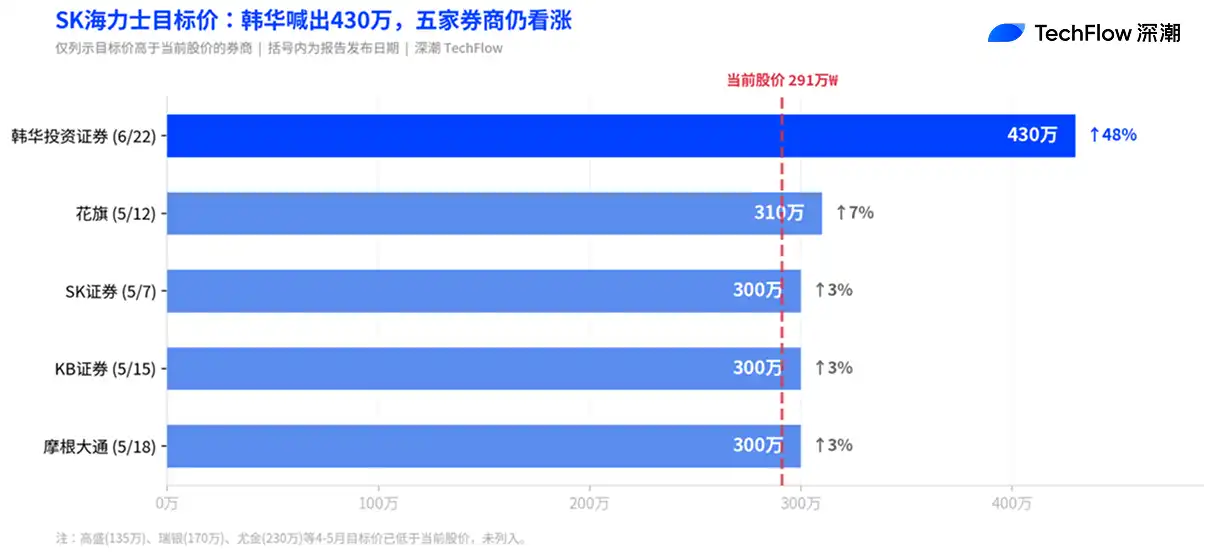
On June 22, Hanwha Investment & Securities analyst Park Jun-young raised SK Hynix's target price from 1.63 million won to 4.3 million won, an increase of nearly 1.6 times, currently the highest target price among Korean brokerages.

Park's core argument is: SK Hynix is no longer a company with severe profit volatility; it is transforming into an enterprise capable of consistently generating high-level profits. He noted that Korean memory chip makers have long suffered from valuation discounts, but with the expansion of long-term supply agreements (LTA) and soaring HBM demand, earnings visibility has fundamentally improved.
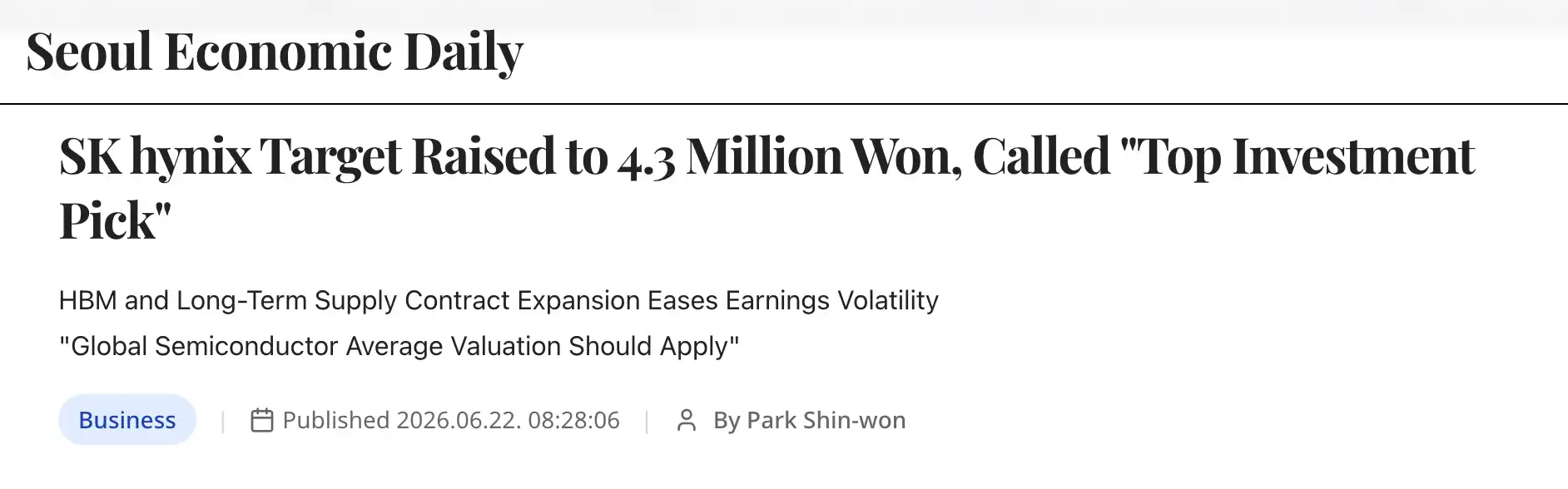
According to the Seoul Economic Daily, Hanwha used a price-to-earnings ratio (P/E) of 10x to calculate the target price, the lowest level among global semiconductor companies. SK Hynix's current 12-month forward P/E is about 6.6x, lower than that of fellow memory maker Micron. Hanwha predicts that even if the memory market weakens, SK Hynix's operating margin will remain above at least 30%, compared to figures that have fallen below 10% or even turned negative in past downturns.

Hanwha also listed ADR listing as a catalyst. Park Jun-young stated that an ADR listing within the year would give SK Hynix the opportunity to be valued directly against peers like Micron in the US market, saying "SK Hynix is currently the optimal investment target in terms of both fundamentals and momentum."

Multiple Brokerages Collectively Raise Target Prices, Memory Industry Valuation Framework Being Rewritten

Hanwha is not alone. In the past two months, Korean and international brokerages have seen a round of intensive upward revisions to SK Hynix's target price.

SK Securities raised its target price to 3 million won on May 7, using a 10x P/E framework, which was the highest among Korean brokerages at the time. KB Securities raised it to 3 million won on May 15, predicting a 2026 operating margin of 78.1%, stating that memory semiconductors are becoming "scarce strategic assets that determine the overall performance of AI systems." Citi raised its target price from 1.7 million won to 3.1 million won on May 12, citing stronger-than-expected HBM price growth in the second half. JPMorgan raised its target to 3 million won on May 18, simultaneously raising its EPS estimates for 2026-2028 by 9% to 20%.

Nomura Securities released a report on May 15, stating bluntly, "This time is really different," believing the valuation logic of the memory industry is undergoing a paradigm-level shift, and risk premiums should converge towards those of TSMC, rather than continuing to apply the traditional cyclical stock framework.

Behind these revisions is a common logical support: LTA has changed the pricing mechanism of the memory industry. According to Hanwha's analysis, current long-term supply agreements include price decline protection clauses and legal safeguards for contract performance, allowing manufacturers to maintain certain profit margins even during market downturns. This is fundamentally different from the past model where DRAM spot prices fluctuated wildly and manufacturers passively endured cycles.

Q1 Performance: Revenue First Surpasses 50 Trillion Won, Operating Margin at 72%

The target price hikes are supported by hard data. SK Hynix reported Q1 FY2026 revenue of 52.58 trillion won, a 198% year-on-year increase, breaking the 50 trillion won mark for the first time. Operating profit was 37.61 trillion won, a 405% increase. Operating margin reached 72%, surpassing Nvidia's 65% and setting a new record in the semiconductor manufacturing industry.

HBM is the core driver. SK Hynix currently holds about 70% to 80% of the global HBM market share and is a key supplier for Nvidia's AI accelerators. According to a Goldman Sachs report in April, the 2026 global DRAM supply-demand gap forecast has widened from 3.3% to 4.9%, the most severe in 15 years. The top three memory manufacturers have basically sold out their capacity for this year, and fab construction cycles of four to five years mean there will be virtually no new capacity added within the year.

UBS, when raising SK Hynix's earnings forecast in April, noted that AI-driven HBM demand continues to cannibalize DDR capacity, coupled with the server replacement cycle and simultaneous explosion in storage SSD demand, meaning the global DRAM supply-demand gap will persist until Q4 2027, calling it a "storage super cycle not seen in nearly three decades."

Pre-Market Surpasses 3 Million Won, But Falls Over 5% in Regular Trading

In pre-market trading on June 23, SK Hynix briefly touched 3.002 million won on Nextrade's NXT platform, breaking the 3 million won barrier. However, the stock price retreated after the regular session opened, trading at 2.75 million won as of 11 a.m., down 5.79% from the previous close.

The immediate cause of the decline was the overall weakness in global large-cap tech stocks, despite the solid performance of the US memory sector overnight (Micron up 6.9%, SanDisk up 4.1%). The KOSPI has risen 7.53% this month, but the gains have been highly concentrated in Samsung and Hynix stocks. The KOSPI 200 index excluding these two actually fell 2.48% over the same period, indicating extreme market divergence.

According to the Korea Herald, some brokerages have issued warnings: with Samsung Electronics' projected profit scale and growth rate both higher than SK Hynix's, the market cap reversal could be a signal of short-term overheating.

However, data from Mirae Asset Securities tracking high-return investors (top 1% in returns over the past month) shows that SK Hynix was still the most net-bought stock as of the morning of the 23rd. These investors see the pullback as a buying opportunity.

Trending Cryptos

Related Questions

QAccording to the article, what key event occurred for SK Hynix's market capitalization on June 22nd, and why is it significant?

AOn June 22nd, SK Hynix's intraday market capitalization reached 208.1 trillion won, surpassing Samsung Electronics' 207.3 trillion won. This is significant because it marks the first time since November 2000 that Samsung has lost its position as the most valuable company in the Korean stock market, highlighting a major shift in investor valuation within the semiconductor industry driven by the AI era.

QWhat is the new price target set by Hanwha Investment & Securities for SK Hynix, and what is the core reasoning behind this bullish assessment?

AHanwha Investment & Securities raised its price target for SK Hynix from 1.63 million won to 4.30 million won, which is the highest target among Korean brokerages. The core reasoning is that the company is transforming from one with volatile earnings into a business capable of generating consistently high profits, driven by the widespread adoption of long-term supply agreements (LTAs) and surging demand for HBM. These factors have fundamentally improved earnings visibility and reduced the cyclicality of the memory chip business.

QWhat key financial metric from SK Hynix's Q1 2026 earnings is highlighted in the article as an industry record, and what was its primary driver?

ASK Hynix reported an operating profit margin of 72% for Q1 2026, which set a new record in the semiconductor manufacturing industry, surpassing even Nvidia's margin of 65%. The primary driver of this exceptional profitability was the company's dominant position in the HBM (High Bandwidth Memory) market, where it holds an estimated 70-80% global market share and is a major supplier to Nvidia for AI accelerators.

QBesides Hanwha, name two other financial institutions mentioned that raised their price targets for SK Hynix and briefly state their rationale.

A1. KB Securities raised its target price to 3.00 million won, predicting SK Hynix's operating profit margin would reach 78.1% in 2026 and stating that memory semiconductors are becoming 'scarce strategic assets determining the overall performance of AI systems.' 2. Citigroup raised its target from 1.70 million to 3.10 million won, citing stronger-than-expected HBM price growth in the second half of the year as the rationale.

QDespite a pre-market breakthrough, what happened to SK Hynix's stock price during formal trading on June 23rd, and what was cited as a potential reason for the decline?

ADespite briefly touching 3.002 million won in pre-market trading on June 23rd, SK Hynix's stock price fell during formal trading, dropping 5.79% to 2.75 million won by 11 a.m. The article cites a general weakening in large global tech stocks as a direct reason for the decline, even though the U.S. memory sector performed well overnight. Some analysts also warned that the market cap overtaking of Samsung might be a sign of short-term overheating.

Related Reads

Quantum Computing "Manhattan Project" Unveiled: Is the Encryption Industry at a Critical Turning Point?

"Quantum Computing 'Manhattan Project' Launched: Is the Crypto Industry at a Critical Juncture?" On June 22, former U.S. President Donald Trump signed two executive orders. The first mandates all federal agencies upgrade their cryptographic systems to new, quantum-resistant standards by 2030. The second orders the Department of Energy to lead the development of a national quantum computer, signaling a shift from laboratory research to a state-enforced national agenda. This creates a hard deadline. A powerful quantum computer could break current encryption. The threat is compounded by "harvest now, decrypt later" attacks, where encrypted data is stored today for future decryption. Federal agencies must appoint migration officers and complete post-quantum cryptography (PQC) upgrades for key establishment by 2030 and digital signatures by 2031. Procurement rules will also be changed, forcing government contractors to comply. The crypto industry faces a direct threat. Bitcoin's ECDSA signatures are theoretically vulnerable. Research indicates millions of Bitcoin with exposed public keys are at risk if quantum computers advance. While projects like Bitcoin Quantum testnets and efforts by Ethereum, Solana, NEAR, and Zcash are exploring quantum-resistant solutions, achieving consensus in decentralized networks remains a major challenge. The centralized U.S. government has started a 5-year countdown. For decentralized crypto networks, the real test is whether they can complete this anti-quantum upgrade before the theoretical threat becomes a practical reality.

Foresight News3m ago

Quantum Computing "Manhattan Project" Unveiled: Is the Encryption Industry at a Critical Turning Point?

Foresight News3m ago

Coin Stock Barometer丨BitMine's Total Assets and Investment Reach $10.7 Billion, Exceeding ~$9.3 Billion Floating Loss; Strategy Buys Only 520 BTC, Strive Adds Positions Against the Trend (June 23)

This article provides a weekly market update on "coin-equity" trends, focusing on listed companies holding major cryptocurrencies. Key highlights include: **General Market Trends:** Global equities, particularly in the US, Japan, and South Korea, faced significant sell-offs, led by large tech and AI-related stocks. Analysts cite profit-taking and a shift from hype-driven to performance-driven valuation for AI companies. Market focus is on upcoming Micron Technology's earnings. **Cryptocurrency Treasury Updates:** * **Bitcoin (BTC):** Net weekly BTC purchases by listed companies (excluding miners) totaled approximately $86 million, down 13.97% from the prior week. Strategy (formerly MicroStrategy) purchased only 520 BTC for ~$34.9 million, while Strive Asset Management increased its holdings by 759 BTC for ~$50 million. Other notable actions include Mara Holdings adding 1,000 BTC and Capital B shareholders approving a massive financing plan (up to ~$1.2 trillion) to potentially expand its Bitcoin reserves. * **Ethereum (ETH):** BitMine emerged as the largest corporate ETH treasury, holding 5.67 million ETH (4.7% of supply). It purchased an additional 52,203 ETH ($92 million) in the past week. Sharplink completed a $75 million private placement to fund further ETH accumulation and stock buybacks. * **Solana (SOL):** The top five listed companies hold over 15.7 million SOL combined. However, Solmate Infrastructure, a SOL treasury firm, faces a lawsuit from its largest external shareholder alleging board misconduct and self-dealing. * **Other:** Updates include Canton Strategic's $50 million stock buyback plan and Lite Strategy's $1 million strategic investment in LitVM, a Layer-2 network for Litecoin. The article notes that while crypto treasury firms continue fundraising and accumulation, their stocks may struggle to rise against the broader market downturn until Q4.

marsbit17m ago

Coin Stock Barometer丨BitMine's Total Assets and Investment Reach $10.7 Billion, Exceeding ~$9.3 Billion Floating Loss; Strategy Buys Only 520 BTC, Strive Adds Positions Against the Trend (June 23)

marsbit17m ago

OpenAI Partners with PE Firms, Investing $4 Billion. Let's Talk About Silicon Valley's Hottest New Role: FDE.

The hottest new role in Silicon Valley is the Forward Deployment Engineer (FDE), a hybrid of engineer and business consultant whose core mission is to transform AI demos into native, practical workflows within client organizations. The recent surge in demand is driven by a strategic shift from leading AI companies. OpenAI, partnering with 19 private equity firms in a $4 billion investment, formed a Deployment Company and acquired Tomoro along with its 150 FDEs. Anthropic also announced a $1.5 billion joint venture with financial institutions like Blackstone. The article, based on interviews with industry experts Jove (FDE lead at Cresta) and Oliver (VP at Invisible Technologies, ex-McKinsey), explores the FDE role and the rise of deployment-focused companies. Key insights include: **The FDE Role:** Jove describes an FDE as a "Forward Deployed CTO"—a technically strong engineer who works intimately with clients to implement AI solutions, learn from the process, and feed those insights back to improve the core product. They require expertise in AI agents, client-facing experience, resilience, and the ability to handle complex, imperfect systems. While AI tools enhance their efficiency, the role's complexity makes full automation a distant prospect. **Industry Shift:** Model companies are moving beyond selling tools to ensuring real-world adoption. This blurs the line between model and application companies. Collaborations with private equity (PE) firms are key, providing access to large portfolios of traditional businesses needing AI transformation. For PE firms, these partnerships offer signal value to LPs, create tangible value in portfolio companies, and provide exposure to high-growth AI assets. **Consulting & Transformation:** AI deployment involves deep, customized workflow redesign, moving beyond simple tool augmentation. Companies like Invisible Technologies build modular platforms to create bespoke, AI-native workflows for clients. While traditional consulting will see growth in helping businesses rethink their models for AI, the real value is captured by firms that leave behind transformed, operational systems. Critical success factors include building robust data foundations and strategically deciding which workflow steps should be deterministic versus AI-driven. The ultimate goal shifts from pure cost-cutting to unlocking new revenue opportunities previously impossible without AI-scale capabilities.

marsbit30m ago

OpenAI Partners with PE Firms, Investing $4 Billion. Let's Talk About Silicon Valley's Hottest New Role: FDE.

marsbit30m ago

Trading

Spot
Futures

Hot Articles

Discussions

Welcome to the HTX Community. Here, you can stay informed about the latest platform developments and gain access to professional market insights. Users' opinions on the price of S (S) are presented below.

活动图片