Quantum Computing "Manhattan Project" Unveiled: Is the Encryption Industry at a Critical Turning Point?

Foresight NewsPublished on 2026-06-23Last updated on 2026-06-23

Abstract

"Quantum Computing 'Manhattan Project' Launched: Is the Crypto Industry at a Critical Juncture?" On June 22, former U.S. President Donald Trump signed two executive orders. The first mandates all federal agencies upgrade their cryptographic systems to new, quantum-resistant standards by 2030. The second orders the Department of Energy to lead the development of a national quantum computer, signaling a shift from laboratory research to a state-enforced national agenda. This creates a hard deadline. A powerful quantum computer could break current encryption. The threat is compounded by "harvest now, decrypt later" attacks, where encrypted data is stored today for future decryption. Federal agencies must appoint migration officers and complete post-quantum cryptography (PQC) upgrades for key establishment by 2030 and digital signatures by 2031. Procurement rules will also be changed, forcing government contractors to comply. The crypto industry faces a direct threat. Bitcoin's ECDSA signatures are theoretically vulnerable. Research indicates millions of Bitcoin with exposed public keys are at risk if quantum computers advance. While projects like Bitcoin Quantum testnets and efforts by Ethereum, Solana, NEAR, and Zcash are exploring quantum-resistant solutions, achieving consensus in decentralized networks remains a major challenge. The centralized U.S. government has started a 5-year countdown. For decentralized crypto networks, the real test is whether they can complete th...


Author: Ma He, Foresight News

On June 22, Trump signed two executive orders in a single day. One requires all U.S. federal agencies to upgrade their cryptographic locks to a new standard by 2030 to resist the threat of quantum computing decryption; the other orders the Department of Energy to lead the construction of a "National Quantum Computer."

Quantum computing has transitioned from a technical discussion in laboratories to a mandatory national schedule.

At the beginning of 2025, tech industry titan Jensen Huang expressed pessimism about quantum computers, stating "a truly practical quantum computer might still be 15 to 30 years away." Yet, merely two months later, his attitude shifted. This year, NVIDIA released the AI-driven Ising model. Huang indicated that this would enable AI to become the control plane and operating system for quantum machines, transforming fragile qubits into scalable, highly reliable systems, and building standardized, industry-grade infrastructure for quantum computing.

Quantum computing, potentially supercharged by AI, may see its development pace accelerate significantly. The faster it progresses, the greater the daily growing threat to current system security.

The 2030 Deadline: A Hard Order for a Nationwide "Lock Change"

Once large-scale quantum computers emerge, the current cryptographic systems will be shattered. More insidiously, there's the strategy of harvest now, decrypt later—adversaries can store your encrypted data today and patiently crack it a decade later when quantum machines mature.

Hence, the U.S. government issued a hard deadline. All federal agencies must complete the migration to Post-Quantum Cryptography (PQC) for key establishment in their high-value assets and high-impact systems by December 31, 2030. Additionally, they must complete the migration for digital signatures to PQC by December 31, 2031.
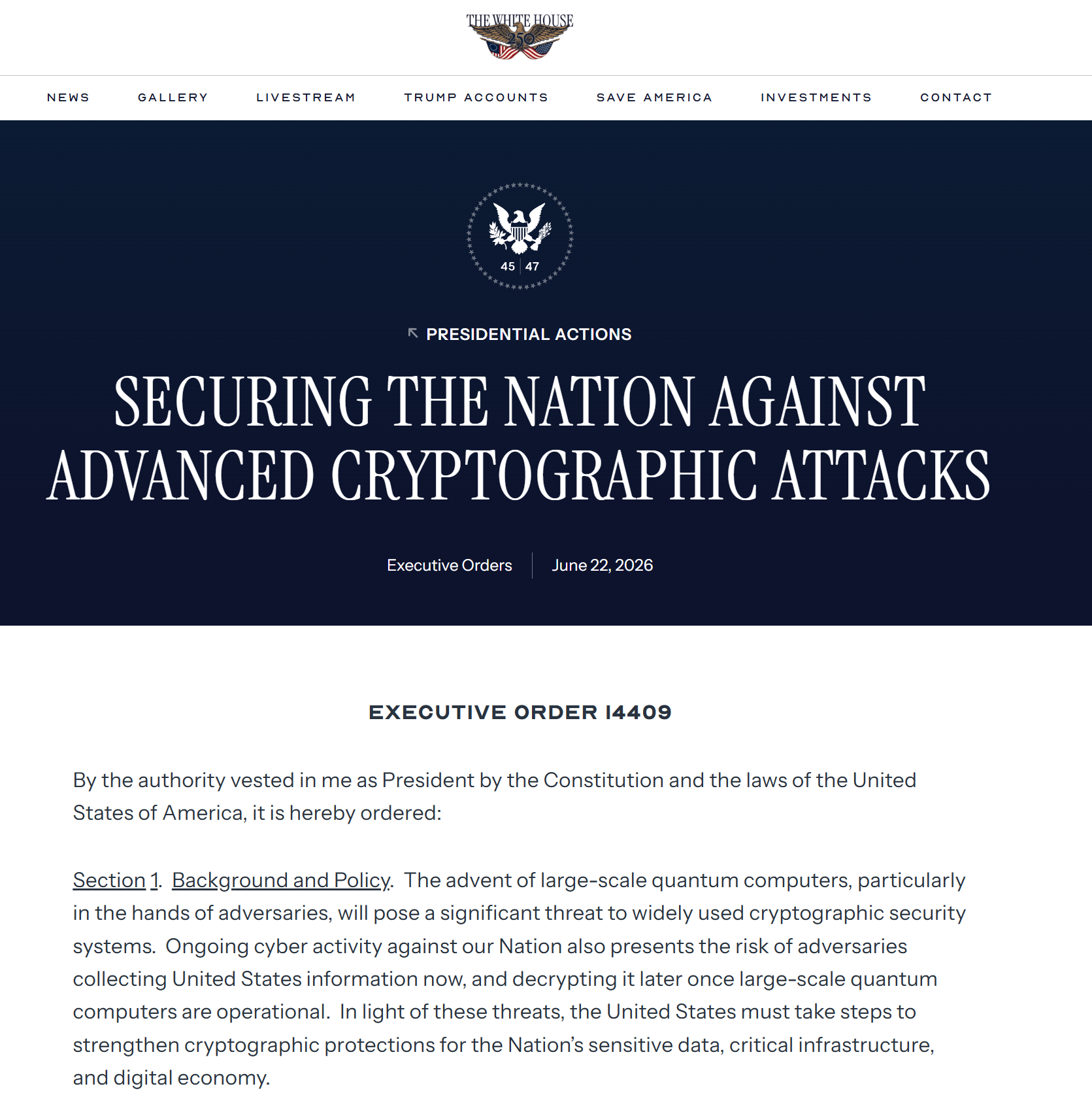

Each agency must appoint a PQC Migration Lead within 30 days, reporting directly to the White House OMB and the National Cyber Director. NIST (National Institute of Standards and Technology) must initiate a PQC migration pilot for its own systems within 180 days and complete it by the end of 2027.

Furthermore, the Federal Acquisition Regulation will be revised within 180 days. All contractors supplying the U.S. government—from Microsoft and Amazon Web Services to various IT service providers—must comply with PQC standards by 2030. The Department of Homeland Security will also assist critical infrastructure like the power grid, banks, hospitals, and communication operators in developing migration plans.

The U.S. government is leveraging administrative power to forcibly drive a massive upgrade of global internet security infrastructure.

The other document signed by Trump on the same day, "Unleashing the Next Frontier in Quantum Innovation," also placed the quantum computing race squarely on the table.
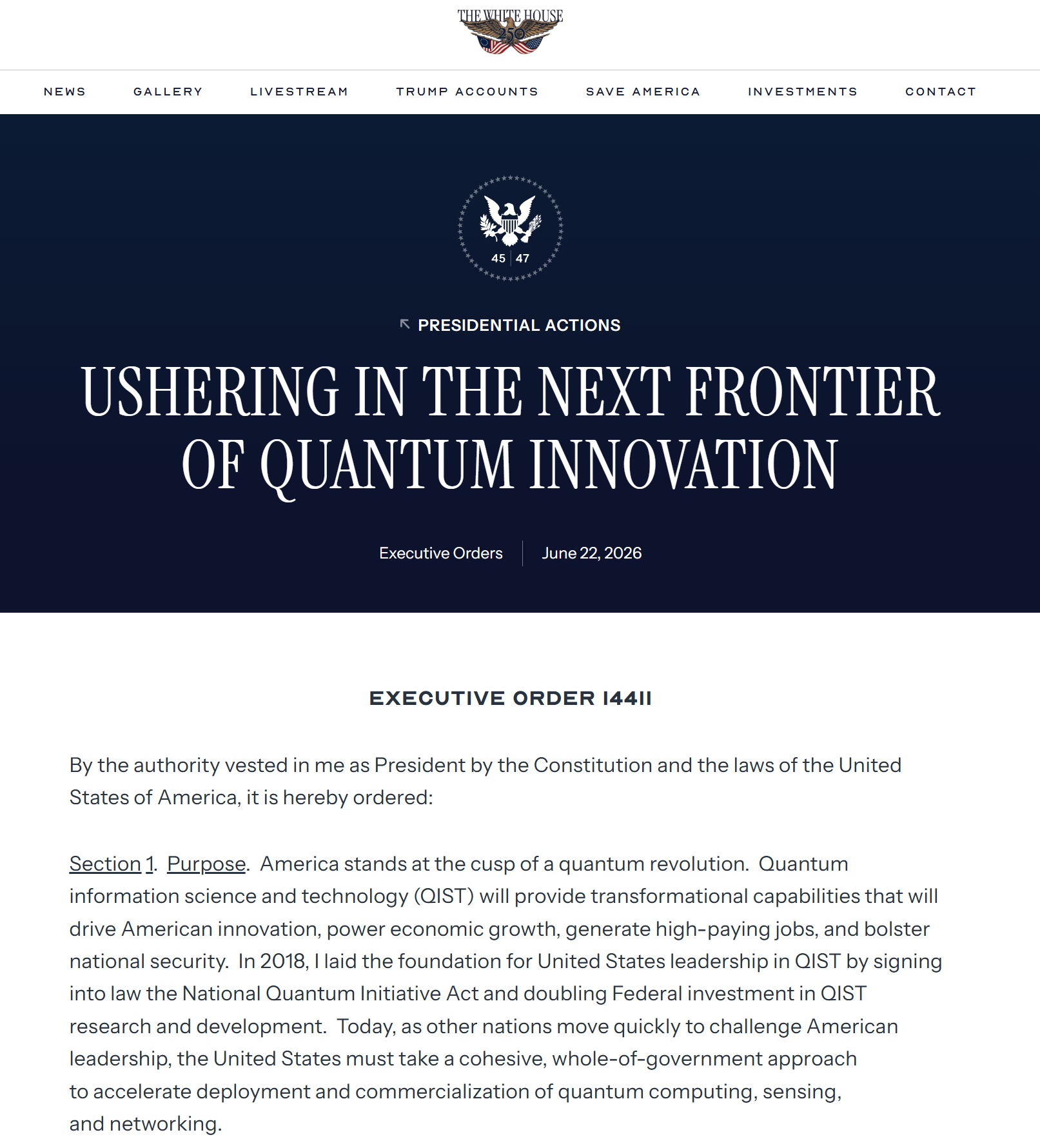

The U.S. government wants a massive machine delivered to the Department of Energy's national laboratories, one that truly solves problems classical supercomputers cannot. The White House requires the Department of Energy to publicly release technical specifications within 90 days and explore public-private partnership models within 180 days.

Perhaps this is the "Manhattan Project" moment for quantum computing. The government provides funding, policies, and orders, guiding through national will to accelerate the evolution of quantum information technology from laboratory prototypes to engineering-grade tools.

While the U.S. races to upgrade its cryptography, the cryptography underpinning the crypto industry is already fraught with peril.

The Crypto Industry Resists Quantum Computing

The foundation of Bitcoin, the ECDSA elliptic curve signature, is theoretically vulnerable to cracking by quantum computers.

According to research data released by BTQ Technologies in October 2025, approximately 6.65 million Bitcoins (worth about $745 billion at the time) have their public keys permanently exposed on the blockchain. This includes 1.9 million Bitcoins in early P2PK addresses and about 4 million Bitcoins in reused addresses.

These BTCs don't need to wait for quantum computers to actively attack transaction broadcasts—the public keys have been lying on the blockchain for over a decade. Once quantum computers mature, they can slowly reverse-engineer the private keys offline.

The Bitcoin base layer protocol has not activated a soft fork in over four years since November 2021. The BIP-360 proposal suggests some mitigation measures, but a complete solution remains distant. Historical precedent is also not optimistic. Bitcoin's SegWit upgrade took three years from proposal in December 2015 to mainstream adoption in December 2018.

In January this year, BTQ Technologies Corp. launched a testnet named Bitcoin Quantum. This testnet is fully open and permissionless, inviting miners, developers, researchers, and users to run nodes, build tools, audit cryptography, and stress-test quantum-resistant transactions before any mainnet migration.

However, achieving consensus among multiple parties for subsequent steps remains a significant challenge.

Coinbase CEO Brian Armstrong rebutted that the quantum computing threat to Bitcoin is severely exaggerated. "This isn't a problem unique to cryptocurrency; it's something the entire world needs to address. We are working directly with core developers to handle the quantum issue."

Beyond Bitcoin, other project protocols are also vigorously advancing their anti-quantum plans.

The Ethereum Foundation has established a dedicated Post-Quantum Security research team and prioritized PQC. Nico, lead of the Ethereum Foundation's privacy project Kohaku, stated that Ethereum can already begin preparing at the account level for the post-quantum era without waiting for a base-layer hard fork upgrade.

Solana has established the Falcon signature standard and announced a three-phase migration roadmap. The NEAR development team plans to add a quantum-resistant secure signature scheme to its testnet by the end of Q2 2026. Zcash expects to achieve protocol-level post-quantum privacy protection through the Tachyon upgrade by the end of 2026.

In this life-or-death race against quantum computing, the highly centralized federal agencies have already pressed the hard switch for a '5-year countdown.' For decentralized networks with concerning governance efficiency that rely on consensus, the real test is not when the quantum crisis arrives, but whether the industry can complete this anti-quantum upgrade before Satoshi Nakamoto's black box is fully deciphered.


Related Questions

QWhat is the significance of the deadlines (2030 and 2031) mentioned in the executive orders for US federal agencies regarding quantum computing?

AThe deadlines set by the executive orders mandate that all US federal agencies must complete the migration of their high-value assets and high-impact systems to Post-Quantum Cryptography (PQC) for key establishment by December 31, 2030, and for digital signatures by December 31, 2031. These deadlines represent a critical and enforceable timeline for upgrading national security infrastructure to resist potential decryption by future quantum computers.

QHow does the article describe the specific threat quantum computing poses to the Bitcoin network?

AThe article describes that Bitcoin's foundational ECDSA (Elliptic Curve Digital Signature Algorithm) is theoretically vulnerable to being broken by quantum computers. Specifically, it highlights that the public keys for approximately 6.65 million Bitcoins are permanently exposed on the blockchain. Once quantum computers become powerful enough, these public keys could be used to derive the corresponding private keys offline, potentially allowing those funds to be stolen without the need to intercept a live transaction.

QWhat is the role of AI, as mentioned in the article, in accelerating the development of quantum computing?

AThe article suggests that AI is poised to significantly accelerate quantum computing development. It cites NVIDIA's release of an AI-driven Ising model, which company CEO Jensen Huang described as turning AI into the control plane and operating system for quantum machines. This integration aims to transform fragile quantum bits into scalable, highly reliable systems, thereby creating standardized, industry-grade infrastructure for quantum computing and speeding up its practical realization.

QAccording to the article, which major blockchain projects are actively working on post-quantum security upgrades, and what are some of their plans?

AThe article mentions several major blockchain projects with active post-quantum security plans: Ethereum has a dedicated research team and considers PQC a priority, noting that account-level preparations can begin without a core protocol upgrade. Solana has adopted the Falcon signature standard and published a three-phase migration roadmap. NEAR plans to add a quantum-resistant signature scheme to its testnet by the end of Q2 2026. Zcash expects to achieve protocol-level post-quantum privacy protection via its Tachyon upgrade by the end of 2026.

QWhat comparison does the article make between the US government's quantum computing initiative and a historical project, and why?

AThe article compares the US government's quantum computing initiative to the 'Manhattan Project.' This comparison is made because the initiative involves a top-down, state-driven effort with significant funding, policy support, and government procurement. The goal is to accelerate the transition of quantum information technology from laboratory prototypes to engineered, practical tools capable of solving problems beyond classical supercomputers, mirroring the concentrated national effort seen in the historical Manhattan Project.

Related Reads

Ethereum's Next Stop Glamsterdam: The Core Upgrades You Must Know

The Glamsterdam upgrade, scheduled for late 2026, is a major Ethereum hard fork combining the Amsterdam execution layer and Glasgow consensus layer updates. Its primary goal is not simply increasing throughput but restructuring Ethereum's block production, validation, and resource pricing to enable future scaling. Key technical changes include **EIP-7732 (ePBS)**, which formally enshrines proposer-builder separation into the protocol. This decouples consensus and execution tasks, extending the execution payload propagation window to ~9 seconds. This provides more time for node verification, allowing for safer increases in block capacity (Gas limit) in the future. Another core component is **EIP-7928 (Block-Level Access Lists - BAL)**. It mandates a list of all state accessed within a block, moving this feature from an optional transaction-level (EIP-2930) to a mandatory block-level requirement. This explicit access list enables client optimizations like parallel disk reads and state root computations, paving the way for parallel execution. To manage long-term state growth, **EIP-8037** increases the cost of creating new state (e.g., accounts, storage slots), separating the pricing of permanent database bloat from temporary computation. This allows execution capacity to scale more aggressively without causing state size to explode proportionally. The planned upgrade bundle includes around 10 EIPs categorized into: 1) Core protocol restructuring (ePBS, BAL), 2) Resource pricing adjustments (state costs, calldata costs), and 3) EVM/developer improvements. Several other EIPs, including those potentially improving staker exit liquidity (EIP-8061, EIP-8080), are under consideration. The technical development coincides with significant personnel changes within the Ethereum Foundation's Protocol team. The Foundation's official communications frame this as part of a broader shift towards a "coalition of organizations" working on the Ethereum roadmap, citing new entities like ethlabs and the Ethereum Economic Zone. In summary, Glamsterdam represents a foundational re-engineering of Ethereum's block pipeline and economic model—focusing on ePBS, BAL, and multi-dimensional resource pricing—to prepare the network for sustainable, high-throughput scaling in the years ahead.

Foresight News7m ago

Ethereum's Next Stop Glamsterdam: The Core Upgrades You Must Know

Foresight News7m ago

The Ethereum Foundation Has Split?! An In-depth Look at Ethlabs' "Bright Future"

"Ethereum Foundation Splits? Understanding Ethlabs and Its 'Bright Future'" Former Ethereum Foundation members Ansgar Dietrichs, Barnabé Monnot, Caspar Schwarz-Schilling, Josh Rudolf, and Julian Ma have announced the launch of Ethlabs, an independent non-profit research and development lab. Announced on June 22nd, the initiative comes amidst discussions about the need for new organizational structures within the Ethereum ecosystem, a point highlighted by Bankless founder David Hoffman. Ethlabs' mission is to establish Ethereum as the foundational settlement layer for the global economy. The organization positions itself as a bridge connecting frontline developers, applications, and user needs with the core protocol. It aims to translate real-world demands into protocol improvements, industry standards, and deployable products. The founding team brings significant expertise: Dietrichs and Monnot are highly cited researchers in areas like Proposer-Builder Separation (PBS) and MEV, while Schwarz-Schilling, Rudolf, and Ma contribute backgrounds in economic modeling, consensus research, and applied cryptography. Initial supporters include BitMine, a major corporate ETH treasury; Sharplink, another treasury firm; and Consensys founder Joe Lubin in a personal capacity. Community backers include figures like Uniswap's Hayden Adams and Base's Jesse Pollak. The timing coincides with internal Ethereum Foundation discussions about "spinout" projects. While Ethlabs and the Foundation share research interests like MEV mitigation, Ethlabs frames its role not as a competitor but as part of a shift from a "single-core coordination model" to a "multi-R&D entity collaboration model." It views Ethereum as a public project belonging to all builders, with Ethlabs as one node in a broader governance network. Ultimately, Ethlabs represents an organizational evolution within the maturing Ethereum ecosystem. The key question is whether multiple research bodies can collaborate effectively to advance Ethereum as a competitive global settlement infrastructure.

Odaily星球日报11m ago

The Ethereum Foundation Has Split?! An In-depth Look at Ethlabs' "Bright Future"

Odaily星球日报11m ago

'Bear' Doomsday Prophecy: AI 'Reaching Its Peak', U.S. Stocks to Top Out Fastest in Q3, Down 30-50%

"A Short Seller's Dire Prediction: AI Boom Fading, US Stocks to Peak by Q3 with 30-50% Decline" Prominent macro investors Jeffrey Gundlach and Felix Zulauf warn that the AI-driven market rally is nearing its end, forecasting a major US stock market correction of 30-50%, potentially beginning as early as Q3. Their analysis points to alarming parallels with historical market tops, citing extreme concentration in the top AI-related stocks within the S&P 500. Zulauf's bearish thesis hinges on unsustainable capital expenditure trends among major cloud companies, negative free cash flow emergence, and soaring semiconductor prices. Gundlach highlights dangerous parallels to the 1999 tech bubble peak. A key divergence from conventional wisdom is Gundlach's view that long-term Treasury yields will not fall meaningfully even during a recession, due to America's structurally out-of-control fiscal deficits and soaring interest costs. He warns this could force the government into yield curve control or even a sovereign debt restructuring. Both investors express severe concerns about the opaque private credit market, drawing parallels to the pre-2008 financial crisis environment. They allege widespread rating inflation, misrepresented credit quality, liquidity illusions, and fraudulent asset valuations within this sector. The analysis links the AI boom and private credit crisis through financing costs. They argue that as AI companies' cash flows weaken and they seek funding, a high and sticky long-term interest rate environment will severely stress lower-rated corporate borrowers, exposing cracks in credit markets. Finally, they predict a regime shift where the US dollar weakens and US equities underperform global markets, marking the end of their long dominance. The stage is set for a significant market reversal.

marsbit18m ago

'Bear' Doomsday Prophecy: AI 'Reaching Its Peak', U.S. Stocks to Top Out Fastest in Q3, Down 30-50%

marsbit18m ago

Why Does No One Buy DeFi Insurance?

**Title: Why Isn't DeFi Insurance Being Bought?** DeFi insurance, which promised automated, unbiased payouts via smart contracts, has failed to gain traction. The core issue is economic: high premiums severely erode the yields that attract users to DeFi in the first place. For example, insuring a USDC deposit on Aave V3 could cost 1.5–2.5% of the annual yield, leaving a net return barely above a savings account. For riskier platforms like Maple Finance or Ethena, premiums can even turn net yields negative. Consequently, users often forgo insurance, as it nullifies their profit motive. The market also suffers from structural flaws. First, DeFi risks are highly correlated (e.g., an oracle failure can impact multiple protocols simultaneously), unlike the independent risks in traditional insurance. This makes large-scale events potentially catastrophic for insurers. Second, the total capital in DeFi insurance pools (e.g., Nexus Mutual's ~$81.5M) is minuscule compared to the hundreds of billions in total value locked (TVL), creating a massive capacity gap. A single major hack could drain the entire industry's reserves. Furthermore, the governance model where tokenholders vote on claims creates a conflict of interest, incentivizing them to deny payouts to protect their own funds. As a result, the sector is shrinking. While pioneers like Nexus Mutual are pivoting to preventative measures (bug bounties) and seeking external capital via reinsurance, the fundamental problems remain. DeFi insurance represents a public good—its stability benefits the entire ecosystem—but without a mechanism to share costs, a "tragedy of the commons" ensues where no one is willing to pay, leaving the system vulnerable.

marsbit32m ago

Why Does No One Buy DeFi Insurance?

marsbit32m ago

Trading

Spot
Futures
活动图片