
Author: Investment Community
"In the AI era, all hardware is worth remaking from scratch."
This statement might have sounded somewhat radical in 2024, but in 2025, its credibility has surged significantly—as we are witnessing, the wave of AI hardware entrepreneurship is rising, with financings following one after another. Across the ocean, the smart ring Oura Health has seen its latest valuation soar to a staggering 70 billion yuan.
This frenzy is sweeping up FOMO-stricken investors. This time, aside from sifting through thousands of pitch deck emails, they have strikingly turned their deal-sourcing gaze towards content communities densely populated by tech geeks and young people.
The underlying logic is rather simple: compared to spec sheets and roadshows, the real demand for a consumer-grade AI smart hardware product is often first exposed by whether it can be understood, discussed, and questioned in the public sphere.
Ultimately, all tech products aimed at the masses must go through the test of the crowd.
AI Hardware Explosion, Investors Scramble for Under-the-Radar Projects
We are experiencing a banner year for AI hardware.
Since 2025, extending from the wearable device track, more segmented smart hardware products such as AI glasses, AI toys, AI recording cards, AI rings, AI earphones, companion robots, and Agent Boxes have collectively seen an explosion.
Amid the fervor, certain details reveal the excitement in the investment circle: in the latter half of 2025, we frequently saw several top-tier institutions posting job openings to recruit AI/smart hardware investors, with the job descriptions almost invariably requiring the candidates to be based in Shenzhen, the hardware capital.
Good projects almost require 'repeated visits' and intense competition, especially those still under the radar with valuations not yet sky-high. Investors have even started approaching potential founders who haven't yet left their jobs. For instance, cafes near DJI are packed with VCs and FAs trying to 'persuade people to start a business.'
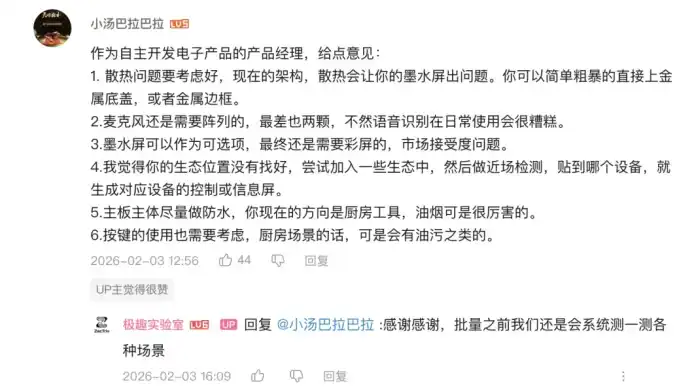
(Comment section of an AI sticky note product pre-sale video)
"After this content was posted, many technical discussion threads appeared in the bullet comments and comment section, and more users began sharing their similar needs: some mentioned frequently attending cross-border exhibitions, others talked about communication barriers when collaborating remotely with overseas teams, and some shared experiences where translation tools were inconvenient when accompanying foreign relatives for medical treatment or handling foreign affairs."
"These feedbacks not only helped us expand the direction for creator content but also directly influenced our thinking about the product line," Wu Zhen said.
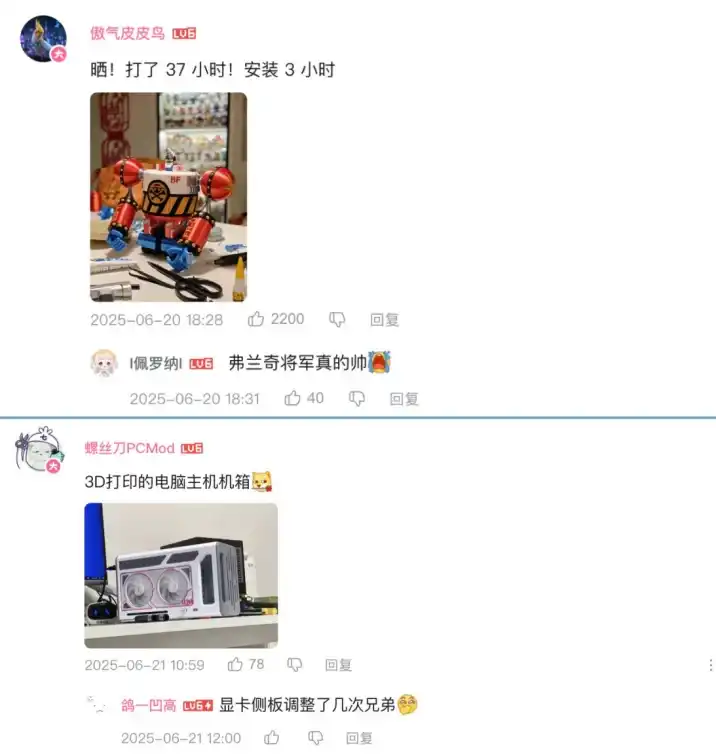
(Comment section of UP主影视飓风's video)
Enthusiasts Gather
Remember January 2024, at CES.
A little orange square box called Rabbit R1, touted as 'the world's first AI hardware device,' stirred a frenzy in the tech world. The market hailed it as the iPhone of the AI era, selling 100,000 units upon launch.
But what followed was not success. On the contrary, skepticism soon arose with comments like 'actually using it is not as good as a phone.' At the time, the high-flying Rabbit R1 failed to adequately explain to users: what exactly can Rabbit R1 do now and in the future? What real user problems does this innovation actually solve?
Even today, user education remains the most critical challenge for AI smart hardware—when AI enters consumer electronics, the product consumption logic is no longer limited to 'improving life efficiency' but also includes higher-dimensional needs like 'unleashing personal creativity' and 'liberating the mind.' In this context, whoever can make users understand, discuss, and pay in real-life scenarios truly crosses the threshold from a tech product to a consumer good.
But this is not easy. Regarding user education for AI glasses, INMO's CMO Wu Zhen told us frankly: This is not simply about conveying product information; it also requires overcoming a psychological barrier. Users must first complete a 'virtual try-on' in their minds, confirming that integrating this device into daily life feels natural and not awkward, before they can proceed to the next step.
In Wu Zhen's view, the process of psychologically preparing users for AI smart hardware might be longer than for most consumer electronics categories. "The day users naturally put on AI glasses to go out without reminding themselves 'I need to use AI glasses today,' this behavioral change might be more convincing than many data points."
Shakeout Begins, Battle for Attention Heats Up
While the frenzy peaks, a shakeout is underway.
There is now market consensus that 2026 will be the year of commercial validation for AI hardware. This also means that trend-chasers and狂热资本 will face rationality and冷静.
A winnowing process is unfolding: At the end of 2025, the AI wearable device Friend AI Necklace stalled after encountering severe market resistance; after its peak appearance in 2024, Rabbit R1, unable to keep up with product expectations amid negative feedback, saw abnormally high return rates, severely damaging its reputation, and ultimately陷入欠薪与现金流枯竭的困境 (fell into困境 of salary arrears and cash flow depletion).
Meanwhile, savvy players are also开始审慎调整和优化决策 (beginning to prudently adjust and optimize decisions). In February 2026, market rumors emerged that the Doubao AI glasses project was suspended; at least within the visible cycle, this product line is no longer considered a direction to pursue. Earlier, in January, smartphone manufacturer vivo halted its AI glasses project, citing the difficulty of achieving differentiation at present.
Such developments are a reflection of industry differentiation.
Nevertheless, it is undeniable that in this trillion-dollar-value赛道 (track), entrepreneurs still possess enormous确定性机会 (deterministic opportunities). According to AICC predictions, by 2030, the global AI-related hardware market will easily surpass several trillion dollars. In China, the industry expects the market size for consumer-grade AI hardware (excluding phones and cars) to突破 (break through) 1.27 trillion yuan in 2026 and reach 2.56 trillion yuan by 2030.
Currently, opportunities for exit and entry coexist. OpenAI just announced it will launch its first AI hardware device in the second half of the year, and Meta plans to double the annual production capacity of its AI smart glasses to 20 million units by the end of 2026. The latest scene domestically: a batch of AI smart terminals from京东 (JD.com), including AI desk lamps, AI cooking machines, AI mattresses, and AI wheelchairs, are酝酿上新售卖 (being酝酿 for launch and sale).
People remain convinced that the battle for入口之争 (portals) behind AI smart hardware will not stop. The AI era is still an era of用户主权 (user sovereignty).
The热浪 (heat wave) will push everyone forward. But when attention, product power, and user perception begin to compete on the same table, the final battle is just beginning.