Mastercard Just Built A Payment Network For AI Agents — And It Runs On Crypto

bitcoinistPublished on 2026-06-10Last updated on 2026-06-10

Abstract

Mastercard has launched "Agent Pay for AI," a new payment protocol enabling AI agents to conduct small, automated, machine-to-machine transactions. The system addresses a gap in traditional payment infrastructure, which is poorly suited for such micropayments. A key feature is the storage of human-granted permissions on the Polygon blockchain, allowing for decentralized verification without a central authority. Mastercard is developing the protocol with partners Adyen, Coinbase, and Cloudflare. It enters a competitive field where Visa, Stripe, and Google have also introduced similar AI payment tools. While Mastercard's Chief Product Officer, Jorn Lambert, does not expect significant near-term revenue, he views it as a strategic infrastructure investment for an anticipated future where AI agents facilitate a meaningful share of commerce. This move follows Mastercard's recent integration of stablecoins, signaling a broader shift towards incorporating crypto into its core systems.

Mastercard has launched Agent Pay for AI, a new protocol designed to enable artificial intelligence agents to pay each other and send micropayments — storing the permissions that humans grant their AI agents on Polygon, a blockchain network built on top of Ethereum, according to an exclusive report by Fortune published June 10.

Related Reading: Trump’s Crypto Deals May Have Increased The Family Fortune By $2 Billion—At Investors’ Expense

The protocol is built around a specific use case that existing payment infrastructure handles poorly: small, automated, machine-to-machine transactions. When an AI agent needs to access data piecemeal from a website, or pay another service incrementally for a task it is performing on a user’s behalf, traditional card rails — built for human-initiated, merchant-facing transactions — are poorly suited for the job. Agent Pay for AI is designed to fill that gap, per Fortune’s reporting.

The decision to log permissions onto a public blockchain rather than a private database is a deliberate architectural choice. Multiple parties that want to verify whether an agent is acting within the boundaries a human has authorized can access that information directly on-chain, without relying on a single centralized authority to confirm it, per Fortune. Mastercard selected Polygon for the initial deployment.
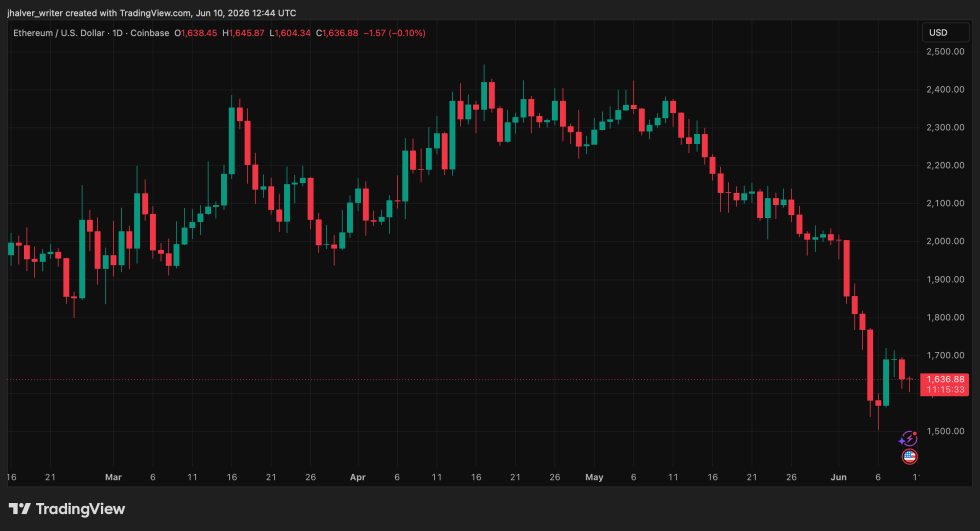
ETH's price trends to the downside on the daily chart. Source: ETHUSD on Tradingview

The Partners And The Crypto Competition

Three companies are working with Mastercard to develop the protocol: fintech platform Adyen, crypto exchange Coinbase, and web infrastructure giant Cloudflare, per Fortune’s reporting. The combination of a payment processor, a crypto-native exchange, and the company that handles a significant share of the internet’s traffic signals that Mastercard is building Agent Pay for AI as interoperable infrastructure rather than a proprietary walled garden.

The competitive landscape is already crowded. Visa and Stripe have each built tools anticipating a world where AI bots buy groceries, manage bank accounts, and pay for subscriptions. Coinbase launched the x402 protocol for AI payments, Stripe collaborated with Tempo to develop the Machine Payments Protocol, and Google released its own standard in September 2025, per Fortune.

Jorn Lambert, Mastercard’s Chief Product Officer, was measured about near-term commercial expectations in his conversation with Fortune. He does not expect Agent Pay for AI to be a significant revenue driver in the next twelve months. Over five years, however, he described it as a meaningful new addressable market. Lambert separately predicted that AI chatbots will eventually sit between a meaningful share of e-commerce transactions — framing the protocol not as a speculative bet but as infrastructure being built ahead of an inevitable shift in how commerce flows.

Related Reading: Japan’s SBI Bank Expands Crypto Push With BTC, ETH, XRP Rewards Program For Depositors

This development marks a pivotal moment for the nascent sector’s convergence with artificial intelligence. Mastercard choosing a public blockchain to anchor the permissions layer of its AI payment infrastructure — one week after opening its global settlement rails to six regulated stablecoins across eight blockchain networks — confirms that the world’s second-largest card network is systematically rebuilding its core architecture around crypto rails rather than alongside them.

Cover image from Grok, ETHUSD chart from Tradingview

Related Questions

QWhat is the name of the new protocol launched by Mastercard for AI agents, and what problem does it aim to solve?

AMastercard launched the Agent Pay for AI protocol. It aims to solve the problem of enabling small, automated, machine-to-machine (AI agent-to-agent) payments and micropayments, a use case poorly handled by traditional card payment infrastructure designed for human-initiated, merchant-facing transactions.

QOn which blockchain network is Mastercard storing the permissions for its Agent Pay for AI protocol, and why was a public blockchain chosen?

AMastercard is storing the permissions for its Agent Pay for AI protocol on the Polygon blockchain. A public blockchain was chosen so that multiple parties can directly verify on-chain whether an agent is acting within authorized boundaries, without relying on a single centralized authority.

QWhich three companies are partnering with Mastercard to develop the Agent Pay for AI protocol?

AThe three companies partnering with Mastercard are the fintech platform Adyen, the crypto exchange Coinbase, and the web infrastructure giant Cloudflare.

QAccording to Mastercard's Chief Product Officer Jorn Lambert, what is the commercial outlook for the Agent Pay for AI protocol in the near term and over a longer period?

AAccording to Jorn Lambert, Agent Pay for AI is not expected to be a significant revenue driver in the next twelve months. However, over a five-year horizon, he described it as a meaningful new addressable market.

QHow does Mastercard's recent launch of Agent Pay for AI, combined with another recent action, indicate its strategic direction regarding cryptocurrency infrastructure?

ACombined with its decision the week prior to open its global settlement rails to regulated stablecoins, the launch of Agent Pay for AI on a public blockchain confirms that Mastercard is systematically rebuilding its core architecture around crypto rails, rather than just operating alongside them.

Related Reads

12.9 Million Candidates: The First Summer of Fate in the Hands of AI

The 2026 Chinese college entrance exam, or Gaokao, saw a novel phenomenon: AI aggressively entering the college application advice arena before results were even released. Major tech companies like Alibaba, Tencent, Baidu, and others launched free AI-powered "agents" and tools designed to generate personalized university and major recommendations for over 12.9 million candidates. For years, a lucrative industry thrived on the "information gap" in college applications, with personalized consulting services costing families thousands of dollars. AI is now disrupting this by providing similar, data-driven analysis for free. These tools process standardized data—scores, rankings, historical admission trends—to create tailored application strategies, offering a form of information parity previously unavailable, especially to students from rural or less-resourced backgrounds. This shift represents more than just a marketing trend; it signifies AI's first large-scale entry into a critical, high-stakes life decision for millions of Chinese families. The Gaokao application, with its clear inputs and outputs, is an ideal scenario for AI. Its involvement begins to level the informational playing field, potentially reducing the advantage held by families with greater social capital or access to expensive consultants. However, the article raises a profound question: while AI can optimize choices for employability and financial return based on cold data, it risks promoting a homogenized, utilitarian path. It might steer a passionate student away from a less lucrative field like literature or archaeology toward supposedly "safer" options like computer science. The core dilemma remains: as AI flattens information disparities, does it also flatten the diversity of life choices and the freedom to make—and learn from—mistakes? Ultimately, 2026 may be remembered not for exam questions, but as the year AI began formally influencing the life trajectories of ordinary Chinese people. The real test lies not in the algorithm's recommendations, but in whether individuals will retain the courage to make their own choices and bear the consequences in an increasingly algorithmic age.

marsbit23m ago

12.9 Million Candidates: The First Summer of Fate in the Hands of AI

marsbit23m ago

IC3 Top Universities Collaborative Analysis: Is AI x Crypto the Real Future or Just a Narrative Bubble?

IC3 researchers from leading universities analyze the convergence of AI and crypto. They argue meaningful integration is still nascent, with hype often outstripping progress. The report frames AI as a "translation middleware" making blockchain accessible, while crypto serves as a "trust middleware" via tools like ZK proofs and TEEs for integrity, availability, and confidentiality. Two main directions are examined: 1) **Crypto x AI**: Using AI to enhance blockchain via analysis (fraud detection), algorithmic design, and AI oracles (with accuracy varying by task). New risks include AI-driven malicious smart contracts. 2) **AI x Crypto**: Using crypto to enhance AI via decentralized infrastructure (DePIN), data markets, agent micropayments, governance, and securing AI pipelines (training/federated learning, secure inference). The "Protected Pipeline" (Props) framework combines oracles and trusted computation for secure use of private data. Key challenges are highlighted: The industry must rigorously prove decentralized AI's cost competitiveness and crypto's utility for agent payments. Major research gaps include providing systemic security for autonomous agents and addressing novel threats like unstoppable AI agents. The report concludes by debunking five common misconceptions: blockchain cannot inherently detect AI content, solve algorithmic bias, grant true AI autonomy, ensure AI trustworthiness through mere transparency, or guarantee that decentralization is always cheaper for AI tasks. The field remains in an early, evidence-seeking phase.

marsbit1h ago

IC3 Top Universities Collaborative Analysis: Is AI x Crypto the Real Future or Just a Narrative Bubble?

marsbit1h ago

Anthropic Released the "Most Powerful Model," But Most People Can't Use It

In April, Anthropic launched a preview of its "Mythos" model, which was not publicly released due to its exceptional ability to autonomously discover high-risk zero-day vulnerabilities, posing a security threat if misused. It was restricted to a trusted group of security partners under "Project Glasswing." On June 10, Anthropic officially released Fable 5 and Mythos 5. They share the same underlying model but are distributed under different rules. Fable 5 is for general users, while Mythos 5 remains locked for trusted security partners. Benchmarks show Fable 5 leading in software engineering and long-task execution, with significant improvements in generating production-ready code. However, Fable 5 includes a safety classifier that automatically downgrades requests related to cybersecurity, biochemistry, or model distillation to the weaker Opus 4.8 model. This mechanism, while intended for safety, can affect the user experience and has faced criticism for being overly conservative. Pricing is another key point. Fable 5's API costs are double that of Opus 4.8. Furthermore, after a free trial period ending June 23, it will be removed from standard subscription plans, requiring users to purchase additional credits for access. This shift signals a move towards pay-as-you-go pricing for the most advanced capabilities. The strategy highlights a growing divergence in the AI industry: while some players like DeepSeek are drastically cutting prices, Anthropic is increasing them for its top-tier model, using cost as a filter for high-value users. The article suggests the AI market is stratifying, with commoditized capabilities becoming cheaper while premium, cutting-edge models command a significant price premium.

marsbit1h ago

Anthropic Released the "Most Powerful Model," But Most People Can't Use It

marsbit1h ago

Trading

Spot
Futures

Hot Articles

Discussions

Welcome to the HTX Community. Here, you can stay informed about the latest platform developments and gain access to professional market insights. Users' opinions on the price of AI (AI) are presented below.

活动图片