Ethereum Needs Better Decentralized Stablecoins, Buterin Says

bitcoinistОпубликовано 2026-01-12Обновлено 2026-01-12

Введение

Vitalik Buterin argues that Ethereum needs better decentralized stablecoins, highlighting three key challenges: the need for a stablecoin not solely pegged to the USD long-term due to inflation risks; the necessity of uncapturable oracles to avoid exploitative governance; and the issue of staking yield competing with stablecoins for capital, creating a usability penalty. He suggests potential solutions like reducing staking yields or creating new staking mechanisms without slashing risk. Buterin's comments coincide with broader critiques that Ethereum represents a "contrarian bet" against mainstream VC-backed crypto trends like gambling and centralized finance.

Ethereum needs “better decentralized stablecoins,” Vitalik Buterin said this weekend, arguing that the next iteration has to solve three design constraints that today’s models keep skirting. His comments landed alongside a broader claim from MetaLeX founder Gabriel Shapiro that Ethereum is increasingly a “contrarian bet” versus what much of the venture-backed crypto stack is optimizing for.

Shapiro framed the split in ideological terms, saying it is “increasingly obvious that Ethereum is a contrarian bet against most of what crypto VCs are betting on,” listing “gambling,” “CeDeFi,” “custodial stablecoins,” and “’neo-banks’” as the center of gravity. By contrast, he argued, “Ethereum is tripling down on disrupting power to enable sovereign individuals.”

Why Ethereum Lacks A Decentralized Stablecoin

Buterin’s stablecoin critique starts with what to stabilize against. He said “tracking USD is fine short term,” but suggested that a long-horizon version of “nation state resilience” points to something that is not dependent on a single fiat “price ticker.”

“Tracking USD is fine short term, but imo part of the vision of nation state resilience should be independence even from that price ticker,” Buterin wrote. “On a 20 year timeline, well, what if it hyperinflates, even moderately?”
That premise shifts the stablecoin problem from simply maintaining a peg to building a reference index that can plausibly survive macro regime changes. In Buterin’s framing, that is “problem” one: identifying an index “better than USD price,” at least as a north star even if USD tracking remains expedient near term.

The second issue is governance and oracle security. Buterin argued that a decentralized oracle must be “not capturable with a large pool of money,” or the system is forced into unattractive tradeoffs that ultimately land on users.

“If you don’t have (2), then you have to ensure cost of capture > protocol token market cap, which in turn implies protocol value extraction > discount rate, which is quite bad for users,” he wrote. “This is a big part of why I constantly rail against financialized governance btw: it inherently has no defense/offense asymmetry, and so high levels of extraction are the only way to be stable.”

He tied that to a longer-running discomfort with token-holder-driven control structures that resemble markets for influence. In his view, “financialized governance” trends toward systems that must continuously extract value to defend themselves, rather than relying on a structural advantage that makes attacks meaningfully harder than normal operation.

The third problem is mechanical: staking yield competes with decentralized stablecoins for capital. If stablecoin users and collateral providers are implicitly giving up a few percentage points of return relative to staking ETH, Buterin called that “quite bad,” and suggested it becomes a persistent headwind unless the ecosystem changes how yield, collateral, and risk interact.

He laid out what he described as a map of the “solution space,” while stressing it was “not endorsement.” Those paths ranged from compressing staking yield toward “hobbyist level,” to creating a staking category with similar returns but without comparable slashing risk, to making “slashable staking compatible with usability as collateral.”

Buterin also sharpened what “slashing risk” actually means in this context. “If you’re going to try to reason through this in detail,” he wrote, “remember that the ‘slashing risk’ to guard against is both self-contradiction, and being on the wrong side of an inactivity leak, ie. engaging in a 51% censorship attack. In general, we think too much about the former and not enough about the latter.”

The constraint bleeds into liquidation dynamics as well. He noted that a stablecoin “cannot be secured with a fixed amount of ETH collateral,” because large drawdowns require active rebalancing, and any design that sources yield from staking must reckon with how that yield turns off or changes during stress.

At press time, ETH traded at $3,118.
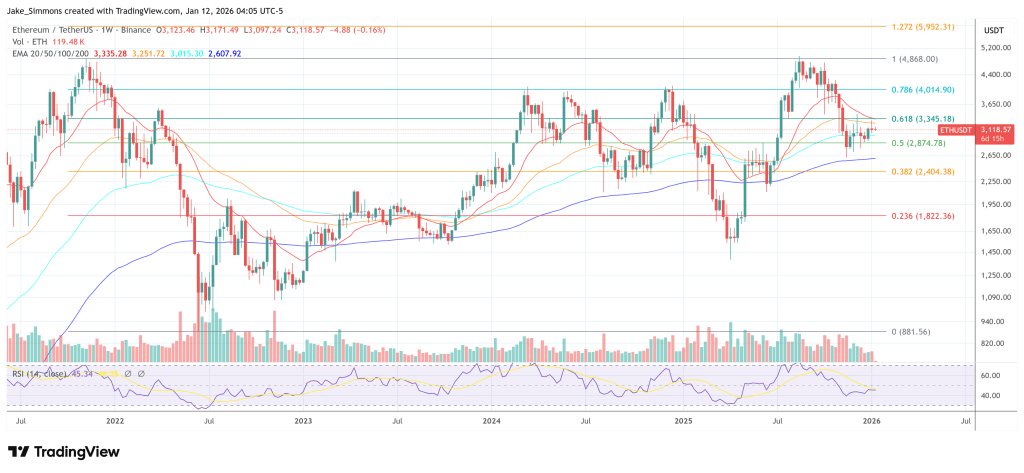
ETH remains between the 0.5 and 0.618 Fib, 1-week chart | Source: ETHUSDT on TradingView.com

Связанные с этим вопросы

QWhat are the three main design constraints that Vitalik Buterin says the next iteration of decentralized stablecoins on Ethereum must solve?

AThe three main design constraints are: 1) Identifying a stable index 'better than USD price' for long-term resilience, 2) Ensuring oracle security that is 'not capturable with a large pool of money', and 3) Solving the mechanical issue where staking yield competes with decentralized stablecoins for capital.

QAccording to Gabriel Shapiro, what is Ethereum increasingly a 'contrarian bet' against?

AAccording to Gabriel Shapiro, Ethereum is increasingly a 'contrarian bet' against what most crypto VCs are betting on, which he lists as 'gambling,' 'CeDeFi,' 'custodial stablecoins,' and 'neo-banks'.

QWhy does Buterin argue that 'financialized governance' is problematic for stablecoins?

AButerin argues that financialized governance is problematic because it has no defense/offense asymmetry, meaning it inherently trends toward systems that must continuously extract high levels of value from users to defend themselves, as the cost of capture must be greater than the protocol token's market cap to be stable.

QWhat two specific risks does Buterin highlight when discussing 'slashing risk' in the context of staking?

AButerin highlights that 'slashing risk' includes the risk of self-contradiction and the risk of being on the wrong side of an inactivity leak, which means engaging in or being affected by a 51% censorship attack.

QWhat is one potential solution Buterin maps out in the 'solution space' for the staking competition problem?

AOne potential solution Buterin maps out is compressing staking yield toward a 'hobbyist level' to reduce its competition with decentralized stablecoins for capital.

Похожее

At What Oil Price Would Systemic Market Risk Be Triggered?

Based on a UBS analysis, the key threshold for systemic risk in global markets is identified as $150 per barrel of oil. The report warns that breaching this level would trigger a dangerous negative feedback loop: soaring oil prices → resurgent inflation → tighter monetary policy → deteriorating financial conditions → collapsing demand → market panic. The impact of an oil shock is not linear but highly dependent on the initial economic vulnerability. In the current environment of high interest rates and weak growth, the damage from rising oil prices is significantly amplified. For instance, with a 40% baseline US recession probability, oil at $150 per barrel could cause an economic downturn nearly five times more severe than under milder conditions. UBS outlines two scenarios: in an ideal steady state, the US economy might withstand oil prices up to $200 per barrel. However, in a realistic risk scenario where financial markets react negatively, the critical threshold drops sharply to $150. At this level, three systemic pressures emerge: macroeconomic stagflation risks as central banks halt or reverse rate cuts; market-wide sell-offs due to compressed valuations and wider credit spreads; and a simultaneous slump in corporate profits and household consumption. The report cautions that markets are currently underestimating this nonlinear, cliff-like risk. While prices between $100-$130 may cause sector-specific stress, $150 represents a breaking point where localized damage transforms into a full-blown systemic crisis, accelerated by vanishing policy flexibility and collapsing market confidence.

marsbit1 ч. назад

At What Oil Price Would Systemic Market Risk Be Triggered?

marsbit1 ч. назад

Торговля

Спот
Фьючерсы

Популярные статьи

Manyu: восходящая мем-звезда на Ethereum, готовая открыть новую эру культуры Shiba

Manyu - это мемтокен на Ethereum, который приносит децентрализованную культурную и развлекательную ценность через вирусное влияние в соцсетях и вовлечённость сообщества.

1.8k просмотров всегоОпубликовано 2025.11.27Обновлено 2025.11.27

Manyu: восходящая мем-звезда на Ethereum, готовая открыть новую эру культуры Shiba

Обсуждения

Добро пожаловать в Сообщество HTX. Здесь вы сможете быть в курсе последних новостей о развитии платформы и получить доступ к профессиональной аналитической информации о рынке. Мнения пользователей о цене на ETH (ETH) представлены ниже.

活动图片