Strive Deepens Bitcoin Bet With Fresh 1,109 BTC Purchase

bitcoinistPublished on 2026-05-28Last updated on 2026-05-28

Abstract

Strive Asset Management has increased its Bitcoin holdings by purchasing an additional 1,109 BTC, bringing its total to 16,500 BTC valued at roughly $1.3 billion. This move solidifies its position as the seventh-largest public company by Bitcoin treasury. The firm is expanding in the "digital credit" sector, notably through its SATA preferred shares which offer a 13% annualized dividend paid daily. Meanwhile, rival firm Strategy's STRC product, a dominant Bitcoin-backed security, recently saw a record $1.53 billion in daily trading volume. Strive continues to use equity-linked financing, including stock sales, to fund further Bitcoin acquisitions.

Jeff Walton thinks the idea is almost too simple. The chief risk officer at Strive Asset Management said this week that Bitcoin-backed securities could reshape how people think about money and credit — and that skepticism around the sector partly stems from how straightforward the concept seems.

A Growing Class Of Yield-Bearing Products

Strive is not alone in betting on that idea. The Dallas-based firm has joined a field of companies issuing preferred securities tied to Bitcoin treasury holdings, a category that issuers are calling “digital credit.”

Strategy, the world’s largest corporate Bitcoin holder, offers four such products: STRC, STRD, STRF, and STRK, with STRC emerging as the dominant instrument since its launch in July 2025.
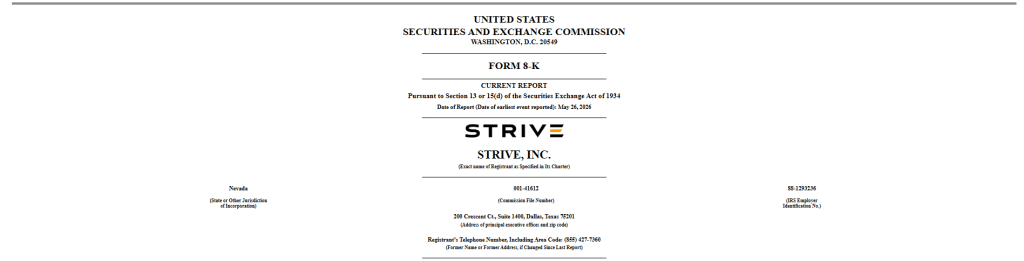
Strive added 1,109 BTC, boosting its holdings to 16,500 Bitcoin. Source: SEC

Strive’s own entry into that space, its SATA preferred shares, carries a 13% annualized dividend rate and was described by the company as the first listed US security structured to pay dividends every business day.

The firm recently cleared all outstanding debt and announced that daily dividend payments on SATA would begin in June. SATA’s market capitalization currently sits at around $332 million, a fraction of STRC’s more than $10 billion.

BTCUSD now trading at $75,238. Chart: TradingView

Strive Climbs The Bitcoin Treasury Rankings

The fresh purchase puts Strive at 16,500 BTC total, according to a Securities and Exchange Commission filing covering the period of May 19 to 22.

At current valuations, that positions the firm seventh among public companies holding Bitcoin on their balance sheets, with roughly $1.3 billion in BTC.

The company also reported about $93 million in cash and cash equivalents as of May 22, along with approximately $50.1 million in fair value tied to its holdings of Strategy’s STRC product.

Strive also grew its Class A common shares outstanding by more than 2 million during the period, while SATA preferred share count rose by about 515,000, reflecting continued use of equity-linked financing to fund Bitcoin acquisitions.

The company said it is evaluating refreshed at-the-market stock sale programs that could support further purchases.

The Broader Digital Credit Push

STRC recorded a single-day trading volume of $1.53 billion earlier this month, a record for the product. Strategy chairman Michael Saylor called STRC the company’s main vehicle for funding Bitcoin purchases in 2026, and shareholders are set to vote soon on a proposal to shift dividend payments to twice monthly.

Strive was founded by Vivek Ramaswamy, who ran for US president before pivoting to a Republican gubernatorial campaign in Ohio.

Featured image from Getty Images, chart from TradingView

Related Questions

QHow many Bitcoin did Strive purchase in the recent transaction mentioned in the article?

AStrive purchased 1,109 Bitcoin in the recent transaction.

QWhat is the name of Strive's listed US security that pays daily dividends and what is its annualized dividend rate?

AThe security is called SATA preferred shares, and it carries a 13% annualized dividend rate.

QAccording to the article, what ranking does Strive now hold among public companies for Bitcoin holdings after its latest purchase?

AAfter its latest purchase, Strive is ranked seventh among public companies holding Bitcoin on their balance sheets.

QWhat is the record single-day trading volume achieved by Strategy's STRC product as mentioned in the article?

ASTRC recorded a single-day trading volume of $1.53 billion earlier in the month, which is a record for the product.

QWho founded Strive Asset Management, and what was his previous political activity?

AStrive was founded by Vivek Ramaswamy, who previously ran for US president and later pivoted to a Republican gubernatorial campaign in Ohio.

Related Reads

The Truth About Global Payments, Exposed by Airwallex

Airwallex's founder, Jack Zhang, outlines the three primary paths in the global payments industry and explains why the company chooses the most demanding one: building its own global financial infrastructure. The article begins by highlighting a common industry problem: payment platforms appear homogenized on the surface, offering similar features like global acquiring and multi-currency accounts. However, their underlying capabilities differ vastly. Customers truly care about payment stability, compliance robustness, and reliable market entry support. Zhang identifies three strategic paths: 1. **Bypassing Traditional Systems (Web3/Crypto):** This path promises efficiency via stablecoins and blockchain settlement but struggles with mainstream adoption, significant regulatory friction, and a lack of competitive edge against established players, often leaving it with niche or non-compliant markets. 2. **Packaging Existing Infrastructure:** The most common route, where companies layer a modern interface over legacy banking and partner networks. While enabling fast expansion, it fails to solve core issues like dependency on correspondent banks and intermediary risk, merely postponing the need for solid foundations. 3. **Building Own Global Infrastructure:** The path chosen by Airwallex, Ant International, and others. It involves obtaining local licenses, establishing direct regulatory relationships, building local teams, and controlling the full technology stack. This "heavy" approach is slow and capital-intensive but aims to internalize complexity, providing customers with a "lighter" experience. The core argument is that for business clients, the highest cost isn't transaction fees but hidden risks like frozen accounts, payment delays, and regulatory shocks. By investing heavily in its own infrastructure, Airwallex seeks to absorb these complexities, offering customers greater stability, cost savings (beyond fees), and long-term certainty. This foundational investment, though initially slow, enables compound growth, as evidenced by Airwallex's accelerated revenue scaling. In conclusion, while shortcuts enable faster growth, mastering the most difficult aspects—owning the underlying infrastructure—creates durable value for customers and sustainable advantage for the payment provider.

marsbit3h ago

The Truth About Global Payments, Exposed by Airwallex

marsbit3h ago

The Truth About Global Payments, Revealed by Airwallex

The article discusses Airwallex's approach to global payments, highlighting the key challenges and different strategic paths in the industry. It begins by addressing common user questions about platform reliability, cryptocurrency payments, and the necessity of Airwallex's "heavy" infrastructure model. The core argument is that while many payment platforms appear similar on the surface—offering features like global acquiring and multi-currency accounts—their underlying capabilities differ drastically. The piece identifies three primary paths for global payment providers: 1. **Bypassing Traditional Infrastructure (Web3/Crypto):** This path promises efficiency through stablecoins and on-chain settlements but faces significant regulatory hurdles and offers little advantage over established players for mainstream use, often serving only niche or non-compliant markets. 2. **Aggregating/Packaging Existing Infrastructure:** The most common route, where companies layer a better user experience over legacy banking and partner networks. While fast to market, this approach does not solve fundamental issues like dependency on intermediaries, correspondent banking risks, and compliance fragility. 3. **Building Proprietary Global Infrastructure:** The path chosen by Airwallex and similar firms. This involves obtaining local licenses, building direct regulatory relationships, establishing local teams, and controlling the compliance and technology stack. This is the most difficult and capital-intensive route but aims to internalize complexity. Airwallex's strategy of "heavy" investment in its own infrastructure is framed not as inefficiency, but as a long-term bet to provide clients with greater stability, cost savings beyond fees, and certainty. The platform's "heaviness" absorbs risk and operational complexity, aiming to deliver a "lighter" experience for business customers. The article concludes that in global payments, while shortcuts enable faster growth, mastering the most difficult aspects—the underlying infrastructure—is what creates durable value for clients and sustainable competitive advantage.

链捕手3h ago

The Truth About Global Payments, Revealed by Airwallex

链捕手3h ago

Trading

Spot
Futures
活动图片