Circle’s Stablecoin Infrastructure Just Got A Major European Upgrade — And It’s Already Processing Trillions

bitcoinistPublished on 2026-05-28Last updated on 2026-05-28

Abstract

Orbital, a global payment orchestration platform, has partnered with Banking Circle, a fully MiCA-compliant bank, as its primary European banking partner to expand stablecoin settlement and multi-currency payment capabilities. This integration connects Orbital's platform directly to Banking Circle's infrastructure, which processes over €1.5 trillion annually. The partnership provides Orbital's clients with instant, 24/7 two-way conversion between fiat currencies and stablecoins like USDC, USDG, and EURI. It also consolidates access to SEPA, named IBANs, and compliance checks into a single layer. Banking Circle's unique simultaneous holding of banking, electronic money token, and Crypto-Asset Service Provider licenses in Luxembourg positions it as a comprehensively regulated EU digital asset settlement bank. This collaboration arrives as Europe's MiCA regulation is enforced, offering institutional clients a unified regulatory framework for both stablecoin and traditional payment operations.

Orbital, a global payment orchestration platform connecting stablecoin and traditional payment rails, has selected Banking Circle as its primary banking partner to expand stablecoin settlement and multi-currency payment capabilities across Europe — a partnership that plugs Orbital directly into a fully MiCA-compliant infrastructure already processing more than €1.5 trillion annually across 750 financial institutions.

The partnership, announced May 28 via PR Newswire, connects Orbital’s payment orchestration layer to Banking Circle’s newly activated stablecoin settlement services — capabilities the Luxembourg-based bank launched on April 27, 2026, following its receipt of a Crypto-Asset Service Provider license from Luxembourg’s Commission de Surveillance du Secteur Financier on April 15, per Stablecoin Insider’s reporting of the bank’s announcement.

The timing is notable: Banking Circle became the first institution in Luxembourg to simultaneously hold banking, electronic money token, and CASP licenses — a regulatory trifecta that positions it as one of the most comprehensively licensed digital asset settlement banks in the European Union.
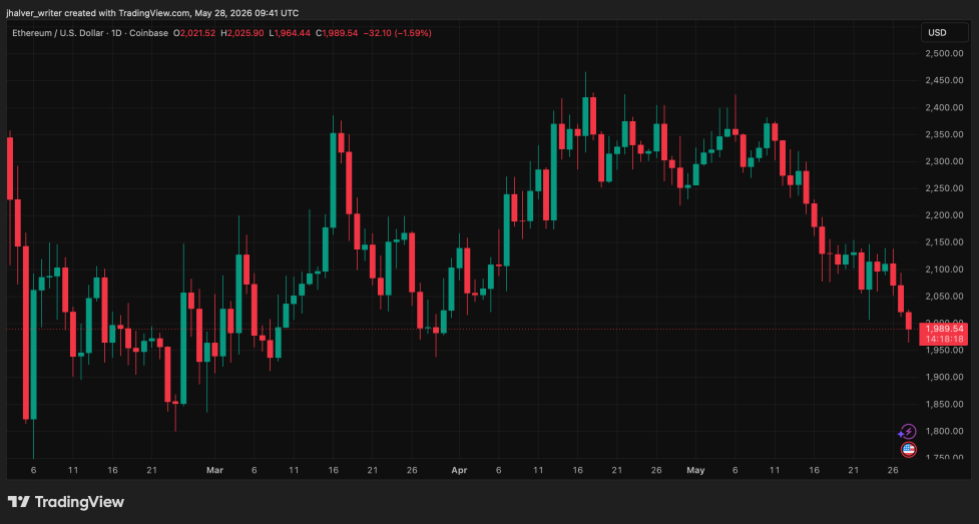
ETH's price trends to the downside on the daily chart. Source: ETHUSD on Tradingview

What The Integration With Circle Delivers

Through Banking Circle’s platform, Orbital gains access to instant two-way fiat-to-stablecoin and stablecoin-to-fiat settlement supporting Circle’s USDC, Paxos’ USDG, and Banking Circle’s own euro stablecoin EURI — all with 24/7 real-time execution directly from the bank’s core platform, per the PR Newswire announcement.

The integration removes a structural friction point that has historically complicated enterprise stablecoin adoption in Europe: the requirement to maintain separate relationships with multiple settlement counterparties across different jurisdictions and regulatory frameworks.

For Orbital’s enterprise clients — which include businesses managing cross-border payments across both stablecoin and traditional rails — the Banking Circle connection adds direct access to SEPA infrastructure, named IBANs, and full AML and KYC compliance checks within a single integrated payment layer, per the announcement.

The MiCA Context

The partnership arrives as Europe’s Markets in Crypto-Assets regulation enters its operational enforcement phase — creating both an opportunity and a compliance threshold that many payment infrastructure providers are scrambling to meet. Banking Circle’s simultaneous licensing across banking, EMT, and CASP categories means Orbital’s stablecoin settlement activity now operates under the same regulatory oversight framework that governs its traditional payment operations — a structural alignment that matters considerably for the institutional clients both companies serve.

The broader European stablecoin infrastructure buildout is accelerating in parallel. A consortium of twelve European banks including ING, UniCredit, and CaixaBank is advancing the Qivalis euro stablecoin project with a planned launch in the second half of 2026 — signaling that the institutional demand Orbital and Banking Circle are positioning to capture is expanding rapidly across the continent.

This development marks a pivotal moment for the nascent sector’s integration with Europe’s regulated financial infrastructure. A payment orchestration platform connecting stablecoin rails to a bank processing €1.5 trillion annually — under full MiCA oversight — is precisely the institutional plumbing the sector has been building toward, and its arrival suggests the gap between crypto payment infrastructure and traditional finance settlement is narrowing faster than most observers anticipated.

Cover image from Grok, ETHUSD chart from Tradingview

Related Questions

QWhat is the main purpose of the partnership between Orbital and Banking Circle announced in the article?

AThe partnership aims to expand Orbital's stablecoin settlement and multi-currency payment capabilities across Europe by connecting it to Banking Circle's MiCA-compliant infrastructure, which processes over €1.5 trillion annually.

QWhat regulatory achievement makes Banking Circle a uniquely positioned partner for digital asset settlement in the EU according to the article?

ABanking Circle is the first institution in Luxembourg to simultaneously hold banking, electronic money token (EMT), and Crypto-Asset Service Provider (CASP) licenses, making it one of the most comprehensively licensed digital asset settlement banks in the European Union.

QWhat stablecoins does the integration between Orbital and Banking Circle support for instant fiat conversion?

AThe integration supports instant two-way settlement for Circle's USDC, Paxos's USDG, and Banking Circle's own euro stablecoin, EURI.

QHow does the partnership address a key friction point for enterprise stablecoin adoption in Europe?

AIt removes the structural friction of needing separate relationships with multiple settlement counterparties across different jurisdictions by providing access to a single, integrated payment layer with full compliance checks.

QWhat broader trend in European finance does the article mention in relation to the Orbital-Banking Circle partnership?

AThe article mentions an accelerating European stablecoin infrastructure buildout, exemplified by the Qivalis euro stablecoin project involving twelve major banks, signaling rapidly expanding institutional demand across the continent.

Related Reads

The Truth About Global Payments, Exposed by Airwallex

Airwallex's founder, Jack Zhang, outlines the three primary paths in the global payments industry and explains why the company chooses the most demanding one: building its own global financial infrastructure. The article begins by highlighting a common industry problem: payment platforms appear homogenized on the surface, offering similar features like global acquiring and multi-currency accounts. However, their underlying capabilities differ vastly. Customers truly care about payment stability, compliance robustness, and reliable market entry support. Zhang identifies three strategic paths: 1. **Bypassing Traditional Systems (Web3/Crypto):** This path promises efficiency via stablecoins and blockchain settlement but struggles with mainstream adoption, significant regulatory friction, and a lack of competitive edge against established players, often leaving it with niche or non-compliant markets. 2. **Packaging Existing Infrastructure:** The most common route, where companies layer a modern interface over legacy banking and partner networks. While enabling fast expansion, it fails to solve core issues like dependency on correspondent banks and intermediary risk, merely postponing the need for solid foundations. 3. **Building Own Global Infrastructure:** The path chosen by Airwallex, Ant International, and others. It involves obtaining local licenses, establishing direct regulatory relationships, building local teams, and controlling the full technology stack. This "heavy" approach is slow and capital-intensive but aims to internalize complexity, providing customers with a "lighter" experience. The core argument is that for business clients, the highest cost isn't transaction fees but hidden risks like frozen accounts, payment delays, and regulatory shocks. By investing heavily in its own infrastructure, Airwallex seeks to absorb these complexities, offering customers greater stability, cost savings (beyond fees), and long-term certainty. This foundational investment, though initially slow, enables compound growth, as evidenced by Airwallex's accelerated revenue scaling. In conclusion, while shortcuts enable faster growth, mastering the most difficult aspects—owning the underlying infrastructure—creates durable value for customers and sustainable advantage for the payment provider.

marsbit3h ago

The Truth About Global Payments, Exposed by Airwallex

marsbit3h ago

The Truth About Global Payments, Revealed by Airwallex

The article discusses Airwallex's approach to global payments, highlighting the key challenges and different strategic paths in the industry. It begins by addressing common user questions about platform reliability, cryptocurrency payments, and the necessity of Airwallex's "heavy" infrastructure model. The core argument is that while many payment platforms appear similar on the surface—offering features like global acquiring and multi-currency accounts—their underlying capabilities differ drastically. The piece identifies three primary paths for global payment providers: 1. **Bypassing Traditional Infrastructure (Web3/Crypto):** This path promises efficiency through stablecoins and on-chain settlements but faces significant regulatory hurdles and offers little advantage over established players for mainstream use, often serving only niche or non-compliant markets. 2. **Aggregating/Packaging Existing Infrastructure:** The most common route, where companies layer a better user experience over legacy banking and partner networks. While fast to market, this approach does not solve fundamental issues like dependency on intermediaries, correspondent banking risks, and compliance fragility. 3. **Building Proprietary Global Infrastructure:** The path chosen by Airwallex and similar firms. This involves obtaining local licenses, building direct regulatory relationships, establishing local teams, and controlling the compliance and technology stack. This is the most difficult and capital-intensive route but aims to internalize complexity. Airwallex's strategy of "heavy" investment in its own infrastructure is framed not as inefficiency, but as a long-term bet to provide clients with greater stability, cost savings beyond fees, and certainty. The platform's "heaviness" absorbs risk and operational complexity, aiming to deliver a "lighter" experience for business customers. The article concludes that in global payments, while shortcuts enable faster growth, mastering the most difficult aspects—the underlying infrastructure—is what creates durable value for clients and sustainable competitive advantage.

链捕手4h ago

The Truth About Global Payments, Revealed by Airwallex

链捕手4h ago

Trading

Spot
Futures

Hot Articles

Discussions

Welcome to the HTX Community. Here, you can stay informed about the latest platform developments and gain access to professional market insights. Users' opinions on the price of S (S) are presented below.

活动图片