Bitcoin Exchange Reserves Plummet To Lowest Level – Why This May Not Be Bullish

bitcoinistPublished on 2026-03-21Last updated on 2026-03-21

Abstract

Bitcoin exchange reserves have hit a historic low of 2.72 million BTC, representing only 13.6% of the circulating supply. While this typically signals bullish sentiment as investors move assets to private wallets for long-term holding, a concerning withdrawal of approximately $600 million in stablecoin reserves over 48 hours suggests potential market liquidity issues. This pattern previously preceded significant market downturns. Despite Bitcoin's recent price struggles, including a drop to $60,000, whale wallets holding 100+ BTC have increased by 753 in three months, indicating continued accumulation by large investors. Bitcoin is currently trading around $70,600, with mixed short-term performance but a 5.95% gain over the past month.

The Bitcoin exchange reserve has recorded its lowest-ever value, which should represent a bullish development. However, recent stablecoin reserve activity highlights a point of concern.

Exchanges Now Hold Only 13% Of BTC Supply – Details

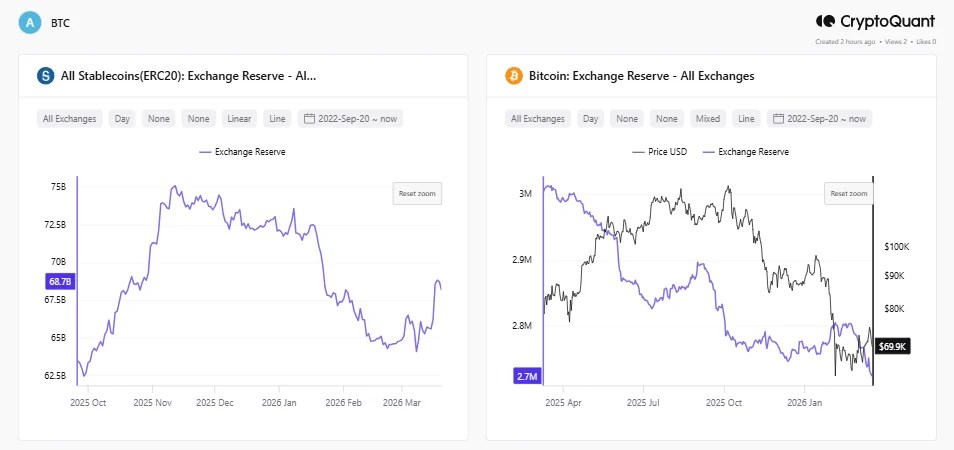
In a QuickTake post on CryptoQuant, APTRekt reports that only 2.72 million BTC is now available on crypto exchanges. This recorded figure represents 13.60% of the circulating BTC supply and is the lowest ever value of Bitcoin exchange reserves. APTRekt states Bitcoin reached this new all-time low of exchange reserves despite a dominant selling pressure between Wednesday and Thursday, triggered by a failed price breakout at the $75,000 region.

Typically, an increase in exchange deposits indicates a rise in investors’ readiness to offload their assets on the market. Conversely, a fall in exchange reserves is regarded as a positive development, which indicates that investors are opting to move their holdings into private wallets, showing long-term confidence and anticipation of price appreciation.
Source: CryptoQuant

Therefore, the new low in Bitcoin exchange reserve is to be regarded as a bullish event. However, coinciding developments in the stablecoin market paint a negative alternative scenario. Notably, Stablecoin exchange reserves were valued at $68.8 billion on March 18. However, present figures are reported to be around $68.2 billion, highlighting a withdrawal of approximately $600 million within 48 hours.

A similar flash transaction last occurred between January 18 and January 21, preceding a massive liquidity withdrawal from the cryptocurrency market. According to APTRekt, Bitcoin usually undergoes a massive downturn during such pullouts, putting the premier cryptocurrency in danger of another price downswing if the historical pattern plays out.

Bitcoin Whale Wallets Rise By 753 Despite Price Struggles

In other news, data from Santiment reveals that market whales, i.e., wallets holding 100 BTC or more, have increased by over 753 in the past three months. Notably, this bullish development comes amid a prolonged corrective phase during which the flagship cryptocurrency has traded as low as $60,000 with a net market loss of 20.2%.

Santiment explains that this accumulation trend is one of many bullish divergences amid the present short-term price volatility, which also reflects a sustained confidence among Bitcoin major investors. At press time, Bitcoin is valued at $70,600 after losses of 0.05% and 0.5% on the daily and weekly charts, respectively. Meanwhile, the digital asset reports a net gain of 5.95% in the past 30 days, suggesting that market action has been largely positive in recent weeks.

BTC trading at $70,619 on the daily chart | Source: BTCUSDT chart on Tradingview.com

Related Questions

QWhat is the current percentage of Bitcoin's circulating supply held on exchanges, and why is this typically considered a bullish sign?

AExchanges currently hold only 13.60% of the circulating Bitcoin supply, which is the lowest level on record. This is typically considered bullish because it indicates investors are moving their holdings to private wallets, showing long-term confidence and anticipation of price appreciation.

QWhat recent development in the stablecoin market contradicts the bullish signal from the low Bitcoin exchange reserves?

AStablecoin exchange reserves have decreased by approximately $600 million within 48 hours, dropping from $68.8 billion to around $68.2 billion. This large withdrawal is a point of concern as similar flash transactions have historically preceded massive liquidity withdrawals and Bitcoin price downturns.

QAccording to the article, what historical pattern suggests Bitcoin could be in danger of another price downswing?

AThe article states that a similar rapid withdrawal of stablecoin reserves occurred between January 18 and January 21, which preceded a massive liquidity withdrawal from the cryptocurrency market. Historically, Bitcoin has undergone a massive downturn during such stablecoin pullouts.

QDespite recent price struggles, what bullish divergence is occurring among large Bitcoin investors (whales)?

AData from Santiment shows that the number of whale wallets (holding 100 BTC or more) has increased by over 753 in the past three months. This accumulation trend indicates sustained confidence among major investors despite the short-term price volatility and corrective phase.

QWhat was Bitcoin's price and performance at the time of the report, according to the article?

AAt press time, Bitcoin was valued at $70,600. It had recorded losses of 0.05% and 0.5% on the daily and weekly charts, respectively. However, it reported a net gain of 5.95% over the past 30 days.

Related Reads

Abandoning Token Issuance, Abolishing veBAL: Can Balancer's 'All-or-Nothing Gamble' Bring Renewal?

Balancer, a veteran DeFi protocol, is undergoing a radical transformation following a major $120M security breach in November 2025 that accelerated its existing financial decline. With annual revenue of just $290K against a $2.87M operational budget, its DAO treasury was on track to be depleted within four years. TVL plummeted from a peak of $3B to under $160M. On March 23, 2026, the core team proposed two major overhauls: a tokenomics reform and an operational restructuring. The key strategy shifts from token emission-driven growth to a sustainable, fee-based model. Operational changes include dissolving Balancer Labs, reducing the team from 25 to 12.5 full-time equivalents, and cutting the annual budget by 34% to $1.9M. The protocol will focus solely on its core products: Boosted Pools, a revamped reCLAMM, and LBPs, while maintaining deployments only on Ethereum, Gnosis, Arbitrum, and Base. Tokenomics reforms are more drastic: BAL token emissions will stop immediately, and the veBAL governance system will be abolished. All protocol fees will now go entirely to the DAO treasury, and V3 protocol fees are reduced from 50% to 25% to attract LPs. A $500K compensation fund is allocated for veBAL holders. A crucial exit mechanism is proposed: a 12-week window, opening one year after the vote, allowing BAL holders to burn their tokens for stablecoins at a Net Asset Value (NAV) of $0.16 per BAL. If fully utilized, this could burn 35% of the circulating supply. The team projects that these changes could boost annual DAO revenue to $1.22M and extend the treasury's runway to 9 years. However, this survival depends heavily on the success of the streamlined operations and core products. This high-stakes gamble aims to secure a sustainable future for the protocol.

marsbit12m ago

Abandoning Token Issuance, Abolishing veBAL: Can Balancer's 'All-or-Nothing Gamble' Bring Renewal?

marsbit12m ago

Trading

Spot
Futures

Hot Articles

What is $BITCOIN

DIGITAL GOLD ($BITCOIN): A Comprehensive Analysis Introduction to DIGITAL GOLD ($BITCOIN) DIGITAL GOLD ($BITCOIN) is a blockchain-based project operating on the Solana network, which aims to combine the characteristics of traditional precious metals with the innovation of decentralized technologies. While it shares a name with Bitcoin, often referred to as “digital gold” due to its perception as a store of value, DIGITAL GOLD is a separate token designed to create a unique ecosystem within the Web3 landscape. Its goal is to position itself as a viable alternative digital asset, although specifics regarding its applications and functionalities are still developing. What is DIGITAL GOLD ($BITCOIN)? DIGITAL GOLD ($BITCOIN) is a cryptocurrency token explicitly designed for use on the Solana blockchain. In contrast to Bitcoin, which provides a widely recognized value storage role, this token appears to focus on broader applications and characteristics. Notable aspects include: Blockchain Infrastructure: The token is built on the Solana blockchain, known for its capacity to handle high-speed and low-cost transactions. Supply Dynamics: DIGITAL GOLD has a maximum supply capped at 100 quadrillion tokens (100P $BITCOIN), although details regarding its circulating supply are currently undisclosed. Utility: While precise functionalities are not explicitly outlined, there are indications that the token could be utilized for various applications, potentially involving decentralized applications (dApps) or asset tokenization strategies. Who is the Creator of DIGITAL GOLD ($BITCOIN)? At present, the identity of the creators and development team behind DIGITAL GOLD ($BITCOIN) remains unknown. This situation is typical among many innovative projects within the blockchain space, particularly those aligning with decentralized finance and meme coin phenomena. While such anonymity may foster a community-driven culture, it intensifies concerns about governance and accountability. Who are the Investors of DIGITAL GOLD ($BITCOIN)? The available information indicates that DIGITAL GOLD ($BITCOIN) does not have any known institutional backers or prominent venture capital investments. The project seems to operate on a peer-to-peer model focused on community support and adoption rather than traditional funding routes. Its activity and liquidity are primarily situated on decentralized exchanges (DEXs), such as PumpSwap, rather than established centralized trading platforms, further highlighting its grassroots approach. How DIGITAL GOLD ($BITCOIN) Works The operational mechanics of DIGITAL GOLD ($BITCOIN) can be elaborated on based on its blockchain design and network attributes: Consensus Mechanism: By leveraging Solana’s unique proof-of-history (PoH) combined with a proof-of-stake (PoS) model, the project ensures efficient transaction validation contributing to the network's high performance. Tokenomics: While specific deflationary mechanisms have not been extensively detailed, the vast maximum token supply implies that it may cater to microtransactions or niche use cases that are still to be defined. Interoperability: There exists the potential for integration with Solana’s broader ecosystem, including various decentralized finance (DeFi) platforms. However, the details regarding specific integrations remain unspecified. Timeline of Key Events Here is a timeline that highlights significant milestones concerning DIGITAL GOLD ($BITCOIN): 2023: The initial deployment of the token occurs on the Solana blockchain, marked by its contract address. 2024: DIGITAL GOLD gains visibility as it becomes available for trading on decentralized exchanges like PumpSwap, allowing users to trade it against SOL. 2025: The project witnesses sporadic trading activity and potential interest in community-led engagements, although no noteworthy partnerships or technical advancements have been documented as of yet. Critical Analysis Strengths Scalability: The underlying Solana infrastructure supports high transaction volumes, which could enhance the utility of $BITCOIN in various transaction scenarios. Accessibility: The potential low trading price per token could attract retail investors, facilitating wider participation due to fractional ownership opportunities. Risks Lack of Transparency: The absence of publicly known backers, developers, or an audit process may yield skepticism regarding the project's sustainability and trustworthiness. Market Volatility: The trading activity is heavily reliant on speculative behavior, which can result in significant price volatility and uncertainty for investors. Conclusion DIGITAL GOLD ($BITCOIN) emerges as an intriguing yet ambiguous project within the rapidly evolving Solana ecosystem. While it attempts to leverage the “digital gold” narrative, its departure from Bitcoin's established role as a store of value underscores the need for a clearer differentiation of its intended utility and governance structure. Future acceptance and adoption will likely depend on addressing the current opacity and defining its operational and economic strategies more explicitly. Note: This report encompasses synthesised information available as of October 2023, and developments may have transpired beyond the research period.

363 Total ViewsPublished 2025.05.13Updated 2025.05.13

What is $BITCOIN

Discussions

Welcome to the HTX Community. Here, you can stay informed about the latest platform developments and gain access to professional market insights. Users' opinions on the price of BTC (BTC) are presented below.

活动图片