NYDIG Says $1.3 Billion IBIT Trade Reveals Urgent Bitcoin ETF Exit

bitcoinist发布于2026-06-01更新于2026-06-01

文章摘要

A $1.26 billion off-exchange sale of BlackRock's spot Bitcoin ETF, IBIT, on May 26 is believed by NYDIG to be a large directional holder making an urgent exit rather than a basis-trade unwind. The seller accepted a $29.5 million discount (2.3% below market price) to execute the block trade of 29.21 million shares immediately, prioritizing speed and certainty. NYDIG's analysis points to a concentrated Bitcoin-linked position liquidation, citing the trade's size, price concession, and absence of corresponding CME futures activity typical of a basis trade unwind. The trade occurred amidst a backdrop of net outflows from spot Bitcoin ETFs and a deteriorating technical setup for Bitcoin, which had failed to break through key resistance. The transaction was executed under specific conditions allowing for a privately negotiated block sale. Despite IBIT reporting net redemptions around the same dates, NYDIG cautions that these figures do not directly measure the block trade's impact. The seller's identity and exact motivation remain unclear, but the event demonstrates a sophisticated investor's willingness to pay a significant premium for a rapid exit.

NYDIG says a $1.26 billion off-exchange sale of BlackRock’s spot Bitcoin ETF, IBIT, was most likely a large directional holder exiting fast, rather than a basis-trade unwind. The May 26 block trade stood out not only for its size, but for the $29.5 million discount the seller accepted to move the position immediately.

In its May 29 weekly Bitcoin digest, NYDIG’s Global Head of Research Greg Cipolaro examined the transaction in detail, arguing that the tape, holder data, ETF flows, and CME futures activity all point toward an urgent liquidation of a concentrated Bitcoin-linked position.

Bitcoin ETF Whale Pays $29.5M To Exit IBIT Fast

At 10:30:34 ET on May 26, a single counterparty sold 29.21 million IBIT shares at $43.16 per share through FINRA/Nasdaq TRF Carteret, one of the reporting facilities used for privately negotiated off-exchange trades. The block was worth roughly $1.26 billion. The sale price came in $1.01 below the prevailing market price of $44.17, a 2.3% concession worth about $29.5 million.

“The evidence is most consistent with a large directional holder exiting a concentrated position rather than a contemporaneous basis-trade unwind,” NYDIG wrote. “The transaction exceeded the reported position of every disclosed March 31, 2026, 13F holder, required an unusually large price concession, and was not accompanied by the CME futures activity that would be expected if a basis position were being unwound.”

The trade occurred against a weaker market backdrop for US spot Bitcoin ETFs. NYDIG noted that the category had entered May 26 after six straight sessions of net outflows beginning May 15. Over that stretch, spot Bitcoin ETFs lost approximately $1.55 billion, with IBIT accounting for about $1.1 billion of the total.

Bitcoin’s technical setup had also deteriorated. According to NYDIG, BTC had rallied into its descending 200-day moving average near $82,000 to $82,500 in early May but failed to break through. By mid-May, price had fallen back below the trendline, while the 14-day RSI slid from around 70 to the mid-30s. That failed breakout likely contributed to the ETF outflows that preceded the block sale.

The minutes before the trade showed a burst of activity. IBIT opened May 26 at $43.44 and traded normally during the first hour, before volume accelerated between 10:16 and 10:28 as the ETF moved from $43.81 to an intraday high of $44.24. The 10:26–10:27 and 10:27–10:28 intervals recorded 822,000 and 702,000 shares, respectively, about three to four times normal activity.

NYDIG said the trade condition codes also mattered. The transaction was marked as an off-exchange TRF trade, carried a Rule 611 trade-through exemption, and was designated as an Intermarket Sweep Order. In practice, those conditions point to a privately negotiated block designed to prioritize execution certainty over price improvement.

“Taken together, the designations indicate a negotiated off-exchange block transaction executed under trade-through exemptions and sweep procedures that allowed the seller to prioritize certainty of execution over price improvement,” NYDIG wrote.

That urgency is central to NYDIG’s conclusion. A 20,000-share trade printed seconds earlier at $44.17, confirming that the $43.16 price was specific to the block rather than a broader market move. IBIT then rebounded to roughly $44.06 within the next minute before sliding later in the session and closing at $42.99.

NYDIG also pushed back on the idea that the trade was a delta-neutral basis unwind. A 29.21 million-share IBIT position represented approximately 18,500 BTC of exposure, equivalent to around 3,700 CME Bitcoin futures contracts. Total CME Bitcoin futures volume that day was about 8,630 contracts, but the 10:30–10:31 interval saw only 91 contracts, and the adjacent minute saw 93. Even the full 10:30–11:00 window accounted for only about 1,070 contracts.

“A simultaneous basis unwind of this size would have represented approximately 43% of total daily CME volume and likely produced a visible spike in futures activity,” NYDIG wrote. “No such activity occurred.”

The firm also cautioned against reading IBIT’s reported $720 million of net redemptions across May 26 and May 27 as a direct measure of the block trade. ETF creations and redemptions can obscure simultaneous gross activity, and IBIT’s reported NAVs of $42.955 and $42.431 on those dates were both below the $43.16 block price.

The seller remains unidentified. NYDIG said public data cannot conclusively determine whether the exit reflected forced constraints, such as investor redemptions or risk limits, or a discretionary investment call. What the trade does show, however, is that one sophisticated holder was willing to pay nearly $30 million for speed.

At press time, BTC traded at $72,891.
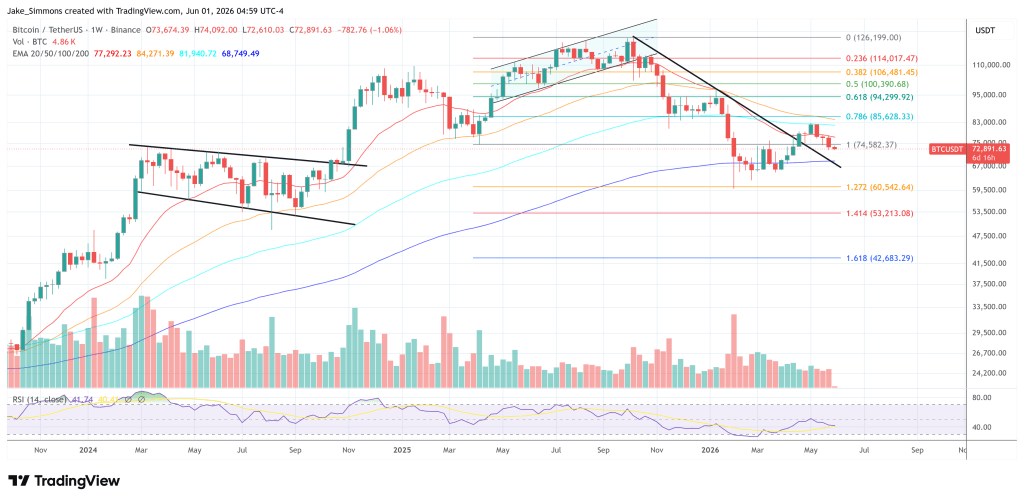
Bitcoin hovers below the 1.0 Fib, 1-week chart | Source: BTCUSDT on TradingView.com

相关问答

QAccording to NYDIG's analysis, what was the most likely reason for the $1.26 billion IBIT block trade on May 26?

ANYDIG concluded the trade was most likely a large directional holder urgently exiting a concentrated Bitcoin-linked position, rather than a delta-neutral basis trade unwind. The evidence pointed to a seller prioritizing execution certainty and accepting a significant price discount for speed.

QWhat key evidence did NYDIG cite to argue against the trade being a basis-trade unwind?

ANYDIG cited the lack of corresponding activity in CME Bitcoin futures. An unwind of that size (equivalent to ~3,700 futures contracts) would have represented a significant portion of daily volume and likely caused a visible spike, but no such spike occurred in the relevant time windows.

QWhat market conditions preceded the large IBIT block trade?

AThe trade occurred after six straight sessions of net outflows from US spot Bitcoin ETFs, totaling approximately $1.55 billion, with IBIT itself seeing about $1.1 billion in outflows. Bitcoin's price had also failed to break through its descending 200-day moving average, and its RSI had weakened.

QWhat specific trade conditions indicated the seller's urgency to execute the block trade?

AThe trade was executed off-exchange (TRF), carried a Rule 611 trade-through exemption, and was designated as an Intermarket Sweep Order. These conditions point to a privately negotiated block designed to prioritize execution certainty over obtaining a better price.

QHow much of a discount did the seller accept to execute the $1.26 billion IBIT trade immediately, and what was its value?

AThe seller accepted a price of $43.16 per share, which was $1.01 (a 2.3% discount) below the prevailing market price of $44.17. This price concession was worth approximately $29.5 million.

你可能也喜欢

Deepseek 能否为中国节省 1 万亿美元?

《DeepSeek 能否为中国节省 1 万亿美元?》一文探讨了DeepSeek如何通过技术创新,可能大幅降低中国AI基础设施的建设成本。 核心在于,AI硬件的成本正从计算芯片向昂贵的内存(如HBM)倾斜。DeepSeek通过三方面技术突破,系统性降低了对这类稀缺硬件的依赖: 1. **压缩“记性”**:采用多头潜在注意力(MLA)等技术,将长上下文对话所需的缓存(KV Cache)压缩至原来的极小部分,极大节省显存。 2. **按需唤醒“身体”**:利用混合专家(MoE)模型架构,每次只激活部分参数,并结合智能的存储调度,将多数参数移出昂贵显存。 3. **复用计算结果**:将算过的上下文作为缓存复用,用低成本的内存读取替代高成本的重复计算。 这些技术协同,使DeepSeek V4等模型在长上下文场景下,用同等硬件可能产出数倍的有效Token,等效于大幅提升硬件效率、摊薄单位成本。 文章据此进行推演:到2030年,全球AI硬件投资预计达数万亿美元。若DeepSeek的技术路线能使中国未来AI基建的硬件需求等效减少75%,在日均Token消耗达到数千万亿级的规模时,节省的投资额可能接近1万亿美元(约7万亿元人民币),相当于少建数万座智算中心。 更重要的是,此举将产业价值从受制于人的尖端算力芯片,部分转移至中国已有所突破的存储芯片及系统工程领域,提升了供应链安全性。DeepSeek的意义不在于“消灭硬件”,而在于通过极致优化,降低行业对最昂贵、最稀缺硬件的边际依赖,让AI能力更普惠,重塑未来AI基建的账本。 (注:文中关于万亿节省的具体数字属于基于行业趋势的推演观点。)

marsbit1小时前

Deepseek 能否为中国节省 1 万亿美元?

marsbit1小时前

推翻主流治幻觉思路:元认知,才是大模型破幻觉的全新解法

谷歌研究院与特拉维夫大学联合发表论文,提出对抗大模型“幻觉”问题的新思路:与其追求让AI全知全能或过度拒答,不如培养其“元认知”能力,即让模型能够感知并诚实表达自身对每个答案的确信程度。 论文指出,当前主流方法存在局限:一味增加知识覆盖无法穷尽所有事实;而通过大幅拒答来降低错误率则会征收沉重的“实用性税”,牺牲大量本可正确回答的问题。核心原因在于模型缺乏“判别力”,难以精准区分具体问题的对错,导致校准良好但实用性低下。 论文重新定义了“幻觉”:问题不在于AI输出错误信息,而在于其“没有资格确定却以确定的语气给出错误信息”。因此,解决路径应是实现“忠实不确定性”——让AI语言表达的确信度与其内部状态的真实确信度对齐。这比消灭所有错误更可行,是一个依赖内部信号的闭环问题。 在AI代理(Agent)时代,元认知更为关键。没有它,Agent在调用外部工具(如搜索)时将陷入“盲飞”,无法智能决策何时需要搜索、如何评估信息可信度。 实现元认知面临几大挑战:“自举悖论”涉及用静态数据训练动态能力的困难;“对齐破坏信号”指RLHF等训练可能磨灭模型原有的内部不确定性信号;“因果性评估”则需区分真正的元认知与对其的表演。 论文建议,评估反幻觉方法应超越单一准确率指标,转而分析完整的“实用性-错误率权衡曲线”,并关注其在其他任务上的“附带损伤”。最终目标是让AI学会诚实地沟通其认知状态,从而在保留实用性的同时,将错误信息的危害降至最低,建立可靠信任。

marsbit1小时前

推翻主流治幻觉思路:元认知,才是大模型破幻觉的全新解法

marsbit1小时前

交易

现货
合约

热门文章

加密市场宏观研报:《GENIUS Act》法案取得重大进展,BTC突破历史新高,后市全新展望

2025年5月22日,比特币价格正式突破11万美元大关,创下历史新高。在政策面、宏观经济、资金面与投资者结构共同作用下,一场结构性牛市浪潮正在展开。而此轮上涨背后的核心驱动,是美国《GENIUS稳定币法案》的实质性进展以及多项利好的叠加。本文将从政策端突破、宏观环境转向、链上与ETF资金结构、交易行为演化,以及重点受益赛道五大维度,全面解析此轮BTC再创新高的深层逻辑,并前瞻下半年市场的潜在趋势。

1.6k人学过发布于 2025.05.22更新于 2025.05.22

加密市场宏观研报:《GENIUS Act》法案取得重大进展,BTC突破历史新高,后市全新展望

相关讨论

欢迎来到HTX社区。在这里,您可以了解最新的平台发展动态并获得专业的市场意见。以下是用户对BTC(BTC)币价的意见。

活动图片