Grayscale: After Halving, BTC is Nearing the Bottom of This Cycle

marsbitPublished on 2026-07-01Last updated on 2026-07-01

Abstract

Grayscale Research suggests Bitcoin's recent decline below $60,000, a >50% drop from its October peak, represents a cyclical correction within a long-term uptrend rather than a trend reversal. Key factors behind the pullback include a shift in market expectations toward Federal Reserve rate hikes under new Chair Kevin Warsh, uncertainty around the CLARITY Act's Senate passage, pressure on leveraged entities like Strategy, and concerns over quantum computing risks. The path out of the current bear market hinges on upcoming catalysts. An optimistic scenario, where the CLARITY Act passes, leverage is contained, and the Fed refrains from hiking, could mean Bitcoin is nearing its cycle bottom. A pessimistic scenario, featuring legislative failure, further deleveraging, and Fed rate hikes, could lead to additional moderate downside. Grayscale does not expect a historically deep ~80% drawdown due to a more measured prior bull run and stickier institutional demand. Despite short-term headwinds, Grayscale remains highly optimistic about crypto's long-term structural prospects, driven by institutional adoption of public blockchains, unsustainable government debt, declining trust in intermediaries, and AI's potential demand for alternative systems. The report concludes that while the exact cycle low depends on near-term catalysts, current valuations present an attractive entry point for long-term investors betting on the decade-ahead growth of digital assets.

Author: Zach Pandl (Head of Research, Grayscale)

Compiled by: Deep Chao TechFlow

Deep Chao Guide: Bitcoin fell below $60,000 this week, hitting a new low for this cycle. From the October peak of $125,000, it has now halved. Grayscale's Head of Research Zach Pandl puts this pullback into historical context, viewing it as another cyclical correction within a long-term uptrend, not a trend reversal. He outlines two scenarios for exiting the bear market: under an optimistic scenario, Bitcoin may already be nearing its bottom; under a pessimistic scenario, it could fall further. The key variables in this judgment are whether the Fed raises interest rates and whether the CLARITY Act can pass the Senate. This is a research report perspective, intended to aid holders in their directional judgment.

This week, Bitcoin fell below $60,000, setting a new low for this cycle. From the October peak of $125,000, Bitcoin has now dropped over 50%. In our view, this pullback is another periodic correction within Bitcoin's long-term uptrend (Chart 1).
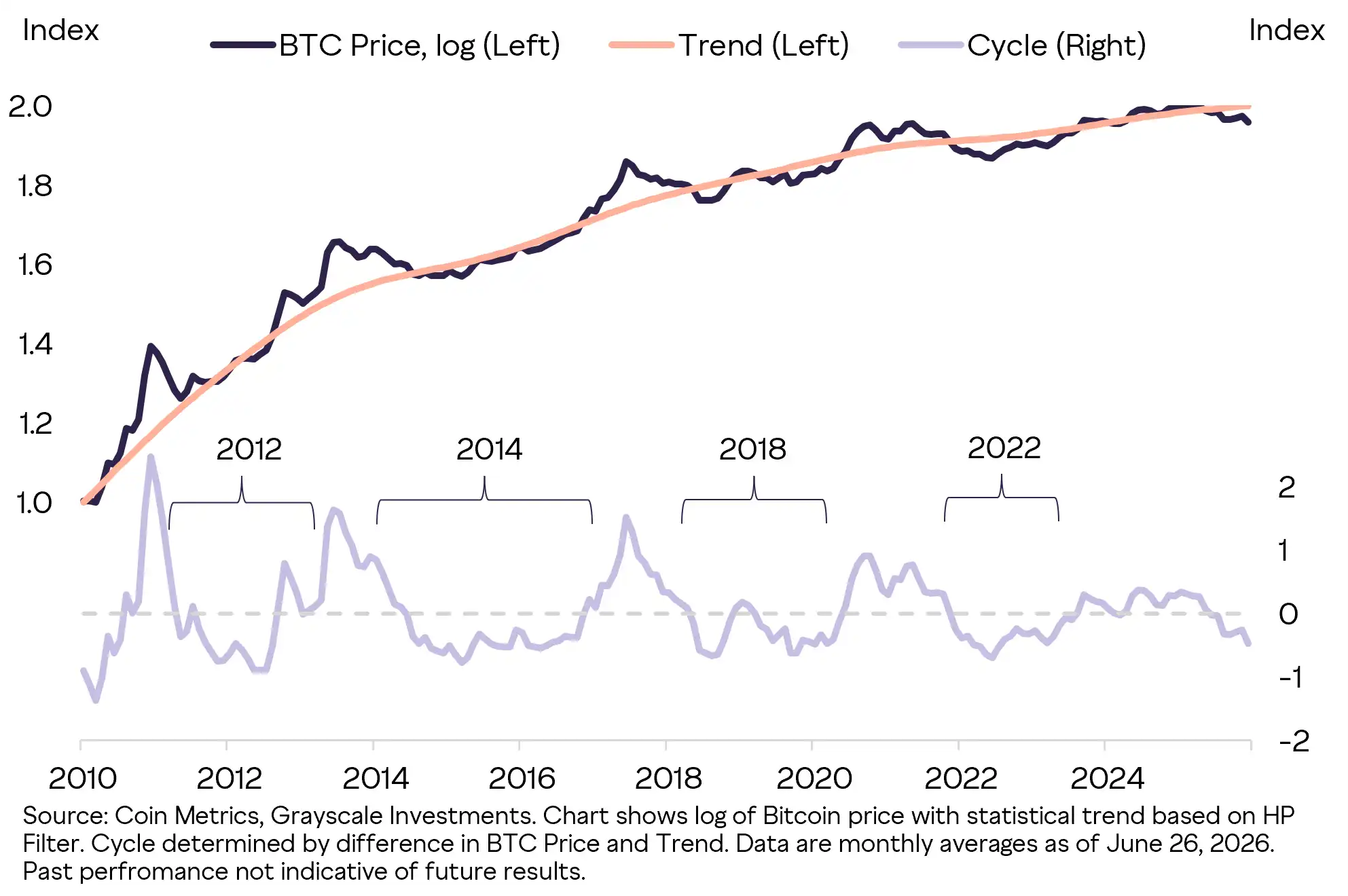
Chart 1: Bitcoin's pullback is just another cycle in the uptrend. The dark line is the Bitcoin price (logarithmic, left axis), the orange line is the statistical trend line based on an HP filter, and the light purple line is the cyclical deviation of the price from the trend (right axis). The cyclical lows from years 2012, 2014, 2018, and 2022 are marked, showing the current cyclical deviation has once again fallen below the zero line.

Source: Coin Metrics, Grayscale Investments, monthly averages through June 26, 2026. Past performance is not indicative of future results.

Several factors have suppressed Bitcoin's price in recent months. The most critical is the shift in market expectations for Fed policy, directly impacting the "money debasement trade" thesis. Late last year, prediction markets widely anticipated Trump would nominate the relatively dovish Kevin Hasset as Fed Chair. Instead, he nominated the relatively hawkish Kevin Warsh, who officially took office this month. Due to persistent inflation, markets now expect the Fed to hike rates this year, not cut (Chart 2). The spot price of gold, also competing with fiat currencies (like the US dollar), has fallen about 25% from its peak; after volatility adjustment, the decline is similar to Bitcoin's.1
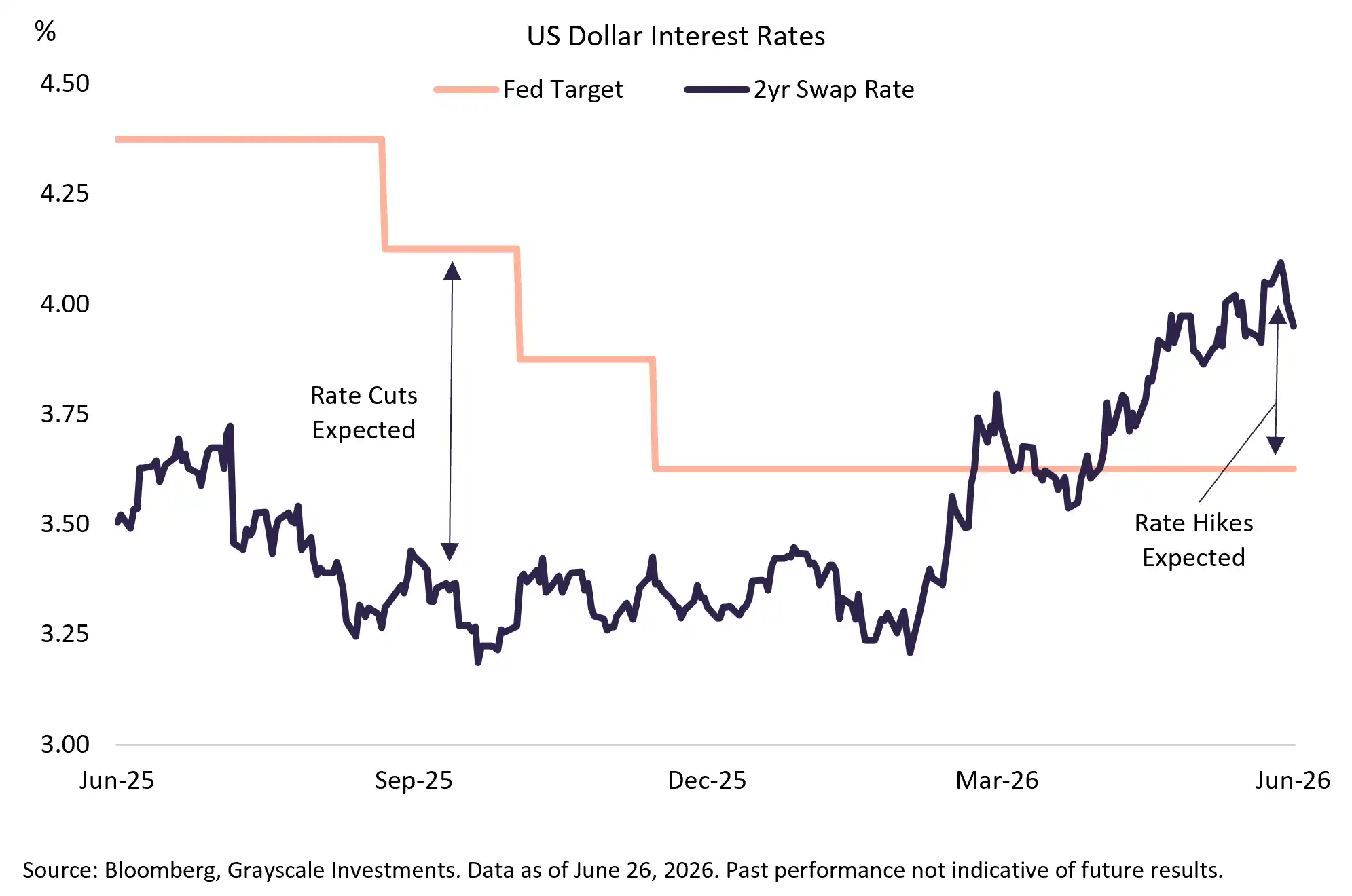
Chart 2: Markets now expect the Warsh-led Fed to hike rates. The orange line is the Fed target rate, the dark line is the 2-year swap rate. In the left half, swap rates were below the target rate (markets expecting cuts); after March 2026, swap rates surpassed the target rate and continued rising (markets expecting hikes).

Source: Bloomberg, Grayscale Investments, through June 26, 2026. Past performance is not indicative of future results.

Beyond the Fed's pivot, the crypto market is currently grappling with three other issues: uncertainty around the passage of the CLARITY Act; pressure on Strategy's leveraged balance sheet; and investor concerns about digital asset security risks from quantum computing.

Meanwhile, improving regulatory conditions continue to drive institutional adoption of public blockchain technology. We believe this is the most important structural trend for the digital asset market. Just this month, the CFTC approved the first perpetual futures contracts in the US, and the growth of stablecoins and tokenized assets will support many leading public chains. The broader social and political underpinnings for crypto assets also remain: unchecked expansion of government debt, declining public trust in intermediaries, and the rise of AI. AI may spur demand for alternative payment systems and technologies that safeguard human sovereignty.

Broadly, we see two paths for Bitcoin to exit this bear market (Chart 3). The base case scenario is: the CLARITY Act passes the Senate, Strategy takes measures to shore up its balance sheet, and the Fed refrains from raising rates. If upcoming developments move in this direction, Bitcoin's price may already be near a bottom. The downside scenario is: the CLARITY Act fails to pass this year, Strategy and other DATs (Digital Asset Treasury companies) further deleverage, and the Fed is forced to hike due to persistent inflation. If downside risks materialize, Bitcoin could still see a moderate decline. Historically, Bitcoin has fallen about 80% in several cycles, but we do not expect such a deep drawdown from peak to trough this cycle, due to the relatively restrained nature of this bull run and stickier institutional demand for digital assets.
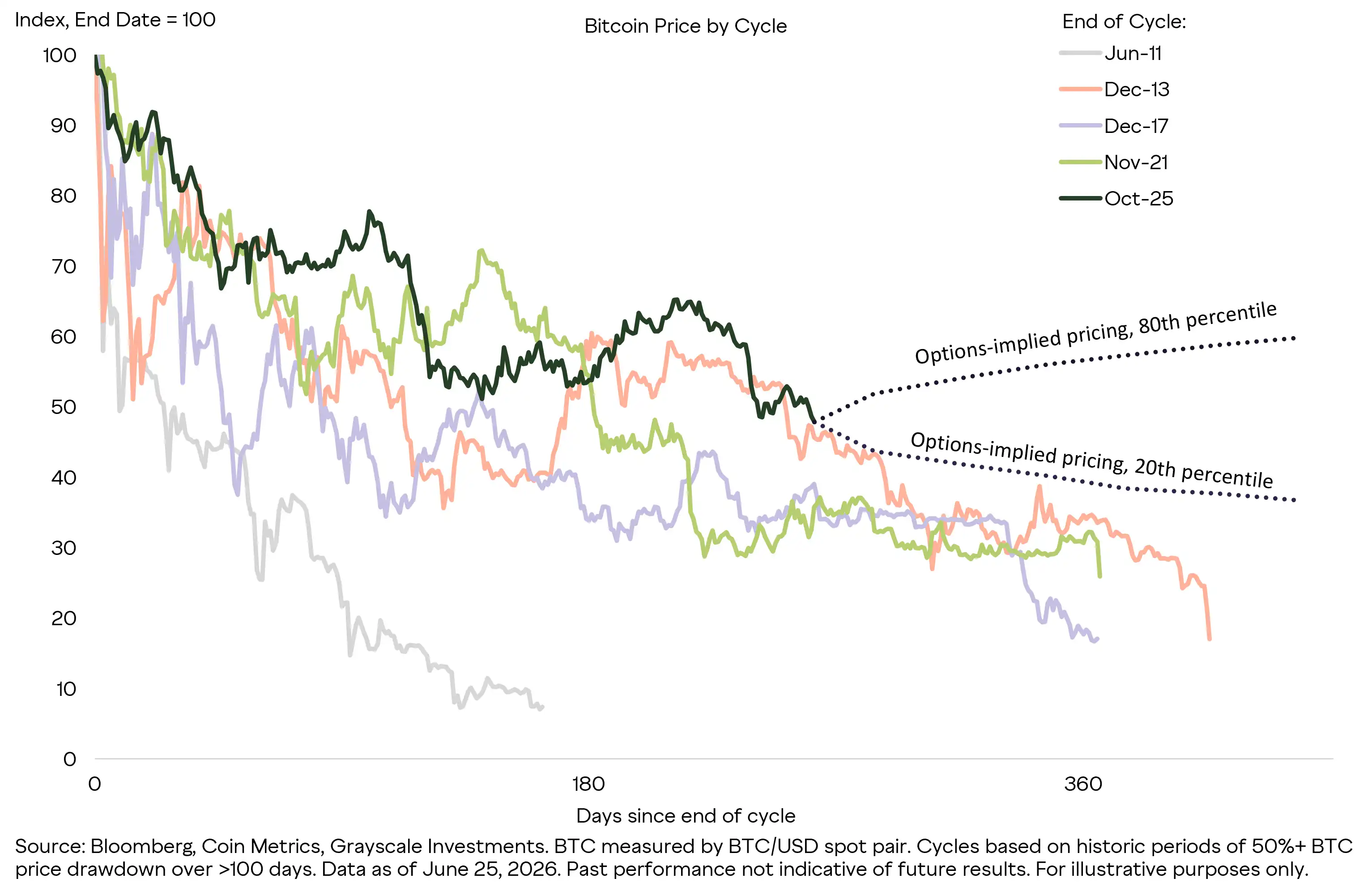
Chart 3: Two scenarios for Bitcoin exiting the latest bear market. The chart aligns historical cycle price movements to the same starting point (Cycle End Day = 100), with the x-axis being days after the cycle end. Gray is Jun-11, orange is Dec-13, purple is Dec-17, green is Nov-21, dark green is this cycle Oct-25. The two dashed lines on the right are the 80th and 20th percentile paths implied by options pricing, corresponding to the optimistic and downside scenarios mentioned above. The worst historical cycles (e.g., Jun-11, Dec-17) fell to levels of 10-20.

Source: Bloomberg, Coin Metrics, Grayscale Investments. Bitcoin priced in BTC/USD spot. Cycles defined as historical periods lasting over 100 days with declines exceeding 50%. Through June 25, 2026. Past performance is not indicative of future results, for illustrative purposes only.

The Grayscale Research team remains extremely bullish on the medium- to long-term prospects for crypto assets. It has been the best-performing asset class over the past decade2, and we believe it will remain so over the next decade. Investors will manage portfolio risk around short-term catalysts according to their individual needs. In our view, the current bear market offers long-term investors an excellent opportunity to position early, betting on the structural growth of public blockchain technology and digital asset valuations over the next decade.

Key Conclusion: Whether Bitcoin's price has seen the low for this cycle depends on upcoming catalysts, including the Fed's rate decisions and the progress of the CLARITY Act in the US Senate. We see many structural tailwinds for crypto assets and believe current valuations represent an attractive entry point for long-term investors.

1 Considering the difference in relative volatility between the two (22% for gold vs. 47% for Bitcoin over the past two years), gold's 25% decline roughly corresponds to a 40-50% decline for Bitcoin.

2 Asset classes represented by the following indices: S&P 500 Total Return Index (US Equities), Dow Jones US Real Estate Total Return Index (Real Estate), S&P/GSCI Total Return Index (Commodities), Bloomberg US Aggregate Bond Index (US Bonds), MSCI Emerging Markets Total Return Index (EM Equities), Bloomberg US Treasury Index (US Treasuries).


Trending Cryptos

Related Questions

QAccording to the article, what does Grayscale's research director believe the recent Bitcoin price decline represents in the context of its long-term trend?

AHe believes the recent decline is another periodic pullback within Bitcoin's long-term upward trend, not a trend reversal.

QWhat are the two key variables mentioned that are crucial for determining if Bitcoin has reached its cycle bottom?

AThe two key variables are the Federal Reserve's decision on interest rates (whether to hike) and the progress of the CLARITY Act in the U.S. Senate.

QWhat are the two primary scenarios outlined in the article for Bitcoin to exit the current bear market?

AThe optimistic scenario (Bitcoin may be near the bottom) involves the CLARITY Act passing the Senate, Strategy shoring up its balance sheet, and the Fed refraining from hiking rates. The pessimistic scenario (further moderate decline) involves the CLARITY Act failing, further deleveraging by Strategy and other DATs, and the Fed being forced to hike rates due to persistent inflation.

QWhy does the author argue that the potential drawdown in this cycle might not be as severe as the historical ~80% declines?

AThe author argues this because the preceding bull market was more restrained and institutional demand for digital assets is now more sticky, providing underlying support.

QDespite short-term headwinds, what major structural trend is cited as still positively driving institutional adoption and supporting digital assets?

AThe major structural trend cited is the continued improvement in the regulatory environment, which is driving institutional adoption of public blockchain technology, including recent CFTC approvals for perpetual futures and growth in stablecoins and tokenized assets.

Related Reads

YouTube Crypto Channel Views Drop 70% by 2026, Retail Attention Crisis Reshaping Next Cycle

Major cryptocurrency YouTube channels are experiencing a severe decline in viewership, signaling a potential crisis in retail investor attention for the next market cycle. Analysis of six top channels shows monthly view counts have plummeted 27% to 79% compared to January 2025, with four channels down approximately 75%. While subscriber counts remain high (e.g., Coin Bureau with 2.72M, Altcoin Daily with 1.65M), current engagement tells a different story. Recent 30-day view counts are significantly lower: Coin Bureau at 1.24M views, Crypto Banter at 1.06M, with Altcoin Daily and Benjamin Cowen performing relatively better at 1.79M and 1.8M respectively. The core issue is that subscriber numbers are cumulative and reflect past interest, while views measure current demand. The dramatic drop indicates a fragmented and more selective retail audience. This contrasts sharply with the 2021 bull market, where channels reportedly garnered 3-4 million daily views. Now, daily views for major channels range from roughly 35,000 to 60,000. This divergence suggests a new type of market cycle. Bitcoin's price can be sustained by ETFs and institutional activity, but without strong retail engagement via content channels, the dynamics of the next bull run will be fundamentally different. The real signal for a retail resurgence will be a sustained increase in daily and monthly view counts, not subscriber growth. If viewership fails to recover, long-form YouTube content may become a lagging indicator, with retail attention shifting to other, faster formats.

marsbit44m ago

YouTube Crypto Channel Views Drop 70% by 2026, Retail Attention Crisis Reshaping Next Cycle

marsbit44m ago

Confirmed: Claude Code Secretly Inspects Users, Time Zone and Chinese AI Labs Are Key Factors

Today was a significant day for Anthropic. The company announced the launch of Claude Sonnet 5, described as its most agentic model yet, and separately confirmed that the U.S. Department of Commerce has lifted export controls on its Claude Fable 5 and Mythos 5 models, allowing their distribution to resume. However, a separate controversy has emerged regarding its coding assistant, Claude Code. Developers have exposed that certain versions of the tool allegedly contain hidden code designed to detect specific user data. This code reportedly checks for the use of Chinese time zones (like Asia/Shanghai), the presence of custom API proxy URLs, and connections to domains associated with Chinese tech companies and AI labs. If triggered, this information is said to be encoded into the system prompt sent to the AI cloud, using subtle, nearly indistinguishable variations in characters (like different Unicode apostrophes in the "Today's date" line) as a form of steganography. The core issue is the covert nature of this data collection. While telemetry for security and abuse prevention is common, implementing it through hidden channels within the prompt—without user awareness or documented disclosure—fundamentally breaches trust. This is particularly sensitive for a coding assistant that operates with access to source code and system commands. Following the exposure, an Anthropic engineer acknowledged the code's existence and stated it would be removed in an upcoming release. The incident raises serious questions about transparency and the boundaries of data collection in AI developer tools.

marsbit1h ago

Confirmed: Claude Code Secretly Inspects Users, Time Zone and Chinese AI Labs Are Key Factors

marsbit1h ago

Web3 Bear Market Survival Guide: Ten Great Books to Help You Navigate the Cycles

"Web3 Bear Market Survival Guide: Ten Books to Help You Navigate the Cycle" This article presents a curated book list aimed at helping Web3 enthusiasts and professionals endure and grow during crypto market downturns. It argues that bear markets are not just periods of waiting but crucial times for deepening one's foundational understanding beyond technical whitepapers and price charts. The ten recommended books offer perspectives on technology, economics, philosophy, and strategy to build resilience and long-term vision. The list includes: 1. **"The Inevitable" by Kevin Kelly:** For using a long-term technological lens to combat uncertainty about the future, including the role of crypto and AI. 2. **"Human Action" by Ludwig von Mises:** To upgrade one's economic and philosophical framework, understanding action, speculation, and calculation in a bear market context. 3. **"The Nature of Technology" by W. Brian Arthur:** For viewing blockchain and crypto as combinatorial evolutions of existing technologies, understanding their modular and economic development. 4. **"The Distant Savior" (Chinese novel):** Explores the cultural attributes of self-reliance ("strong culture") versus dependency ("weak culture"), crucial for surviving industry cycles. 5. **"The Sovereign Individual" by James Dale Davidson & Lord William Rees-Mogg:** A prophetic 1997 work on how technology empowers individuals and challenges nation-states, foreshadowing Bitcoin's emergence. 6. **"Japanization: What the World Can Learn from Japan's Lost Decades" (Adapted title):** Uses Japan's economic history as a case study to identify structural opportunities that persist even during broader recessions. 7. **"Denationalisation of Money" by F.A. Hayek:** The ideological blueprint for Bitcoin, arguing for competitive currency issuance beyond state monopoly. 8. **"Duan Yongping Investment Q&A" (Chinese compilation):** Emphasizes the simple discipline of "doing the right things and doing things right," focusing on fundamentals and maintaining a "stop doing list." 9. **"The Network State: How To Start a New Country" by Balaji Srinivasan:** A visionary text from a crypto insider outlining bold predictions and concrete ideas for a blockchain-based future across media, governance, and identity. 10. **"Selected Works of Mao Zedong" (Vol. 1):** Analyzed as a strategic playbook for a weak force challenging a powerful establishment, offering lessons on strategy, alliance-building, and perseverance for the crypto movement. The conclusion states that bear markets filter out those with weak conviction, not weak skills. Survival depends on cognitive depth and mental fortitude, which these books aim to provide.

Foresight News2h ago

Web3 Bear Market Survival Guide: Ten Great Books to Help You Navigate the Cycles

Foresight News2h ago

Trump's 25-Year Financial Report: Family Earns Over $1 Billion Annually from Crypto, While Retail Investors Lose Money on $TRUMP

Former President Donald Trump's family earned approximately $1.2 billion from cryptocurrency ventures in 2025, according to a financial disclosure report. This revenue stream, outlined in a 927-page filing, now surpasses income from most of his long-established real estate holdings. The crypto earnings originated from two main sources: over $500 million from the sale of products like "governance tokens" by World Liberty Financial, a DeFi project co-owned by the Trump family, and roughly $635 million in royalties from the Trump-themed meme coin $TRUMP, issued by CIC Digital LLC. While Trump's entities profited, retail investors faced significant losses. The $TRUMP token, which peaked above $74 shortly after its January 2025 launch, has plummeted to around $1.68. World Liberty Financial's token has also fallen roughly 80% since its debut. Reports indicate that the majority of meme coin buyers have lost money, with Trump-linked entities still holding about 80% of $TRUMP's supply under vesting plans. The disclosure highlights a stark contrast: Trump's crypto and real estate businesses flourished—with new international property deals bringing in tens of millions—even as his administration shifted to crypto-friendly policies, relaxing the stringent regulatory stance of the previous Biden administration. The White House maintains that Trump acts only in the public interest, with his businesses placed in a trust managed by his sons, denying any conflict of interest. However, the report notes the difficulty of assessing such conflicts, particularly regarding foreign business dealings with countries that later received favorable U.S. policy decisions.

marsbit2h ago

Trump's 25-Year Financial Report: Family Earns Over $1 Billion Annually from Crypto, While Retail Investors Lose Money on $TRUMP

marsbit2h ago

Trading

Spot

Hot Articles

What is $BITCOIN

DIGITAL GOLD ($BITCOIN): A Comprehensive Analysis Introduction to DIGITAL GOLD ($BITCOIN) DIGITAL GOLD ($BITCOIN) is a blockchain-based project operating on the Solana network, which aims to combine the characteristics of traditional precious metals with the innovation of decentralized technologies. While it shares a name with Bitcoin, often referred to as “digital gold” due to its perception as a store of value, DIGITAL GOLD is a separate token designed to create a unique ecosystem within the Web3 landscape. Its goal is to position itself as a viable alternative digital asset, although specifics regarding its applications and functionalities are still developing. What is DIGITAL GOLD ($BITCOIN)? DIGITAL GOLD ($BITCOIN) is a cryptocurrency token explicitly designed for use on the Solana blockchain. In contrast to Bitcoin, which provides a widely recognized value storage role, this token appears to focus on broader applications and characteristics. Notable aspects include: Blockchain Infrastructure: The token is built on the Solana blockchain, known for its capacity to handle high-speed and low-cost transactions. Supply Dynamics: DIGITAL GOLD has a maximum supply capped at 100 quadrillion tokens (100P $BITCOIN), although details regarding its circulating supply are currently undisclosed. Utility: While precise functionalities are not explicitly outlined, there are indications that the token could be utilized for various applications, potentially involving decentralized applications (dApps) or asset tokenization strategies. Who is the Creator of DIGITAL GOLD ($BITCOIN)? At present, the identity of the creators and development team behind DIGITAL GOLD ($BITCOIN) remains unknown. This situation is typical among many innovative projects within the blockchain space, particularly those aligning with decentralized finance and meme coin phenomena. While such anonymity may foster a community-driven culture, it intensifies concerns about governance and accountability. Who are the Investors of DIGITAL GOLD ($BITCOIN)? The available information indicates that DIGITAL GOLD ($BITCOIN) does not have any known institutional backers or prominent venture capital investments. The project seems to operate on a peer-to-peer model focused on community support and adoption rather than traditional funding routes. Its activity and liquidity are primarily situated on decentralized exchanges (DEXs), such as PumpSwap, rather than established centralized trading platforms, further highlighting its grassroots approach. How DIGITAL GOLD ($BITCOIN) Works The operational mechanics of DIGITAL GOLD ($BITCOIN) can be elaborated on based on its blockchain design and network attributes: Consensus Mechanism: By leveraging Solana’s unique proof-of-history (PoH) combined with a proof-of-stake (PoS) model, the project ensures efficient transaction validation contributing to the network's high performance. Tokenomics: While specific deflationary mechanisms have not been extensively detailed, the vast maximum token supply implies that it may cater to microtransactions or niche use cases that are still to be defined. Interoperability: There exists the potential for integration with Solana’s broader ecosystem, including various decentralized finance (DeFi) platforms. However, the details regarding specific integrations remain unspecified. Timeline of Key Events Here is a timeline that highlights significant milestones concerning DIGITAL GOLD ($BITCOIN): 2023: The initial deployment of the token occurs on the Solana blockchain, marked by its contract address. 2024: DIGITAL GOLD gains visibility as it becomes available for trading on decentralized exchanges like PumpSwap, allowing users to trade it against SOL. 2025: The project witnesses sporadic trading activity and potential interest in community-led engagements, although no noteworthy partnerships or technical advancements have been documented as of yet. Critical Analysis Strengths Scalability: The underlying Solana infrastructure supports high transaction volumes, which could enhance the utility of $BITCOIN in various transaction scenarios. Accessibility: The potential low trading price per token could attract retail investors, facilitating wider participation due to fractional ownership opportunities. Risks Lack of Transparency: The absence of publicly known backers, developers, or an audit process may yield skepticism regarding the project's sustainability and trustworthiness. Market Volatility: The trading activity is heavily reliant on speculative behavior, which can result in significant price volatility and uncertainty for investors. Conclusion DIGITAL GOLD ($BITCOIN) emerges as an intriguing yet ambiguous project within the rapidly evolving Solana ecosystem. While it attempts to leverage the “digital gold” narrative, its departure from Bitcoin's established role as a store of value underscores the need for a clearer differentiation of its intended utility and governance structure. Future acceptance and adoption will likely depend on addressing the current opacity and defining its operational and economic strategies more explicitly. Note: This report encompasses synthesised information available as of October 2023, and developments may have transpired beyond the research period.

535 Total ViewsPublished 2025.05.13Updated 2025.05.13

What is $BITCOIN

Discussions

Welcome to the HTX Community. Here, you can stay informed about the latest platform developments and gain access to professional market insights. Users' opinions on the price of BTC (BTC) are presented below.

活动图片