Trump's 25-Year Financial Report: Family Earns Over $1 Billion Annually from Crypto, While Retail Investors Lose Money on $TRUMP

marsbitPublished on 2026-07-01Last updated on 2026-07-01

Abstract

Former President Donald Trump's family earned approximately $1.2 billion from cryptocurrency ventures in 2025, according to a financial disclosure report. This revenue stream, outlined in a 927-page filing, now surpasses income from most of his long-established real estate holdings. The crypto earnings originated from two main sources: over $500 million from the sale of products like "governance tokens" by World Liberty Financial, a DeFi project co-owned by the Trump family, and roughly $635 million in royalties from the Trump-themed meme coin $TRUMP, issued by CIC Digital LLC. While Trump's entities profited, retail investors faced significant losses. The $TRUMP token, which peaked above $74 shortly after its January 2025 launch, has plummeted to around $1.68. World Liberty Financial's token has also fallen roughly 80% since its debut. Reports indicate that the majority of meme coin buyers have lost money, with Trump-linked entities still holding about 80% of $TRUMP's supply under vesting plans. The disclosure highlights a stark contrast: Trump's crypto and real estate businesses flourished—with new international property deals bringing in tens of millions—even as his administration shifted to crypto-friendly policies, relaxing the stringent regulatory stance of the previous Biden administration. The White House maintains that Trump acts only in the public interest, with his businesses placed in a trust managed by his sons, denying any conflict of interest. However, the re...

Author: Claude, Deep Tide TechFlow

Deep Tide Guide: Trump's 2025 annual financial disclosure reveals his crypto businesses generated approximately $1.2 billion in revenue for the year, surpassing most of his real estate portfolio built over decades. The money flowed in from two main sources: World Liberty Financial's sales of new products like governance tokens brought in over $500 million, while another company, CIC Digital, earned about $635 million from royalties on the meme coin TRUMP. Meanwhile, TRUMP has fallen from its initial $74 at launch to $1.68, World Liberty Financial's token is down 80% from its opening price, leaving a large number of retail investors holding heavy bags.
In the first year of Trump's presidency, his crypto ventures have become his most lucrative businesses.

According to the Associated Press, the U.S. Office of Government Ethics released Trump's 2025 annual financial disclosure report on June 30th. This 927-page document shows that the Trump family's crypto operations brought in nearly $1.2 billion over the year. In contrast, former President Obama's final disclosure report was only 8 pages, President Biden's was 11 pages, and Vice President Vance's this year is 17 pages.

These crypto enterprises were just startups when Trump took office, but their revenue now exceeds most of the real estate portfolio Trump accumulated over decades. The AP report directly points out that their rise was fueled by several billionaire investors, and by Trump's policy shift halting the federal regulatory crackdown on the crypto industry.

Two Revenue Streams: World Liberty Financial Gets $500M+, $TRUMP Meme Coin Gets $635M

The $1.2 billion figure isn't from a single source; the disclosure document splits it into two parts.

The first part comes from World Liberty Financial, a DeFi project jointly held by the Trump family and real estate magnate Steve Witkoff, founded with the participation of Eric Trump and Donald Trump Jr. According to the AP, Trump received over $500 million from World Liberty Financial's sales of new crypto products, including "governance tokens." Unlike stocks, buying these tokens does not represent ownership in the company, only voting rights on certain corporate matters, and they are difficult to value—regulators had issued risk warnings before World Liberty Financial even began selling them. Furthermore, the disclosure document shows an additional over $290 million categorized as income from crypto wallets associated with World Liberty Financial, and over $65 million from the sale of equity in a World Liberty Financial holding company.
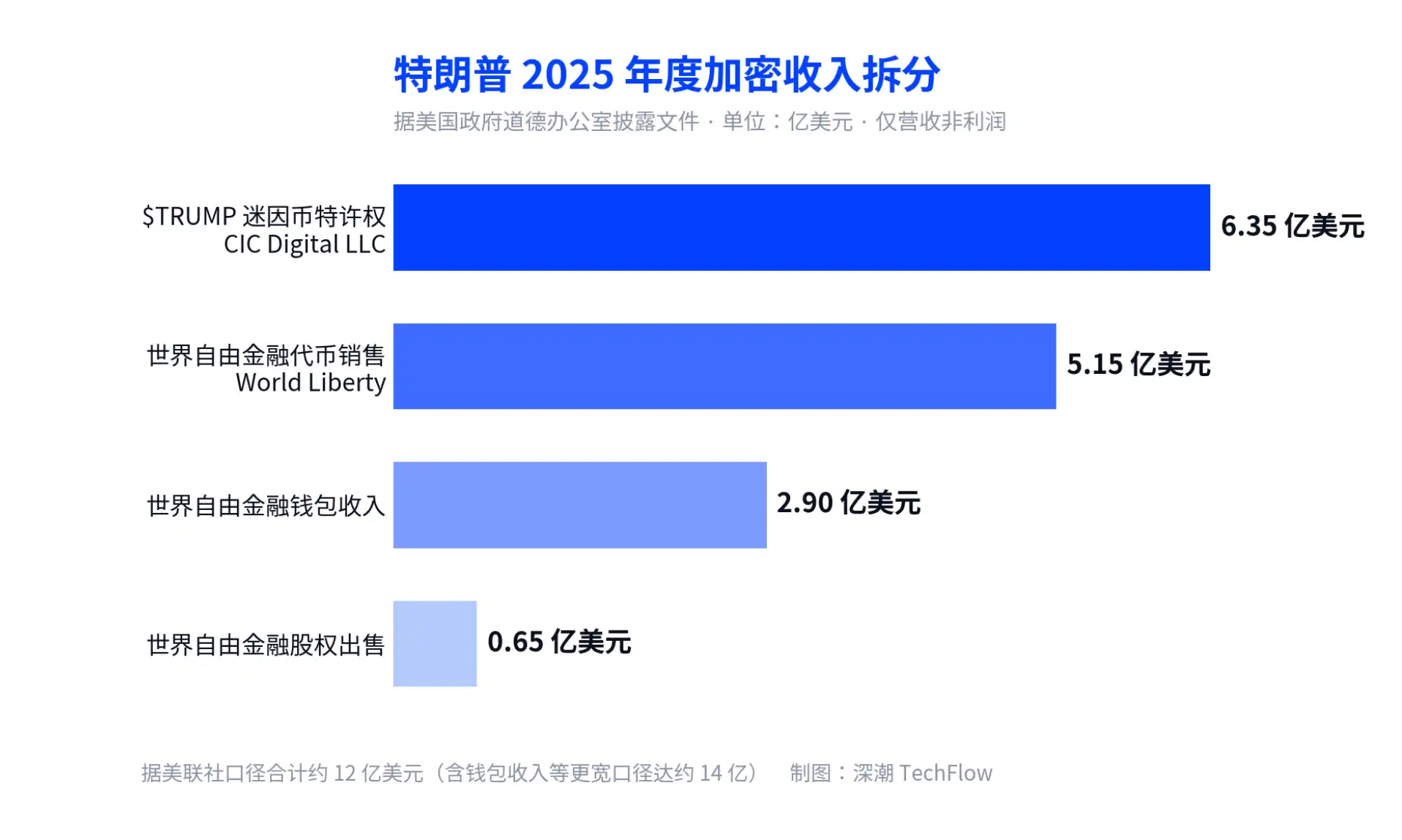
The second part comes from a company called CIC Digital LLC, which earned over $600 million selling commemorative-style "meme coins" featuring Trump's image. This refers to $TRUMP, the meme coin launched on the Solana blockchain just days before Trump's second inauguration in January 2025, listed in the disclosure document under the item "Celebration Coins," amounting to approximately $635 million, categorized as royalties.

It should be noted that the combined total of these two parts, around $1.1 to $1.2 billion, is the figure commonly cited in the market; if the aforementioned $290 million wallet income and $65 million equity sale are included, some media reports give a higher total, reaching into the $1.4 billion range. The total varies with the accounting method, but the conclusion that "crypto revenue exceeded $1 billion for the year" is undisputed.

Trump Rakes It In, While Retail Investors Holding the Bag Lose Money

The disclosure document only reports revenue, not profit, so it's impossible to know exactly how much net profit Trump made. However, the price movements of the tokens and meme coins paint a clear picture of the losses for those who bought in.

TRUMP soared above $74 shortly after launch but now trades at just $1.68. World Liberty Financial's token has fallen 80% since it began trading last September. According to independent data, the vast majority of meme coin buyers lost money, with around 80% of TRUMP's token supply still held by Trump-affiliated entities according to vesting schedules.

One prominent buyer among them is Chinese-born billionaire Justin Sun. According to the AP, he spent $75 million on World Liberty Financial's governance token WLFI and $200 million on meme coins. A federal lawsuit accusing him of defrauding investors, filed in February last year, was briefly paused and settled last month with a $10 million fine. Sun has consistently denied any connection between his spending on Trump's ventures and his federal case, and World Liberty Financial also denies any conflict of interest.

On one side, Trump locks in gains; on the other, retail investors get trapped.

Crypto Has Surpassed Real Estate, Becoming Trump's Signature Business

Trump entered the White House on the reputation of a real estate mogul, but now the rise of his crypto business has overshadowed real estate—a point worth noting especially because his real estate business also surged last year.

According to the AP, Trump collected tens of millions in fees last year from a batch of new overseas hotel, resort, and condominium projects, representing the largest real estate expansion in the century-old family business's history. Many of these countries are in negotiations with the U.S. on important matters like tariffs and military aid. A property in the UAE brought in $10.4 million, one in Saudi Arabia (built by a developer closely tied to the ruling family) wired $9 million to Trump's company, and properties in Bucharest, Romania, and Qatar each wired $5 million. Domestically, Mar-a-Lago brought in $77 million last year, a 50% jump from the year before he was president.

Forbes estimates Trump's net worth at $6 billion, up from $2.3 billion in 2024.

White House: Trump Acts Only in Public Interest, No Conflict of Interest

In response to conflict of interest concerns, the White House has repeatedly emphasized that Trump has placed his businesses in a trust managed by his sons, that no conflicts exist, and that he acts only in the national interest. Trump's umbrella company, The Trump Organization, claims its overseas deals are with private companies, not governments.

But the AP points out that in countries ruled by authoritarians, royal families, or one-party states, it's difficult to determine what qualifies as "private." Taking a new Trump resort in Vietnam as an example, the disclosure document shows Trump received $5 million from it last year, while according to The New York Times, Vietnam's ruling party sent a deputy prime minister to endorse the deal and displaced farmers from their land to make way for the project.

Whether these transactions have directly influenced U.S. policy adjustments is almost impossible to verify, but these countries have indeed gotten what they wanted: Vietnam secured tariff reductions, Qatar obtained previously restricted advanced U.S. technology, and Saudi Arabia received the American fighter jets it long coveted.

The regulatory thread remains. Before World Liberty Financial sold its governance tokens, regulators had warned about the risks of such new crypto assets. After taking office, Trump reversed the Biden administration's hardline stance towards the crypto industry, implementing industry-friendly policies instead—this disclosure document places both the relaxation of regulation and the family's over $1 billion crypto revenue on the same page.


Trending Cryptos

Related Questions

QAccording to the article, how much did Trump's family businesses earn from crypto-related activities in 2025, and what were the two main sources?

ATrump's family crypto businesses earned nearly $12 billion in 2025. The two main sources were: over $5 billion from World Liberty Financial's sale of new crypto products like governance tokens, and approximately $635 million in royalties from the meme coin $TRUMP sold by CIC Digital LLC.

QWhat has been the price performance of the $TRUMP meme coin and World Liberty Financial's token since their launch, and what does this indicate about retail investors?

AThe $TRUMP meme coin, which initially reached over $74, is now trading at $1.68. World Liberty Financial's token has fallen 80% since it began trading. This indicates that most retail investors who bought these tokens have suffered significant losses and are 'locked in' their positions.

QHow does the revenue from Trump's crypto businesses compare to his traditional real estate portfolio, and what other notable change occurred in his real estate income?

AThe revenue from Trump's crypto businesses now surpasses that of most of his decades-old real estate portfolio. Furthermore, his real estate business also experienced major growth, with new overseas projects bringing in tens of millions and domestic properties like Mar-a-Lago seeing a 50% revenue increase.

QWhat is the White House's stated position regarding potential conflicts of interest between Trump's business dealings and his presidential duties?

AThe White House has repeatedly stated that Trump has placed his businesses in a trust managed by his sons, asserts there is no conflict of interest, and claims he acts only in the public interest. The Trump Organization adds that its overseas deals are with private companies, not governments.

QWhat major policy shift regarding cryptocurrency regulation did President Trump enact, and how is it linked to the financial disclosures discussed in the article?

APresident Trump reversed the Biden administration's tough stance on the crypto industry, implementing industry-friendly policies. The financial disclosure report, showing his family earned over $10 billion from crypto, places this regulatory shift and the family's financial gain from the sector on the same page, highlighting a potential link.

Related Reads

Grayscale: After Halving, BTC is Nearing the Bottom of This Cycle

Grayscale Research suggests Bitcoin's recent decline below $60,000, a >50% drop from its October peak, represents a cyclical correction within a long-term uptrend rather than a trend reversal. Key factors behind the pullback include a shift in market expectations toward Federal Reserve rate hikes under new Chair Kevin Warsh, uncertainty around the CLARITY Act's Senate passage, pressure on leveraged entities like Strategy, and concerns over quantum computing risks. The path out of the current bear market hinges on upcoming catalysts. An optimistic scenario, where the CLARITY Act passes, leverage is contained, and the Fed refrains from hiking, could mean Bitcoin is nearing its cycle bottom. A pessimistic scenario, featuring legislative failure, further deleveraging, and Fed rate hikes, could lead to additional moderate downside. Grayscale does not expect a historically deep ~80% drawdown due to a more measured prior bull run and stickier institutional demand. Despite short-term headwinds, Grayscale remains highly optimistic about crypto's long-term structural prospects, driven by institutional adoption of public blockchains, unsustainable government debt, declining trust in intermediaries, and AI's potential demand for alternative systems. The report concludes that while the exact cycle low depends on near-term catalysts, current valuations present an attractive entry point for long-term investors betting on the decade-ahead growth of digital assets.

marsbit5m ago

Grayscale: After Halving, BTC is Nearing the Bottom of This Cycle

marsbit5m ago

Web3 Bear Market Survival Guide: Ten Great Books to Help You Navigate the Cycles

"Web3 Bear Market Survival Guide: Ten Books to Help You Navigate the Cycle" This article presents a curated book list aimed at helping Web3 enthusiasts and professionals endure and grow during crypto market downturns. It argues that bear markets are not just periods of waiting but crucial times for deepening one's foundational understanding beyond technical whitepapers and price charts. The ten recommended books offer perspectives on technology, economics, philosophy, and strategy to build resilience and long-term vision. The list includes: 1. **"The Inevitable" by Kevin Kelly:** For using a long-term technological lens to combat uncertainty about the future, including the role of crypto and AI. 2. **"Human Action" by Ludwig von Mises:** To upgrade one's economic and philosophical framework, understanding action, speculation, and calculation in a bear market context. 3. **"The Nature of Technology" by W. Brian Arthur:** For viewing blockchain and crypto as combinatorial evolutions of existing technologies, understanding their modular and economic development. 4. **"The Distant Savior" (Chinese novel):** Explores the cultural attributes of self-reliance ("strong culture") versus dependency ("weak culture"), crucial for surviving industry cycles. 5. **"The Sovereign Individual" by James Dale Davidson & Lord William Rees-Mogg:** A prophetic 1997 work on how technology empowers individuals and challenges nation-states, foreshadowing Bitcoin's emergence. 6. **"Japanization: What the World Can Learn from Japan's Lost Decades" (Adapted title):** Uses Japan's economic history as a case study to identify structural opportunities that persist even during broader recessions. 7. **"Denationalisation of Money" by F.A. Hayek:** The ideological blueprint for Bitcoin, arguing for competitive currency issuance beyond state monopoly. 8. **"Duan Yongping Investment Q&A" (Chinese compilation):** Emphasizes the simple discipline of "doing the right things and doing things right," focusing on fundamentals and maintaining a "stop doing list." 9. **"The Network State: How To Start a New Country" by Balaji Srinivasan:** A visionary text from a crypto insider outlining bold predictions and concrete ideas for a blockchain-based future across media, governance, and identity. 10. **"Selected Works of Mao Zedong" (Vol. 1):** Analyzed as a strategic playbook for a weak force challenging a powerful establishment, offering lessons on strategy, alliance-building, and perseverance for the crypto movement. The conclusion states that bear markets filter out those with weak conviction, not weak skills. Survival depends on cognitive depth and mental fortitude, which these books aim to provide.

Foresight News28m ago

Web3 Bear Market Survival Guide: Ten Great Books to Help You Navigate the Cycles

Foresight News28m ago

From 'Address Clustering' to 'Evidence Standards': Why is Chainalysis Redefining Blockchain Tracing?

**Summary:** In June 2026, Chainalysis introduced the **Blockchain Tracing Ontology (BTO)**, a proposed data framework aiming to establish standardized, transparent, and verifiable models for blockchain analysis. This initiative addresses a core industry issue: despite public blockchain data, different firms often produce inconsistent results (e.g., differing entity labels for the same address) due to non-uniform methodologies, particularly in **address clustering**. This lack of standardization poses challenges for judicial investigations, AML, and enforcement. The BTO is not a new clustering algorithm but a **common "language" or conceptual framework**. It moves beyond the simplistic "cluster" model by introducing a hierarchical structure: **Entity → Wallet → Wallet Segment → Address**, which better reflects complex organizational wallet management. A key shift is from presenting mere results to ensuring **process trust and explainability**. The framework emphasizes documenting the **Evidence** and **Confidence** behind each analytical claim—specifying the on-chain/off-chain data, rules applied, and certainty levels—enabling third-party verification. This focus is partly informed by legal precedents like the **Bitcoin Fog** case, where Chainalysis's methods underwent rigorous judicial scrutiny (Daubert hearing), highlighting the need for reproducible, scientifically sound analysis. The proposal clarifies that on-chain analysis identifies address relationships and flow patterns, not real-world identities, which still require off-chain evidence (e.g., KYC data). Ultimately, Chainalysis envisions steering the industry from an "experience-driven" to a **"standards-driven"** future, where competition centers on **data quality, analytical transparency, and judicial admissibility** rather than just label coverage. Widespread adoption could facilitate cross-agency collaboration, reduce disputes, and provide a more reliable foundation for global compliance and enforcement.

marsbit1h ago

From 'Address Clustering' to 'Evidence Standards': Why is Chainalysis Redefining Blockchain Tracing?

marsbit1h ago

The 'Conference Circuit' for the Second Half of the Year Begins! A Complete Overview of the 2026 Web3 Global Summit Schedule

"Web3 Global Summit Calendar for the Second Half of 2026" provides a comprehensive list of major Web3 and blockchain conferences worldwide, focusing on events from July to December 2026. The schedule starts in July with IVS in Kyoto, WebX in Tokyo, Canada Crypto Week in Toronto, and Malaysia Blockchain Week in Kuala Lumpur. August features Conviction in Ho Chi Minh City, Coinfest Asia in Bali, and Bitcoin Hong Kong. September is the most intense month, with notable events like NFT NYC in New York, ETHRome in Rome, Money20/20 in Saudi Arabia, European Blockchain Convention in Barcelona, and Korea Blockchain Week in Seoul. The fourth quarter begins with the significant TOKEN2049 Singapore in October, which will be the sole TOKEN2049 event of the year following the cancellation of the Dubai edition. November includes Devcon 8 and Bitcoin Amsterdam in Amsterdam, Digital Asset Summit and Solana Breakpoint in London. The year concludes in December with Blockchain Life in Dubai and Bitcoin MENA in Abu Dhabi. The article also lists key events from the first half of the year (January to June, marked as concluded) for reference, including Consensus Hong Kong, ETHDenver, and Paris Blockchain Week. The guide serves as a resource for planning attendance at these industry gatherings across Asia, Europe, North America, and the Middle East.

Foresight News1h ago

The 'Conference Circuit' for the Second Half of the Year Begins! A Complete Overview of the 2026 Web3 Global Summit Schedule

Foresight News1h ago

Trading

Spot

Hot Articles

Discussions

Welcome to the HTX Community. Here, you can stay informed about the latest platform developments and gain access to professional market insights. Users' opinions on the price of S (S) are presented below.

活动图片