9 Red Candles Before The Bottom: Why Bitcoin Price Will Continue To Crash

bitcoinistPublished on 2026-05-14Last updated on 2026-05-14

Abstract

A crypto analyst warns that Bitcoin may still face significant downside despite holding above $80,000. The warning is based on a historical pattern where Bitcoin's major bear market bottoms in recent cycles have only formed after nine consecutive red monthly candles. This pattern was observed in both the 2018 and 2022 cycles. While Bitcoin's monthly chart has recently shown green candles in March and April 2026, breaking the sequence of red candles after the October 2025 all-time high, the analyst cautions that this bounce may not yet signal a new bull phase. Other technical outlooks suggest Bitcoin bear markets typically take about a year to fully unfold. Consequently, the current correction could extend further, possibly into Q4 2026, before a durable long-term bottom is established.

Bitcoin’s hold above $80,000 has increased the possibility of the worst of the current correction being over. However, one crypto analyst is warning that the monthly chart may still be telling a different story, with Bitcoin’s past bear-market structures pointing to more downside before a price bottom.

The analysis, shared on X, is based on a simple pattern: Bitcoin has not formed its major bear-market bottom in recent cycles until it printed nine red monthly candles.

The Bottom Call May Be Too Early

The analysis, which was posted on X by a crypto market commentator, looks at a monthly candlestick pattern visible on Bitcoin’s long-term price chart. The observation is that Bitcoin has never established a bear market bottom before printing nine consecutive red monthly candles.

The first trend of nine consecutive red monthly candles can be seen in the 2018 cycle. Starting from the January 2018 peak that followed Bitcoin’s first major mainstream rally, the cryptocurrency printed nine consecutive red monthly candles before finding its bottom around $3,200 in December of that year.

The 2022 cycle repeated the sequence with near-identical precision. From the November 2021 all-time high, Bitcoin closed nine straight red monthly candles before bottoming around $15,500 in November 2022, a decline of about 77%.
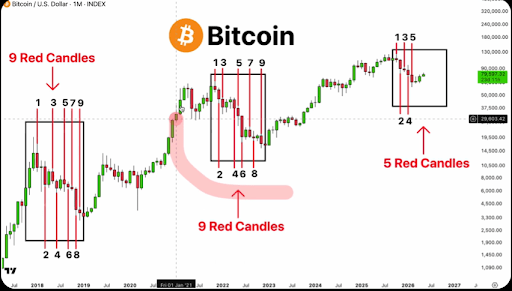
Source: Chart from Degargoyle on X

Bitcoin reached its current all-time high of $126,080 on October 6, 2025, before the monthly candle that followed closed in the red. That bearish sequence continued through February, giving the analyst’s red-candle theory some weight. However, the structure has since started to change, with Bitcoin closing March and April in the green. May is also on track to produce another green monthly candle, although it is still too early to tell.

What Does This Mean For Bitcoin?

This outlook does not mean Bitcoin must copy its past cycle candle-for-candle. However, the pattern is being used as a warning against assuming very early that the current bounce above $80,000 is the start of a new bull phase. Bitcoin still needs to register weekly closes above some levels before the price action can be called the start of a new bull phase. It’s just a theory. But it’s happened twice in a row.

That view also aligns with the broader market mood. Bitcoin has recently climbed back above $80,000, but the recovery has not been strong enough to erase caution from the market. It also matches other technical outlooks from crypto analysts who argue that Bitcoin bear markets usually take about a year to fully play out before a durable bottom is formed.

Based on that reading, the current corrective price action may still extend further, possibly stretching into Q4 2026 before Bitcoin finds a stronger long-term floor.

BTC trading at $80,952 on the 1D chart | Source: BTCUSDT on Tradingview.com

Related Questions

QWhat simple monthly candlestick pattern does the analyst identify as a sign of a major bear-market bottom in Bitcoin's recent cycles?

AThe analyst identifies a pattern where Bitcoin has not formed its major bear-market bottom in recent cycles until it has printed nine consecutive red monthly candles.

QAccording to the article, why might the current bounce above $80,000 not necessarily signal the start of a new bull phase?

AThe analyst warns against assuming the bounce is a new bull phase too early, pointing to the historical pattern of nine red candles and noting that Bitcoin still needs to register weekly closes above key resistance levels.

QIn the 2022 bear market cycle, how many consecutive red monthly candles did Bitcoin close before bottoming?

AIn the 2022 cycle, Bitcoin closed nine straight red monthly candles from the November 2021 all-time high before bottoming around $15,500 in November 2022.

QWhat is the broader timeframe suggested by some analysts for Bitcoin bear markets to fully play out before a durable bottom is formed?

AOther crypto analysts argue that Bitcoin bear markets usually take about a year to fully play out before a durable bottom is formed.

QBased on the 'nine red candles' theory, how long might the current corrective price action potentially extend according to the article?

ABased on the theory and aligning market views, the current corrective price action may still extend further, possibly stretching into Q4 2026 before Bitcoin finds a stronger long-term floor.

Related Reads

Winter for Crypto IPOs: Consensys and Ledger Withdraw Applications

The crypto IPO window is tightening significantly in 2026, marked by prominent companies delaying or pausing their public listing plans. Following a successful 2025 "harvest year" that saw Circle, Bullish, and Gemini go public amidst a bull market, the tide has turned. Consensys, developer of MetaMask, recently postponed its IPO until at least fall 2026. Hardware wallet leader Ledger also suspended its planned US listing due to unfavorable market conditions, with Kraken having previously delayed its own plans. This shift is driven by a cooling market in 2026, characterized by a significant Bitcoin price correction, declining trading volumes, and reduced investor risk appetite for crypto stocks. The poor post-IPO performance of 2025 listings like Circle and Bullish, which saw major share price declines, has heightened investor caution. This contrasts sharply with the current AI sector, where companies like SpaceX, OpenAI, and Anthropic are commanding massive valuations and investor enthusiasm based on narratives of stable, exponential growth. Crypto companies now face pressure to transition from hype-driven models to demonstrating reliable cash flows and robust compliance. While the paused IPO plans may lead to valuation resets and affect ecosystem liquidity, they also accelerate industry consolidation toward stronger, more compliant infrastructure players. A potential recovery in Bitcoin's price and clearer regulations could reopen the IPO window in the latter half of 2026.

marsbit1h ago

Winter for Crypto IPOs: Consensys and Ledger Withdraw Applications

marsbit1h ago

ChatGPT Can Manage Your Money for You. Would You Trust It with Your Bank Account?

OpenAI has launched a personal finance tool for ChatGPT, currently in preview for US-based ChatGPT Pro users. This feature allows users to connect their bank and investment accounts (via Plaid, supporting over 12,000 institutions) directly to ChatGPT. It analyzes transactions, generates visual dashboards, and offers conversational financial advice—such as budgeting or planning for major purchases—based on the user's actual data. This move follows OpenAI's acquisitions of fintech startups Roi and Hiro Finance, signaling a strategic push into vertical "super assistant" applications, similar to its earlier health-focused feature. However, the launch has sparked significant privacy concerns. Critics question the safety of granting such sensitive financial access to an AI, especially amid ongoing lawsuits alleging OpenAI shared user chat data with third parties like Meta and Google. OpenAI emphasizes that ChatGPT only reads data (no transaction capabilities), deletes it within 30 days if disconnected, and offers opt-out options for model training. Yet, trust remains a major hurdle. The trend reflects a broader industry shift: AI companies like Anthropic and Perplexity are also targeting high-value, data-rich domains like finance and health. While technically promising, the tool operates in a regulatory gray area—it provides personalized guidance but disclaims formal financial advice or liability. Ultimately, OpenAI's challenge is convincing users to trust an AI with their most private financial information.

marsbit1h ago

ChatGPT Can Manage Your Money for You. Would You Trust It with Your Bank Account?

marsbit1h ago

Trading

Spot
Futures

Hot Articles

Discussions

Welcome to the HTX Community. Here, you can stay informed about the latest platform developments and gain access to professional market insights. Users' opinions on the price of S (S) are presented below.

活动图片