Bullish Sentiment Spikes As Axie Infinity Price Propels 9%, What’s Next For AXS?

newsbtcPublished on 2022-12-07Last updated on 2022-12-07

Abstract

The Axie Infinity price has skyrocketed in the past week; the altcoin has secured close to 40% appreciation. On the daily chart, AXS registered a 4.8% spike. This positive price...

The Axie Infinity price has skyrocketed in the past week; the altcoin has secured close to 40% appreciation. On the daily chart, AXS registered a 4.8% spike. This positive price sentiment can be tied to the recent developments within the AXS ecosystem.
Axie Infinity’s community made its first move into developing the project into a decentralized future just a day ago. According to the technical outlook, buyers have made a strong comeback in the market. This has caused major accumulation over the past trading sessions.
AXS formed a tall green wick tied to increased trading activity to corroborate the same. The chance of a price pullback cannot be ruled out, considering that the coin surged substantially overnight.
Buyers might have difficulty sustaining the price breakout, so that AXS will travel close to its immediate support level. Only if this rally pushes the coin above the $10 level can AXS continue its bullish price action.
Axie Infinity Price Analysis: One-Day Chart
Axie Infinity Price

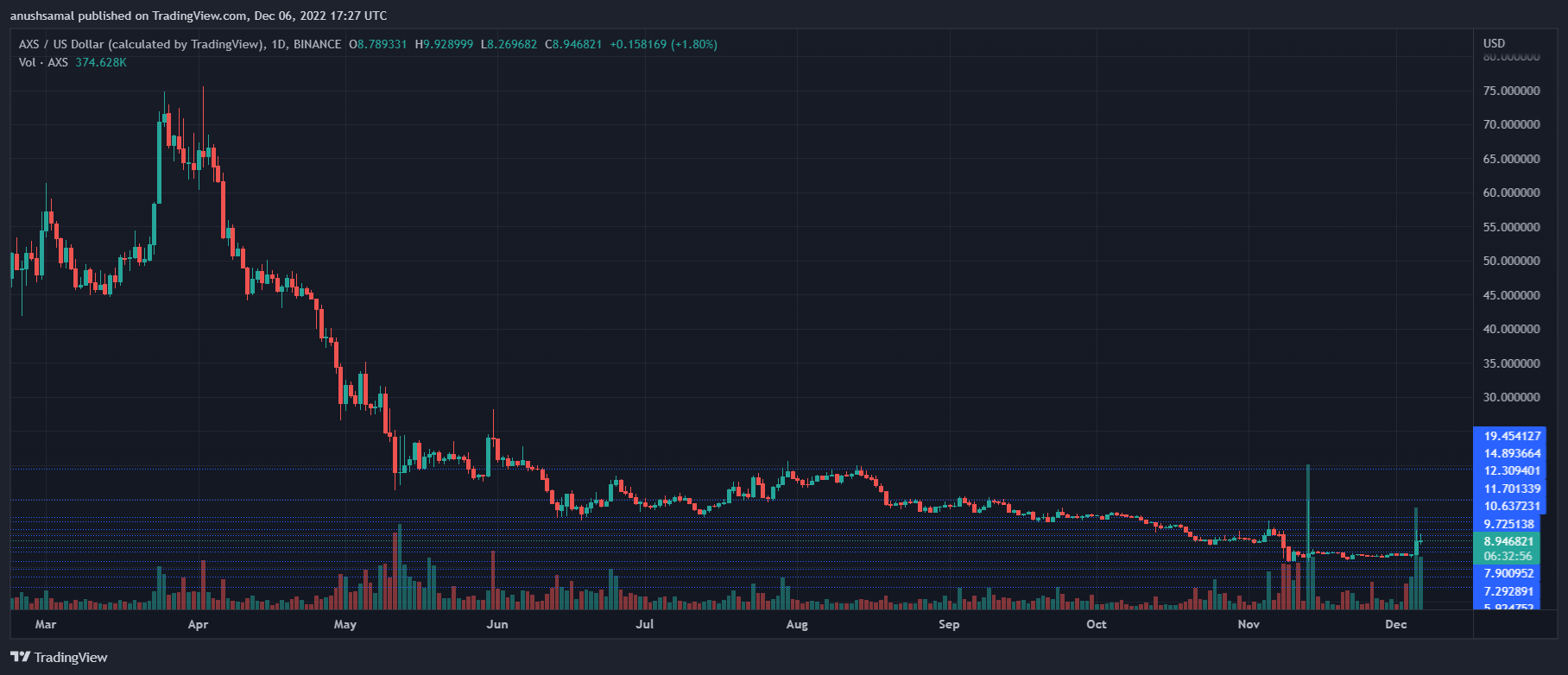
Axie Infinity was priced at $8.96 on the one-day chart | Source: AXSUSD on TradingView AXS was priced at $8.96 after the recent surge in price. Overhead resistance for the coin was $9 and then at $9.72. Moving above the $9.72 level will help AXS to breach the $10 resistance mark. The aforementioned price ceiling has proved difficult for the bulls as the altcoin has been rejected at that level over the past few months.
Clearance of the $10 mark will pave the way for AXS to reach $12. On the other hand, a price pullback will bring AXS to $7.20. The amount of AXS traded in the last session increased, which portrayed the bulls taking charge of the price action.
Axie Infinity Price

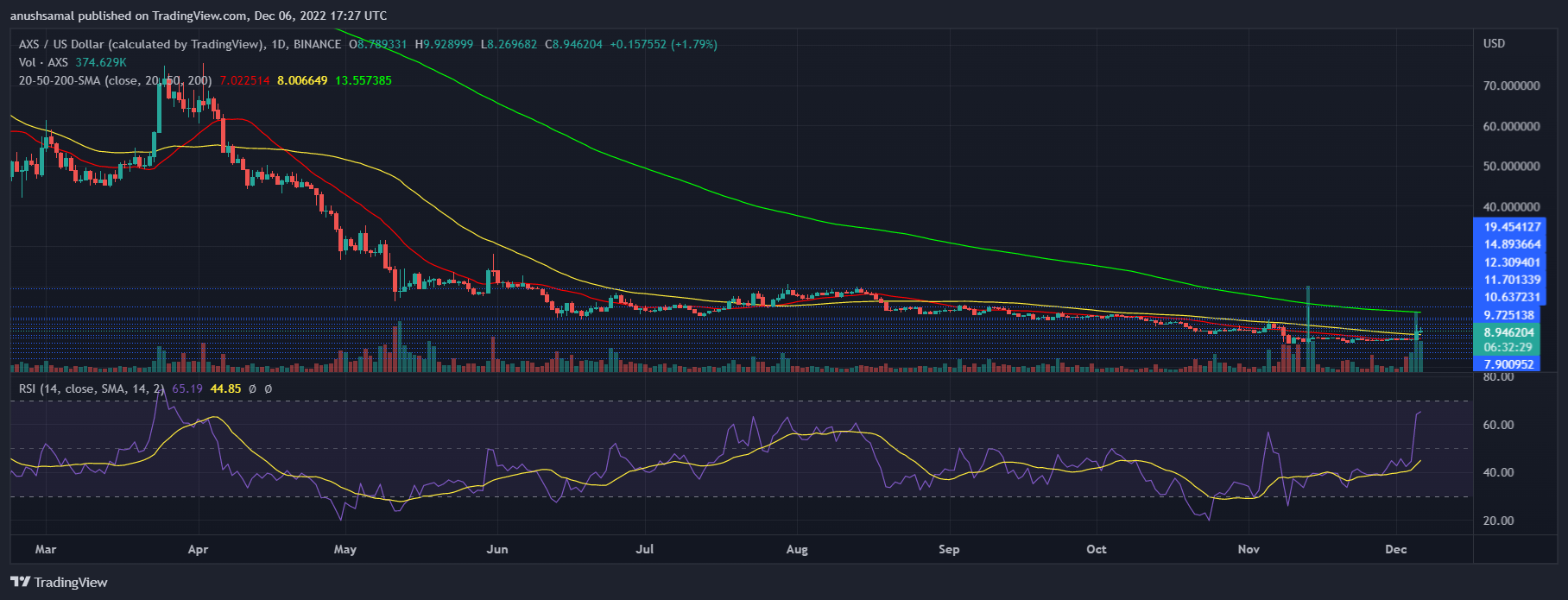
Axie Infinity was nearing the overbought zone on the one-day chart | Source: AXSUSD on TradingView In correspondence to the tall green wick Axie Infinity Price formed in the recent trading session, the coin was nearing the overvalued zone. The Relative Strength Index shot past the half-line and stood below the 80-mark.
With a slight push from buyers, AXS will enter the overbought zone. AXS was also above the 20-Simple Moving Average line, which meant that the altcoin registered substantial demand. It denotes that the buyers were driving the price momentum in the market. AXS was also above the 50-Simple Moving Average line, which shows strong bullish price momentum.
Axie Infinity Price

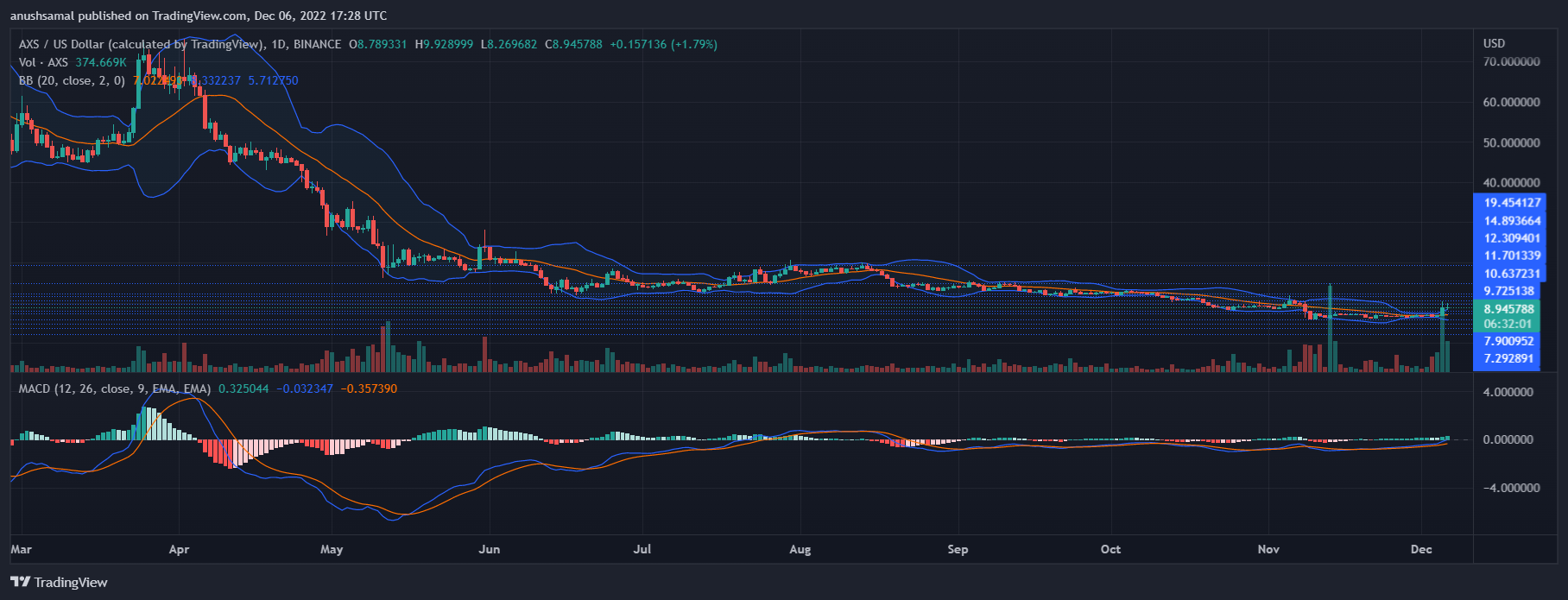
Axie Infinity registered buy signal on the one-day chart | Source: AXSUSD on TradingView AXS depicted a buy signal on the daily chart in conformity with increased accumulation. The Moving Average Convergence Divergence identifies the price trend and reversals in the same. MACD assembled green signal bars over the half-line, which was the buy signal for the altcoin.
Bollinger Bands forecast price volatility and the chance of fluctuations. The bands widened, indicating that the coin would continue to rise in value on its chart. Moving above $9.20 should not be difficult if the broader market is strong.


Related Reads

Why the Establishment of SocialFi Originates from a Misunderstanding of Its Own Medium

"Why SocialFi's Establishment Stems from a Misunderstanding of Its Own Medium" This article critiques the failure of SocialFi projects by applying Marshall McLuhan's theory of "hot" and "cool" media. McLuhan posited that a medium's form—not its content—reshapes user behavior. "Hot" media (e.g., print, radio) deliver high-definition, complete information, promoting passive consumption. "Cool" media (e.g., cartoons, telephone calls) provide low-definition, fragmented signals, requiring active user participation to complete the meaning. Traditional social media platforms (like early Twitter) are quintessentially "cool." A tweet or like is an incomplete fragment; its significance emerges only through replies, shares, and community engagement—it's a participation engine disguised as a content system. SocialFi (e.g., Friend.tech) aimed to monetize social capital by attaching real-time, tradable prices to follows and posts. However, this didn't add an economic layer to a cool medium; it fundamentally transformed the medium itself. The explicit, high-resolution signal of price replaced the ambiguous, low-resolution signal of social interaction. The platform became a financial market dressed as a social network. Once the financial dynamics (speculative profits) faded, the underlying social fabric, which had been suffocated from the start, could not sustain it. The medium overheated and collapsed. This "heat death" pattern isn't unique to crypto. Over time, mainstream platforms often drift from cool to hot by adding features like public metrics, verification badges, and algorithmic feeds that optimize for clarity over participation, leading to user disengagement. The article proposes a viable alternative: the "condensation point." Here, capital is introduced locally and infrequently into a cool medium without saturating it. Examples include Substack (subscriptions), Patreon (memberships), and Bandcamp (music purchases). The core social medium remains cool and participatory, while capital condenses at specific, structurally separate points (e.g., a monthly fee). The key lesson: "Liquidity is heat." Adding it to a cool medium doesn't enhance it but alters its fundamental nature. The NFT boom and bust provides a starker example. Collecting is a classic cool medium, where value is built slowly through stories and community. By making floor prices, rarity scores, and real-time charts omnipresent, NFT platforms rapidly overheated the medium, turning collectors into traders and destroying the participatory culture that gave collections meaning in the first place. The conclusion is that for the next wave to succeed, designers must ask not how to price every social action, but how to let capital condense within a social system without disrupting the cool, participatory mechanics that create its enduring value.

marsbit8m ago

Why the Establishment of SocialFi Originates from a Misunderstanding of Its Own Medium

marsbit8m ago

After Storage, Are Copper and Fiber Optic Cables Facing an AI "Great Famine"?

Following the storage sector, copper and fiber optics are emerging as potentially the next major markets to experience explosive growth due to AI. Demand for copper, described by Goldman Sachs as "the oil of the AI era," is surging. Prices are near record highs, with LME copper up 41% over the past 12 months. This is driven by AI's immense and unique requirements: copper is the essential material for the massive electrical distribution (e.g., a 1GW AI data center requires ~27,000 tons) and advanced liquid cooling systems needed for high-power AI clusters like NVIDIA's GB200. Meanwhile, new large-scale copper mine discoveries have been scarce for a decade, tightening supply. Concurrently, a "fiber famine" is unfolding. AI's need for ultra-high-speed, long-distance interconnects between thousands of GPUs is pushing data transmission beyond the physical limits of copper cables. Demand for fiber optics is experiencing a step-change, with a single AI data center requiring up to 36 times more fiber than a traditional CPU rack. This has caused prices for standard G.652D fiber in China to nearly double in just three months. Supply is critically constrained due to the long (18-24 month) lead times required to expand production of the core preform material. In summary, AI's infrastructure demands are cascading down from semiconductors to foundational materials. Copper faces a structural supply-demand imbalance, while fiber optics is entering a period of severe shortage, positioning both as critical and potentially strained components of the AI build-out.

marsbit21m ago

After Storage, Are Copper and Fiber Optic Cables Facing an AI "Great Famine"?

marsbit21m ago

The Construction of SocialFi Originates from a Misreading of Its Own Medium

This article argues that the fundamental failure of SocialFi projects like Friend.tech stems from a misunderstanding of social media's core nature. It applies Marshall McLuhan's theory of "hot" and "cool" media. "Cool" media (like traditional social networks) rely on low-resolution, incomplete signals (e.g., a tweet) that require user participation to create meaning. "Hot" media (like radio or print) deliver complete, high-resolution information that encourages passive consumption. SocialFi attempted to layer finance onto social media by making actions like follows and posts directly tradable with visible, real-time prices. However, this financial signal is a definitive "hot" signal. By superimposing it onto the inherently "cool" medium of social interaction, it fundamentally transformed the medium. Users stopped participating socially and instead began allocating capital rationally based on prices. The financial layer consumed the social one, leaving no genuine social substrate when speculation faded. The article extends this analysis to broader platform decay (e.g., Twitter's shift from cool participation to hot performance metrics) and NFTs. NFT platforms, by optimizing collections with real-time floor prices and rarity scores, rapidly "heated up" the traditionally "cool," participation-rich medium of collecting, destroying its cultural essence and leaving only speculative trading. The solution proposed is not to abandon capital in social contexts, but to design for "condensation points"—localized, infrequent financial interfaces (like Substack subscriptions or Patreon memberships) that allow capital to gather without saturating and overheating the core cool medium. The key lesson is that "liquidity is heat"; adding it to a cool medium doesn't enhance it but alters it, often destroying what made it valuable. Successful platforms will be those that introduce capital while meticulously preserving the cool, participatory nature of their underlying medium.

链捕手24m ago

The Construction of SocialFi Originates from a Misreading of Its Own Medium

链捕手24m ago

Bitwise: Why Are Top-Tier Capitals Frenziedly Betting on New Public Blockchains? The Answer Lies in These Three Points

Recently, a wave of major funding announcements for new public blockchains like Arc, Canton, and Tempo signals a significant industry shift. This article analyzes the driving forces behind this surge. Firstly, regulatory clarity is a key catalyst. These massive investments, including Circle's Arc ($222M), Digital Asset's Canton ($300M), and Stripe's Tempo ($500M), all followed the US passage of the *Genius Act* in July 2025. This suggests that clear legislation is unlocking institutional capital. The anticipated, broader *Clarity Act* could further accelerate growth, particularly in tokenization and compliant infrastructure. Secondly, built-in privacy is emerging as a critical design feature. Unlike Ethereum or Solana, these new chains natively support confidential transactions. This directly addresses real-world business needs, where public transparency can be a liability for corporate dealings or personal salary data, making privacy a potential killer application. Finally, the entry of traditional giants marks a new competitive phase. These projects are backed by major firms: Arc by Circle, Canton by a consortium including Goldman Sachs and Nasdaq, and Tempo by Stripe with partners like Visa. While crypto-native projects remain strong contenders, this institutional involvement brings substantial capital, execution capability, and operational rigor. In conclusion, the convergence of regulatory progress, demand for privacy, and competition from established financial and tech players is rapidly reshaping the blockchain landscape, pushing innovation and expanding the industry's boundaries.

marsbit27m ago

Bitwise: Why Are Top-Tier Capitals Frenziedly Betting on New Public Blockchains? The Answer Lies in These Three Points

marsbit27m ago

Trading

Spot
Futures

Hot Articles

How to Buy AXS

Welcome to HTX.com! We've made purchasing Axie Infinity (AXS) simple and convenient. Follow our step-by-step guide to embark on your crypto journey.Step 1: Create Your HTX AccountUse your email or phone number to sign up for a free account on HTX. Experience a hassle-free registration journey and unlock all features.Get My AccountStep 2: Go to Buy Crypto and Choose Your Payment MethodCredit/Debit Card: Use your Visa or Mastercard to buy Axie Infinity (AXS) instantly.Balance: Use funds from your HTX account balance to trade seamlessly.Third Parties: We've added popular payment methods such as Google Pay and Apple Pay to enhance convenience.P2P: Trade directly with other users on HTX.Over-the-Counter (OTC): We offer tailor-made services and competitive exchange rates for traders.Step 3: Store Your Axie Infinity (AXS)After purchasing your Axie Infinity (AXS), store it in your HTX account. Alternatively, you can send it elsewhere via blockchain transfer or use it to trade other cryptocurrencies.Step 4: Trade Axie Infinity (AXS)Easily trade Axie Infinity (AXS) on HTX's spot market. Simply access your account, select your trading pair, execute your trades, and monitor in real-time. We offer a user-friendly experience for both beginners and seasoned traders.

4.9k Total ViewsPublished 2024.03.29Updated 2025.05.06

How to Buy AXS

Discussions

Welcome to the HTX Community. Here, you can stay informed about the latest platform developments and gain access to professional market insights. Users' opinions on the price of AXS (AXS) are presented below.

活动图片