NFT项目NeoNexus停运 真没钱还是软跑路?

蜂巢TechОпубликовано 2022-03-23Обновлено 2022-03-23

Введение

NeoNexus 属于以 NFT 驱动的链上虚拟空间项目,供用户铸造虚拟建筑。

3月21日晚,Solana链上的元宇宙项目 NeoNexus 宣布因资金不足无法继续运行,项目创始人Jack Shi 将「资金不足」归结为SOL的下降和整个Solana NFT生态的低迷,并表示愿意将项目交给社区。

NeoNexus 属于以 NFT 驱动的链上虚拟空间项目,供用户铸造虚拟建筑。据粗略估算,该项目自去年9月起以 NFT 的方式筹集了25000 SOL,收入在300多万美元到600多万美元之间。

如今,NeoNexus 因「资金不足」停运的说法被社区成员质疑为「慢性地毯拉动」,有用户从去年年底就在 Discord 上吐槽该项目发展缓慢。质疑声四起之时,有人贴出了Jack Shi 在领英上的履历信息,甚至表示将发起诉讼。

3月23日凌晨,Jack Shi更新推特称,正在努力过渡、将NeoNexus交给某个团队来接管,已开始与感兴趣的各方交谈。截至目前,NeoNexus官网仍处于无法访问的状态。

项目资金不足?创始人被曝与超跑合影

「我们不能再继续健康发展 NEONEXUS 项目了。」3月21日,NeoNexus项目的创始人Jack Shi在社区Discord上致信用户称,将在本月底解雇所有员工,愿意将项目移交给社区或社区选择一方接管。

Jack Shi 将 NeoNexus 难以为继的原因归结于SOL生态低迷造成了团队入不敷出。

他称,由于SOL价格下降很多,整个Solana NFT空间的活跃度、交易量和兴趣都在下降,想要在这样环境下发展和继续项目非常困难,他们的资金用于支付20多名员工的工资、开发和技术成本、法律费用、会计费用、债务和所有应缴的商业税,「我们不再有足够的资金来继续这个项目的发展。」

Jack Shi 没有披露项目到目前为止的收入。但根据NeoNexus官方信息显示,这个构建在Solana链上的NFT应用,从去年9月通过空投引流后,开始销售Golden Tickets(金票)、虚拟的住宅、商业楼等形态的NFT和财产代币,并筹集了以SOL结算的资金。

根据公开信息,NeoNexus已经铸造了4000个建筑类NFT,分别为2000个住宅属性的NFT 和2000个商区属性的NFT,还有6000个包括娱乐、工业、公共地产属性的NFT待开发。

Magic Eden上仍在列的Neo Nexus NFT系列

据估算,NeoNexus 通过铸造系列NFT筹集了大约 25000 SOL,在密集铸造的10月、11月,SOL 最高上涨至259美元,最低为137美元,以此计算,NeoNexus募资价值约在342.5万美元到647.5万美元之间。进入12月,SOL开始随加密资产市场的下行而下跌,目前徘徊在92美元附近。

尽管Jack Shi 说明了资金的用途,但并没有列出各项用途的具体支出,这导致用户无法相信 NeoNexus「资金不足」一说。而该项目进展缓慢的状况则被用户在Discord提及,有人在去年12月时就发现社区活跃度下降,担心自己铸造的房子NFT 凉凉;另有人在今年1月时询问项目是否还在继续运营,社区管理员提示他跟进「住宅画廊」的公告。

3月15日,NeoNexus 还在预告娱乐建筑NFT的铸造,6天后,该项目创始人突然宣布因「资金不足」停运,项目的官网也已经无法打开。

Jack Shi「资金不足」的说法被一些用户指责为「慢性的地毯拉动」、「软跑路」。而3月22日,以抨击NFT欺诈而闻名的推特网友zachxbt 贴出Jack Shi于去年11月与兰博基尼跑车的合影,以此追问项目到底是以什么方式耗尽了资金。

针对 NeoNexus 的质疑声就这样在加密社区KOL的晒图推动下达到了高潮。

创始人信息遭曝光 项目更新接管动态

NeoNexus 创始人用一封信就将项目甩给了社区,但他并未详细规划项目该如何由社区接管,他也未与用户在Discord社群中探讨相关细节。

NeoNexus 官网停止访问后,其已经上线二级市场的住宅NFT和商区建筑NFT均有所下跌。Solana NFT数据网站SolsWatch显示,3月22日, NeoNexus住宅NFT 的地板价最低为0.6 SOL,而前一日为2.75 SOL;NeoNexus 商区 NFT的地板价跌到了0.64 SOL,前一日为2.45 SOL。

在Jack Shi被晒出与超级跑车的合影后,他在领英上的职业履历也被网友扒出。他于2012年毕业于哥伦比亚大学计算机和数学专业,曾在加拿大皇家银行资本市场实习,并在这家公司担任过商品技术分析师和场外清算技术分析师;2016年4月起,他在道明证券美国公司担任高级开发人员;2021年8月,他创建了Unlock DeFi公司,并开始了第一个 NFT 项目 NeoNexus。

大多数情况下,区块链上创建的项目往往由匿名团队运营,人们大概也比较意外,Jack Shi 居然是 NeoNexus 的实名创始人。也因如此,项目因资金原因难以为继的消息出现后,有用户表示将搜集团队信息和相关证据,对该项目发起诉讼。

3月23日凌晨,Jack Shi 和 NeoNexus 的推特均发布了新动态称,正在努力将项目移交给某个团队接管,已经开始与相关方交谈,今日将继续更新消息来解释情况。
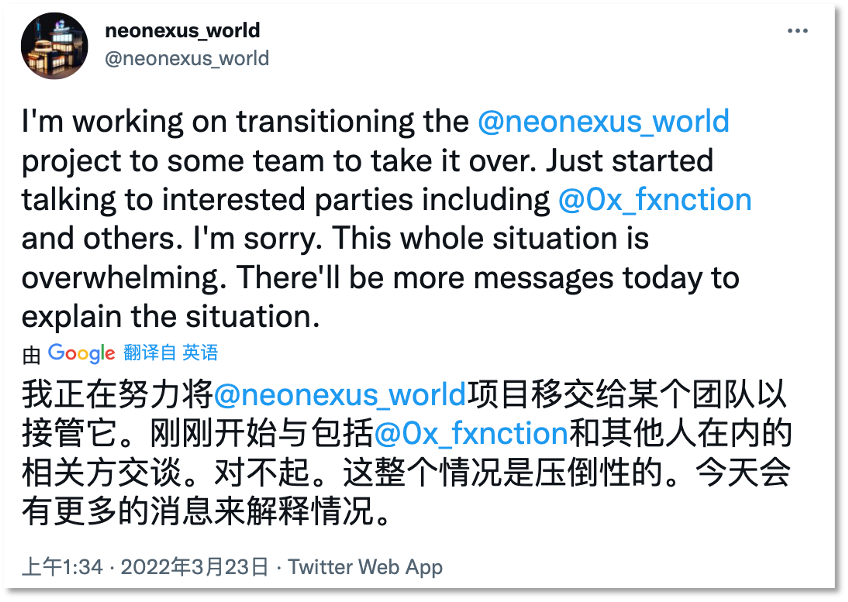
NeoNexus更新接管动态

这一信息更新后,NeoNexus 的住宅和商区建筑NFT的价格有所回升,均达到了1 SOL以上。尽管该项目的官网仍处于无法访问中,但从Jack Shi的表达看,NeoNexus 可能会迎来新的转机。

截至目前,上线了NeoNexus NFT的二级市场平台均未下架该NFT,鉴于Magic Eden存在专门针对NFT欺诈制定的防范程序,NeoNexus 至少在这个程序下还未被判定为违规。

尽管 NeoNexus 情况未明,但发生在NFT市场的「地毯式拉动」并不少见,它常指一种退出骗局,即匿名的开发商突然离开项目并带着投资者的钱跑路。

此前,在Magic Eden上线的NFT项目King of Chess就从投资者那里卷跑了645 SOL,当时价值58000美元;而另一个项目Balloonsville 造成的损失更大,骗取了投资者 5000 SOL,当时价值近60 万美元。

在Magic Eden上出现的跑路项目不仅让该平台付出了向买家退款的代价,也损害了该平台的声誉。

今年2月,Magic Eden制定了新的安全程序,要求在平台发布NFT产品并募资的创作者进行KYC证明,每个项目在上架前都要签署合作协议,团队负责人私下向平台递交协议后才再公开上架作品。此外,项目需将其资金在平台上托管至少24小时,或选择将托管期延长14天,以证明项目的真实性。该平台试图以此防范「地毯式拉动」骗局。

「匿名」或许是加密社区的原教旨主义体现,但对于用户来说,匿名项目往往存在跑路风险,如何「去信任化」也是区块链的要义,将此理念通过技术落实于应用本身或许还需要很长的路要走。

Похожее

Why is the RWA Boom Failing to Benefit DeFi?

The rapid growth of the tokenized real-world assets (RWA) market, now nearing $30 billion on-chain, has largely bypassed the DeFi ecosystem. Only about $2.47 billion is actively locked in DeFi protocols, indicating a penetration rate of just 9%. A major barrier is the "permissioned" architecture of most RWA products, like BlackRock's BUIDL fund, which are designed for institutional compliance. They require whitelisting, off-chain settlement, and strict investor accreditation, making them incompatible with open, permissionless DeFi applications like Aave or Uniswap. This is evident in categories like bonds/money market funds ($16.6B on-chain, $920M in DeFi) and tokenized equities ($2.7B on-chain, $78M in DeFi). Notable exceptions are private credit protocols (e.g., Maple Finance, Centrifuge) and assets like Ondo's USDY, which were designed from inception for DeFi composability, allowing them to be used freely as collateral. Morpho and Aave Horizon also demonstrate successful RWA lending integrations. However, industry reports (IOSCO, ECB) warn that growth may remain confined within traditional financial systems due to fragmented regulations, lack of unified standards, and inherent conflicts between DeFi's open logic and compliance requirements like minimum investments and fixed redemption windows. The RWA sector is effectively split into two markets: a compliant, permissioned on-chain finance market and a smaller DeFi-native market focused on composability. For DeFi penetration to rise significantly, asset issuers must prioritize designs that enable permissionless circulation from the start, moving away from models centered solely on institutional compliance.

marsbit12 мин. назад

Why is the RWA Boom Failing to Benefit DeFi?

marsbit12 мин. назад

Clarity Act Outlook: No Yield, No Payment

"Clear Act Outlook: No Yield, No Payment" analyzes the evolving U.S. regulatory landscape for stablecoins, focusing on the interplay between the proposed "Clarity Act" and the existing "Genius Act." The article argues that the Genius Act successfully fostered "payment stablecoins" by permitting tokenized assets like U.S. Treasuries as reserves. This created a structured market where stablecoin issuers (like USDC) must hold these reserves, often purchased as Tokenized Money Market Funds (TMMFs) from giants like BlackRock. These TMMFs are primarily B2B products, ensuring user-facing stablecoins remain non-interest-bearing and used primarily for payments. The upcoming Clarity Act is seen as the next phase, aiming to restrict passive yield on stablecoins. Its goal is to dismantle the arbitrage advantage of offshore stablecoins like USDT by redirecting Treasury demand towards compliant, U.S.-sanctioned TMMFs. For on-chain and compliant offshore dollars, this creates new pressure: they must spur adoption and utility to generate yield, as simple Treasury staking may be restricted. This indirectly promotes dollar circulation and sustained Treasury purchases. Ultimately, the analysis posits that U.S. regulation seeks to create a new dollar distribution model. By separating payment function from yield generation and anchoring both to U.S. debt instruments, it aims to embed the dollar and Treasury demand into the global crypto economy, managing yields through sanctioned intermediaries while leaving room for DeFi and cross-border arbitrage.

marsbit40 мин. назад

Clarity Act Outlook: No Yield, No Payment

marsbit40 мин. назад

Money Has Gone to Bonds and IPOs, Leaving Only HYPE Rising in Crypto

The article "Where Has All the Money Gone? Bonds and IPOs Are Soaring, While Crypto Only Sees HYPE Rising" analyzes the recent underperformance of major cryptocurrencies like Bitcoin and Ethereum compared to traditional financial markets. It identifies three primary factors diverting capital away from crypto: First, surging bond yields, with the 30-year U.S. Treasury hitting a near 20-year high of 5.12%, are attracting capital seeking safe, predictable returns. This is evidenced by Bitcoin spot ETFs experiencing a significant $10.39 billion net outflow in mid-May. Second, a massive $4 trillion IPO pipeline, highlighted by SpaceX's upcoming listing, is absorbing risk capital that might otherwise flow into crypto. Platforms like Hyperliquid are even channeling on-chain crypto liquidity into pre-IPO trading for traditional stocks. Third, uncertainty surrounds new Federal Reserve Chair Warsh's ability to deliver expected interest rate cuts this year due to conflicting political pressures and stubborn inflation expectations, potentially eliminating a hoped-for source of new market liquidity. Consequently, while traditional equities and bonds rally, the crypto market's post-leverage crash recovery is stalled. The notable exception is assets like Hyperliquid (HYPE), which is rising due to its role in facilitating traditional asset trading, underscoring a market divergence where only crypto projects with novel, cross-market narratives are gaining. The article concludes that Bitcoin's next major catalyst may be the August enactment of the CLARITY Act, but warns of a potential retest of the $70,000 support level before then.

marsbit55 мин. назад

Money Has Gone to Bonds and IPOs, Leaving Only HYPE Rising in Crypto

marsbit55 мин. назад

Торговля

Спот
Фьючерсы
活动图片